
The Kumbhanda is a class of minor demonic spirits (or nature deities) in Buddhist cosmology. They are frequently categorized as Yakshas or Bhutas and inhabit the lowest tiers of the spirit world.
In Buddhist literature, they are known for their distinctive physical attribute. They are often associated with protecting places, though they can also be malignant and dangerous to humans. They appear prominently in the Pali Canon, particularly in the Dīgha Nikāya and Samyutta Nikāya.
The term Kumbhanda also appears in Hinduism, where it refers to a minor deity or celestial being. If you are interested in their Hindu connections, check the “Hindu Demons“ category for more information.
Summary
Key Takeaways
| Attribute | Details |
| Names | Kumbhanda, Kumbhāṇḍa, Kubhāṇḍa |
| Title | None |
| Region | India, Sri Lanka, Southeast Asia (Theravada Buddhism), generally associated with Buddhist cosmology |
| Type | Buddhist demon/minor nature spirit, a type of Yaksha or bhuta |
| Gender | Male |
| Realm | The Cātummahārājika realm (realm of the Four Great Kings) within the Desire Realm (Kāmadhātu) or the human realm (earth/forests) |
| Obstacle/Threat | Can cause fear, illness, and possession; associated with obstructing spiritual progress |
| Associated Figures | The Four Great Kings (Cātummahārājika Devas), particularly Virūḷhaka (King of the South), other Yakkhas and bhutas |
| Weapon/Item | None specifically mentioned; their body part is their defining attribute |
| Weaknesses | Meditation, listening to the Dharma, specific protective parittas (chants) |
| Associated Deity/Figure | The Buddha; the Four Great Kings (as rulers over them) |
| Pantheon | Buddhist, with Hindu influences (as a general class of being) |
| Primary Sources | Pali Canon (Dīgha Nikāya, Samyutta Nikāya), later commentarial literature |
Who or What is a Kumbhanda?
The Kumbhandas are a class of supernatural beings, principally documented in the literature of the Theravada tradition. They are typically classified among the Yakkhas (Sanskrit: Yakshas) or Bhutas, but are often placed at a lower, less powerful level.
The Kumbhanda are frequently listed as subjects of Virūḷhaka, one of the Four Great Kings (Cātummahārājika Devas) who guard the cardinal directions. Virūḷhaka is the King of the South, and these demons are considered his subordinates, guarding the southern direction.
Their primary function in the hierarchy of the cosmos is often protective. Still, they are also known for their malignant potential, sometimes being associated with diseases and possession.
In specific texts, the Buddha provides protective verses (paritta) for monks against various classes of Yakkhas and spirits, including the Kumbhanda.
“Kumbhanda” Meaning
The term Kumbhanda (Pali: Kumbhāṇḍa) is derived from a Sanskrit word. The most literal and common interpretation of the term relates to the physical shape or attribute associated with these beings.
Linguistically, the name is composed of two elements: kumbha, which means “pot,” “pitcher,” or “jar,” and aṇḍa, meaning “egg,” “testicle,” or “scrotum.” Together, Kumbhanda is often interpreted as meaning “pot-scrotumed” or “testicle-jar,” a direct reference to a striking and defining physical characteristic.
Therefore, the meaning of their name is closely tied to their physical characteristics (they are often described as having testicles the size of a jar or pot). This descriptive name immediately identifies them by their unique, and perhaps grotesque, anatomical feature. However, while this feature is physically descriptive, it may also carry symbolic weight in some contexts, perhaps evoking base desires, raw physicality, or a clumsy, earthy power.
There is no significant variation in the name across the main Buddhist traditions. However, the spelling may differ slightly between Pali (Kumbhāṇḍa) and Sanskrit (Kumbhāṇḍa or Kubhāṇḍa).
How to Pronounce “Kumbhanda” in English
The name Kumbhanda is pronounced roughly as: KOOM-bahn-dah. The stress is typically placed on the first syllable. The ‘bh’ is often pronounced as an aspirated ‘b’ sound followed by a slight ‘h’ or simply as a ‘b’.
What Does a Kumbhanda Look Like?
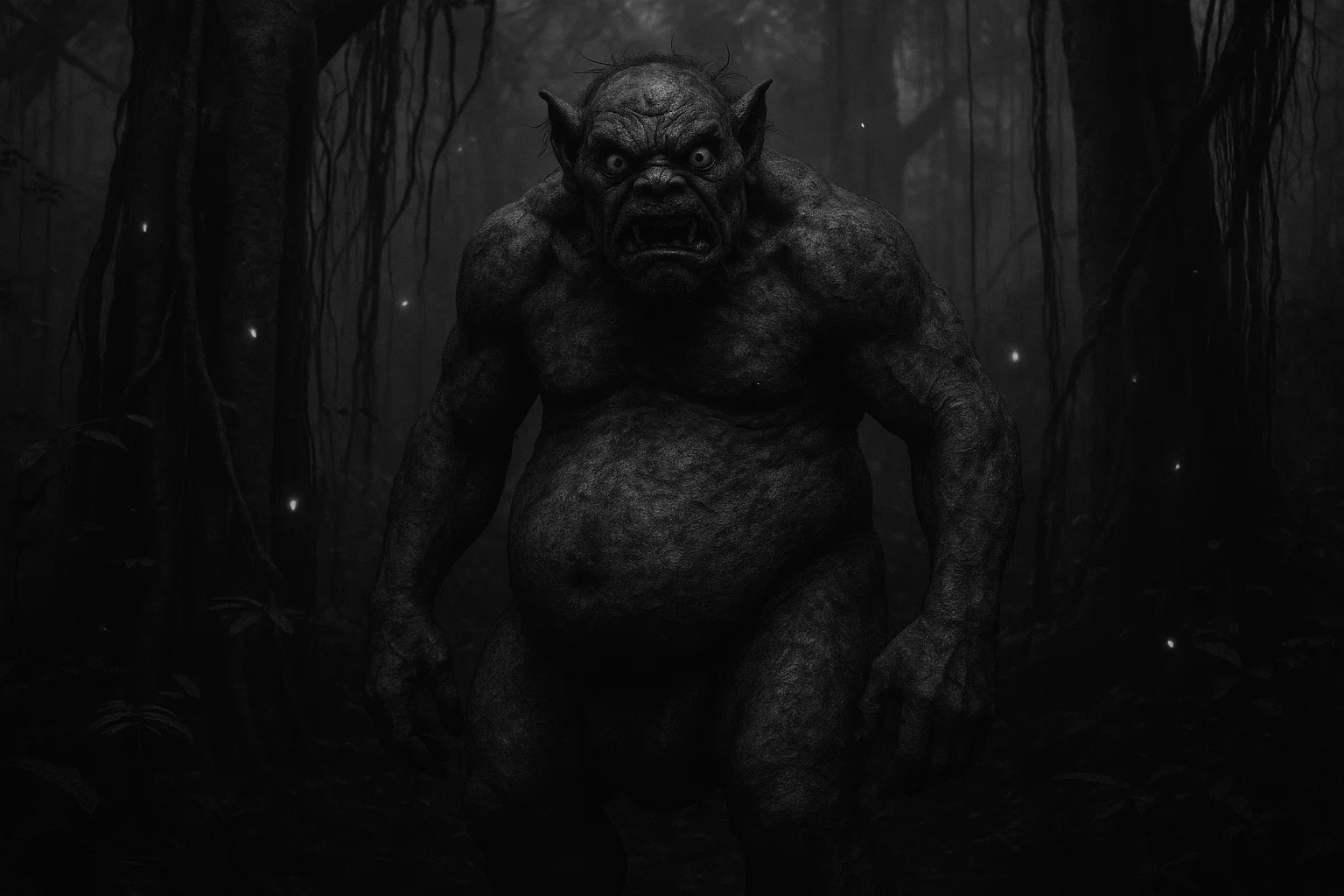
The physical description of the Kumbhanda is unusually specific for a minor class of spirits in the Pali Canon. As mentioned above, the main identifier (from which their name is derived) is the depiction of their large or disproportionate testicles.
Beyond this defining feature, these demons are generally described as Yakkhas or spirits. This association implies a range of possible appearances, as Yakkhas themselves are diverse.
In general, Yakkhas are spirits of the wilderness, sometimes depicted as malevolent, grotesque figures with bulging eyes, fierce countenances, and dark or greenish skin. They can also be shown as strong, somewhat stout guardians or warriors, as they are subjects of the great war-god King Virūḷhaka.
Later Buddhist iconography and textual descriptions that mention Kumbhanda tend to retain the fundamental description of a powerful, earthy male spirit who is one of the retainers of the Four Great Kings.
Because they are a general class of being, their exact appearance may often vary. Still, the large testicles remain the most consistent and definitive physical characteristic across textual traditions.
You may also enjoy:
What Is Jorōgumo? The Deadly Spider Woman of Japanese Myth
February 2, 2026
Who Is Jann in Islamic Mythology and Why Is He Feared?
October 2, 2025
Aamon: The Infernal Marquis of Lust, Feuds, and False Prophecies
September 29, 2025
Al-Ahmar: The Tuesday King of the Seven Jinn
February 13, 2026
Arati: The Beautiful Demon of Aversion in Buddhist Mythology
October 15, 2025
Who Is Andromalius and Why Is He the Last Demon of the Goetia?
January 20, 2026
Origins
The earliest documented appearances of the Kumbhanda are found within the Pali Canon, the foundational scriptural collection of the Theravada tradition. They were established as an existing class of supernatural beings at the time the Buddha was teaching.
In the Dīgha Nikāya, within the Āṭānāṭiya Sutta (DN 32), the Kumbhanda are explicitly mentioned in the context of a protective chant. They are listed alongside the Yakkhas, Nāgas, and Gandhabbas as one of the four classes of beings who serve the Four Great Kings (Cātummahārājika Devas).
Specifically, they are subordinates of Virūḷhaka, the King of the South. This placement indicates they were a well-known entity in the religious landscape of early India, recognized as a part of the Deva (god/spirit) hierarchy, occupying a lower rung in the celestial/spiritual world.
Their role in this text is passive—they are named so that a protective ritual may be effective against them, suggesting they were seen as potentially dangerous or obstructive spirits.
Their origin story is not detailed in terms of a specific birth or creation myth; rather, they are a pre-existing type of spirit entity assimilated into the Buddhist cosmological framework. Their nature as Yakshas strongly suggests pre-Buddhist or cross-cultural influences from the popular folk beliefs of ancient India.
In early Indian religion, Yakkhas were widely worshipped nature deities associated with fertility, wealth, and the wilderness.
The Kumbhanda, with their distinctive, reproductive-associated physical trait, fit within this broader category of earthy, strong, and sometimes brutish nature spirits. As Buddhism developed, these local spirits were organized into the six realms of existence, with the Kumbhanda being placed in the lowest Deva realm (or among the Bhutas of the human realm).
Regional Variations
The Kumbhanda are not primary deities or figures in any major Mahayana tradition (such as in Tibet, China, or Japan) to the same extent as they are in the Pali texts. Their most significant and consistent portrayal is within the Theravada tradition (Sri Lanka, Thailand, Myanmar, etc.), where the Pali Canon remains the central textual source.
| Region/Tradition | Appearance | Role |
| Theravada (Sri Lanka/SE Asia) | Male, large testes, potentially grotesque, strong, sometimes described as earthy or dark-skinned. | Subordinate to King Virūḷhaka (South), minor earth/forest spirit, potential source of disease or obstruction. |
| Mahayana (General) | Appearance varies or Not generally depicted. | Classified as a minor spirit or Yaksha but not a major focus of worship or doctrine. |
Buddhist Cosmology
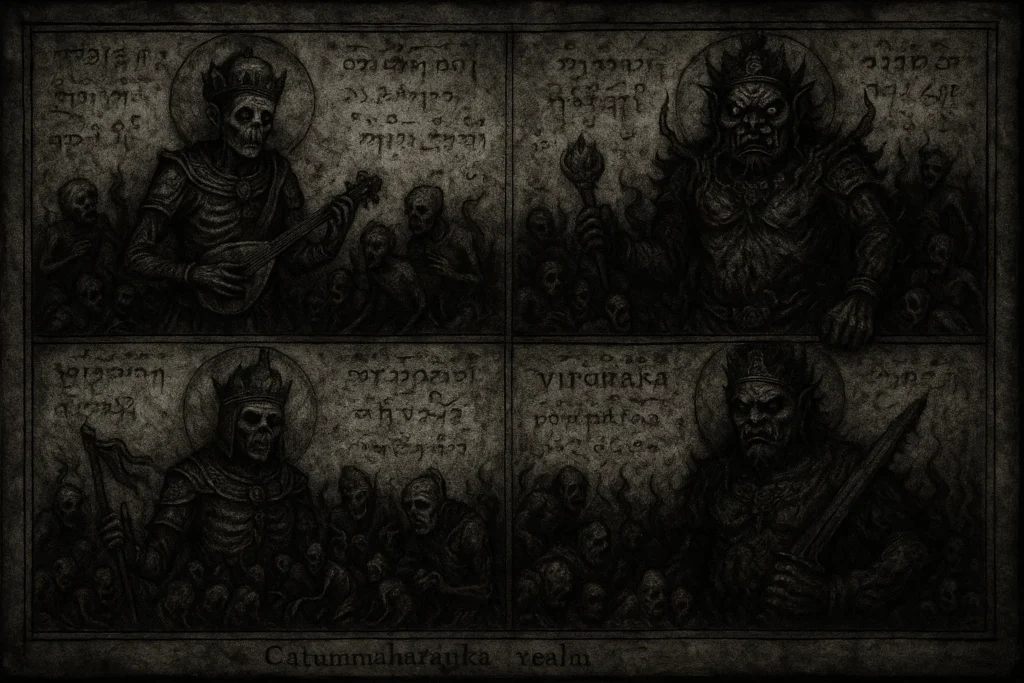
The Kumbhanda reside in the lowest of the six Buddhist realms: the Desire Realm (Kāmadhātu). Specifically, they are occupants of the Cātummahārājika realm, the world of the Four Great Kings. This realm is the one closest to the human world, located on the slopes of Mount Meru, the cosmic mountain.
The Cātummahārājika realm is where the four Great Kings—Dhataraṭṭha (East), Virūḷhaka (South), Virūpakkha (West), and Kuvera or Vessavaṇa (North)—rule over various classes of minor spirits. The Kumbhanda are explicitly stated to be the subjects of Virūḷhaka, the King of the South.
Their position here suggests that they are technically devas (gods/celestial beings). However, they are devas of the lowest and most physical order. Generally associated with the natural world and possessing a volatile temperament that places them near the category of minor demons or malevolent spirits (Bhutas). They are also associated with the dense, dark, and sensual aspects of the Kāmadhātu.
Kumbhanda in the Pali Canon
The Kumbhanda’s role in the Pali Canon is principally to be named as a class of beings who pose a potential threat or obstruction to practicing monks and laypeople. They are called so that their power can be mitigated or avoided through the recitation of protective chants (parittas).
| Source | Quote |
| Dīgha Nikāya, Āṭānāṭiya Sutta (DN 32) | “These are the Kumbhanda chiefs: King Vessavaṇa’s chiefs, a hundred and sixty, with names great and glorious, of varied powers, with bands of retainers, and with children for followers; all are in the west. These are the Kumbhanda chiefs: King Virūḷhaka’s chiefs, a hundred and sixty, with names great and glorious, of varied powers, with bands of retainers, and with children for followers; all are in the south.” |
| Samyutta Nikāya, Sataga (SN 10.12) | “A man who has taken refuge in the Buddha, in the Dhamma, and the Saṅgha, and who has firm faith in the Kumbhaṇḍa… is not led by the world, but is purified and attains wisdom.” |
| Dīgha Nikāya, Mahasamaya Sutta (DN 20) | “Kumbhaṇḍa-yakkhas, too, came there: Inda, Somas and all others, Vessavaṇa’s retainers, glorious, with varied powers.” |
Kumbhanda in Mahayana Sutras
The Kumbhanda are mentioned in some Mahayana texts, where they are classified as a type of spirit or Yaksha, but rarely take a central role in narrative or doctrine. They are frequently included in the standard lists of non-human beings who attend the Buddha’s discourses.
| Source | Quote |
| Lotus Sūtra (Saddharmapuṇḍarīka Sūtra), Chapter 26, Dharaṇī | “There came Kumbhāṇḍas and Piśācas; those who seize the essence, those who seize the form, those who seize the life; they all came to listen to the Law.” |
You may also enjoy:
Hitotsume kozō: One-Eyed Yōkai of Japanese Folklore
February 4, 2026
Who Is the Demon Andras, The Great Marquis of Discord?
January 15, 2026
Who Is the Demon Baphomet and What Does It Represent?
March 2, 2026
Aim (Aym): The Great Duke of Hell in the Ars Goetia
November 11, 2025
Who Is Arioch, the Demon of War and Vengeance?
January 21, 2026
Arati: The Beautiful Demon of Aversion in Buddhist Mythology
October 15, 2025
Kumbhanda in Chinese or Korean Folklore
The Kumbhanda is not prominently mentioned or developed in any unique way in Chinese or Korean folklore, beyond direct translations of Buddhist canonical texts. They are usually simply categorized as Yaogui (Chinese: demons/spirits) or Gwi (Korean: ghosts/demons) when they appear in translated Buddhist cosmology.
Powers and Abilities
The Kumbhanda are generally considered a minor class of spirit and are not as powerful or sophisticated as major Devas, Asuras, or chief demons like Mara. Their power level is comparable to that of other minor spirits.
Their powers and abilities, though not extensively documented, are consistent with their classification as nature spirits:
- Inflicting Illness and Possession: They are believed to be capable of entering humans and causing illness, madness, or general misfortune, a common trait of malevolent Bhutas and Yakkhas.
- Minor Guardian Role: As subjects of King Virūḷhaka, they perform a minor protective or territorial guardian function in the southern quarter and certain earthly locations (e.g., forests, trees).
- Supernatural Strength: As a type of Yaksha, they are attributed with immense physical strength and the ability to travel quickly.
- Changing Form (Implied): While not explicitly stated for the Kumbhanda, other Yakkhas possess the power of shapeshifting (rūpa-parivattana), and it is implied that the Kumbhanda may share this basic demonic ability to deceive or approach humans.
Kumbhanda Myths, Legends, and Stories
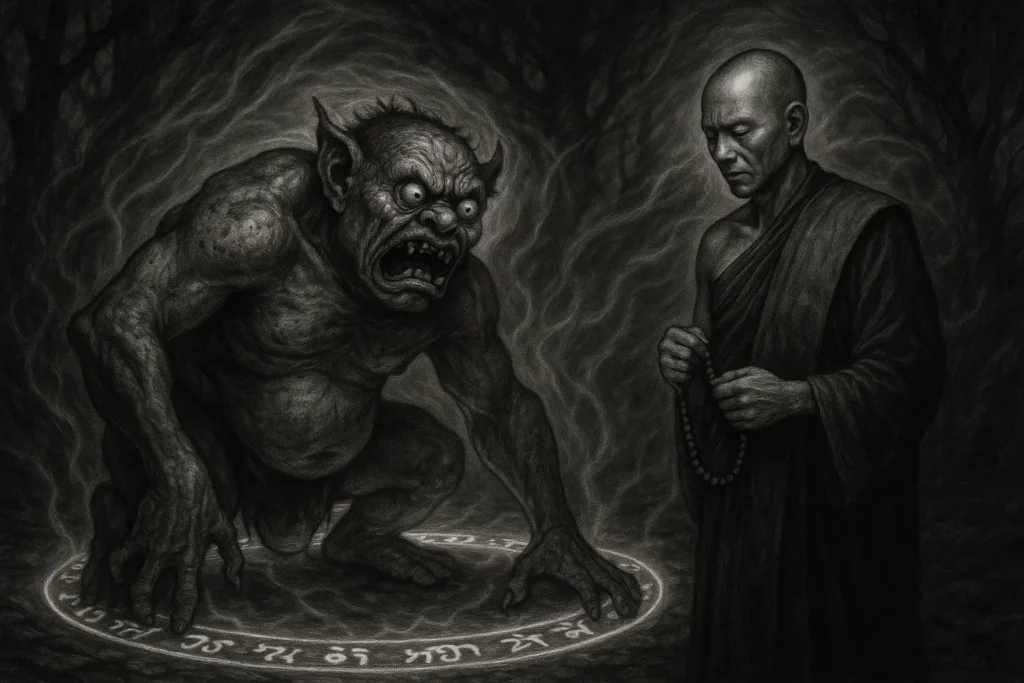
The Kumbhandas rarely feature as protagonists or primary antagonists in detailed narrative myths (unlike major figures such as Mara). Instead, their presence is established through enumeration in the major protective texts of the Pali Canon, which serve to define the cosmology and provide methods for dealing with various supernatural entities.
Enumeration in the Āṭānāṭiya Sutta
The most significant “appearance” of the Kumbhanda is their listing in the Āṭānāṭiya Sutta (DN 32). This text is critical as it outlines a protective ritual (paritta) given by the Four Great Kings to the Buddha, intended to safeguard Buddhist practitioners from various non-human entities who do not respect the Buddha and his disciples.
The four Great Kings—Dhataraṭṭha, Virūḷhaka, Virūpakkha, and Vessavaṇa—appear before the Buddha and state that while some of the Yakkhas and their retainers are faithful, many are not and continue to cause trouble.
The Kumbhanda are named as the primary retainers of Virūḷhaka, the King of the South. The Great Kings then confer the Āṭānāṭiya protection on the Buddha, consisting of a recitation of the names of various powerful Yakkha leaders and the Four Great Kings themselves.
The text specifies that if any non-human being, including a Kumbhanda, should harass a monk or nun, that person should appeal to the Four Great Kings by reciting the names and the protective verses.
The recitation is powerful enough to summon the Great Kings’ own forces to seize, bind, and punish the offending spirit, even to the point of splitting its head.
Attending the Mahasamaya (Great Assembly)
In the Mahasamaya Sutta (DN 20), the Kumbhanda are listed among the vast congregation of deities, spirits, and non-human beings who gather to pay respect to the Buddha and the Saṅgha.
The Sutta describes the various classes of beings who have arrived from different directions and realms to attend the great spiritual assembly in the Mahāvana (Great Wood).
The text reports: “Kumbhaṇḍa-yakkhas, too, came there: Inda, Somas and all others, Vessavaṇa’s retainers, glorious, with varied powers.”
Although the primary text states that they are Vessavaṇa’s retainers, it is generally accepted that the Kumbhanda belong to Virūḷhaka, the Nāgas to Virūpakkha, the Gandhabbas to Dhataraṭṭha, and the Yakkhas to Vessavaṇa (Kuvera).
Kumbhanda vs Other Buddhist Demons
The Kumbhanda occupy a position among the lesser, earthy spirits in the Buddhist hierarchy, distinguished from major figures by their lack of narrative centrality and association with specific cosmological events.
| Demon Name | Associated Obstacle/Role | Origin/Source | Key Traits/Powers |
| Mara | Temptation, Ego, Obstruction to Enlightenment | Pali Canon, Mahayana Sutras | Illusion, Army of Desire, Mind control, Shape-shifting |
| Yaksha (Yakkha) | Guardian of Wealth, Nature Spirits, Local Protector/Threat | Pali Canon, Hindu Texts | Immense strength, Shape-shifting, Guardianship, Cannibalism (in some cases) |
| Gandhabba (Gandharva) | Celestial Musicians, Spirits of the Air, Spirits of Fragrance | Pali Canon, Hindu Texts | Celestial music, Intoxicating fragrances, Association with conception |
| Nāga | Guardians of Water, Earthly Wealth, Rain/Flooding | Pali Canon, Hindu Texts | Shape-shifting (human/serpent), Venom, Water control, Guardianship of relics |
| Preta (Peta) | Perpetual Hunger and Thirst, Greed | Pali Canon, Buddhist Cosmology | Starvation, Distorted bodies, Affliction of the greedy |
| Asura | War, Pride, Envy, Combat with Devas | Pali Canon, Hindu Texts | Fighting skills, Supernatural strength, Emotional intensity |
| Pishacha (Pisāca) | Disease, Cannibalism, Mental Illness | Pali Canon, Hindu Texts | Flesh-eating, Possession, Causing disease and madness |
| Rakshasa (Rakkhaka) | Ferocious Giants, Demons of the Night, Obstruction | Hindu Epics, Buddhist Jataka Tales | Great ferocity, Night hunting, Shape-shifting, Threatening to humans |
| King Virūḷhaka | Great King, King of the South, Ruler of Kumbhandas | Pali Canon, Buddhist Cosmology | Military leadership, Protector of the Dharma, Rule over subordinate spirits |
| Mahakala | Protector of the Dharma, Wrathful Deity | Mahayana, Vajrayana Texts | Great wrath, Destruction of obstacles, Immense power, Manifestation as Dharma-pala |
Mystical Correspondences
As minor demonic entities, they do not have a robust, formalized system of mystical correspondences like major deities (e.g., Mara, Yama). Their associations are largely inferred from their cosmological placement as subjects of the King of the South.
| Attribute | Details |
| Planet | Mars (Due to association with the South and the warrior King Virūḷhaka) |
| Zodiac Sign | Scorpio (Associated with raw, reproductive energy and the grotesque body part) |
| Element | Earth (As minor spirits tied to the earthly realm and physical body) |
| Direction | South (As subjects of King Virūḷhaka) |
| Color | Black/Dark Brown (Earthy, low-tier spirit, often depicted as dark) |
| Number | None specific |
| Crystal/Mineral | Iron/Copper (Earthy metals, basic/martial association) |
| Metal | Iron (Symbolizing the basic, strong, and sometimes brutish nature) |
| Herb/Plant | None specific |
| Animal | A large-scrotumed animal, e.g., a bull |
| Trait/Role | Base Physicality, Obscenity, Minor Obstruction, Subordinate Protector |
The mystical correspondences for the Kumbhanda are primarily derived from their association with the South and its Great King, Virūḷhaka. In Buddhist and Hindu cosmology, the South is often associated with the element of Earth and the directions of growth and power. Still, it is also occasionally associated with Yama (Death/Judgment).
The Kumbhanda’s defining characteristic—their large testicles—links them to raw, earthy, and reproductive energy, suggesting a connection to elements of physicality and basic desire, which fits within the Kāmadhātu (Desire Realm).
They symbolize the base, sometimes grotesque, aspects of the natural world that can be dangerous but are still ultimately subservient to the higher spiritual order.
Kumbhanda’s Items & Symbolism
These entities are not associated with any specific weapons, items, or thrones in the canonical literature, as they are a collective class of minor spirits rather than individual figures.
Their primary symbol and item is their own body part: the large, pot-sized testicles. This unique and explicit physical feature serves as their symbolic designation.
The symbolism of this feature is:
- Gross Materiality and Desire: The exaggerated reproductive organs symbolize the demon’s strong connection to the base, physical, and sensual aspects of the Kāmadhātu (Desire Realm). They represent the type of coarse, unrefined energy that must be mastered by a spiritual practitioner.
- Obscenity/Grotesque Nature: This physical trait places them among the more grotesque and less refined classes of spirits, distinguishing them from the more beautiful Devas and Gandhabbas.
- Subordination: Their coarse nature and low rank symbolize the fact that all forms, even the most raw, earthy power, are ultimately subject to the cosmic order, as represented by their ruler, the Great King Virūḷhaka, and ultimately to the Dharma.
You may also enjoy:
Bakeneko: A Supernatural Cat Yōkai in Japanese Folklore
January 27, 2026
Setcheh: Egypt’s Soul-Stealing Ancient Demon
November 11, 2025
Vaisravana: The Golden Guardian King Who Rules the North
October 16, 2025
What Is the Abumi-guchi Yōkai and Why Does It Wait Forever?
October 22, 2025
Ammit: Devourer of the Dead in Ancient Egyptian Mythology
November 10, 2025
Who Is Jann in Islamic Mythology and Why Is He Feared?
October 2, 2025
Frequently Asked Questions
Are Kumbhandas good or evil?
These minor demonic entities are generally considered to be neither purely good nor purely evil. In Buddhist cosmology, they are a class of minor nature spirits or Yakkhas who serve the Dharma and the Buddha under King Virūḷhaka. Their nature is often volatile and earthy. They are capable of causing illness, madness, or possession, which classifies them as potential threats or malignant forces to be guarded against (hence the need for paritta protection). However, as they are ultimately subjects of the cosmic kings who protect the Buddhist teachings, they are also constrained by the Dharma.
What is Kumbhanda weak to?
The primary vulnerability of a Kumbhanda is exposure to the Dharma and the protective power of the Buddha, Dhamma, and Saṅgha. In the Pali Canon, the solution to a Kumbhanda’s obstruction is the recitation of specific protective chants, known as parittas (such as the Āṭānāṭiya Sutta), which invoke the names of powerful protectors and the Great Kings to seize and punish the troublesome spirit. Additionally, a strong practice of meditation and moral conduct is considered the ultimate defense against all forms of demonic or spiritual harm.
What are Kumbhandas in Hinduism?
In Hinduism, the term Kumbhāṇḍa refers to a class of semi-divine or minor celestial beings, often associated with the retinue of the god Shiva or sometimes considered as a type of Gana (attendant). Similar to the Buddhist classification, they are generally viewed as grotesque, pot-bellied, or dwarfish entities that form a kind of troop or army. The association with the distinctive physical attribute (pot-sized testicles) is present in both traditions, linking them to an ancient Indian folk belief in earthy, powerful nature spirits.
Where do Kumbhandas live?
Kumbhandas live in the Cātummahārājika (Realm of the Four Great Kings), the lowest of the six heavenly realms within the Desire Realm (Kāmadhātu). This realm is located on the outer slopes of the cosmic mountain Mount Meru. As subordinates to Virūḷhaka, the King of the South, they are particularly associated with the southern quadrant. They may also roam the human realm, particularly in wild, unsettled areas such as forests and mountains.
Who is the King of the Kumbhandas?
The King of the Kumbhandas is Virūḷhaka, one of the Cātummahārājika Devas (Four Great Kings). Virūḷhaka is the guardian king of the South and wields a sword. He is the leader of the Kumbhandas, just as Dhataraṭṭha leads the Gandhabbas, Virūpakkha leads the Nāgas, and Vessavaṇa (Kuvera) leads the general Yakkhas.
Are Kumbhandas mentioned in the Jātaka Tales?
Yes, Kumbhandas are mentioned in the Jātaka Tales. They appear as one of the types of Yakkhas or Bhutas encountered by the Bodhisattva (the Buddha’s past life). In these stories, they usually serve as minor antagonists or background entities, typically able to cause distress or act as guardians of particular locations, reflecting their volatile but manageable nature-spirit role.
