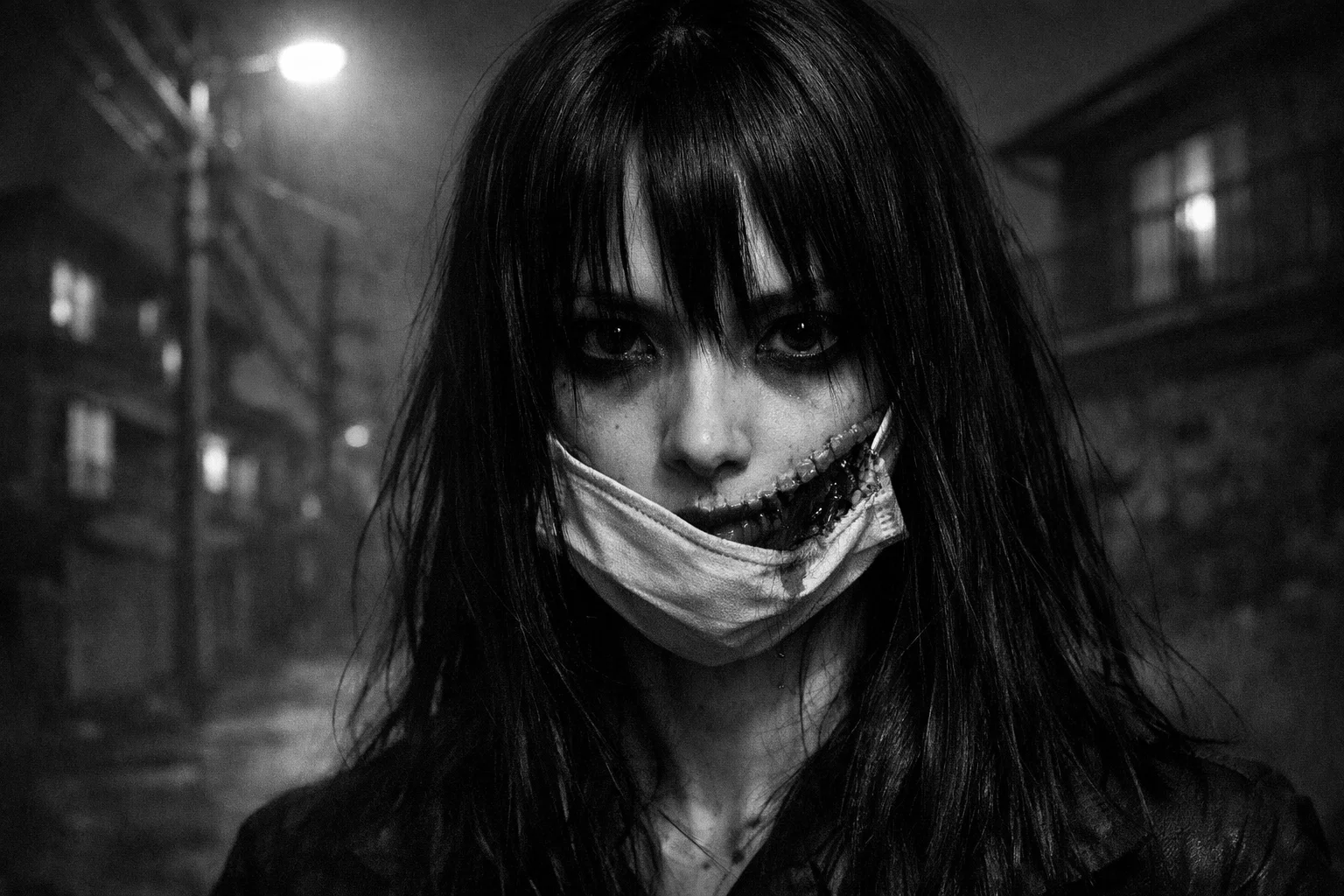

Kuchisake-onna is a frightening entity from Japanese folklore and urban legends, known for her severely disfigured mouth. She is usually shown as a woman with her face cut from ear to ear, leaving her with a disturbing, permanent smile.
She is often called an onryō, or vengeful spirit. She is known for approaching people—often children or students—and asking them if they think she is beautiful. Her story is a warning in modern Japanese society, highlighting concerns about city safety, parental neglect, and the dangers of vanity or infidelity.
Summary
Key Takeaways
| Attribute | Details |
| Names | Kuchisake-onna, Slit-Mouthed Woman |
| Translation | Mouth-slit woman |
| Title | The Slit-Mouthed Woman |
| Type | Onryō (vengeful spirit) or Urban Legend |
| Origin | Spirit of a mutilated woman; records date back to the Edo period with a resurgence in 1979 |
| Gender | Female |
| Appearance | A woman wearing a surgical mask or scarf, hiding a mouth slit from ear to ear, carrying large scissors |
| Powers/Abilities | Superhuman speed, teleportation, invisibility (in some versions), and lethal use of bladed weapons |
| Weaknesses | Confusing her with ambiguous answers, offering hard candy (Bekko Ame), or saying “pomade” three times |
| Habitat | Urban streets, dark alleys, school routes, and parks |
| Diet/Prey | Children, students, and lone travelers |
| Symbolic Item | Surgical mask and industrial-sized scissors or a sickle |
| Symbolism | The dangers of vanity, urban isolation, and the fragility of social masks |
| Sources | Ehon Hyaku Monogatari (Edo period mentions), modern newspaper reports (1979) |
Who or What is Kuchisake-onna?
Kuchisake-onna is a well-known character in Japanese ghost stories, combining traits of traditional yōkai with modern fears. She is usually described as the ghost of a woman who was badly injured in life, either by a jealous husband, a rival, or a failed medical procedure, and now returns to take out her pain on others.
Like other female spirits, such as Sadako or Kayako, she is a yōrei or onryō. Still, she stands out because of her unique way of approaching people. She usually appears at night, covering her face with a cloth or mask.
The meeting centers on a question: “Am I pretty?” (“Watashi kirei?”) No matter how someone answers, the result is usually violent. She either cuts the person to look like her or kills them.
MEET THE MONSTERS THAT HAUNT JAPAN Limited-Time: Up to 28% OFF!
Kappa • Yuki-onna • Tanuki • Kitsune • Hundreds more legendary spirits Hilarious, horrifying, and downright bizarre tales from Japan’s shadow side. Fully illustrated encyclopedia by Thersa Matsuura – your passport to the world of yōkai. Anime origins • Real folklore • Things that go bump in the tatami. Dare you invite them in?
“Kuchisake-onna” Meaning
The name Kuchisake-onna comes from three Japanese words: kuchi (口) means “mouth,” sake (裂け) comes from the verb sakeru, meaning “to be torn” or “to be split,” and onna (女) means “woman.” Put together, the name means “Mouth-slit woman.”
The name itself points to the physical injury that makes her unique. In the past, especially during the Edo period, stories and art sometimes showed similar “slit-mouthed” figures. However, they did not always use this exact name.
The name Kuchisake-onna became widely used in the late 1970s, when the legend spread across Japan. Unlike some symbolic yōkai names, her name simply describes how she looks.
How to Pronounce “Kuchisake-onna” in English
In English, Kuchisake-onna is pronounced Koo-chee-sah-keh ohn-nah. The “u” sounds like the “u” in “pull,” the “i” is pronounced “ee,” and the “e” at the end of “sake” sounds like “eh” in “pet.” The double “n” in “onna” means you should hold the “n” sound a little longer.
What Does Kuchisake-onna Look Like?
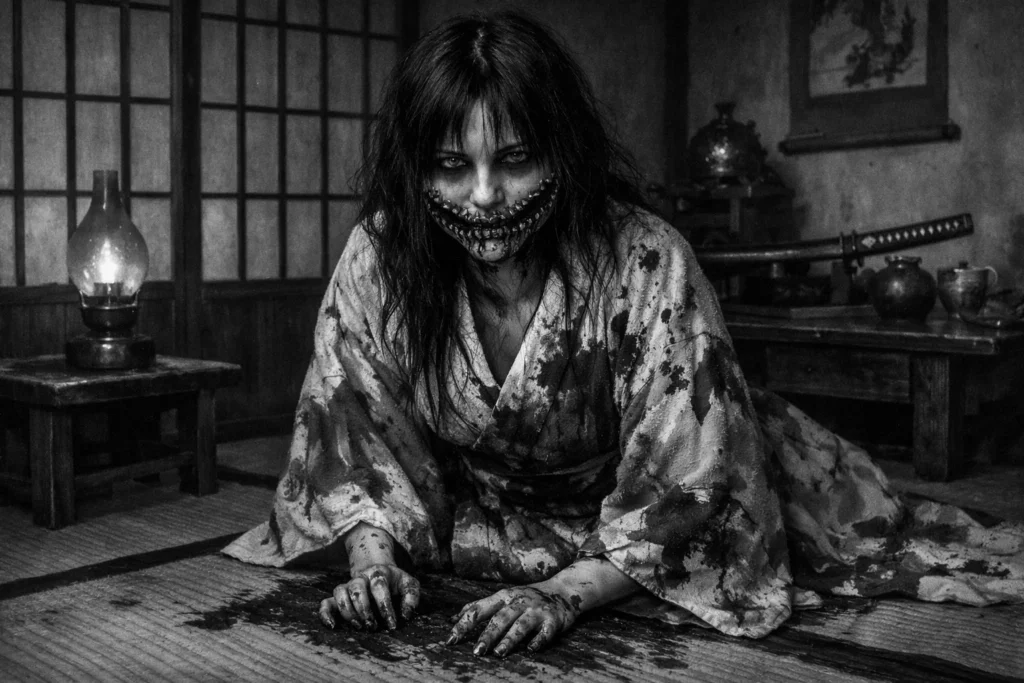
Kuchisake-onna looks both ordinary and terrifying. Most stories describe her as a woman in her 20s or 30s with long, straight black hair. She usually wears modern clothes, like a long trench coat or a simple dress.
Her most noticeable feature is a surgical mask, scarf, or handkerchief covering the lower part of her face. This is common in Japan for health reasons, which helps her blend in with crowds.
When she takes off her mask, she shows a mouth cut open from ear to ear, with exposed tissue, teeth, and a bloody, permanent grin. In newer versions of the story, she often carries big scissors or a blade.
People often say her eyes look both sad and intense. Some stories from the 1970s mention that she has three moles near her ears or that she wears a red coat, but the slit mouth is always her main feature.
You may also enjoy:
Jikininki: The Japanese Ghost That Feeds on Human Corpses
February 9, 2026
What Is the Abumi-guchi Yōkai and Why Does It Wait Forever?
October 22, 2025
Rokurokubi: The Yokai That Looks Human Until Midnight
February 3, 2026
Demon Alastor: The Grand Executioner of Hell
November 17, 2025
Palden Lhamo: The Black Goddess of Blood and Protection
October 20, 2025
Barbas: The Lion Demon Who Spreads Disease
March 3, 2026
Habitat
Kuchisake-onna mainly lives in cities. Unlike older yōkai who are found in mountains, rivers, or old temples, she appears in modern places like dark alleys, quiet streets, parks, and paths to and from schools.
The story says she likes these places because many possible victims, especially children, walk there alone or in small groups. The city lets her hide in shadows or around corners. She is often linked to public places that are empty at night, which adds to fears about strangers and the loss of safety in busy cities.
1,000+ SPIRITS, GODS & GODDESSES AWAITING YOUR CALL. Limited-Time: Up to 49% OFF!
The ultimate global spirit encyclopedia – 2,000+ entries from every culture on Earth. Fairies • Djinn • Demons • Loa • Angels • Deities • Ancestors Real names • True offerings • Ancient rituals that actually work. Judika Illes’ legendary masterwork – the one book every serious witch, mage, and spirit-worker owns.
Origins and History
Kuchisake-onna’s story has both old and new parts. While many see her as a modern legend, similar stories appeared in the Edo period (1603–1868). Early tales described women with slit mouths caused by fox possession or as ghosts of women punished for cheating.
The version of the legend we know today became famous in 1979. It started in Gifu Prefecture and quickly spread across Japan through stories and news reports. The panic was so strong that schools had students walk home in groups, accompanied by police or teachers.
People think the 1979 version grew because of stress in the Japanese school system and sensational news stories. Over time, the legend added details on how to escape her, such as using pomade or candy.
Sources
Stories about Kuchisake-onna can be found in both old collections and modern books about folklore.
| Source | Quote |
| Ehon Hyaku Monogatari (1841) | “…there was a woman whose mouth was torn open to her ears, known as the Kuchisake-onna, appearing in the dark of night to frighten travelers.” |
| Gifu Nichinichi Shimbun (1979) | “…an old woman in Gifu City claimed to have seen a woman with a slit mouth standing in her garden, sparking a wave of reports across the region.” |
Famous Kuchisake-onna Legends and Stories
The Question of Beauty
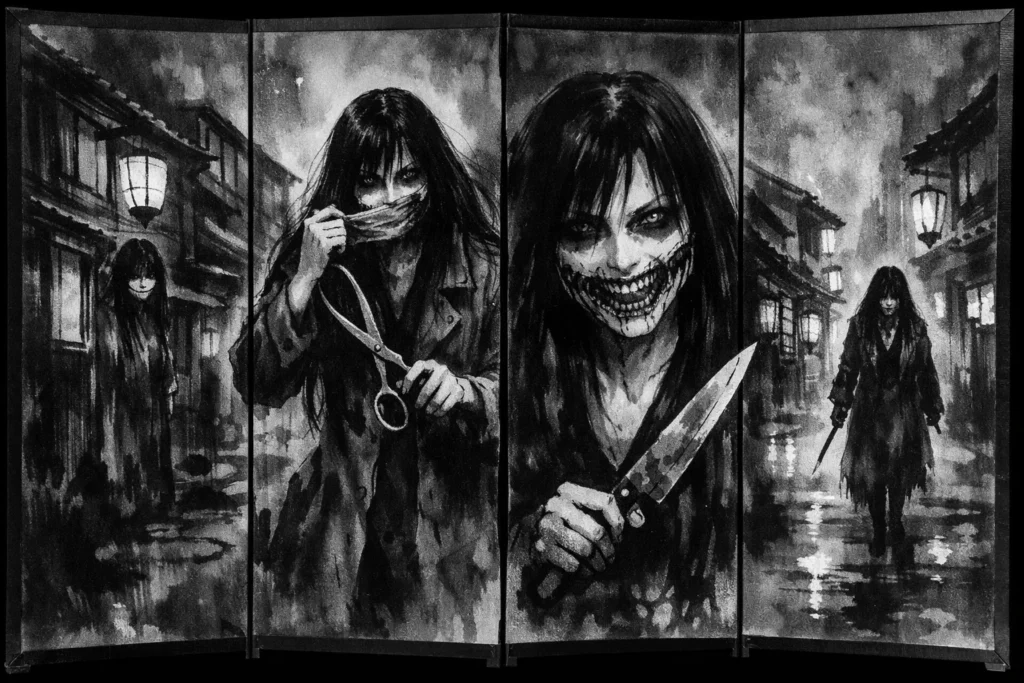
The most well-known story about Kuchisake-onna describes meeting her on a dark street. A woman in a surgical mask walks up to someone alone, often a student coming home from cram school. She stops them and asks, “Am I pretty?” (“Watashi kirei?”).
If the person says “Yes,” she takes off her mask to show her cut face and asks, “Even like this?” (“Kore demo?”). If the person screams or says “No,” she kills them with her scissors. If they say “Yes” again, she cuts their mouth to look like hers. If they say “No” to the first question, she kills them right away.
You may also enjoy:
Who Was Hiranyaksha, the Golden-Eyed Asura?
October 7, 2025
Who Is Ahriman, and Why Is He Pure Evil Incarnate?
January 8, 2026
Arati: The Beautiful Demon of Aversion in Buddhist Mythology
October 15, 2025
What Is a Pishacha, the Flesh-Eating Demon of the Dead?
February 11, 2026
Banasura: The Thousand-Armed Demon King
October 10, 2025
Vaisravana: The Golden Guardian King Who Rules the North
October 16, 2025
The Husband’s Jealousy
An older version of the story, set in the Heian or Edo period, tells of a beautiful woman married to a samurai. She was very vain and often cheated on her husband.
When the samurai found out she was unfaithful, he became furious. He cut her mouth from ear to ear with his sword, yelling, “Who will think you are beautiful now?” Soon after, she died and came back as a vengeful spirit, doomed to ask others the same question her husband had used to mock her.
The Three Moles and the Pomade
During the 1979 scare, a new version of the story about three sisters appeared. It said Kuchisake-onna was the youngest, and her sisters were also deformed or mentally unstable. In this version, she had three moles on her face.
Children were told to say “Pomade” three times to escape her. She supposedly hated the smell of hair wax because it reminded her of the doctor who accidentally cut her mouth during surgery.
SPEAK THEIR TRUE NAMES… IF YOU DARE
Limited-Time: Up to 40% OFF!
Over 1,700+ demons – true names, ranks, infernal seals, powers & forbidden histories. The expanded & revised masterpiece by occult legend Michelle Belanger. Now with 200+ new entities, dozens of never-before-seen illustrations from ancient grimoires. The ultimate arsenal for demonologists, magicians, and the deliciously curious.
Kuchisake-onna Powers and Abilities
Kuchisake-onna has several supernatural powers that make her very dangerous. She is not just a physical attacker but a ghostly being with abilities beyond what humans can do.
- Superhuman Speed: She is said to run 100 meters in just a few seconds (sometimes 3 to 6 seconds), so running away from her is almost impossible.
- Teleportation: Some stories say she can appear in front of a victim, even if the victim turns a corner or goes inside a building.
- Weapon Skills: She uses large scissors, sickles, or razors with deadly accuracy.
- Invisibility/Camouflage: She can hide in crowds or shadows until she decides to show herself to someone.
How to Defend Against Kuchisake-onna
Stories say that fighting her or just running away usually does not work. The best ways to escape involve confusing her or using certain cultural tricks.
- Ambiguous Answers: If she asks if she is pretty, the safest reply is something unclear, like “So-so” (“Mā-mā”) or “Average.” This confuses her and gives you time to escape.
- Hard Candy: She is said to like Bekko Ame, a type of amber-colored hard candy. If you throw the candy to her or offer it, she will stop to eat it, giving you a chance to get away.
- The Pomade Chant: Saying the word “Pomade” three times is thought to drive her away because she hates the smell or even the word itself.
- Inverting the Question: Some stories say you can ask her, “Am I pretty?” in return. This can confuse her and make her pause.
Kuchisake-onna vs Other Yōkai
| Name | Category | Origin | Threat Level | Escape Difficulty |
| Teke Teke | Urban Legend | Girl cut in half by a train | Extreme | Very Hard; she is faster than cars |
| Hanako-san | Urban Legend | Ghost of a girl in a school toilet | Moderate | Easy; avoid the third stall |
| Kappa | Suijin | Water deity/spirit | High | Moderate; bow or offer cucumber |
| Rokurokubi | Obake | Human cursed with a long neck | Low | Easy; they are mostly harmless |
| Aka Manto | Urban Legend | Cloaked spirit in bathrooms | Extreme | Impossible; both options lead to death |
| Oiwa | Onryō | Woman poisoned by her husband | High | Hard; she haunts through objects |
| Kitsune | Yōkai | Magical fox spirit | Variable | Moderate; use salt or dogs |
| Jorōgumo | Yōkai | Spider that turns into a woman | High | Hard; she lures with music |
| Ubume | Yūrei | Woman who died in childbirth | Low | Easy; help her with the baby |
| Gashadokuro | Yōkai | Skeleton of many dead people | Extreme | Hard; listen for the ringing ears |
Symbolism
| Attribute | Details |
| Element | Air (associated with the urban wind and her speed) |
| Animal | None (strictly humanoid) |
| Cardinal Direction | West (associated with the land of the dead in Buddhism) |
| Color | Red (blood and her coat) or White (her surgical mask) |
| Plant | None specific |
| Season | Autumn/Winter (when scarves and masks are common) |
| Symbolic Item | Surgical Scissors |
Kuchisake-onna stands for the fear of strangers in today’s crowded cities. She also shows the dangers of vanity and how people hide their true selves behind a “mask.”
In Japan, she represents parents’ worries about their children’s safety in public. Her story shows how yōkai tales have moved from nature to the city, proving that modern life has its own fears. She is still a key creature in Japanese horror movies and books, and has had a big impact on the “J-Horror” genre.
You may also enjoy:
Who Is Abalam in Demonology? The Demon King That Serves Paimon
September 30, 2025
Who Was Hiranyaksha, the Golden-Eyed Asura?
October 7, 2025
What Is the Akkorokamui, Japan’s Colossal Sea Monster?
November 14, 2025
Hariti: The Demon Mother Who Fed on Children at Night
December 8, 2025
Edimmu: The Mesopotamian Wind Demon That Steals Life
November 6, 2025
Erinyes: The Chthonic Goddesses Who Enforced Blood-Guilt
November 20, 2025
Frequently Asked Questions
What happens if you ignore Kuchisake-onna?
If you ignore Kuchisake-onna by staying silent or trying to walk past her, she usually gets angry. Most stories say she will appearin front of you again, blocking your way and asking her question more forcefully. If you do not answer, she often attacks, seeing your silence as an insult.
Why does Kuchisake-onna target children?
Kuchisake-onna mainly goes after children and students because they are the most at risk in cities and often walk alone on school routes (tsūgakuro). The 1979 scare was linked to the stress of the Japanese school system. People saw her as a symbol of the fearof after-school classes and the risks of walking home alone at night.
Can you kill Kuchisake-onna?
In most stories, you cannot kill Kuchisake-onna by normal means because she is a vengeful spirit or a ghost created by rumors. She does not have a real body that can be destroyed. The only way to escape is by using tricks or rituals, and she will keep haunting a place until the legend dies out or the rules are followed.
Is Kuchisake-onna based on a real person?
There is no proof that Kuchisake-onna was a real person, but the 1979 story may have been inspired by a real event in Gifu Prefecture. People said a woman with mental health problems was seen walking the streets in a mask and scaring children. This local story, mixed with older ghost tales from the Edo period to formed the legend we know today.
What is the Kuchisake-onna “Red Coat” variation?
The “Red Coat” version of the story says she wears a long, bright red trench coat. The red is said to hide bloodstains from her victims, letting her move through busy city streets without being noticed. In some stories, the red coat also connects her to Aka Manto (Red Cloak), another scary spirit from Japanese school legends.
