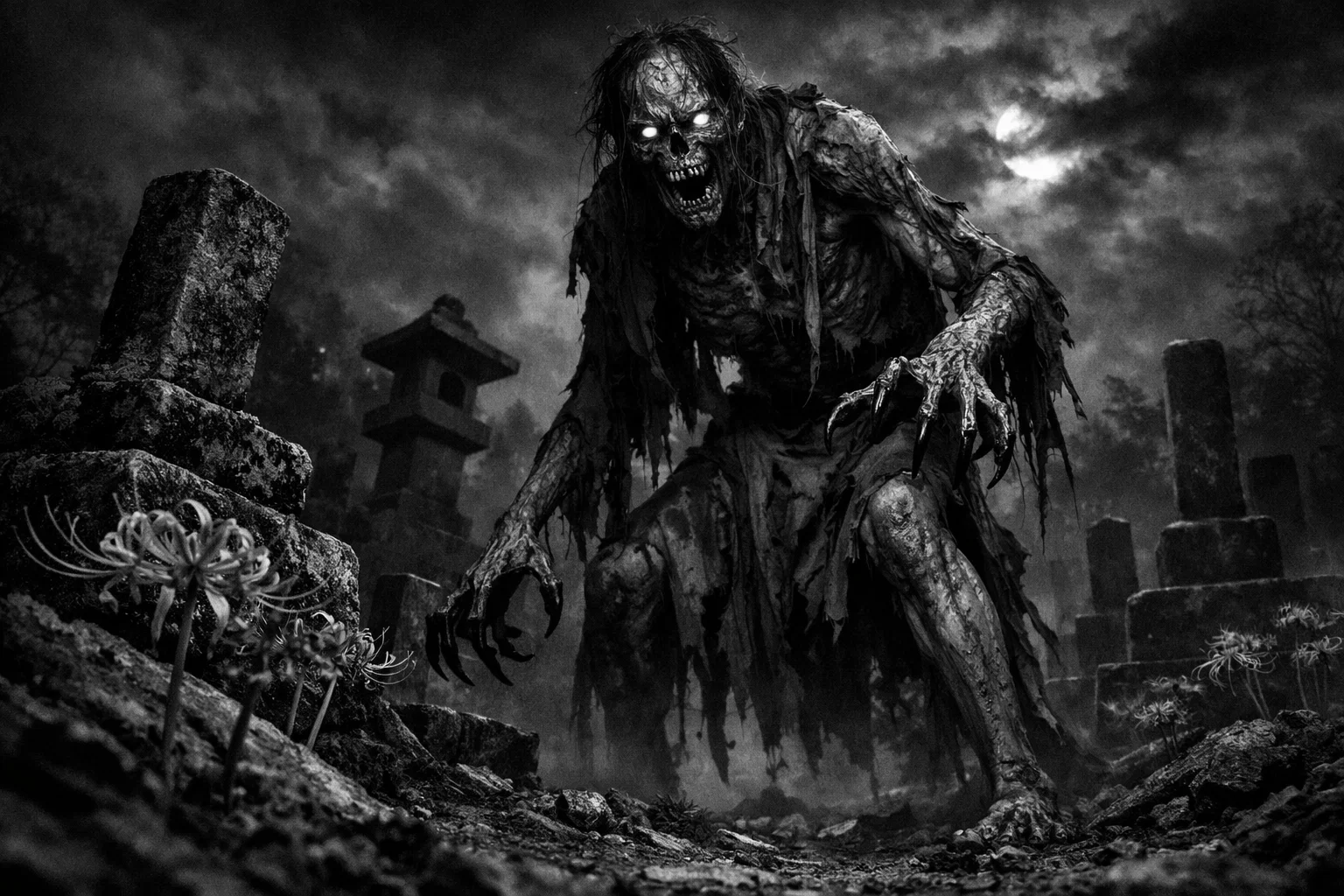

Jikininki are a type of Preta, or hungry ghost, in Japanese Buddhist tradition. They are the spirits of people who lived selfish, greedy lives and are now cursed with endless hunger. Their main trait is a need to eat the flesh and bones of the recently dead.
Jikininki are considered a type of Yōkai in Japanese folklore. Still, their origins come from the Buddhist idea of the Gaki, or hungry ghost. For more on similar beings, see the Yōkai category.
Summary
Key Takeaways
| Attribute | Details |
| Names | Jikininki, Shokujinki, Rakshasa (in specific contexts), Human-eating ghosts |
| Title | Corpse-eating ghost |
| Region | Japan |
| Type | Buddhist demon, Yōkai, Gaki (Hungry Ghost) |
| Gender | Male, Female, or Ambiguous |
| Realm | Preta-gati (Hungry Ghost Realm) manifesting in the Human Realm |
| Obstacle/Threat | Desecration of the dead, psychological terror, spiritual stagnation |
| Associated Figures | Musō Soseki, Buddhist Monks, Enma-ō |
| Weapon/Item | Claws, Teeth |
| Weaknesses | Sutra recitation, Segaki rituals, Buddhist merit-transfer, Segaki-e |
| Associated Deity/Figure | Kannon Bodhisattva, Jizō Bosatsu |
| Pantheon | Japanese Buddhist/Shinto syncretism |
| Primary Sources | Ugetsu Monogatari, Konjaku Monogatarishū, Nihon Ryōiki |
Who or What is Jikininki?
Jikininki are spirits punished for their past actions. In Buddhist belief, they exist between the living and the damned. Rather than being mere monsters, they are tragic figures suffering from past attachments. Unlike other demons that hunt the living, Jikininki scavenge the bodies of the dead.
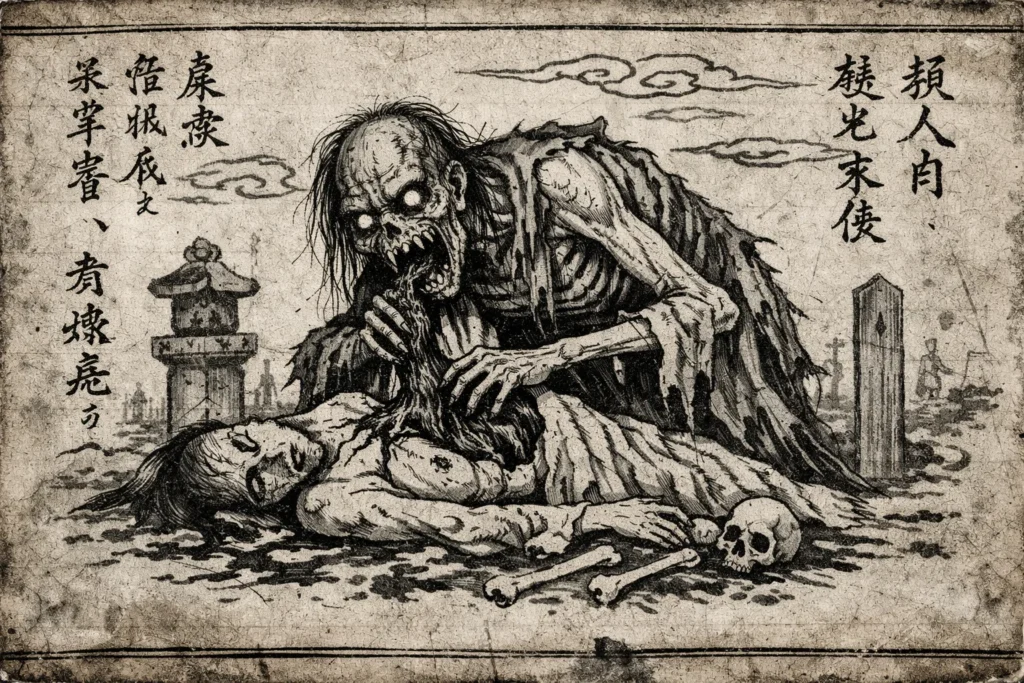
At night, these spirits look for graveyards or homes where someone has just died. They eat the body in a ritual-like way, sometimes taking the burial offerings as well.
Even though they act like monsters, these creatures often keep a bit of their old human awareness. This makes them feel deep shame and self-hatred. Most people cannot see them, but they may appear to those with spiritual abilities or people near death.
1,000+ SPIRITS, GODS & GODDESSES AWAITING YOUR CALL. Limited-Time: Up to 49% OFF!
The ultimate global spirit encyclopedia – 2,000+ entries from every culture on Earth. Fairies • Djinn • Demons • Loa • Angels • Deities • Ancestors Real names • True offerings • Ancient rituals that actually work. Judika Illes’ legendary masterwork – the one book every serious witch, mage, and spirit-worker owns.
“Jikininki” Meaning
The word Jikininki comes from Japanese kanji: shoku or jiki (食) means “to eat,” jin (人) means “human,” and ki (鬼) means “ghost” or “demon.” So, the name means “human-eating ghost.” In some old translations, it matches the Sanskrit word Rakshasa, but in Japan, it refers to corpse-eating Gaki.
As Pure Land and Zen Buddhism spread in Japan, the term Jikininki developed. While Gaki refers to all hungry ghosts, Jikininki came to mean those stuck in the world of the dead.
In some regions, people call them Shokujinki, but Jikininki is the term most commonly used in stories and research. The name highlights eating as their main trait, showing the Buddhist idea that greed in life leads to suffering after death.
How to Pronounce “Jikininki” in English
To say Jikininki in English, break it into four syllables, each with a short, clear vowel sound: “JEE-kee-neen-kee”.
- Ji: Pronounced like the word “gee” as in geese.
- ki: Pronounced like “key”.
- nin: Pronounced like the first syllable of the word “ninja” or the word “in” with an “n” at the start.
- ki: Again, pronounced like “key”.
The stress is usually on the first and third syllables. Every letter is pronounced clearly, with no silent sounds.
What Does Jikininki Look Like?
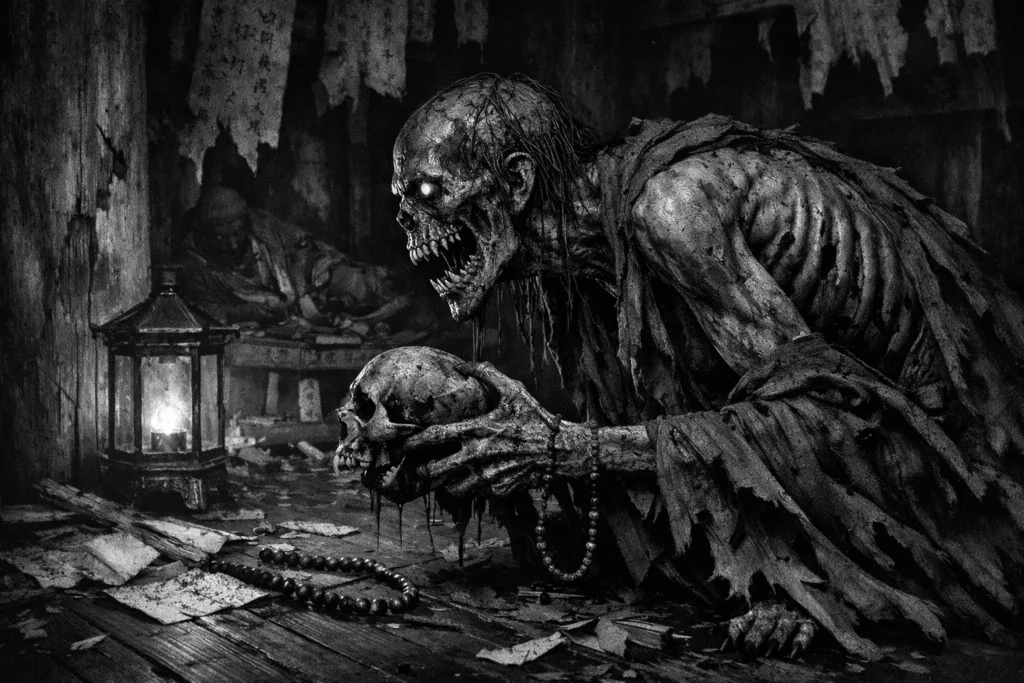
Jikininki look like decayed or skeletal humans. They usually have pale, thin skin stretched over their bones. Their eyes may glow yellow or red, showing their hunger. They have sharp, black claws for digging graves and big teeth for tearing flesh.
Many stories describe them as very tall but hunched, making them look animal-like. Their hair is usually thin and messy. Unlike Gaki in Mahayana sutras, who have big bellies and thin necks, Jikininki are shown as stronger and able to move around the human world.
In some Japanese stories, Jikininki can shapeshift a little, appearing as normal people or even priests by day to hide their curse. This split between their monster form at night and human form by day is a common theme in old Japanese tales.
Origins
Jikininki come from a mix of Indian Buddhist Preta ideas and Japanese ghost stories. The first records of them are in Setsuwa, or teaching tales, from the Heian and Kamakura periods. Monks used these stories to teach about karma and the risks of greed (mushin).
The most well-known origin story is about a corrupt priest who lived in luxury by charging high fees for funerals without real devotion. When he died, Enma-ō, the judge of the dead, sent him to the world of hungry ghosts.
Because he still had ties to the human world, he became a Jikininki. This change from priest to corpse-eater is a strong warning against spiritual hypocrisy. Over time, Jikininki stories moved from religious texts into popular Japanese ghost tales.
You may also enjoy:
Who Is Agares, the Demon of Earthquakes and Deception?
October 13, 2025
What Is the Akkorokamui, Japan’s Colossal Sea Monster?
November 14, 2025
Who Is Andromalius, and Why Is He the Last Demon of the Goetia?
January 20, 2026
Vritra: The Dragon Who Swallowed the Sky in Hindu Mythology
October 7, 2025
What Is the Abumi-guchi Yōkai and Why Does It Wait Forever?
October 22, 2025
Empusa: The Blood-Drinking Wraith of Greek Mythology
November 20, 2025
Regional Variations
Jikininki are mainly found in Japan, but similar corpse-eating spirits appear in other Buddhist cultures. Their names and looks change depending on local stories and which sutras are important in each place.
| Region/Tradition | Appearance | Role |
| Japanese Zen | Skeletal, decaying, glowing eyes | Punished monks, scavengers |
| Tibetan Buddhism | Blue-skinned, emaciated, fiery breath | Protectors of cemeteries or hungry ghosts |
| Chinese Folklore | Green-skinned, stiff-limbed (Jiangshi-like) | Vengeful spirits seeking life essence |
Buddhist Cosmology
In Buddhist belief, Jikininki live in the Preta-gati, or Hungry Ghost Realm, which is one of the Six Realms of Rebirth. They are seen as ghosts that stay close to the human world, not far away in a hellish place.
This placement means they suffer like no other ghost: they are near food (corpses), but eating never satisfies them. Instead, it brings more shame and keeps the curse going.
Jikininki in Mahayana Sutras
While the specific Japanese term “Jikininki” is not used in the original Sanskrit Mahayana sutras, the Shurangama Sutra and the Sutra of the Past Vows of Earth Store Bodhisattva describe various classes of Rakshasas and Pretas that consume human remains.
| Source | Quote |
| Shurangama Sutra | “There are those who are possessed by the ghosts of corpses, who consume the essence of the dead and dwell in the darkness of graveyards.” |
| Kshitigarbha Sutra | “Some ghosts eat the blood of humans, some eat the flesh, and some eat the essence of the bones of those newly deceased.” |
MEET THE MONSTERS THAT HAUNT JAPAN Limited-Time: Up to 28% OFF!
Kappa • Yuki-onna • Tanuki • Kitsune • Hundreds more legendary spirits Hilarious, horrifying, and downright bizarre tales from Japan’s shadow side. Fully illustrated encyclopedia by Thersa Matsuura – your passport to the world of yōkai. Anime origins • Real folklore • Things that go bump in the tatami. Dare you invite them in?
Jikininki in Chinese or Korean Folklore
The Jikininki is not explicitly mentioned in the Jataka Tales, which focus on the Buddha’s previous lives. However, similar entities appear in Chinese and Korean “corpse-ghost” tales.
| Source | Quote |
| Konjaku Monogatarishū | “The creature descended from the rafters, its skin the color of old ash, and began to devour the flesh of the deceased woman with a sound like a dog gnawing a bone.” |
Powers and Abilities
Jikininki are seen as low to mid-level in power. They are strong and can cause fear, but they do not have the great powers of Devas or top Asuras. Their abilities are mostly physical and limited to their surroundings.
- Invisibility: They can remain unseen by ordinary humans, manifesting only when they wish to feed or when confronted by high-ranking spiritualists.
- Metamorphosis: They can assume the likeness of a normal human, often a monk or a traveler, to avoid detection during the day.
- Paralysis Inducement: Their presence can cause a “fear-paralysis” in humans, often described as a heavy pressure on the chest (similar to sleep paralysis).
- Enhanced Strength: Despite their skeletal appearance, they possess enough strength to dig through frozen earth and heavy stones to reach coffins.
- Regeneration: Being already “dead” or in a state of undeath, they are highly resistant to standard physical harm.
Jikininki Myths, Legends, and Stories
The Tale of Musō Soseki and the Jikininki
In a well-known narrative, the Zen master Musō Soseki was traveling alone through the mountains of Mino Province. Having lost his way, he came on a small, dilapidated hermitage where an old monk resided. The old monk refused to give him shelter but directed him to a nearby village.
After arriving at the village, Musō was welcomed into a house where the inhabitants were mourning. The head of the house informed Musō that his father had just died and that, according to village custom, all residents must leave the village for the night, as a Jikininki would surely come to devour the corpse.
Musō, being a monk of great resolve, decided to stay behind and perform funeral rites for the deceased. As he meditated on the body, a monstrous creature entered the room. It was tall and skeletal, moving with a grotesque fluidity.
Musō watched as the entity lifted the corpse and consumed it entirely, including the bones. The creature then turned to Musō but did not attack; instead, it spoke with a sorrowful voice.
The creature revealed itself to be the spirit of the old monk Musō, whom Musō had met earlier. He explained that in his life as a priest, he had cared only for the clothes and food he received for performing services, never truly feeling the words of the sutras.
Because of this greed, he was reborn as a Jikininki. He pleaded with Musō to perform a Segaki ritual to release him from his torment. Musō did so, and the creature vanished. The next morning, Musō returned to the hermitage, only to find a moss-covered grave marker where the old monk had stood.
You may also enjoy:
Who Is Al-Abyad? The White King Jinn Who Rules Love and Chaos
January 26, 2026
Who Is Abaddon, the Demon of the Abyss, in the Bible?
September 29, 2025
Al-Ahmar: The Tuesday King of the Seven Jinn
February 13, 2026
Who Is the Infernal King Balam? Origins, Powers, and Occult History
February 26, 2026
Bali: The Benevolent Asura King of Hindu Mythology
October 10, 2025
Aamon: The Infernal Marquis of Lust, Feuds, and False Prophecies
September 29, 2025
The Corpse-Eater of the Abandoned Temple
In an account from the Konjaku Monogatarishū, a group of travelers took refuge in an abandoned temple during a storm.
One traveler, unable to sleep, observed a pale, thin creature creeping into the main hall where a body was being kept for a funeral the next day. The entity began to eat the offerings first, then moved toward the body. The traveler noticed that the ghost was weeping as it ate, muttering about its unending hunger and the bitterness of its fate.
This story focuses on the psychological suffering of the Jikininki, who is conscious of the revolting nature of their own actions but is unable to stop due to the weight of their past karma.
Jikininki vs Other Buddhist Demons
| Demon Name | Associated Obstacle/Role | Origin/Source | Key Traits/Powers |
| Mara | Temptation/Distraction | Pali Canon | Illusion, control over desires |
| Gaki | Hunger/Greed | Abhidharma | Bloated belly, needle-neck |
| Kumbhanda | Vitality draining | Mahayana Sutras | Shapeshifting, energy theft |
| Yaksha | Protection/Nature | Vedic/Buddhist | Superhuman strength, invisibility |
| Rakshasa | Violence/Consumption | Sanskrit texts | Man-eating, terrifying form |
| Oni | Punishment/Wrath | Japanese folklore | Horns, iron clubs, great strength |
| Preta | Unfulfilled desire | Six Realms | Invisible to humans, suffering |
| Dakin | Death/Transition | Vajrayana | Consumption of heart/essence |
| Asura | Pride/Warfare | Vedic/Buddhist | Multiple arms, combat prowess |
| Pishacha | Disease/Madness | Hindu/Buddhist | Possession, eating raw flesh |
| Vetala | Corpse possession | Sanskrit folklore | Reanimating dead bodies |
UNLOCK THE FORBIDDEN KNOWLEDGE OF DEMONS. Limited-Time: Up to 29% OFF!
The Encyclopedia of Demons & Demonology 400+ entries • Real history • Exorcisms & Ancient Evils • Possession • Terrifying photos. This is Rosemary Ellen Guiley’s masterpiece of the occult.
Mystical Correspondences
| Attribute | Details |
| Planet | Saturn (associated with decay and karma) |
| Zodiac Sign | Capricorn (structure and consequence) |
| Element | Earth (specifically cemetery soil) |
| Direction | North-East (the Demon Gate or Kimon) |
| Color | Ashen Gray / Bone White |
| Number | 2 (representing the duality of priest and monster) |
| Crystal/Mineral | Obsidian (for grounding and protection) |
| Metal | Lead |
| Herb/Plant | Higanbana (Spider Lily – the flower of the dead) |
| Animal | Hyena or Jackal (scavengers) |
| Trait/Role | Gleaning / Karmic Retribution |
Jikininki are linked to the border between the physical and spiritual worlds. They are connected to the earth, especially the grave soil. Their arrival is often marked by the smell of sulfur or decay. In spiritual practices, they symbolize the hidden greed within people that can block spiritual growth if ignored.
To calm or drive away a Jikininki, people often use the Segaki-e ceremony. In this ritual, food is given to hungry ghosts to ease their cravings and help them earn merit for a better rebirth.
Jikininki’s Items & Symbolism
Jikininki do not usually carry weapons because they use their claws and teeth to survive. Symbolically, they are linked to The Shroud, which stands for the thin line between life and death.
The most important ‘item’ for a Jikininki is the corpse, which shows that the body is not permanent (Anicca). By eating the body, Jikininki reminds us that our physical form is only a temporary vessel.
Another symbol is the broken rosary or torn robe, often shown when the Jikininki was once a monk. These items stand for broken promises and the loss of sacred duties.
You may also enjoy:
What Is a Dīv? The Terrifying Giant Demon of Persian Myth
January 22, 2026
Bakeneko: A Supernatural Cat Yōkai in Japanese Folklore
January 27, 2026
Who Are the Yaksha, and Why Did Buddhists Fear Their Wrath?
October 20, 2025
Aeshma: The Zoroastrian Demon of Wrath and Fury
January 13, 2026
Frequently Asked Questions
What is the difference between a Gaki and a Jikininki?
All Jikininki are a kind of Gaki, or hungry ghost, but they look and act differently. Most Gaki cannot eat because of heat or narrow throats, but Jikininki can eat human flesh. Unlike other Pretas who live in another world, Jikininki stay in the human world, haunting graveyards and empty temples to find bodies.
Can a Jikininki be cured or released from its curse?
Yes, a Jikininki can be freed through the Segaki ritual or by transferring merit (Pariṇāmanā). Because their curse comes from karmic debt, a living person, usually a senior Buddhist monk, must recite sutras and offer’ pure food’ to feed the ghost spiritually. When enough merit is shared to balance their past sins, the spirit can leave the Hungry Ghost Realm and be reborn in a better place.
Why do Jikininki specifically eat the dead instead of the living?
Jikininki eat the dead as a punishment for spiritual greed. In life, they often made money from the dead, like corrupt priests or undertakers. As a result, they are cursed to be obsessed with death. They do not hunt the living because their curse forces them to scavenge, showing how little the body is worth compared to what they once believed it was.
Are Jikininki considered dangerous to humans?
Jikininki are not usually violent, but they are seen as spiritually dangerous. Their presence brings pollution (Kegare), which can cause illness or bad luck. Meeting one can cause deep fear or trauma. In stories, the real danger is not being eaten but being cursed or seeing the harsh results of karmic punishment, which can affect a person’s mind.
What is the Segaki-e ceremony associated with Jikininki?
The Segaki-e, or Feeding the Hungry Ghosts, is a Japanese Buddhist ceremony during the Ubon festival. A special altar called the Gakidan is set up facing away from the main temple icons. Monks offer water and food and recite mantras to help spirits like Jikininki, who are said to have ‘narrow throats.’ This ritual is meant to ease the suffering of spirits with no living relatives to pray for them, stopping them from becoming angry or desperate.
