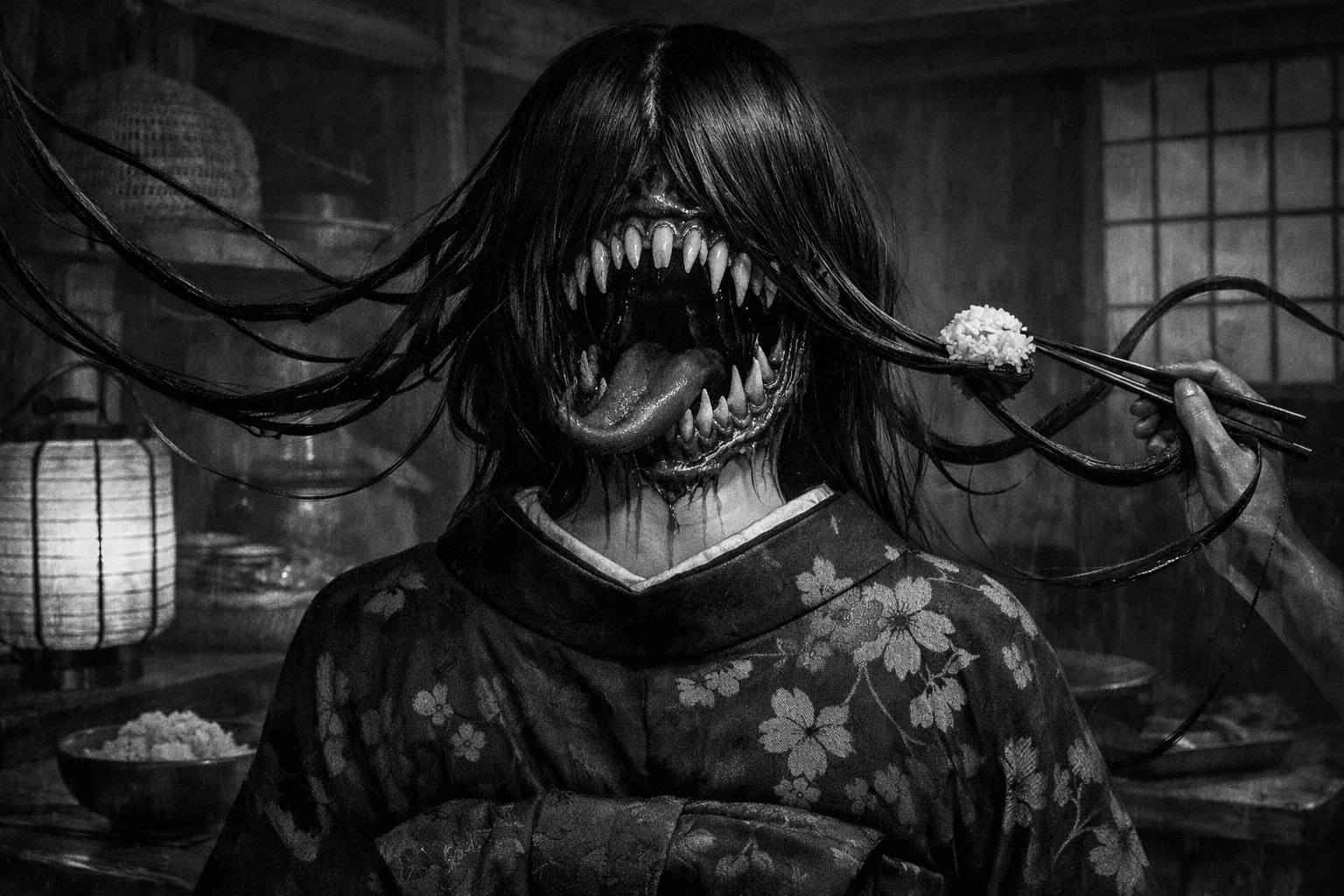

The Futakuchi-onna is a yōkai, or supernatural being, known for having a second working mouth on the back of her head, hidden under her hair. She looks like an ordinary woman until her secret is revealed by the second mouth’s huge appetite.
This legend mainly warns against greed, mistreating others at home, and letting hidden resentment grow. It is often seen as a story about a person changed by a curse or spiritual punishment.
Summary
Key Takeaways
| Attribute | Details |
| Names | Futakuchi-onna |
| Translation | Two-mouthed woman |
| Title | The Devouring Wife |
| Type | Human-type yōkai (transformed human) |
| Origin | Cursed transformation resulting from starvation or negligence |
| Gender | Female |
| Appearance | A woman with a second mouth on the back of the skull, often with prehensile hair |
| Powers/Abilities | Prehensile hair manipulation, independent consumption by the second mouth |
| Weaknesses | Exerting control over the primary mouth, proper provision of food |
| Habitat | Human dwellings, particularly kitchens and dining areas |
| Diet/Prey | Large quantities of rice and human food; targets household supplies |
| Symbolic Item | Rice paddle or large cooking pot |
| Symbolism | The consequences of greed and the hidden nature of domestic strife |
| Sources | Ehon Hyaku Monogatari |
Who or What is Futakuchi-onna?
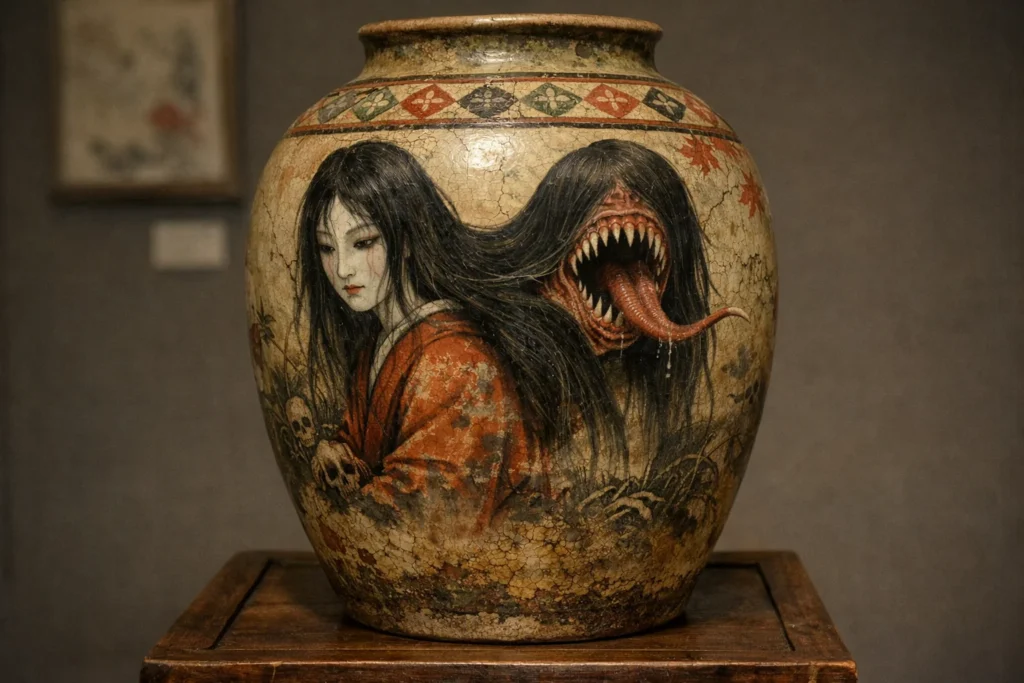
The Futakuchi-onna is a monster from Japanese folklore who appears to be a normal woman. Still, it has a second, hungry mouth hidden beneath her long hair at the back of her head. This mouth has its own teeth and tongue, and can speak and ask for food on its own.
Most stories describe the Futakuchi-onna as a woman who became this way because of a curse or deep emotional pain, not as a separate kind of monster. The change often happens because she refuses to eat in front of others, while the second mouth secretly eats a lot. This shows the idea of a hidden side or the results of ignoring family or responsibilities.
MEET THE MONSTERS THAT HAUNT JAPAN Limited-Time: Up to 28% OFF!
Kappa • Yuki-onna • Tanuki • Kitsune • Hundreds more legendary spirits Hilarious, horrifying, and downright bizarre tales from Japan’s shadow side. Fully illustrated encyclopedia by Thersa Matsuura – your passport to the world of yōkai. Anime origins • Real folklore • Things that go bump in the tatami. Dare you invite them in?
“Futakuchi-onna” Meaning
The name Futakuchi-onna comes from the Japanese words futa (two), kuchi (mouth), and onna (woman). It literally means “two-mouthed woman.” The name simply describes her most unusual feature.
Historians believe the name became common during the Edo period (1603–1868), when yōkai were listed and depicted in popular monster books such as those by Toriyama Sekien. Unlike other yōkai, the name Futakuchi-onna has stayed mostly the same over time.
The name also points to the character’s double nature: a polite, controlled woman on the outside, but a wild, greedy mouth hidden behind.
How to Pronounce “Futakuchi-onna” in English
In English, you say it as foo-tah-koo-chee ohn-nah. The “u” sounds are short, like the “oo” in “foot.” The “i” in “kuchi” sounds like “ee” in “bee.” The double “n” in “onna” is a bit longer, but in everyday speech, it often sounds like “own-nah.”
What Does Futakuchi-onna Look Like?
From the front, the Futakuchi-onna looks like any other woman. She is usually shown in traditional Japanese clothes, like a kimono, with tidy hair. But the back of her head hides something strange and unsettling.
At the base of her skull or neck is a big, open mouth with sharp teeth and a working tongue. In many old drawings, especially from the Edo period, the hair around this mouth moves like tentacles or extra arms.
Her hair can move on its own, grabbing food like rice balls or vegetables and feeding the second mouth. The mouth can also make noises, such as growling, muttering, or screeching, when it is hungry.
You may also enjoy:
Bali: The Benevolent Asura King of Hindu Mythology
October 10, 2025
Al-Ahmar: The Tuesday King of the Seven Jinn
February 13, 2026
Who Is Abalam in Demonology? The Terrifying King That Serves Paimon
September 30, 2025
Mara: The Buddhist Demon King of Desire and Death
October 13, 2025
Who Is Ambolin, the Demon of Nighttime Dread
December 1, 2025
Azhi Dahaka: The Three-Headed Dragon of Zoroastrian Mythology
January 14, 2026
Habitat
The Futakuchi-onna is a yōkai that lives in human homes. Unlike yōkai that live in the mountains, she is usually found in traditional Japanese houses, especially in kitchens and dining rooms where food is made and eaten.
Since the Futakuchi-onna starts as a human, she usually stays in the same community. She only leaves for the wild if people find out her secret. Her link to the home comes from her serving as a symbol of hidden family problems.
1,000+ SPIRITS, GODS & GODDESSES AWAITING YOUR CALL. Limited-Time: Up to 49% OFF!
The ultimate global spirit encyclopedia – 2,000+ entries from every culture on Earth. Fairies • Djinn • Demons • Loa • Angels • Deities • Ancestors Real names • True offerings • Ancient rituals that actually work. Judika Illes’ legendary masterwork – the one book every serious witch, mage, and spirit-worker owns.
Origins and History
The Futakuchi-onna became well-known in the mid-Edo period, appearing in the Ehon Hyaku Monogatari (1841), a famous book of stories and pictures. At that time, people were especially interested in strange and creepy tales.
There are two main legends about how the Futakuchi-onna came to be. In the first, a stingy man marries a woman who says she never needs to eat. He is happy to save money, but his rice keeps disappearing. He later finds out that the mouth on the back of her head is eating all his food.
The second story is about a stepmother who let her stepchild starve while feeding her own child well. The spirit of the dead child is said to have created the second mouth on the stepmother’s head as a lasting punishment for her cruelty.
Sources
The Futakuchi-onna appears often in Edo-period books about supernatural beings.
| Source | Quote |
| Ehon Hyaku Monogatari | “The mouth at the back of the head is said to be a manifestation of the spirit of a child who died of starvation due to the cruelty of a stepmother.” |
Famous Futakuchi-onna Legends and Stories
The Miser and His Wife
In a small village, a stingy man refused to marry because he didn’t want to pay for a wife’s food. Then he met a woman who claimed she never ate rice. Happy with this, he married her right away. She worked hard and never joined him for meals, but soon he noticed his rice was disappearing much too quickly.
One day, he pretended to leave for work but hid in the attic to watch his wife. To his shock, he saw her untie her hair and reveal a second mouth on the back of her head. Her hair stretched out like long arms, grabbing rice balls and feeding them to the mouth.
The man tried to leave her, but she changed completely, trapping him in a tub of water and trying to take him to the mountains. He managed to escape by hiding in a patch of strong-smelling lilies, which she could not stand.
You may also enjoy:
Mara: The Buddhist Demon King of Desire and Death
October 13, 2025
Marid: The Ocean Jinn That Defies Heaven and Earth
September 30, 2025
Allocer: Great Duke of Hell and the 52nd Spirit of the Ars Goetia
November 17, 2025
Who Is the Demon Andras, The Great Marquis of Discord?
January 15, 2026
Andrealphus: The Peacock Demon Who Twists Minds and Bodies
January 19, 2026
Amdusias in the Ars Goetia: The Demon of Dark Music
December 2, 2025
The Grudge of the Starved Child
Another story tells of a woman who married a widower with a young daughter. She later had her own child and, out of favoritism, fed her own child well but gave the stepdaughter very little. The stepdaughter eventually died from starvation.
Soon after the child died, the stepmother was chopping wood when a splinter hit the back of her head, causing a deep wound. The wound would not heal and slowly turned into a mouth.
To her horror, the wound started to demand food, screaming in the voice of the dead stepdaughter. If she didn’t feed it, she felt terrible pain. She had to feed the mouth for the rest of her life, as a reminder of her cruelty.
Futakuchi-onna Powers and Abilities
The Futakuchi-onna has supernatural abilities that set her apart from normal people. Still, she is not as powerful or destructive as an Oni:
- Prehensile Hair: Her most famous power is her hair, which acts like extra arms to grab food or hold people.
- Independent Vocalization: The second mouth can talk, sometimes saying what the woman really thinks or asking for food.
- Massive Consumption: The second mouth can eat much more than a normal person ever could.
1,000+ SPIRITS, GODS & GODDESSES AWAITING YOUR CALL. Limited-Time: Up to 49% OFF!
The ultimate global spirit encyclopedia – 2,000+ entries from every culture on Earth. Fairies • Djinn • Demons • Loa • Angels • Deities • Ancestors Real names • True offerings • Ancient rituals that actually work. Judika Illes’ legendary masterwork – the one book every serious witch, mage, and spirit-worker owns.
How to Defend Against Futakuchi-onna
To protect yourself from a Futakuchi-onna, legends say you should first discover her secret and then use certain plants. She is said to be weak against the smell of some strong herbs:
- Scented Plants: Shōbu (sweet flag) or lilies are often mentioned as ways to keep her away. The smell of these plants is said to drive her off or stop her from coming near.
- Exorcism: Because her condition is usually a curse, Buddhist or Shinto rituals are sometimes shown as ways to heal her. Still, in many stories, the Futakuchi-onna just runs away instead of being cured.
Futakuchi-onna vs Other Yōkai
| Name | Category | Origin | Threat Level | Escape Difficulty |
| Yama-uba | Obake | Mountain witch | High | Difficult; she is a fast hunter. |
| Yuki-onna | Yūrei-like | Spirit of the snow | High | Hard; she freezes victims. |
| Kappa | Suijin | Water spirit | Moderate | Easy if you bow or offer cucumbers. |
| Rokurokubi | Transformed human | Cursed woman | Low | Easy; usually just a prankster. |
| Kuchisake-onna | Urban Legend | Mutilated woman | Critical | Extreme; requires specific answers. |
| Oni | Demon | Hell/Wicked humans | Critical | Very Hard; requires physical combat. |
| Noppera-bō | Obake | Shapeshifter | Low | Very Easy; they only want to scare. |
| Ubume | Yūrei | Died during childbirth | Moderate | Moderate; based on emotional interaction. |
| Taka-onna | Obake | Jealous woman | Low | Easy; she stays near brothels. |
| Ohaguro-bettari | Obake | Faceless bride | Low | Easy; she only startles people. |
Symbolism
| Attribute | Details |
| Element | Earth (Domestic/Material) |
| Animal | None |
| Cardinal Direction | Northeast (The Demon Gate) |
| Color | Black (Hair and hidden secrets) |
| Plant | Shōbu (Sweet Flag) |
| Season | Winter (Association with food scarcity) |
| Symbolic Item | Rice Bowl |
In Japanese culture, the Futakuchi-onna symbolizes the taboo against selfishness and the hidden problems within families. In the Edo period, a “good wife” was supposed to be modest and careful with money. The Futakuchi-onna turns this idea on its head, showing that pretending not to eat can actually mask a huge appetite.
The stepmother stories also stress the importance of caring for family and the spiritual cost of neglecting children. The yōkai is a symbol for hypocrisy—showing one face to others, but hiding a much greedier side at home.
You may also enjoy:
Who Is Astaroth in Demonology and the Ars Goetia?
February 20, 2026
Palis: The Foot-Licking Desert Jinn That Drinks Your Blood
December 3, 2025
Who Is Arioch, the Demon of War and Vengeance?
January 21, 2026
Edimmu: The Mesopotamian Wind Demon That Steals Life
November 6, 2025
Jikininki: The Japanese Ghost That Feeds on Human Corpses
February 9, 2026
Who Was Mahishasura, the Buffalo Demon Slain by Goddess Durga?
October 3, 2025
Frequently Asked Questions
Is the Futakuchi-onna based on a real person or medical condition?
Although the Futakuchi-onna is a mythical creature, some historians think the story may have been inspired by teratomas. These tumors can grow hair and teeth, or, in rare cases, parasitic twins. The legend also reflects worries about eating disorders or hidden hunger during famines in old Japan.
What is the difference between Futakuchi-onna and Kuchisake-onna?
The Futakuchi-onna is an old yōkai with a second mouth on the back of her head, usually caused by a curse or greed. The Kuchisake-onna, or Slit-Mouthed Woman, is a newer urban legend about a woman whose mouth is cut from ear to ear, often because of an accident or a jealous husband.
Can a Futakuchi-onna be cured of her second mouth?
Some regional stories say a Futakuchi-onna can only be cured if she fixes the moral problem that caused the curse. If the second mouth came from a neglected child’s spirit, the curse might end with true regretand prayer. But in most old stories about misers, the woman stays a yōkai and runs away to the mountains to live as a Yama-uba.
Does the Futakuchi-onna appear in modern anime or video games?
Yes, the Futakuchi-onna shows up in many modern games and anime. For example, Pokémon Mawile has a big steel jaw on the back of its head, and the character Mika from Under Night In-Birth is based on her. She also appears as enemies in games like Nioh and Shin Megami Tensei.
