
In Ancient Greek mythology, the Erinyes are chthonic entities who serve as the personifications of divine vengeance.
They are primarily responsible for pursuing and punishing those who commit heinous crimes, particularly offenses against kindred—murder, unfilial conduct, and perjury. They are most notably associated with crimes that violate the natural and moral order (Dike), ensuring that no transgression goes unpunished, especially within the family unit.
These powerful, inescapable demons are also frequently referred to by the euphemistic name Eumenides, meaning “The Kindly Ones,” which was used to appease them and avoid incurring their wrath. They play a significant role in various classical texts, embodying the relentless, inexorable force of retribution that maintains cosmic balance.
Summary
Key Takeaways
| Attribute | Details |
| Names | Erinyes (plural); Erinys (singular); Eumenides (euphemistic name); Dirae (Latin); Furies (Roman name) |
| Title | Ministers of Divine Vengeance, Avenging Goddesses, Chthonic Vengeance Spirits |
| Origin | Ancient Greek and Roman Mythology |
| Gender | Female (commonly a triad of sisters) |
| Genealogy | Daughters of Gaia (born from the blood of Uranus) or Daughters of Nyx (Night) |
| Role | Pursuing and punishing wrongdoers, especially those who commit patricide, matricide, or oath-breaking |
| Associated Deity/Figure | Hades and Persephone (as chthonic deities), Apollo and Athena (in the Oresteia trial) |
| Brings | Madness, torment, endless persecution, guilt |
| Weaknesses | The command/judgment of a higher divine authority (e.g., Athena), cleansing ritual and atonement |
| Realm/Domain | The Underworld (Hades/Erebus), earth’s hidden places |
| Weapon/Item | Whips, torches, snakes |
| Symbolism | Inescapable Retribution, Cosmic Justice, Guilt and Conscience |
| Sources | Homer’s Iliad and Odyssey, Hesiod’s Theogony, Aeschylus’s Oresteia |
Who or What Are the Erinyes?
The Erinyes are powerful, primordial spirits from Greek mythology who embody the principle of retribution and cosmic justice. They are commonly identified as a triad of sisters: Alecto (“The Unceasing”), Megaera (“The Grudging”), and Tisiphone (“The Vengeance-Retribution”).
Their fundamental role is to track down and relentlessly punish individuals who have committed unforgivable offenses, particularly those involving blood-guilt within the family or breaking a sacred oath.
Once a crime is committed, they pursue the offender both on earth and into the Underworld, causing them perpetual torment and driving them to madness until they are either purified or dead. They are inexorable and cannot be appeased until justice (as they perceive it) is fully served.
“Erinyes” Meaning
The name Erinyes (plural, Eρινύες) is generally believed to derive from the Greek verb erinein, which signifies “to pursue” or “to harass,” accurately reflecting their function as avenging pursuers of wrongdoers. Another proposed root is the Greek word eris (έρις), meaning “strife” or “quarrel,” suggesting a connection to discord and conflict resulting from transgression.
In various contexts, they are also known by the euphemistic name Eumenides (Εὐμενίδες), meaning “The Kindly Ones.” This title was a form of apotropaism—a strategy of calling dangerous entities by a benign name to avoid invoking their wrath and ensure their favor, or at least their neutrality.
The Romans adopted them as the Furies (or Dirae), both terms also conveying the sense of wrath and terrible power.
How to Pronounce “Erinyes” in English
The common English pronunciation for Erinyes is eh-RIN-ee-eez or er-IN-ee-ees. The stress typically falls on the second syllable (-RIN-). In Ancient Greek, the pronunciation would have been closer to e-ri-ny’-es, with the final syllable being pronounced. The Roman name, Furies, is pronounced FYOOR-ees.
Origins
The origins of the Erinyes are detailed in one of the most fundamental texts of Greek mythology, Hesiod’s Theogony.
According to this text, their birth is linked to the primordial act of violence when Cronus mutilated his father, Uranus (Sky). As Cronus castrated Uranus with a sickle, the blood that spilled and dripped onto Gaia (Earth) caused her to conceive and give birth to three powerful entities: the Giants, the Meliae (ash tree nymphs), and the Erinyes.
This origin establishes the Erinyes as primordial beings, predating the Olympian gods, which shows their fundamental role in cosmic law. Being born of the blood of an injured divine ancestor, they are inherently bound to the concept of blood-guilt and the lex talionis (law of retaliation). Later traditions (particularly those associated with the tragedians) sometimes cite them as the daughters of Nyx (Night), or of Skotos (Darkness) and Gaia, further stressing their chthonic, dark, and ancient nature.
You may also enjoy:
Si’la: The Seductive Jinn Who Lures Travelers to Their Doom
October 9, 2025
Amdusias in the Ars Goetia: The Demon of Dark Music
December 2, 2025
Who Is Ariton, the Infernal King of the Eastern Gate?
February 17, 2026
Who Is Taṇhā, the Seductive Demon of Craving in Buddhist Mythology?
October 15, 2025
Bakeneko: A Supernatural Cat Yōkai in Japanese Folklore
January 27, 2026
Barbas: The Lion Demon Who Spreads Disease
March 3, 2026
Genealogy
| Relationship | Details |
| Parents | Gaia (Earth) and the Blood of Uranus (Sky), according to Hesiod. Alternatively, Nyx (Night) |
| Siblings | Giants, Meliae (Ash Tree Nymphs), and possibly the Moirai (Fates) or other children of Nyx |
| Spouse | None |
| Children | None |
Sources
The Erinyes appear in several foundational works of Ancient Greek literature, signifying their importance in the moral and religious framework of the time. They are particularly prominent in the works of the epic poet Homer and the tragedian Aeschylus.
| Source | Quote |
| Homer, Iliad IX, 453-457 (English Translation) | and the mother prayed to the Furies, lifting up her hands, and the Furies, who walk in darkness, hearkened to her, and they brought all these things to pass. |
| Homer, Odyssey XV, 234 (English Translation) | For this he was hated by all the gods and men, and the Furies were set upon him by his father. |
| Hesiod, Theogony 183-185 (English Translation) | And all the drops of blood that gushed forth, Earth received; and as the years went round, she bore the fierce Erinyes and the great Giants with their gleaming armour… |
| Aeschylus, Eumenides 415-419 (English Translation) | We are the eternal children of Night. In the hollows of the earth we have our dwelling, and neither god nor man can approach us. It is my charge to drive men from their homes when their hands are stained with kindred blood. |
| Virgil, Aeneid VI, 570-572 (Latin and English Translation) | continuo auditae voces, vagitus et ingens / infantumque animae flentes in limine primo, / quos dulcis vitae exsortes et ab ubere raptos / abstulit atra dies et funere mersit acerbo. (Latin) Straightway voices are heard, and vast wailings, and the spirits of infants weeping on the threshold of the very first entrance, whom, without share in sweet life, and torn from the breast, a dark day carried off and plunged in bitter death. (English Translation of a passage involving them in the Underworld) |
What do Erinyes Look Like?
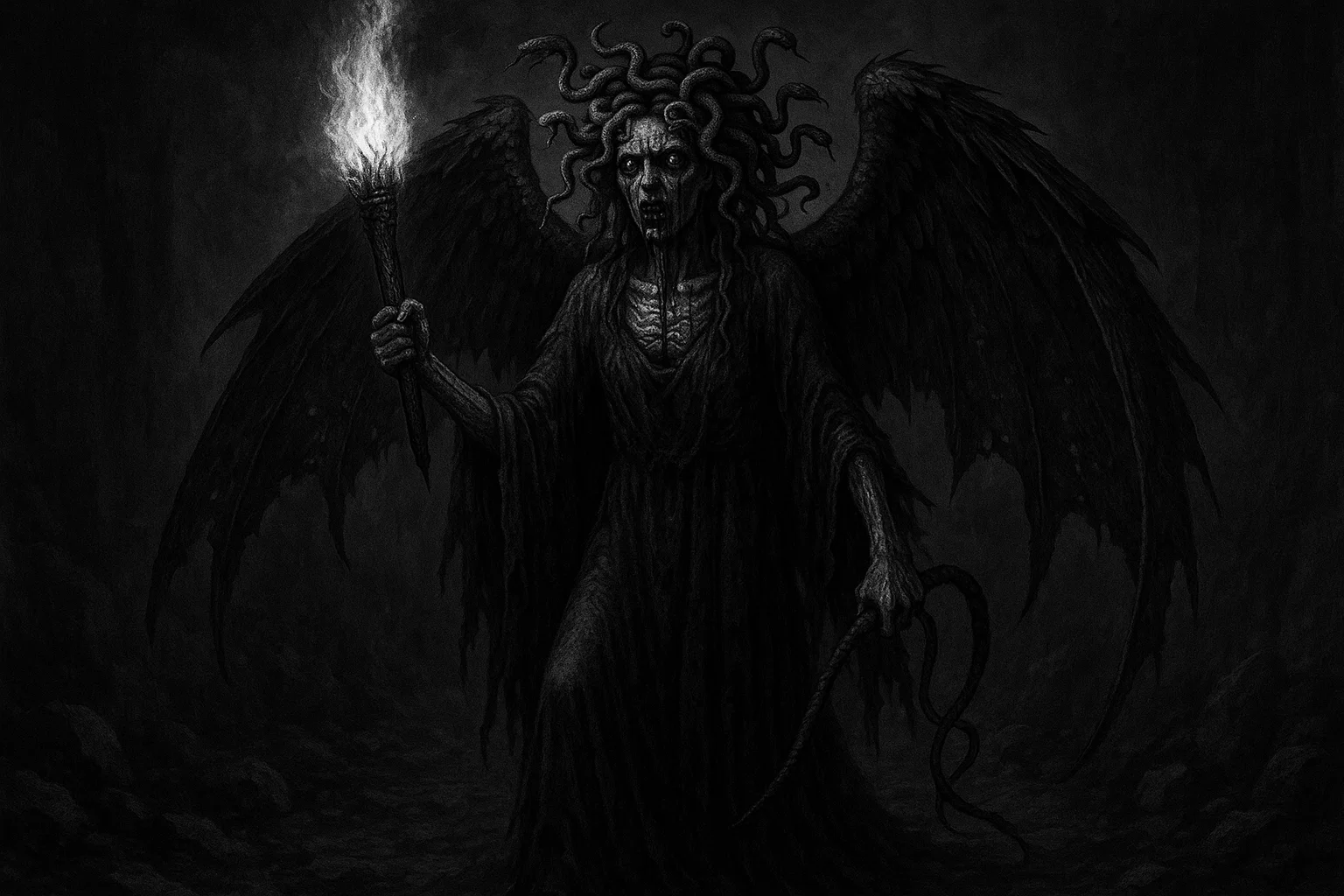
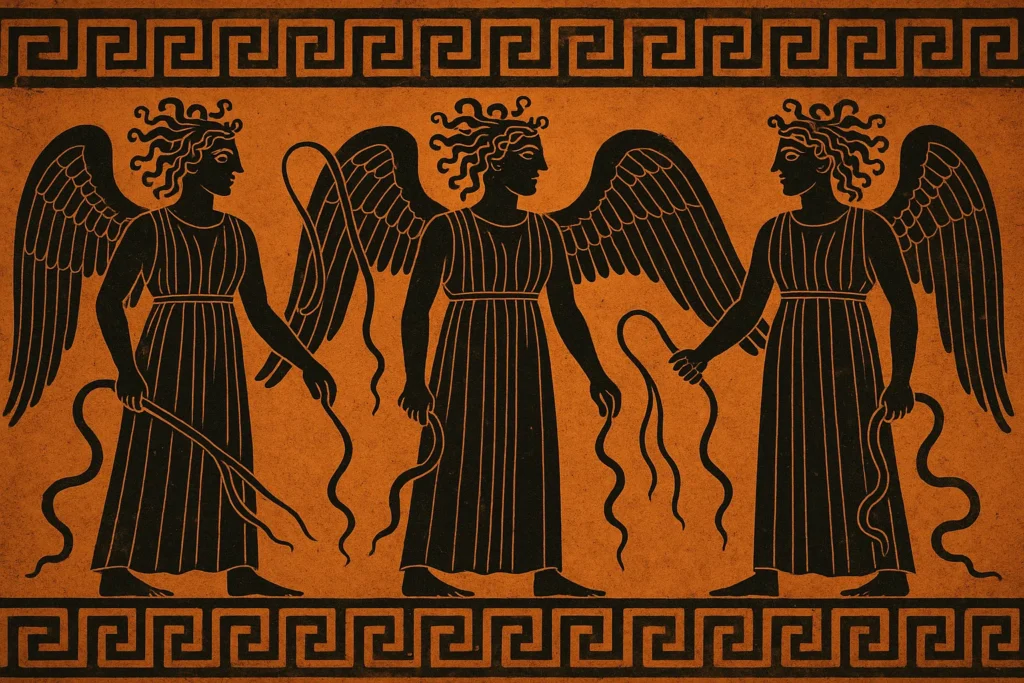
The Erinyes’ physical description is consistently terrifying and repulsive in classical literature, designed to evoke horror and dread. They are typically depicted as dreadful female monsters, often described as winged, signifying their speed and relentless pursuit. Their appearance is strongly associated with the underworld and pollution.
A common visual characteristic is having snakes woven into their hair, sometimes described as vipers or other venomous serpents, instead of normal locks. Their eyes are frequently described as bloodshot or dripping with poisonous ichor.
They are often shown carrying torches to illuminate and expose the darkest guilt of their victims, and whips or scourges to administer physical punishment and mental torment. Their clothing is generally black or dark, emphasizing their connection to Nyx (Night) and the chthonic realms.
This strong visual aspect reinforces their role as harbingers of destruction and madness.
Enemies, Rivals, and Allies
The Erinyes essentially function as neutral executors of divine law regarding blood-guilt, making them less likely to have established allies or traditional enemies in the manner of gods or heroes.
However, their primary opposition arises when the concept of justice evolves or when a god attempts to overrule their ancient, primordial authority.
Rivals/Opponents: Their top opposition in Greek myth is depicted in Aeschylus’s Oresteia, where they vigorously pursue Orestes for the murder of his mother, Clytemnestra. Here, their ancient, absolute form of blood-for-blood justice clashes directly with the newer, more nuanced legal system championed by Apollo (who commanded Orestes to commit the act) and Athena (who presides over the final trial). Apollo actively attempts to drive them away from Orestes. Ultimately, Athena does not defeat them but rather placates and transforms them into the Eumenides by offering them a place of reverence in Athens.
Allies: Their closest associations are with the chthonic deities and forces of the Underworld. They are the Ministers of Hades and Persephone, assisting in the judgment and punishment of the dead in their realm. They also act in concert with Dike (Justice) and Nyx (Night) in maintaining the moral order.
Connections to Other Ancient Demons
The Erinyes share a thematic role with various other ancient entities as enforcers, punishers, or figures of chaos/calamity.
| Name | Genealogy | Type | Appearance |
| Lamashtu | Babylonian, Sumerian | Disease Spirit, Child-Killer | Hairy body, lion’s head, donkey’s teeth and ears, taloned hands and feet, often nursing a pig and dog. |
| Pazuzu | Assyrian, Babylonian | Wind Demon, Protector against Lamashtu | Man-like body, lion/dog-like head, two pairs of wings, eagle’s talons, serpentine penis, and tail. |
| Humbaba | Sumerian, Akkadian | Guardian of the Cedar Forest | Giant, monstrous figure with a terrifying face, described as having a lion’s head, or multiple terrifying faces. |
| Tiamat | Babylonian | Primordial Chaos Monster | Massive sea dragon or serpent, often depicted with horns and scaly skin, embodying salt water. |
| Lilith | Mesopotamian, Jewish | Night Hag, Seductress | Initially a winged demon, later a beautiful woman with long hair, associated with night and causing harm to infants. |
| Jörmungandr | Norse | Chaos Serpent, World Serpent | An immense serpent that encircles the world, often described as biting its own tail. |
| Apep (Apophis) | Egyptian | Primordial Chaos Serpent | A colossal serpent, often coiled, symbolizing darkness and un-creation. |
| Mara | Buddhist (India) | Adversary, Tempter | Often depicted as a demon with multiple arms, riding an elephant, or having a horde of monstrous followers. |
| Chemosh | Moabite (Canaanite) | National God (later viewed as a demon) | No consistent demonic appearance, sometimes associated with Saturn or depicted as a bull-like figure. |
| Mormo | Greek | Female Boogeyman, Vampire/Ghoul | A terrifying, shapeshifting female monster used to frighten disobedient children. |
| Asmodeus | Jewish/Christian | Lust Demon, King of Demons | Varies, sometimes three-headed (bull, man, ram) with a goose-foot, or a monstrous, winged figure. |
| Alal | Sumerian (later Akkad.) | Underworld Spirit | Not clearly described, associated with the underworld and possibly a guardian or spirit of the dead. |
You may also enjoy:
Nasnas: The Monstrous Demon Hybrid That Haunted Pre-Human Earth
November 12, 2025
Amenadiel: Origins, Hierarchy, and Demonic Attributes
January 5, 2026
Vaisravana: The Golden Guardian King Who Rules the North
October 16, 2025
The Kumbhanda: Grotesque Demons of Buddhist Hell
November 13, 2025
Setcheh: Egypt’s Soul-Stealing Ancient Demon
November 11, 2025
Who Was Hiranyakashipu, the Demon King of Hindu Mythology?
October 6, 2025
Erinyes Myths, Legends, and Stories
The most detailed and significant narrative concerning the Erinyes is found in Aeschylus’s Oresteia trilogy, particularly the final play, The Eumenides.
The Pursuit of Orestes for Matricide
The story centers on the tragic House of Atreus, which is caught in a curse-driven cycle of violence.
Orestes, the son of King Agamemnon and Queen Clytemnestra, returns to his home in Mycenae after his mother has killed his father with the help of her lover, Aegisthus. Following a command from the god Apollo to avenge his father’s death, Orestes takes the dramatic and painful step of killing his mother, Clytemnestra, and Aegisthus.
However, this act of killing his own mother—known as matricide—awakens the Erinyes, also known as the Furies, from the Underworld. These dark figures are guardians of justice for crimes against family, and they consider the murder of a mother by her child to be the worst kind of offense. Strangely, they do not pursue Clytemnestra or Aegisthus for the murder of Agamemnon since that crime didn’t involve family ties in their eyes.
Once awakened, the Furies relentlessly chase after Orestes. While most people cannot see them, Orestes is tormented by their fearsome appearance, which drives him to the brink of madness. They are described as terrifying women wearing dark robes, with snakes in their hair, and a foul, poisonous presence.
Desperate for help, Orestes seeks refuge in the temple of Apollo at Delphi. Apollo, who had initially encouraged Orestes to take revenge, tries to shield him from the Furies. He uses his divine power to fend them off and calls upon Zeus for support.
Nonetheless, the Furies insist on their claim, rooted in ancient law, which even Apollo struggles to dispute. He suggests that the bond between a father and son holds more weight than that between a mother and son, and insists that Orestes’s actions should be considered in judgment.
The Trial and Transformation into the Eumenides
The ongoing conflict comes to an end thanks to the goddess Athena, who holds a trial on the Areopagus, a hill in Athens. She gathers a jury made up of ordinary Athenian citizens, marking the beginning of a new system of justice. This trial tests the old, harsh idea of revenge, represented by the Erinyes (also known as the Furies), against the more organized and fair approach of the gods and of human society.
The Erinyes argue that they are there to enforce an age-old principle: that anyone who sheds blood must pay for it with their own blood. In contrast, Apollo defends Orestes, insisting that a mother is just a vessel for a father’s child, and therefore killing one’s mother isn’t as serious as the Erinyes claim. He also says Orestes acted on the orders of the gods. The jury finds itself split in its decision.
In the end, Athena casts the deciding vote, choosing to acquit Orestes. She states that the justice of the state, which considers the whole situation, is more important than the Erinyes’ cycle of revenge.
The Erinyes are furious at this decision. They threaten to bring disaster upon Athens as punishment for what they see as an unfair verdict. Instead of fighting them, Athena takes a diplomatic approach.
She acknowledges their ancient power and offers them a new place to live beneath the Acropolis, along with a promise that the people of Athens will honor and worship them. She persuades them that they can help ensure the city’s peace and success, rather than just seeking revenge.
The Erinyes accept Athena’s offer. They transform from terrifying figures into the Eumenides, or “The Kindly Ones.” While they are still respected and feared, they are now seen as helpful goddesses who promote growth, success, and harmony in the city. Instead of punishing wrongdoers with vengeance, they help maintain the steady prosperity of the land.
Erinyes Powers and Abilities
The Erinyes are formidable, powerful beings whose strength derives from their status as primordial, inexorable forces of nature and justice.
Their power is absolute within their sphere: the pursuit and mental/physical torment of those who have spilled kindred blood or violated sacred oaths. They are not easily repelled and are not subject to the immediate commands of most Olympian deities, holding an older, deeper authority. Their strength is not military, but psychological and chthonic.
Their powers and abilities include:
- Relentless Pursuit and Inescapability: They can track any wrongdoer across the earth and into the Underworld. Their chase is unending and inevitable, lasting until the offender is dead or purified.
- Madness and Guilt: Their primary and most devastating power is to inflict mental torment and madness upon their victim. They embody the guilty conscience, driving the perpetrator to distraction, paranoia, and physical decay.
- Control over Blights: When enraged, they possess the power to invoke sterility and destruction upon a land, causing famine, plague, and death. This power highlights their deep connection to Gaia (Earth).
- Absolute Authority: As chthonic spirits, they wield authority within the Underworld and act as ministers of Hades and Persephone, ensuring the continued punishment of the damned.
- Casting Curses: The Erinyes are potent executors of curses, especially those laid by a wronged party or parent. They ensure the curse comes to fruition with absolute certainty.
Rituals, Amulets, and Protective Practices
Given their nature as personifications of unavoidable vengeance, the approach to the Erinyes was typically not about confrontation but about avoidance or appeasement. Practices associated with them generally focused on purification from the blood-guilt that attracts them, or on rites designed to honor them in their mollified form, the Eumenides.
Incantations and Ceremonies
The most significant ceremonies associated with the Erinyes involved purification rituals and the establishment of their cult as the Eumenides in Athens.
Purification of Blood-Guilt (The Necessity of Atonement)
The single most effective counter-measure to the pursuit of the Erinyes was divine purification or religious cleansing, often involving a journey to a specific sacred site or the assistance of a god, such as Apollo.
In The Eumenides, Orestes is briefly cleansed by Apollo, though the Erinyes reject this as sufficient. The ultimate ceremony was the public, legal trial on the Areopagus, which served as a form of collective atonement and the establishment of a new legal framework that superseded the immediate blood-vengeance.
The Establishment of the Cult of the Eumenides
Following their successful transformation by Athena, a chthonic cult in their honor was established in Athens. The ceremony involved dedicating a shrine beneath the Areopagus. The people of Athens were obligated to perform annual sacrifices to the Eumenides to ensure the city’s prosperity and prevent the return of their vengeful wrath.
These sacrifices were conducted at night, consistent with their chthonic nature, and typically involved libations of wine mixed with honey or pure water, rather than blood, to avoid attracting their older, sanguinary nature. Vows were also made to them to ensure honesty and peace within the community.
Amulets and Talismans
There are no specific amulets or talismans in classical sources designed to magically ward off the Erinyes, as they represent an inescapable moral force, not a common malicious demon that can be deterred by a simple charm.
The only true “protection” was ritual purification of blood-guilt, atonement for the transgression, and the gods’ protection. After their appeasement, their sanctuary and name (Eumenides) effectively served as a communal “talisman” for Athens, promising protection from civic strife and blight in exchange for piety.
You may also enjoy:
Akateko: The Bloody Hand Ghost That Guards a Cursed Temple Tree
November 14, 2025
What Is a Bhuta? The Backward-Footed Ghosts of Hindu Horror
February 5, 2026
Who Is Ambolin, the Demon of Nighttime Dread
December 1, 2025
Who Is Azazel, the Demon Blamed for Human Corruption?
February 24, 2026
Who Is Asmodeus in Demonology and the Bible?
February 18, 2026
Lamia: The Queen Cursed to Devour the Children of Others
January 7, 2026
Frequently Asked Questions
What are the Erinyes the goddesses of?
The Erinyes are not goddesses in the traditional Olympian sense, but rather primordial, chthonic spirits who function as the personifications of divine vengeance, retribution, and cosmic justice. They are specifically charged with pursuing and tormenting those who commit heinous crimes, especially those involving kindred blood-guilt (like matricide or patricide) and breaking sacred oaths.
Are Erinyes and Furies the same?
Yes, the Erinyes and the Furies are the same entities, differing only in their name due to cultural origin. Erinyes is the original Greek name. Furies is the common Roman name for the same figures, often referred to in Latin as the Dirae. Both names refer to the three relentless spirits of vengeance: Alecto, Megaera, and Tisiphone.
Are Erinyes fallen angels?
No, the Erinyes are not fallen angels. They originate in Ancient Greek and Roman mythology, which is a polytheistic system, and predate the monotheistic concept of fallen angels found in Abrahamic religions (like Christianity or Islam). The Erinyes are primordial spirits born from the blood of the castrated god Uranus, which dripped onto Gaia (Earth), establishing them as ancient forces of nature and moral law.
What did Erinyes look like?
The Erinyes were depicted as terrifying and dreadful female figures. Their most distinctive features included snakes woven into their hair instead of normal locks. They were often shown as winged and wearing dark robes. They were commonly armed with torches (to expose guilt) and whips or scourges (to inflict torment), with their eyes often described as bloodshot or dripping ichor.
Who are the three Erinyes sisters?
The Erinyes are typically identified as a triad of three sisters: Alecto (meaning “The Unceasing“), Megaera (meaning “The Grudging“), and Tisiphone (meaning “The Vengeance-Retribution“). These three spirits work together to relentlessly pursue and torment those guilty of blood-guilt.
How were the Erinyes born?
According to the most famous account in Hesiod’s Theogony, the Erinyes were born from the blood of the primordial god Uranus (Sky) when his son, Cronus, castrated him. The drops of blood that fell onto the earth (Gaia) caused her to give birth to the Erinyes, signifying their connection to the earth and blood-guilt.
