
The Chort (plural: Chorti) is a well-known supernatural entity in Slavic mythology and folklore. It is seen as the embodiment of evil, chaos, and bad luck.
Before Christianity, the Chort was probably a minor spirit of the woods or underworld, linked to the cold and dark parts of nature. After Slavic regions became Christian, people started to associate the Chort with the Devil or other demons. Over time, it became a familiar folk character known for its trickiness and meanness.
Across Eastern and Western Slavic traditions, the Chort usually looks the same: it has goat-like features such as horns, hooves, and a tail. Unlike the more powerful gods, the Chort is often shown as a bothersome spirit that deals directly with people, trying to tempt them or cause trouble.
Summary
Key Takeaways
| Attribute | Details |
| Names | Chort, Czort, Čort, Čert, Korčun (archaic variant) |
| Title | The Evil One, The Unclean Spirit, The Horned One |
| Origin | Slavic (Proto-Slavic) |
| Gender | Male |
| Genealogy | No clear lineage; occasionally cited as a servant of Chernobog in modern reconstructions |
| Role | Temptation, bringing misfortune, trickery, and presiding over the “other world” |
| Associated Deity/Figure | Chernobog (Black God), Veles (in some interpretations), and St. Nicholas (as an adversary) |
| Brings | Bad luck, illness, spiritual corruption, and death |
| Weaknesses | Signs of the cross, holy water, silver, and specific herbs like wormwood |
| Realm/Domain | Swamps, deep forests, and the underworld (Peklo) |
| Weapon/Item | A trident or thin switch/rod |
| Symbolism | Moral decay, chaos, and the predatory nature of the wild |
| Sources | East Slavic chronicles, West Slavic folk tales, and the Primary Chronicle |
Who or What is Chort?
The Chort is an old Slavic demon or spirit, seen as the classic “bad spirit” in pagan beliefs. At first, it was thought to live in the underworld or wild, empty places. While gods like Perun ruled the sky, the Chort stayed in “unclean” spots like swamps, ravines, and thick forests.
In folk stories, the Chort is not all-powerful but is a sneaky and dangerous creature. It can change its shape, but usually takes on a mix of human and goat or pig features.
The Chort is often shown as the cause of human problems, waiting near people who are angry or drunk to make them do things they regret. In many villages, people thought saying “Chort” out loud was risky because it might call the spirit to them.
1,000+ SPIRITS, GODS & GODDESSES AWAITING YOUR CALL. Limited-Time: Up to 49% OFF!
The ultimate global spirit encyclopedia – 2,000+ entries from every culture on Earth. Fairies • Djinn • Demons • Loa • Angels • Deities • Ancestors Real names • True offerings • Ancient rituals that actually work. Judika Illes’ legendary masterwork – the one book every serious witch, mage, and spirit-worker owns.
“Chort” Meaning
The origin of the word “Chort” (Old Church Slavonic: чьртъ) is debated among language experts. One common idea is that it comes from the Proto-Slavic root *čert-, which means to cut or draw a line. This could mean the Chort is “cut off” from the divine, or is the one who “marks” someone for bad luck or death.
Another theory connects the name to the Indo-European root for “curse” or “shortened.” Some experts think it is related to the German word Kurz (short), pointing to the Chort’s short, stubby tail, which is often mentioned in stories.
In the past, the word was used for anything black, twisted, or upside down. Today, in Slavic languages, it is still the usual word for “devil.” Still, people use it both in serious religious talk and as a mild curse.
You may also enjoy:
What Is the Akkorokamui, Japan’s Colossal Sea Monster?
November 14, 2025
Who Is Shiva, the Destroyer and the Lord of the Universe?
November 12, 2025
What Is Qarin and Why Does It Follow Every Human Being?
October 8, 2025
Apophis: The Great Serpent of Egyptian Chaos
November 11, 2025
Who Is Azazel, the Demon Blamed for Human Corruption?
February 24, 2026
What Is a Pishacha, the Flesh-Eating Demon of the Dead?
February 11, 2026
How to Pronounce “Chort” in English
In English, Chort is usually pronounced /tʃɔːrt/. The “Ch” sounds like the “ch” in “church,” and the “o” is pronounced like in “fort.” In some Slavic languages, the “r” is rolled, but in English, a regular “r” is fine.
Origins
The Chort comes from early Slavic beliefs, where it was probably one of many spirits living in nature. Unlike the main gods, the Chort was seen as a local danger. Ancient Slavs thought the world had “pure” places like the home and “unclean” places like forests and bogs. The Chort mainly lived in these unclean areas.
When Slavic people settled and began farming, the Chort’s role expanded to include causing trouble at home. People blamed it for things like spoiled milk, lame horses, and missing children.
When Kievan Rus’ and Western Slavic lands became Christian, the Chort was added to the Christian system as a servant of Satan. Still, it kept its old pagan traits, especially its animal-like look and its link to places like “Chort’s Bridges” or “Chort’s Rocks.”
UNLOCK THE FORBIDDEN KNOWLEDGE OF DEMONS. Limited-Time: Up to 29% OFF!
The Encyclopedia of Demons & Demonology 400+ entries • Real history • Exorcisms & Ancient Evils • Possession • Terrifying photos. This is Rosemary Ellen Guiley’s masterpiece of the occult.
Genealogy
Old texts do not clearly explain the Chort’s family background, since it was seen more as a type of creature than as a single being with a family tree. Later stories, though, began to show a hierarchy.
| Relationship | Details |
| Parents | No clear lineage; sometimes said to be “spawned from the earth” or the breath of Chernobog. |
| Siblings | Other Chorti, Leshy (forest spirits), and Vodianoy (water spirits) in some regional lore. |
| Spouse | Chortovka (a female demon or she-devil). |
| Children | Chortenyata (imp-like offspring). |
Sources
The Chort is rarely the subject of formal theological treatises. Still, it appears frequently in chronicles, hagiographies, and ethnographic collections of the 18th and 19th centuries.
There is no singular “sacred text” for the Chort; it appears in the Primary Chronicle (Tale of Bygone Years) as a general term for demonic influence and in the Stoglav (Book of a Hundred Chapters).
| Source | Quote |
| The Primary Chronicle (Povest’ vremennykh let, 12th Century) | Original: “Се бо суть беси… чёрт бо прельстивъ человека, идоломъ заставилъ кланятися.” Translation: “For these are demons… the Chort, having deceived man, made him bow to idols.” |
| The Life of Procopius of Ustyug (Zhitie Prokoriya Ustyuzhskogo, 16th Century) | Original: “И видеша святый чёрта, сидяща на распутии, и пакости деюща путникам.” Translation: “And the saint saw a Chort sitting at the crossroads, doing harm to travelers.” |
| The Stoglav (Book of a Hundred Chapters, 1551) | Original: “Аще кто… призывает черта на помощь или в гадании, да будет проклят.” Translation: “If anyone… calls upon the Chort for help or in divination, let him be cursed.” |
| The Igor Tale (Slovo o polku Igoreve, 12th Century – suspected allusion) | Original: “Дети бесови кликомъ поля прегородиша… аки черти в дебри.” Translation: “The children of the demons [besy] blocked the fields with their shouting… like Chorti in the thicket.” |
| Russian Folk Tales (Alexander Afanasyev, 1855–1863) | Original: “Выскочил из пекла чёрт, хвостом машет, рогами тычет, хочет мужика в болото затянуть.” Translation: “A Chort jumped out of the underworld [Peklo], wagging his tail, prodding with his horns, wanting to drag the peasant into the swamp.” |
| The Great Mirror (Velikoe Zertsalo, 17th Century Translation) | Original: “И пришел чёрт в образе прекрасного юноши, и прельстил девицу златом.” Translation: “And the Chort came in the form of a beautiful youth, and seduced the maiden with gold.” |
| Panslavonic Folklore Collections (Karel Jaromír Erben, 19th Century) | Original: “Čert seděl na vrbě a šil si boty, aby mohl v noci strašit lidi.” Translation: “The Chort sat on a willow tree and sewed himself boots, so he could frighten people at night.” |
What Does Chort Look Like?
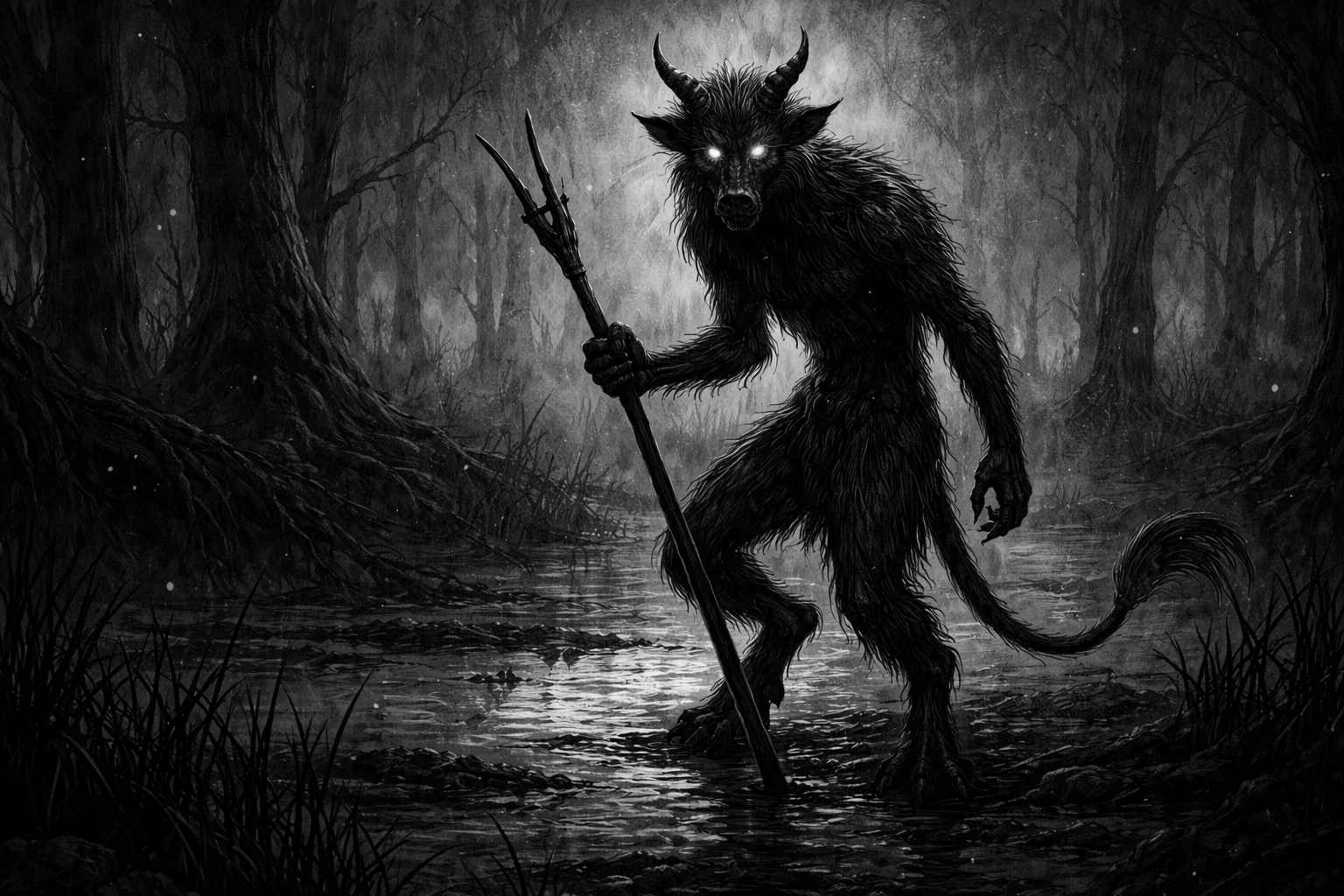
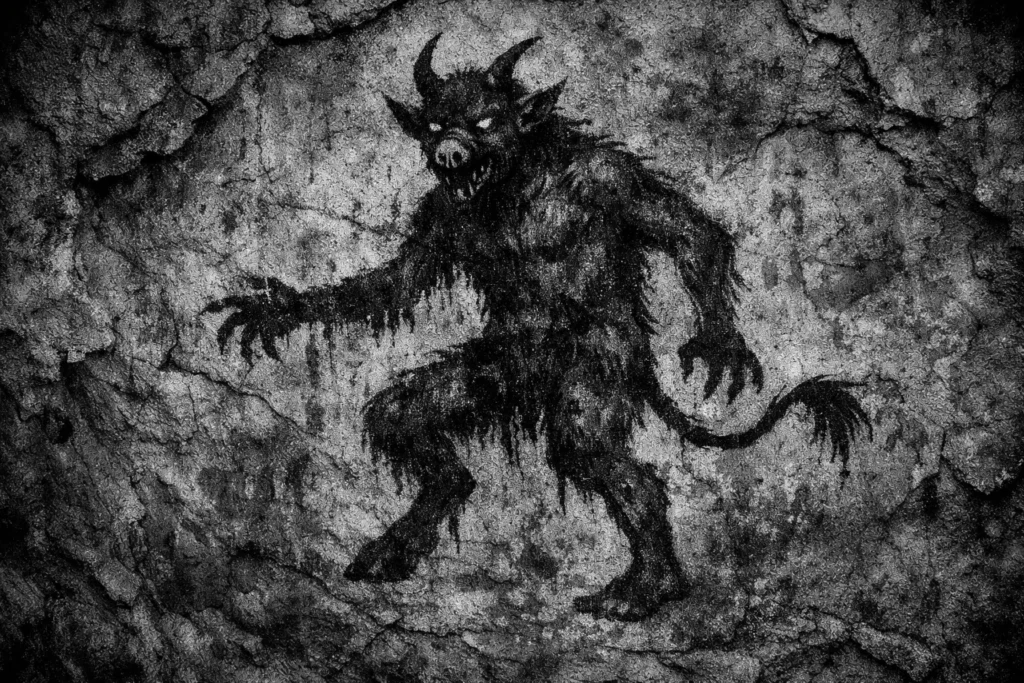
The Chort’s look is unique and has shaped how people in Eastern Europe picture the devil today. It is usually described as being covered in thick black or dark brown fur, with two small, sharp horns and pointed ears on its head. One of its main features is a pig-like snout instead of a human nose.
The Chort’s arms and legs are part human and part animal. It usually has cloven hooves instead of feet, though some stories say it has one hoof and one human foot. It also has a long, thin tail with a tuft of hair at the end, which it tries to hide under clothes when pretending to be human.
Its eyes are often said to glow like hot coals or look yellow. The Chort can turn into a black cat, a black dog, or even a good-looking man, but its true form is a thin, wiry creature that looks like a goat standing on its hind legs.
Enemies, Rivals, and Allies
The Chort’s main enemies are angels and saints, especially St. George and St. Nicholas, who are often shown outsmarting or punishing it. In older pagan stories, the Chort often fought with Perun, the thunder god, who would chase it with lightning as the Chort tried to hide in trees or under rocks.
The Chort often rivals other spirits, such as the Leshy (forest spirit) and the Vodianoy (water spirit). Folk tales sometimes show Chorti gambling with these spirits, betting human souls or even the weather. Its usual allies are witches and sorcerers, making deals where the Chort gives magic or secret knowledge in return for a soul or some “unclean” task.
Connections to Other Ancient Demons
| Name | Genealogy | Type | Appearance |
| Pazuzu | Babylonian | Wind Demon | Human body, lion head, wings, scorpion tail |
| Lamashtu | Sumerian | Child-snatching Demon | Hairy body, lioness head, donkey teeth, long fingers |
| Apep | Egyptian | Chaos Serpent | Massive, coiled snake |
| Jörmungandr | Norse | World Serpent | Sea serpent large enough to encircle Midgard |
| Rakshasa | Hindu | Shapeshifting Man-eater | Fanged, clawed, often with vertical eyes |
| Krampus | Alpine | Yuletide Punisher | Hairy, horned, cloven hooves, long tongue |
| Asmodeus | Abrahamic | Prince of Lust | Three heads (bull, man, ram), goose feet, riding a dragon |
| Ghul | Arabian | Graveyard Dweller | Hairy, anthropomorphic, often hyena-like |
| Oni | Japanese | Ogre-demon | Red or blue skin, horns, carrying a club |
| Ahriman | Persian | Spirit of Darkness | Often formless or a lizard/serpent |
You may also enjoy:
Aim (Aym): The Great Duke of Hell in the Ars Goetia
November 11, 2025
Who Is Taṇhā, the Seductive Demon of Craving in Buddhist Mythology?
October 15, 2025
Abura-akago: The Oil-Licking Demon Baby
October 22, 2025
Who Is Shiva, the Destroyer and the Lord of the Universe?
November 12, 2025
Chort: The Sinister Slavic Demon of Chaos and Bad Luck
March 10, 2026
Bakeneko: A Supernatural Cat Yōkai in Japanese Folklore
January 27, 2026
Chort Myths, Legends, and Stories
The Chort and the Blacksmith
In a well-known story, a blacksmith painted a picture of the Chort being beaten by St. Peter on a church wall. This angered a local Chort, so it decided to bother the blacksmith. The demon disguised itself as a young apprentice and helped in the shop, working with supernatural speed.
But the Chort tricked the blacksmith into trying to “reforge” an old woman to make her young again, almost killing her. The blacksmith realized who the apprentice really was when he saw a cloven hoof sticking out of his boot.
He trapped the Chort in a small iron box and hammered it on his anvil until the demon begged for mercy and promised to leave the forge alone.
The Devil’s Bridge
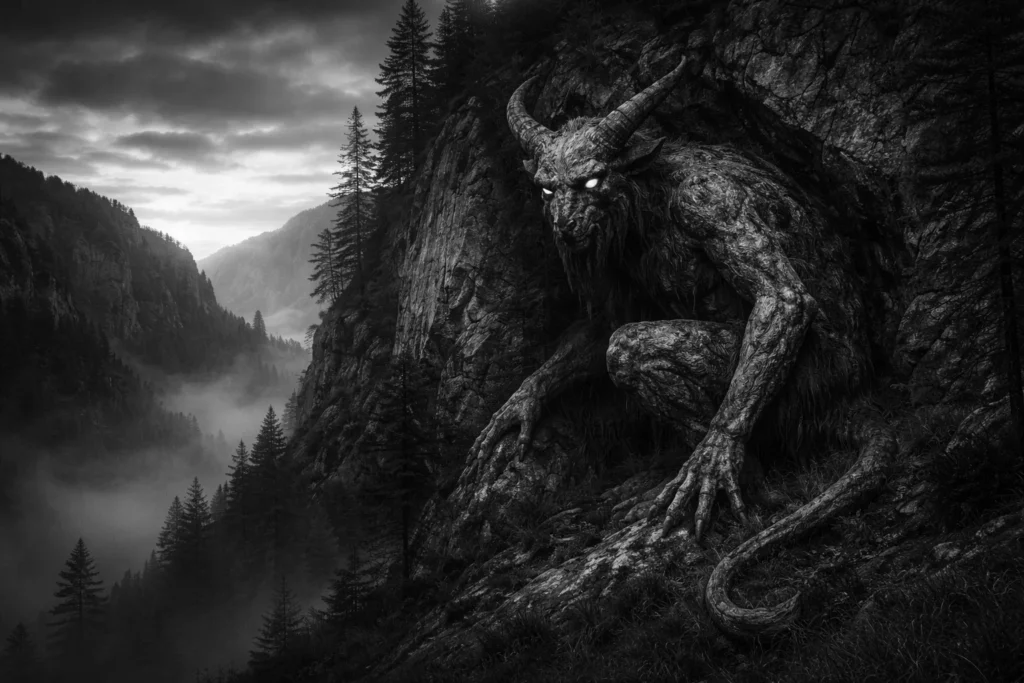
In many Slavic mountain areas, there are stories about “Chort’s Bridges.” Often, a village needs a bridge over a dangerous ravine. A Chort shows up and offers to build it in one night, but asks for the soul of the first living thing to cross. The villagers agree, but when the bridge is finished, they send a black dog or a goat across first, rather than a person.
The Chort, angry at being tricked by the villagers, tries to destroy the bridge. But the first sunlight or the sound of a church bell freezes him or turns him to stone.
Chort Powers and Abilities
The Chort can change its shape and is skilled at tricking people’s minds. It is not as powerful as a god, but it can affect the real world through small miracles and illusions. It is strong enough to carry people through the air and can move very fast.
- Metamorphosis: The ability to transform into animals (cats, pigs, wolves) or specific human beings to deceive targets.
- Invisibility: The power to remain unseen while whispering into a person’s ear to incite anger or lust.
- Teleportation: Moving instantly between the human world and the underworld or “unclean” places.
- Materialization: Summoning gold, food, or alcohol, though these items often turn into dry leaves or dung after the Chort leaves.
- Environmental Manipulation: Causing sudden localized storms, whirlwinds, or making travelers lose their way in familiar woods.
SPEAK THEIR TRUE NAMES… IF YOU DARE
Limited-Time: Up to 40% OFF!
Over 1,700+ demons – true names, ranks, infernal seals, powers & forbidden histories. The expanded & revised masterpiece by occult legend Michelle Belanger. Now with 200+ new entities, dozens of never-before-seen illustrations from ancient grimoires. The ultimate arsenal for demonologists, magicians, and the deliciously curious.
Rituals, Amulets, and Protective Practices
Ancient and medieval Slavs used many ways to protect themselves from the Chort. These methods aimed to keep the “clean” human soul safe from the demon’s “unclean” influence. People often used fire, iron, and strong-smelling herbs in rituals to drive the Chort away.
Incantations and Ceremonies
People used special words to “bind” or “banish” the Chort, often whispered by village healers or elders. A common method was to draw a circle in the dirt with a silver knife and say a protective chant:
“Chort, Chort, go to the deep bog
Where the sun does not shine
Where the wind does not blow
Where the cock does not crow.
Salt in your eyes, a stone in your teeth.
Leave this servant of God in peace.”
Amulets and Talismans
The most common way to protect against a Chort was to carry a small piece of iron, like a horseshoe or a nail, since spirits were thought to fear metal. Wormwood was the main herb used; people hung it over doors or wore it in their belts because the smell was said to drive the Chort away.
After people became Christian, the pectoral cross became the most important charm, often used with “Thursday’s salt” (salt blessed on Maundy Thursday), which was believed to burn the Chort’s skin.
You may also enjoy:
Vritra: The Dragon Who Swallowed the Sky in Hindu Mythology
October 7, 2025
Who Is Asmodeus in Demonology and the Bible?
February 18, 2026
What Is the Abumi-guchi Yōkai and Why Does It Wait Forever?
October 22, 2025
Who Is Agaliarept, the General of Hell Under Lucifer?
October 8, 2025
Palis: The Foot-Licking Desert Jinn That Drinks Your Blood
December 3, 2025
Erinyes: The Chthonic Goddesses Who Enforced Blood-Guilt
November 20, 2025
Frequently Asked Questions
What is the difference between a Chort and a Bies?
Today, people often use the words Chort and Bies to mean the same thing, but in the past, Bies was seen as an older spirit of pure rage and evil. The Chort is usually shown as a physical trickster with goat-like features who makes deals and plays tricks on people, while the Bies is more like an invisible force that causes madness.
Can a Chort be tamed or used as a servant?
In some Slavic traditions, especially in Ukrainian stories, a Chort can be tamed or bought from a powerful sorcerer called a Molfar. Once it is tied to a household, it is called a Khovanets (the hidden one). It does chores and brings wealth, but it can be moody and may cause trouble if upset.
Does the Chort have any connection to the Witcher series?
The Chort appears as a monster in The Witcher universe, shown as a strong, forest-dwelling creature called a “relict.” In the game, it looks more like a beast and less like the human-like trickster from old myths, but it keeps the name and its link to the wild, “unclean” places of Slavic folklore.
What are the most common Slavic idioms involving the Chort?
The Chort is a big part of the Slavic language, showing up in many curses and sayings. For example, “Chort poberi!” means “May the Chort take it!” and is used when someone is very frustrated. “Chort poputal” means “The Chort led me astray” and is used to explain a sudden mistake or lapse in judgment.
What is the relationship between the Chort and Chernobog?
In some modern versions of Slavic paganism, the Chort is seen as the son of Chernobog (the Black God) and Mara (the goddess of death). In this system, the Chort works for these powerful gods by spreading bad luck and collecting souls in the human world.
