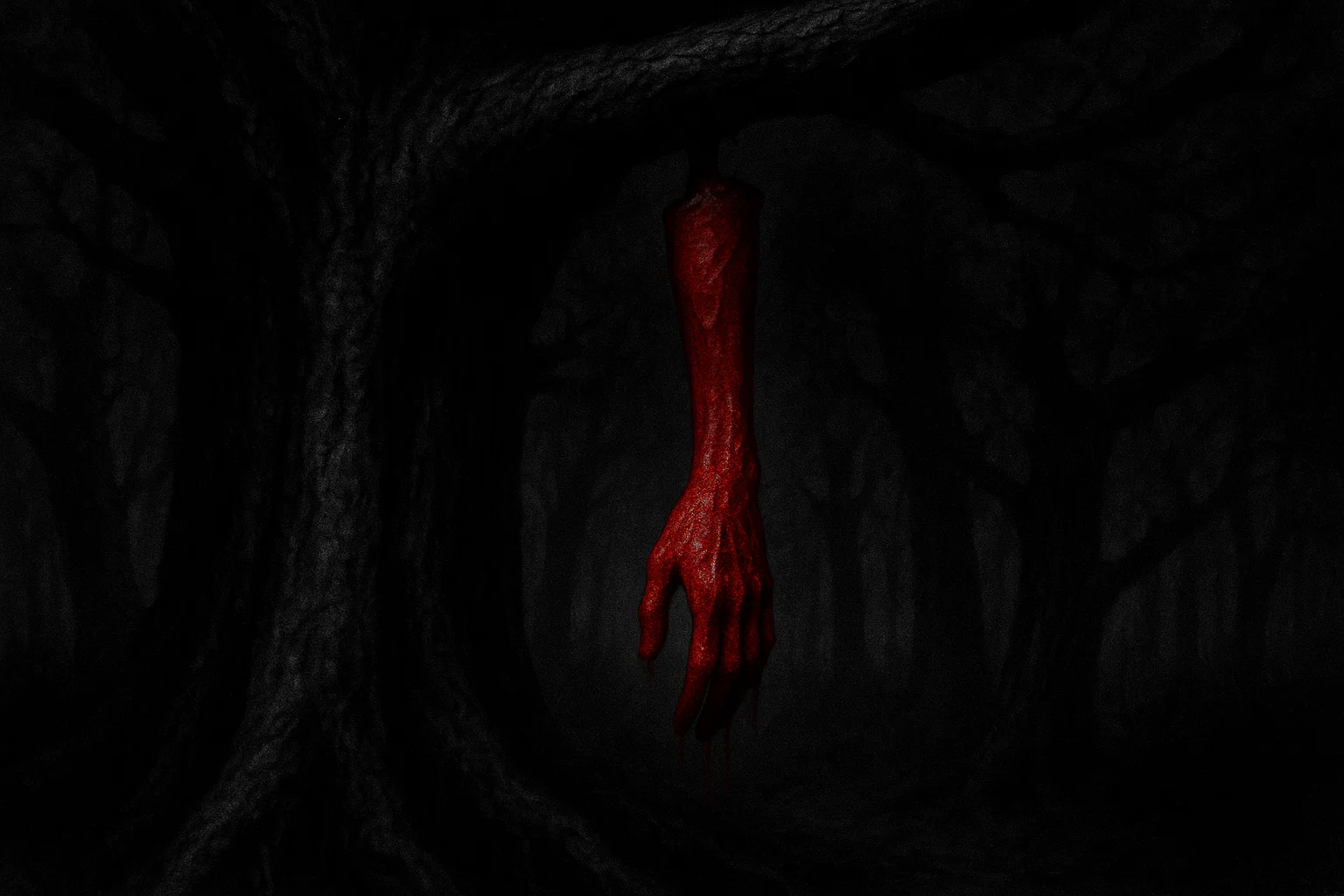

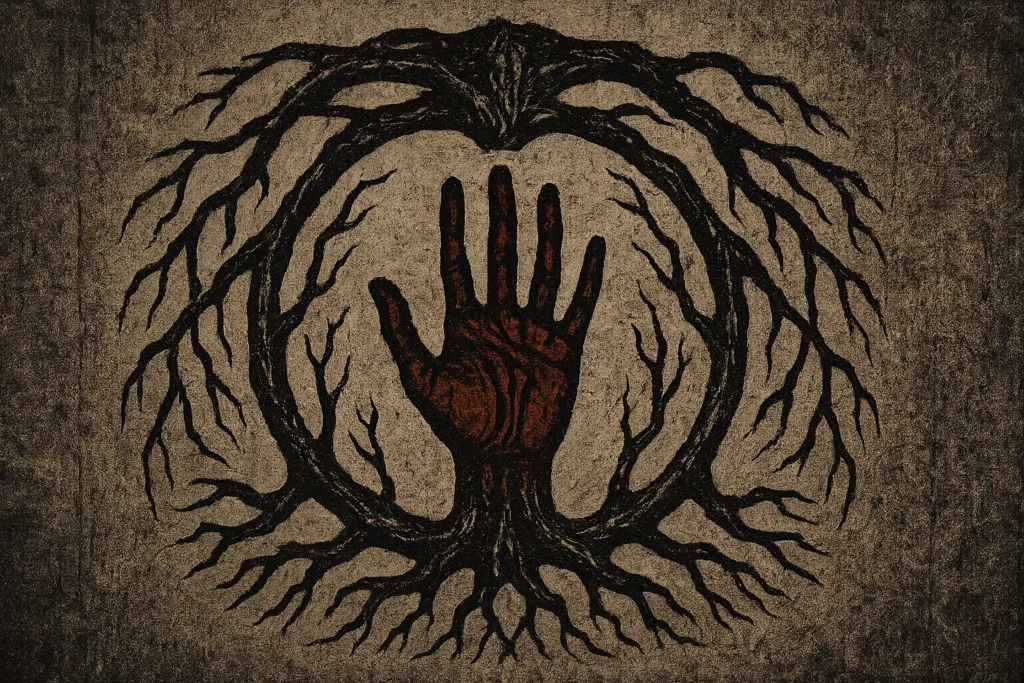
Akateko is a malevolent yōkai in Japanese folklore. The spirit is predominantly depicted as a supernatural entity that manifests as a severed, red, blood-covered human arm or hand.
This terrifying monster is largely localized to the Kōchi and Fukushima prefectures. Its most notable stories and legends originate from a specific kaya tree near the Kanzeon-ji Temple in the town of Inawashiro, Fukushima.
The legends surrounding Akateko describe it primarily as a creature of ambush and subtle terror. Seeing the creature is an omen or an immediate threat to those who trespass on its chosen habitat.
Summary
Key Takeaways
| Attribute | Details |
| Names | Akateko (赤手児), Akate (赤手) |
| Translation | The Red Hand Child or Red Hand |
| Title | The Red Hand of the Kanzeon-ji (due to its most famous location) |
| Type | Yōkai, specifically a type of obake (a shapeshifting or grotesque spirit) |
| Origin | The spirit of a person who died by hanging in a specific tree, or a localized nature spirit (kami) corrupted by malice |
| Gender | Ambiguous, typically represented solely as a disembodied limb |
| Appearance | A disembodied human hand or arm, notably stained or completely red |
| Powers/Abilities | Ambushing and striking victims with its strength, sudden manifestations, and producing an eerie, childlike cry |
| Weaknesses | Protection offered by Shinto or Buddhist charms (implied by its temple location) |
| Habitat | Specific trees, particularly old, large trees near temples or schools, or in the upper branches of specific trees |
| Diet/Prey | Humans, especially those who walk alone or at night |
| Symbolic Item | None |
| Symbolism | The fear of unseen dangers in the natural world, the consequence of trespassing on sacred or cursed ground |
| Sources | Tōhoku Kaidan no Tabi, Inawashiro-machi-shi (History of Inawashiro Town) |
Who or What is Akateko?
Akateko (赤手児) is a Japanese yōkai known almost exclusively for its singular, terrifying feature: a crimson-colored, disembodied hand or forearm. The name, translating to “Red Hand Child” or “Red Hand,” is highly indicative of its appearance.
Unlike yūrei (ghosts), which possess a full, though ethereal, human form, this creature is classified as an obake—an umbrella term for entities that often assume grotesque or unnatural physical forms.
This yōkai is documented in the folklore of various regions, most prominently in Fukushima Prefecture, where it is associated with a specific, massive kaya (Japanese Torreya) tree near the Kanzeon-ji temple.
It is here that Akateko’s legend grew: it allegedly waits unseen in the upper branches, dropping down or extending its arm to strike at victims below. In some accounts, before the arm itself appears, the unsuspecting victim hears an unsettling sound resembling a child’s cry or giggle.
The entity acts as a formidable, localized guardian of a cursed spot, instilling dread in those who pass by.
“Akateko” Meaning
The name Akateko (赤手児) provides a direct, literal description of the entity. The name is composed of three kanji characters: 赤 (aka), meaning red or crimson; 手 (te), meaning hand or arm; and 児 (ko), meaning child or young one.
The primary translation is thus The Red Hand Child. The element, aka (red), is crucial, as the color in Japanese folklore can symbolize many concepts, including blood, life, death, and powerful protective or malevolent forces.
In Akateko’s case, the color red strongly suggests blood or a deeply unsettling, unnatural vitality. The most commonly accepted origin for the red color is the unnatural state of the spirit itself, possibly resulting from a violent death, such as hanging, where blood pools or the skin becomes unnaturally flushed.
The final character, ko (児), meaning child, is perhaps the most ambiguous part of the name. It could refer to the arm’s size (suggesting a small, childlike limb) or to the childlike wailing sound sometimes associated with its appearance.
However, some variants drop the ko character, resulting in the simpler Akate (赤手, Red Hand), which is sometimes used as an alternate name for the entity, particularly in the Kōchi Prefecture, where its legends are less developed than in Fukushima.
Historically, the name’s simple descriptive quality suggests a local folklore origin, likely not dating back to classical literature but rather emerging from Edo- or Meiji-period regional ghost story collections (kaidan).
How to Pronounce “Akateko” in English
The name Akateko is pronounced with four syllables: Ah-kah-teh-koh.
The emphasis is generally placed on the second syllable (kah). The pronunciation of the ‘A’s is similar to the ‘a’ in father, the ‘E’ is like the ‘e’ in get, and the ‘O’ is like the ‘o’ in go. A common phonetic guide is ‘ah-KAH-teh-koh’.
What Does Akateko Look Like?
The creature is described as a severed human hand or forearm. However, the color is its most striking attribute.
In most stories, the yōkai is portrayed as having a deep, vibrant red or crimson. This coloration is not that of a typical, healthy hand. Instead, it is often compared to a bloodstain or the intense flushing of skin due to trauma. Its texture (or skin condition) is generally not detailed in the sources. However, the hand is implied to have an unsettling yet distinctly human anatomy.
Interestingly, while the entity is named “Red Hand Child,” descriptions do not consistently mandate that the hand be small or childlike. In the most famous Fukushima account, the arm is implied to be strong enough to strike or grasp adult victims with significant force, implying a size equivalent to an adult or adolescent arm.
Crucially, the hand lacks any connection to a visible body. It simply is a hand or forearm that appears, often dangling from a high branch, extending from a dark place, or dropping suddenly onto a victim.
Unlike yūrei, which are defined by their pale, spectral quality, Akateko is characterized by its solid, physical red color, which lends it a more obake-like and material presence, making the threat feel immediate and physical rather than purely spiritual.
In some narratives, the red color is stated to be blood itself, staining the limb of a vengeful ghost.
You may also enjoy:
Hariti: The Demon Mother Who Fed on Children at Night
December 8, 2025
Who Is the Demon Andras, The Great Marquis of Discord?
January 15, 2026
Who Is Taṇhā, the Seductive Demon of Craving in Buddhist Mythology?
October 15, 2025
Vritra: The Dragon Who Swallowed the Sky in Hindu Mythology
October 7, 2025
What Is the Akkorokamui, Japan’s Colossal Sea Monster?
November 14, 2025
Tarakasura: The Dark Demon Who Ruled Hell on Earth
December 4, 2025
Habitat
Akateko’s habitat is overwhelmingly localized and tied to specific, prominent natural features. The most famous and well-documented location is a massive kaya tree (kaya no ki) that stood near Kanzeon-ji Temple in the town of Inawashiro, Fukushima Prefecture.
This preference for specific, solitary, and often ancient trees comes from the entity’s supposed origins as a spirit bound to the location, often by a tragic event like suicide or a hanging execution.
The tree itself becomes a supernatural beacon and anchor for the malignant spirit. Such ancient, solitary trees are often revered or feared in Japan, as they are sometimes believed to be homes for kami (gods) or to be naturally cursed, making them dangerous thresholds between the human world and the spiritual realm.
Folklore suggests that Akateko lives in the upper canopy or the dense branches of its chosen tree. This high vantage point keeps it out of human eyes on the ground. It also allows it to ambush its victims by dropping down or suddenly extending its arm.
The location, near a Buddhist temple, is also important. Temples are often erected on sites believed to have strong spiritual energy or to pacify restless spirits. In Akateko’s case, the proximity of the temple to the creature’s lair shows the yōkai’s power, suggesting that even sacred ground cannot fully dispel its malevolent influence.
In other, less detailed accounts from regions like Kōchi, Akateko is simply associated with dark, lonely roads or the eaves of old, abandoned houses, but the specific tree association in Fukushima remains the primary and most descriptive habitat detail.
Origins and History
The historical context of Akateko firmly places its origins in regional, localized folklore, likely emerging during the Edo Period (1603–1868) and formally documented in the Meiji and Shōwa eras. Unlike major yōkai like the Tengu or Kappa, Akateko does not appear in classical Japanese texts such as the Kojiki or the Nihon Shoki.
The most influential and descriptive accounts of Akateko are found in the Fukushima Prefecture, particularly around the Kanzeon-ji Temple in Inawashiro. The primary origin story holds that the Akateko is the vengeful spirit of an individual who committed suicide or was executed by hanging in the massive kaya tree.
In Japanese folk belief, a death by hanging is considered particularly tragic and “unclean,” often leading to the creation of a powerful, tethered yūrei whose suffering binds them to the location. The arm or hand may be the only part of the spirit that retains a solid, physical form, or it may be the primary tool through which the spirit attacks.
Another interpretation suggests Akateko is a corrupted kami (a local protective deity or nature spirit).
In pre-modern Japan, large, ancient trees were often revered as shintai (vessels for spirits). If such a spirit were slighted, forgotten, or displaced, it could transform into a malevolent yōkai, acting out of a defensive or aggressive territorial impulse. The color red could symbolize the ancient, primordial power of nature itself, stained by a dark, vengeful purpose.
The yōkai’s presence in regional kaidan (ghost story) compilations, such as the Tōhoku Kaidan no Tabi, suggests a common function in oral tradition: a simple cautionary tale used to deter children or travelers from venturing too close to specific, dangerous landmarks, like an old, dark tree near a sacred site.
Its localized nature means it was not subject to the broad religious or political shifts that influenced major yōkai like the Oni, but rather remained a stable, local threat tied to a fixed geographical point.
Sources
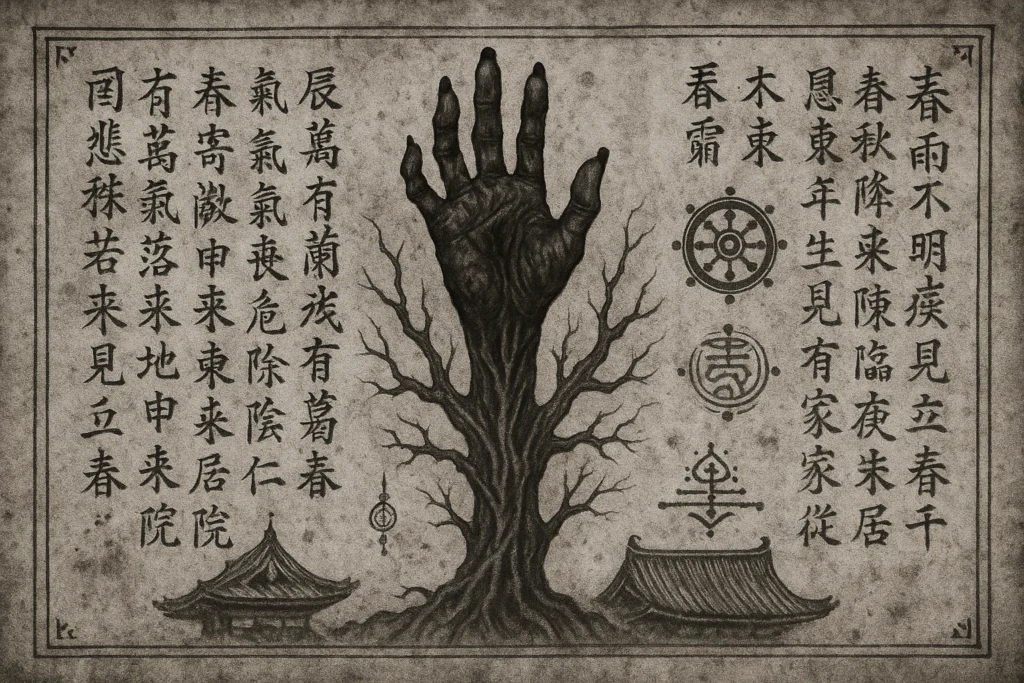
Akateko’s mentions are predominantly found in regional folklore collections and historical town records rather than classical national texts.
| Source | Quote |
| Inawashiro-machi-shi (History of Inawashiro Town) | “…Inawashiro machi no Kanzeonji-mae no kaya no ki ni wa, akai te ga dete hito wo toru to iwareta…” (…It was said that a red hand would appear from the kaya tree in front of Kanzeon-ji in Inawashiro town and grab people…) |
| Tōhoku Kaidan no Tabi (Travels with Ghost Stories of Tōhoku) | “Akateko wa Kanzeonji-mae no kaya no ki no ue ni sumi, shita o tōru hito ni mukatte akai te o tarashi, “akateko, akateko” to sakenda…” (Akateko lived in the upper part of the kaya tree in front of Kanzeon-ji, and would dangle a red hand toward people passing below, screaming “Akateko, Akateko”…) |
| Tōno Monogatari (Legends of Tōno, by Kunio Yanagita) | Akateko is not mentioned in this definitive work of Tōhoku folklore, which suggests its legend was not widely known outside of specific localities, even within the same region, during the early 20th century. |
Famous Akateko Legends and Stories
The Red Hand of Kanzeon-ji
The most prominent and detailed story of Akateko is intrinsically linked to its “home”, the ancient, towering kaya tree situated directly in front of the Kanzeon-ji Temple gate in Inawashiro, Fukushima.
The legend recounts that the spirit resided in the dense, high branches of this particular kaya tree. Locals and travelers who approached the tree, especially after twilight, were often warned not to pass directly beneath it.
According to the accounts, as an unsuspecting person walked beneath the dark canopy, they would first hear an unsettling, high-pitched noise, often described as a faint “kyah-kyah” sound, resembling the unnatural cry or giggle of a small child. This sound served as the preliminary signal of the yōkai’s presence.
Immediately following the sound, the creature would manifest. A vibrant crimson-red hand or forearm would abruptly drop or extend itself out of the gloom of the branches.
The hand’s intent was unequivocally hostile. It would lash out, attempting to violently strike, clutch, or even drag the victim up into the tree. The arm possessed surprising strength and mobility, despite being detached from a body.
Many accounts stress the sheer terror of this sudden, silent attack from above, where a disembodied red hand was the only physical assailant. Those who managed to escape were often left deeply traumatized by the sight of the bloody-colored limb and the uncanny, high-pitched sound.
The fear of this entity was so profound that even after the legendary tree was eventually felled, the memory and warnings against the site persisted among the townspeople.
The Attack at the Schoolhouse
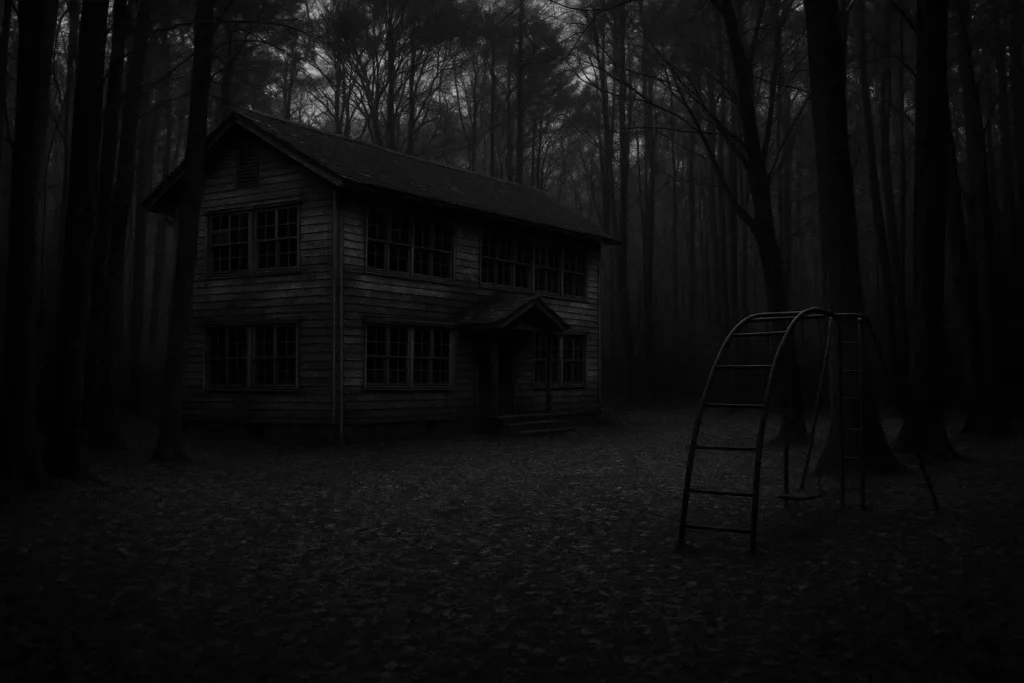
A lesser-known, regional variation of the Akateko myth links the yōkai not only to the temple grounds but also to an old, wooded area surrounding a village schoolhouse. In this version, Akateko targeted children, playing on the shared anxiety about children being lured into danger.
The story tells of students at an old school who were strictly forbidden from playing near a particular grove of large trees at the edge of the schoolyard. It was said that if a student wandered too close to the woods, a childlike voice would call their name, taunting or inviting them. If the child paused or responded, a single, bare, blood-red hand would swiftly shoot out from the shadow of the leaves.
Unlike the temple legend, which focused on striking or grabbing, this version emphasized psychological terror. The hand would reportedly tap on the child’s shoulder or lightly brush their cheek before retracting at high speed, leaving the victim in a state of shock, marked by the momentary touch of the ice-cold, crimson limb.
These children would often become ill or suffer from debilitating nightmares, suggesting the attack was part physical and part spiritual contamination.
You may also enjoy:
Lamashtu, the Mesopotamian Demoness of Childbirth and Infant Death
November 4, 2025
Setcheh: Egypt’s Soul-Stealing Ancient Demon
November 11, 2025
What Is Jorōgumo? The Deadly Spider Woman of Japanese Myth
February 2, 2026
Who Is Abaddon, the Demon of the Abyss, in the Bible?
September 29, 2025
What Is a Rakshasa? Meaning, Origins, and Dark Powers
January 23, 2026
Erinyes: The Chthonic Goddesses Who Enforced Blood-Guilt
November 20, 2025
Akateko Powers and Abilities
Akateko is a highly specialized yōkai whose powers are focused almost entirely on ambush and physical assault from its specific habitat. Its strength lies in the unexpected, sudden nature of its manifestation and its unnerving appearance.
Compared to powerful, shapeshifting yōkai like the Kitsune or the elemental force of the Raijū, Akateko is a low-tier, localized threat. Nevertheless, its power is absolute within the narrow confines of its territory. Its strength is physical and immediate, rather than manipulative or widespread.
The core of this yōkai‘s power is its ability to be partially corporeal and partially ethereal, allowing a disembodied limb to strike with significant, unnatural force.
Powers and abilities include:
- Sudden Manifestation/Retraction: The yōkai’s primary power is the ability to instantaneously manifest a fully red, seemingly solid arm or hand from the darkness of a high branch, and to retract it just as quickly.
- Physical Force: The arm is strong enough to effectively strike, grab, or attempt to lift an adult human, making its attacks physically dangerous.
- Vocal Lure/Omen: Akateko can produce an unsettling sound resembling a child’s cry or giggle (“kyah-kyah”), which serves as an auditory prelude to its physical attack, increasing the psychological terror.
- Geographical Binding: Akateko’s spirit is powerfully bound to a specific location (e.g., the kaya tree), allowing it to wield its power over a fixed, territorial space.
How to Defend Against Akateko
According to the specific folklore surrounding Akateko, defenses are implicitly and explicitly tied to avoiding its habitat and invoking religious protection. Because the yōkai is so tied to a single location (the Kanzeon-ji tree), the most effective and primary defense is strict avoidance of the cursed area, especially at night.
Akateko’s weaknesses are not well-documented in terms of complex rituals, but rather fall into standard yōkai countermeasures. Since its most famous location is directly adjacent to a Buddhist temple, it is strongly implied that the creature is repelled or contained by the spiritual power of sacred religious items.
Alleged effective defensive measures include:
- Carrying Ofuda: Having several Shinto or Buddhist charms (ofuda), which are paper talismans inscribed with sacred script. Since the yōkai is hostile yet localized near a temple, these charms would, in theory, create a personal barrier against its malicious spiritual energy.
- Reciting Sutras or Prayers: The chanting of Buddhist sutras or Shinto prayers (norito) is a common protection against yōkai and yūrei, and would be a logical defense against a spirit haunting temple grounds.
- Direct Evasion: If the cry is heard, the lore suggests the best immediate defense is to run away as fast as possible without looking up, as the yōkai’s attack requires it to drop or extend its limb to strike.
Akateko’s weakness is its fixed location. Moving away from its specific tree or area of influence immediately removes the person from danger, as the yōkai is powerless outside of its territory.
Akateko vs Other Yōkai
| Name | Category of Yōkai | Origin | Threat Level | Escape Difficulty |
| Tenjō-name | Tsukumogami / Obake | Malign spirit of a ceiling brush, often unseen | Low | Easy: Causes only cosmetic damage and messes, not physical harm. |
| Nuppepo | Obake | Reanimated corpse or slab of flesh left to rot | Low to Medium | Easy: Slow-moving and often just stares; difficult only due to shock. |
| Ao-andon | Yūrei / Obake | Fear generated by a group telling 100 ghost stories | Medium | Medium: Difficult, as it attacks psychologically and is fear-based, but can be stopped by breaking the tradition. |
| Hone-Onna | Yūrei / Onryō | Spirit of a beautiful woman who died of a broken heart | Medium | Medium: Difficult, as it lures victims by seduction; escape requires spiritual conviction. |
| Jorōgumo | Henge (Shapeshifter) | Large spider that lived for 400 years and gained magical powers | High | Difficult: Lures and traps victims in remote, watery habitats with cunning and webs. |
| Taka-onna | Obake | Spirit of a jealous woman who can stretch her body to look into houses | Medium | Easy: Avoids direct confrontation; mostly a voyeuristic, frightening presence. |
| Kappa | Yōkai / Suijin | Amphibious creature, often considered a corrupted water deity | High | Difficult: Physically strong, habitat is hard to escape (water); requires trickery (bowing). |
| Yamauba | Oni / Obake | Elderly, cannibalistic mountain hag | High | Difficult: Possesses powerful magic and immense strength; attacks in a remote, dangerous habitat. |
| Gashadokuro | Yūrei / Goryō | Giant skeletal spirit formed from the bones of starved dead | High | Medium: Difficult to fight physically due to size; victims can often hear a bell ringing before its appearance. |
| Nopperabō | Obake | Creature that appears human but has no face | Low | Easy: Causes extreme fear but lacks physical means to harm; victims usually escape in terror. |
Symbolism
| Attribute | Details |
| Element | Earth (due to binding to a massive tree) |
| Animal | None |
| Cardinal Direction | North (Fukushima is in the Tohoku region of Northern Japan) |
| Color | Crimson Red |
| Plant | Kaya Tree (Japanese Torreya) |
| Season | Autumn/Winter (associated with darkness, cold, and lonely roads) |
| Symbolic Item | None |
Akateko functions primarily as a symbol of immediate, visceral, and territorial danger in Japanese culture. Unlike yōkai that embody broad philosophical concepts (like Kitsune representing duality or Tengu representing fallen pride), Akateko is a specific, potent embodiment of a cursed place.
The entity’s strict binding to a single, localized area—such as the kaya tree—reflects the traditional Japanese belief that nature’s energy, when disturbed or corrupted, can manifest as a terrifying, physical threat.
The Crimson Red color is crucial to its symbolism. Red, in this context, does not signify the protective nature of torii gates but rather unnatural vitality, fresh blood, and a death by violence.
The severed arm suggests a fragmented or incomplete spirit, one whose rage and pain are so great that only the striking part of its body remains to act out its trauma.
Akateko serves as a powerful cautionary figure in local folklore, a warning to children and travelers about the consequences of trespassing or disrespecting specific, potentially sacred and malevolent, landmarks within the natural environment. Its simple, terrifying image requires no complex cultural interpretation, making it an effective instrument of localized social control.
You may also enjoy:
Azhi Dahaka: The Three-Headed Dragon of Zoroastrian Mythology
January 14, 2026
Mara: The Buddhist Demon King of Desire and Death
October 13, 2025
Who Is the Infernal King Balam? Origins, Powers, and Occult History
February 26, 2026
Al-Ahmar: The Tuesday King of the Seven Jinn
February 13, 2026
Bakeneko: A Supernatural Cat Yōkai in Japanese Folklore
January 27, 2026
Kuchisake-onna: Folklore, Origins, and Urban Legend History
February 10, 2026
Frequently Asked Questions
Is the Akateko part of modern Japanese pop culture or just old folklore?
While the Akateko originates from localized Edo/Meiji-era folklore in regions like Fukushima, it has been included in modern yōkai encyclopedias, games, and media since the late 20th century. Its simple, graphic appearance (the disembodied red hand) makes it a popular and visually distinct entity for inclusion in comprehensive bestiaries, ensuring its continued relevance beyond its original village tales.
Are there any similar “severed limb” yōkai to the Akateko in Japanese mythology?
Yes, the concept of a disembodied limb is rare but not unique. A somewhat similar entity is the Te-no-me (Eye Hand), a blind spirit with eyes on its palms that chases people in desolate areas. However, unlike the Akateko (a simple arm), the Te-no-me is a full skeletal humanoid body. The Akateko remains unique in its specific focus on a single, red, detached arm that drops from above.
What happens if the Akateko actually grabs you?
According to the legends of Inawashiro, the Akateko’s purpose is to violently drag the victim up into the branches of its tree, presumably to kill or consume them. However, the exact fate is usually left ambiguous. Those who escaped its grip reported severe trauma, injury, and subsequent illness, suggesting the grip itself is incredibly strong and potentially tainted with malignant spiritual energy.
Was the famous kaya tree associated with Akateko ever cut down?
Yes. The legendary ancient kaya tree (Japanese Torreya) near the Kanzeon-ji Temple in Inawashiro, Fukushima, which was the Akateko’s primary habitat, was reportedly cut down due to road construction or concerns about its stability and danger. The legend states that although the tree is gone, the area remains spiritually unsettling, indicating that the spirit may still linger near the site of its binding.
Is the Akateko related to the urban legend of the Teke Teke?
No, the Akateko and the Teke Teke are entirely distinct entities. Akateko is a localized yōkai (obake) from the Edo/Meiji period, consisting solely of a red, disembodied arm. The Teke Teke is a much more recent, post-war urban legend (a yūrei), typically described as the vengeful spirit of a woman severed at the torso, who moves rapidly on her elbows, making a teke teke sound.
