
Arioch is a powerful demon in Judeo-Christian and occult traditions, often depicted as a fallen angel or an entity associated with vengeance and destruction. Although he does not appear among the 72 spirits of the Ars Goetia, earlier biblical apocrypha and later 19th-century writings mention him. He is mainly known as a spirit of war and retribution.
Summary
Key Takeaways
| Attribute | Details |
| Names | Arioch, Erioch, Arioc |
| Title | Demon of Vengeance, Duke of the Empire of Darkness |
| Gender | Male |
| Role | Executing vengeance, inciting military conflict, and acting as a destroyer |
| Rank | One of the fallen angels; occasionally cited as a Duke of Hell |
| Hierarchy | Served under Satan or Belial in various traditions; mentioned as a peer to other fallen Watchers |
| Legions | None specified in traditional grimoires |
| Powers | Granting the power of retribution, inciting bloodlust, and providing tactical military knowledge |
| Associated Figures | King Nebuchadnezzar, Nimrod, the Archangel Michael (as an adversary) |
| Weaknesses | Divine command, the presence of the Archangel Michael, and specific invocations of the Tetragrammaton |
| Opposing Angel/Saint | Archangel Michael |
| Pantheon | Christian and Jewish Apocrypha |
| Primary Sources | The Book of Genesis, The Book of Daniel, Paradise Lost, Dictionnaire Infernal |
Who or What is Arioch?
Arioch’s identity changes depending on the source. Sometimes he is a historical king, while in Christian demonology, he is seen as a fallen angel who sided with Lucifer during the rebellion in Heaven.
Unlike many demons who are linked to specific sins such as gluttony or lust, Arioch is mainly connected to vengeance. He represents “The Vengeful One,” serving as an executioner for those who want to settle scores through violence or supernatural means.
In literature and occult traditions, Arioch is usually shown as a dark, brooding spirit of war. He connects the ancient Mesopotamian world with medieval European occult beliefs. Instead of tempting people with physical desires, he corrupts the spirit by encouraging the pursuit of so-called justified violence.
THE BOOK THEY BANNED FROM THE BIBLE Limited-Time: Up to 90% OFF!
Why was Enoch removed? The fallen Watchers • The birth of the Nephilim • Origin of demons • Names of the angels who became demons • Apocalyptic visions. The original source text that inspired all demonology. Read the apocalyptic visions the church didn’t want you to see.
“Arioch” Meaning
The name Arioch comes from ancient Semitic languages. It is usually traced to the Hebrew’ Aryōk, which likely comes from the Sumerian name Eri-Aku, meaning “Servant of the Moon God” (Nanna/Sin). Historically, this name was used for kings of Larsa, like Rim-Sin I, who lived at the same time as Hammurabi.
As the name moved into Jewish and later Christian beliefs, its meaning changed from a royal title to a term for a demon. Some scholars also think it could come from the Hebrew word’ ari, meaning lion, so it might mean “Lion-like.” This change in meaning shows how Arioch came to be seen as a fierce, predatory entity.
In the Sibylline Oracles, the name Arioch refers to a spirit of destruction, stripping him of any royal or human qualities and making him purely evil. In different texts, the name stays mostly the same, with only small changes in spelling, such as Erioch.
How to Pronounce “Arioch” in English
In English, Arioch is usually pronounced as AIR-ee-ok or AR-ee-ok. The first part sounds like “care” or “car,” and the “ch” at the end is pronounced as a hard “k,” following the way it is written in Hebrew in the Bible.
What Does Arioch Look Like?
Descriptions of Arioch differ a lot depending on the source. In classic occult books like Collin de Plancy’s Dictionnaire Infernal, he is not usually given a monstrous form, unlike many Goetic spirits. Instead, he is often imagined as a rough, armored warrior.
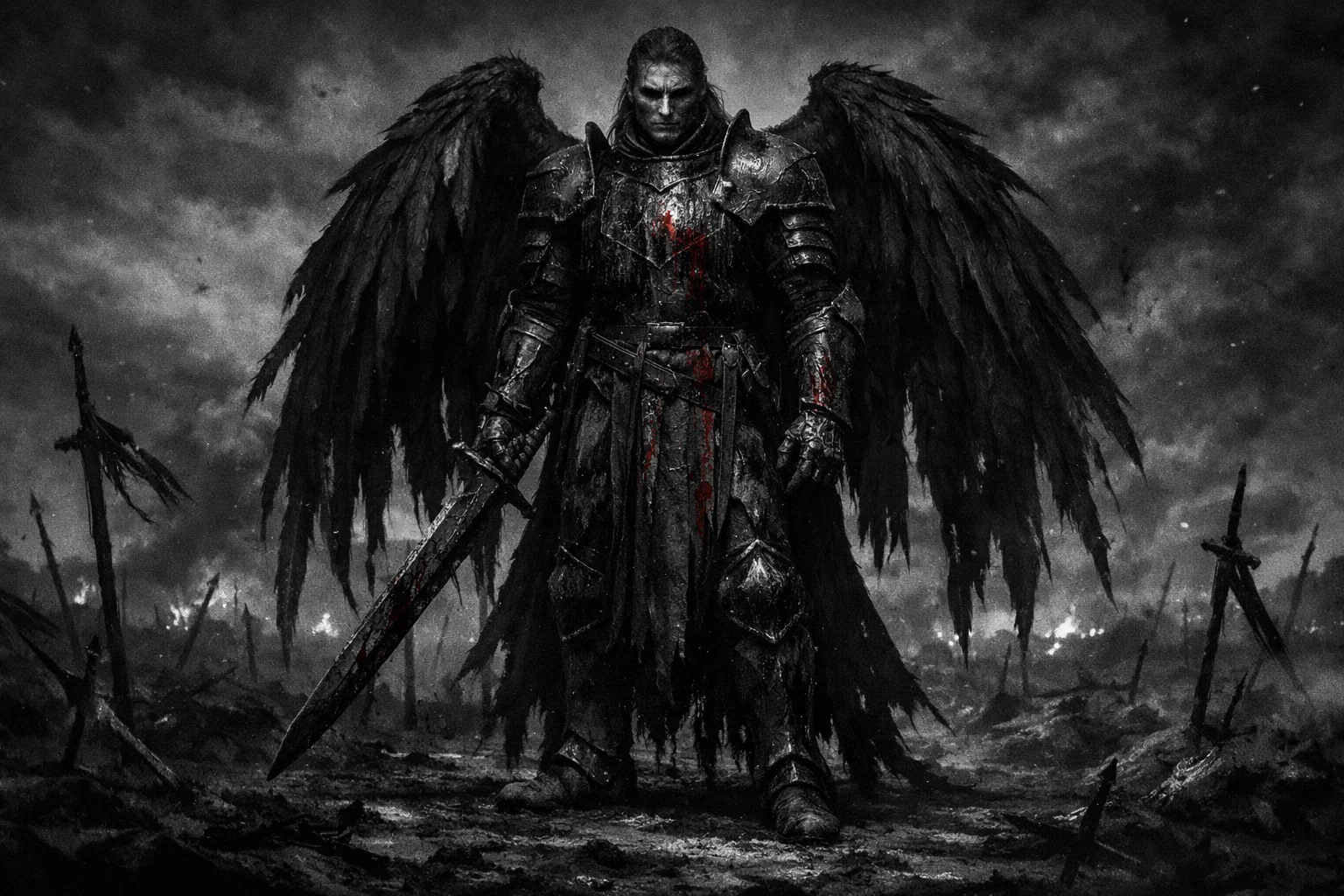
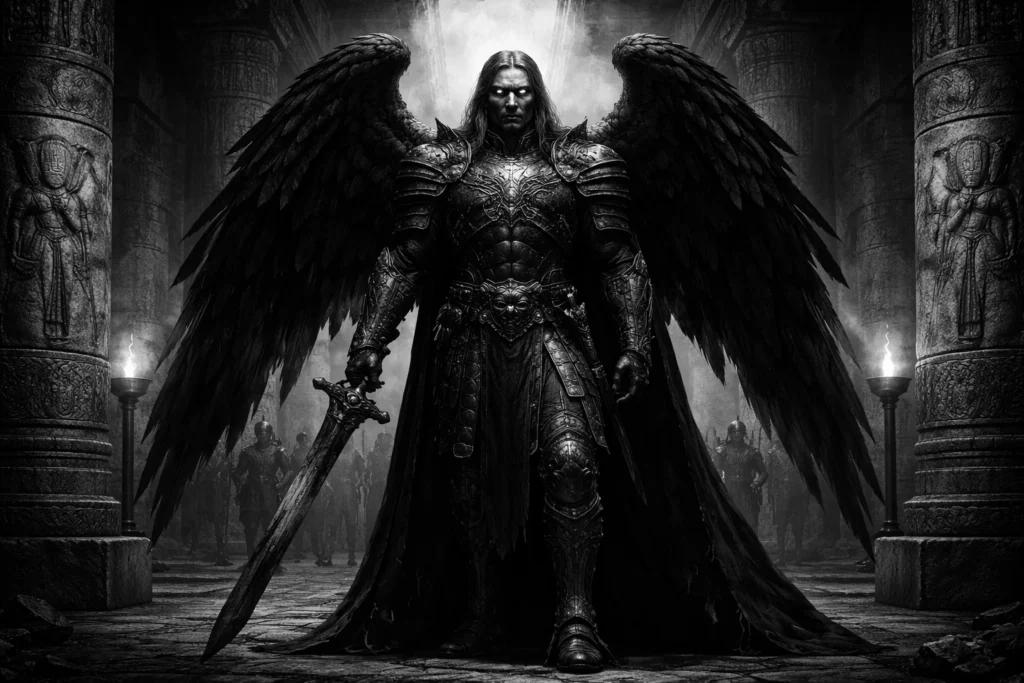
Arioch’s appearance gives off a sense of looming violence. He is often shown as tall and intimidating, wearing dark or blood-stained armor. Some sources say he has the tattered, black wings of a fallen angel. His face is severe, with eyes that seem to burn with war and a look that stirs a desire for battle.
Unlike the strange or animal-headed demons in the Lesser Key of Solomon, Arioch maintains a human-like yet frightening appearance, which highlights his role as a general and executioner.
Origins
Arioch’s story changes from being a royal figure on Earth to a notorious figure in the Heavens. He started in the ancient Near East, especially in early Mesopotamia, before Jewish and Christian beliefs changed his role.
The Historical and Biblical Foundation
The name Arioch first appears in the Middle Bronze Age. It is connected to the Hurrian and Semitic peoples of northern Mesopotamia. In the Hebrew Bible, especially in Genesis 14, Arioch is named as the King of Ellasar.
Today, many scholars link Ellasar to the city-state of Larsa. At that time, Arioch was an ally of the Elamite King Chedorlaomer and joined a group that fought against the kings of Sodom and Gomorrah. Here, he is seen as a classic “conquering king,” known for military campaigns and defeating rivals.
In the Neo-Babylonian Empire, the name Arioch appears again in the Book of Daniel. This time, he is not a king but the Captain of the Guard for King Nebuchadnezzar II. He acts as a top executioner, sent to carry out the king’s order to kill the Magi.
This change from king to executioner is important because it sets the stage for Arioch to later be seen as a demon of revenge and official violence.
You may also enjoy:
Rāga: The Seductive Demon of Passion and Desire in Buddhist Lore
October 16, 2025
Demon Amy, the 58th Goetic Spirit: Origin, Powers, and Rank
January 12, 2026
Yuki Onna: The Terrifying Demon Bride Who Feeds on Travelers
December 9, 2025
Agubanba: The Ash-Born Demon of Japanese Folklore
October 23, 2025
What Is a Yūrei? The True Meaning of Japanese Ghosts
January 30, 2026
What Is Qarin and Why Does It Follow Every Human Being?
October 8, 2025
Transformation in the Pseudepigrapha and Apocrypha
Arioch’s shift from human to demon mostly happened during the Second Temple Period. In the Book of Enoch and similar texts, the names of ancient kings and heroes were often used for the Watchers or Nephilim. In the Sybilline Oracles, Arioch is shown as a vengeful spirit linked to the downfall of nations.
In 2 Enoch (the Slavonic Secrets of Enoch), Arioch is named as one of two angels, along with Marioke, chosen by God to guard Enoch’s books. Later, as ideas about the War in Heaven grew, many of these guardian figures were reimagined as rebels who protected forbidden knowledge or tried to take divine power.
BREAK THE TOUGHEST DEMONIC BONDAGE! Limited-Time: Up to 41% OFF!
Real-life deliverance secrets from Apostle Alexander Chisango – straight from the front lines in Africa. Generational curses • Witchcraft • Sexual bondages • Addiction strongholds. Step-by-step keys that actually work when everything else has failed. Hundreds set free – your breakthrough starts here!
The Fallen Angel of the Middle Ages and Renaissance
By the Middle Ages, Arioch was fully included in the Infernal Hierarchy. In different grimoires and stories, he was seen as a seraph or cherub who followed Lucifer. His main sin was not pride or lust, but harsh judgment. He became the symbol of the “vengeful executioner” in Hell.
In the Renaissance, demonologists started to define Arioch’s role more clearly. Writers like John Milton described him as a fighter in the war in Heaven. Unlike demons who tempted with ideas, Arioch was the raw power behind the rebellion. This period confirmed his place as a Duke of Hell, a title he retained in later works such as those by Collin de Plancy.
| Source | Quote |
| Genesis 14:1 | And it came to pass in the days of Amraphel king of Shinar, Arioch king of Ellasar, Chedorlaomer king of Elam, and Tidal king of nations; |
| Genesis 14:9 | With Chedorlaomer the king of Elam, and with Tidal king of nations, and with Amraphel king of Shinar, and Arioch king of Ellasar; four kings with five. |
| Daniel 2:14 | Then Daniel answered with counsel and wisdom to Arioch the captain of the king’s guard, which was gone forth to slay the wise men of Babylon: |
| Daniel 2:15 | He answered and said to Arioch the king’s captain, Why is the decree so hasty from the king? Then Arioch made the thing known to Daniel. |
| Daniel 2:24 | Therefore Daniel went in unto Arioch, whom the king had ordained to destroy the wise men of Babylon: he went and said thus unto him; Destroy not the wise men of Babylon: bring me in before the king, and I will shew unto the king the interpretation. |
| Daniel 2:25 | Then Arioch brought in Daniel before the king in haste, and said thus unto him, I have found a man of the captives of Judah, that will make known unto the king the interpretation. |
| Judith 1:6 | And there came unto him all they that dwelt in the hill country… and to Arioch the king of the Elymeans, and very many nations of the sons of Chelod, assembled themselves to the battle. |
Arioch in Grimoires and Other Texts
| Source | Quote |
| 2 Enoch 33:11 | And the Lord summoned Arioch and Marioke, and gave them the books, and said: ‘Keep them, and read them to the generations of the earth.’ |
| Paradise Lost (Book VI) | …and Next Arioch and Ramiel blossom’d both by the might of Abdiel. |
| Dictionnaire Infernal | Arioch: Demon of vengeance. He is only used for those who occupy themselves with the sciences of the dark. |
| The Book of the Sacred Magic of Abramelin the Mage | Arioch is one of the servitors of Magot and Kore. |
| The Magus (Francis Barrett) | Arioch is cited as a spirit of vengeance and a messenger of destruction. |
| The Satanic Bible | Arioch is listed as one of the Four Crown Princes of Hell, representing the element of Earth (Note: LaVeyan interpretation varies from classical). |
| Compendium Rarissimum | Arioc: A Duke under the power of the Great King of the East. |
Powers and Abilities
Arioch’s powers focus on destruction and revenge. As a demon of vengeance, he mainly manipulates people’s desire for “eye-for-an-eye” justice, turning it into a harmful cycle of violence. He does not offer wealth or knowledge; instead, he helps people destroy their enemies, but at a great spiritual cost.
In occult beliefs, Arioch is thought to give military advantages, not by offering wisdom, but by making soldiers more aggressive and less merciful. He is said to control the “bloodlust” that happens in battle, making fights as deadly as possible.
He is also believed to have the power to bring out the darkest parts of the human mind, especially hidden grudges. When Arioch acts, old feuds can suddenly and violently come back to life.
Arioch Myths, Legends, and Stories
The Guarding of the Enochic Secrets in 2 Enoch
In the Secret Books of Enoch, we encounter a significant entity alongside another spirit named Marioke. This story takes place after Enoch is taken to the tenth Heaven, where he is given the important task of writing down heavenly secrets that reveal divine wisdom.
When Enoch returns, God giv entrusts these two celestial beings with the critical task of protecting these sacred writings, trusting them to safeguard ancient knowledge for future generations.
The tale highlights an important moment when God calls them for specific instructions to ensure these precious texts are preserved for the enlightenment of humanity.
In this role, one of these beings is a divine guardian, responsible for protecting ancient wisdom—knowledge that intrigues those seeking to understand the mysteries of existence.
With this big responsibility, he is not only supposed to keep the books safe but also to connect with people on Earth by sharing what is written in them. By doing this, he acts as a bridge between divine truths and human understanding, helping to make complex celestial ideas accessible to everyone.
The Confrontation with Abdiel in the War in Heaven
On the second day of the great cosmic battle described in “Paradise Lost,” a significant leader in the rebellion takes to the battlefield. After the first confrontation between the angelic armies, he wants to show how powerful the fallen angels can be by facing off against the loyalist angel, Abdiel.
The story describes a fierce fight where he uses all his strength to try to defeat Abdiel, who was the first to stand up against Lucifer. However, Abdiel’s divine strength turns out to be too much for him. The account reveals that he and his companion, Ramiel, suffer serious injuries from Abdiel’s powerful attack.
This moment signifies not just his defeat in battle but also marks his fall into the abyss, transforming him from a once-great celestial warrior into a damaged spirit trapped in darkness.
UNLOCK THE FORBIDDEN KNOWLEDGE OF DEMONS. Limited-Time: Up to 29% OFF!
The Encyclopedia of Demons & Demonology 400+ entries • Real history • Exorcisms & Ancient Evils • Possession • Terrifying photos. This is Rosemary Ellen Guiley’s masterpiece of the occult.
The Near-Massacre of the Babylonian Magi
In the story of the Babylonian captivity, there’s a remarkable tale about a king who has a forgotten dream. When King Nebuchadnezzar’s sorcerers and astrologers couldn’t tell him what the dream was, he became furious. He ordered that all the wise men in the kingdom should be killed.
The Captain of the Guard plays a key role in this alarming situation. His job is to carry out the king’s order to execute these wise men without delay. The story takes a surprising turn when he meets Daniel, a young man known for his wisdom. Although the Captain is rushed and angry, he still takes a moment to listen to Daniel.
This part of the story shows the Captain as the king’s enforcer, someone who carries out orders that lead to destruction. However, just when it seems tragedy is unavoidable, divine intervention changes the course of events, sparing the lives of those involved.
You may also enjoy:
Lamia: The Queen Cursed to Devour the Children of Others
January 7, 2026
Aamon: The Infernal Marquis of Lust, Feuds, and False Prophecies
September 29, 2025
Who Is Andromalius and Why Is He the Last Demon of the Goetia?
January 20, 2026
Akateko: The Bloody Hand Ghost That Guards a Cursed Temple Tree
November 14, 2025
Who Is the Infernal King Balam? Origins, Powers, and Occult History
February 26, 2026
Gandharva: God, Spirit, or Demon?
November 13, 2025
The Elymean Campaign in the Book of Judith
In the Book of Judith, we find a story about a powerful ruler who leads a large army in response to a call for help from King Nebuchadnezzar. The tale describes how this ruler gathers a huge coalition of forces to punish the nations in the West that refused to support the Assyrian army.
This king is known as the leader of the Elymeans and commands a strong military force. The focus of the story is on the assembly of these armies in a place called Ragau, where they prepare for a major battle.
His role in this story highlights his connection to significant military actions and focuses on his position as a leader of the “sons of Chelod,” who pose a serious threat to the people chosen by God.
The Binding in the Abramelin Tradition
In the writings of Abramelin the Mage, a significant entity in the world of magic, there is mention of a spirit that serves under two powerful demons named Magot and Kore. The tales tell us that to work safely with this spirit, a practitioner must undergo a strict eighteen-month process of purification and preparation.
During a special ritual where different spirits are called upon, this particular spirit is said to help carry out the mage’s wishes, whether that involves gaining knowledge or even causing harm to others.
Unlike stories from the Bible that depict leading figures with authority, this magical account highlights how this spirit is more of a helper, obeying the commands of more powerful beings in the dark realm. This means that the spirit’s abilities come from these powerful entities, and it acts as a tool to fulfill the practitioner’s desires.
Arioch vs Other Christian Demons
| Demon Name | Associated Sin/Temptation | Rank/Origin | Key Traits/Powers |
| Lucifer | Pride | Emperor / Fallen Seraph | Master of all demons; intellectual pride |
| Mammon | Greed | Prince / Biblical | Influencing material obsession |
| Asmodeus | Lust | King / Ars Goetia | Breaking marriages; inducing carnal desire |
| Beelzebub | Gluttony | Prince / Philistine | Lord of the Flies; spreading decay |
| Leviathan | Envy | Grand Admiral / Biblical | Master of the primordial deep; chaos |
| Belphegor | Sloth | Prince / Moabite | Granting wealth through lazy invention |
| Moloch | Child Sacrifice | Prince / Canaanite | Feeding on the suffering of the innocent |
| Abaddon | Destruction | King / Revelation | Lord of the locust swarm; the Abyss |
| Balaam | Avarice | King / Ars Goetia | Teaching invisibility and wit |
| Pazuzu | Plague | King / Mesopotamian | Commanding the south-west wind |
| Astaroth | Vanity | Grand Duke / Ars Goetia | Teaching liberal sciences and secrets |
| Beherit | Blasphemy | Duke / Syriac | Inciting hatred against the divine |
| Chemosh | National Pride | Prince / Moabite | Inciting war through tribalism |
Rank in the Hierarchy of Hell
Arioch has the rank of High Duke or Senior Executioner in the infernal hierarchy. Unlike kings who lead many legions to expand territory, he works as a specialist. Other demons mainly call on him to settle disputes or punish those who have failed their cause.
He is often shown as a subordinate to Magot or Belial, acting as the one who carries out their orders of destruction. In some stories, he is portrayed as a rival to the Archangel Michael, seeking to emulate Michael’s role as a heavenly general but turning it into that of a warlord in Hell.
Among lower-ranking demons, Arioch is both feared and respected because he is closely linked to carrying out pain and revenge directly.
Mystical Correspondences
| Attribute | Details |
| Planet | Mars |
| Zodiac Sign | Aries |
| Element | Fire |
| Direction | South |
| Color | Deep Red / Blood Crimson |
| Number | 9 (Number of Mars and Finality) |
| Crystal/Mineral | Hematite / Bloodstone |
| Metal | Iron |
| Herb/Plant | Nettle / Thistle |
| Animal | Lion / Vulture |
Arioch is strongly connected to Mars, the planet of war and aggression. This link highlights his role in causing conflict and sparking sudden violence. Since Mars rules over assertive and destructive urges, Arioch is most active when these energies are strongest.
He is also linked to the element of Fire and the direction South, which reflects the heat of battle and his destructive nature. These connections help explain his role as a force that destroys peace, since fire changes things by burning them away.
Historically, iron and bloodstone are used to represent Arioch’s tough nature, showing that he is unyielding, cold, and focused only on carrying out vengeance.
Arioch’s Sigil
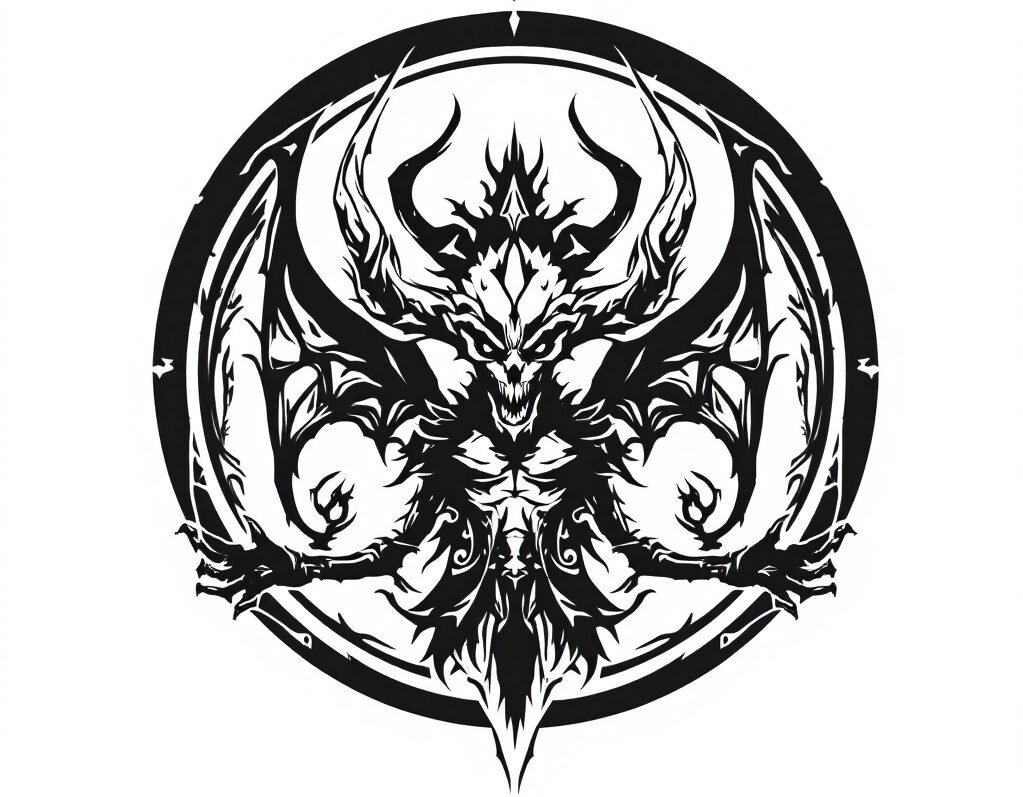
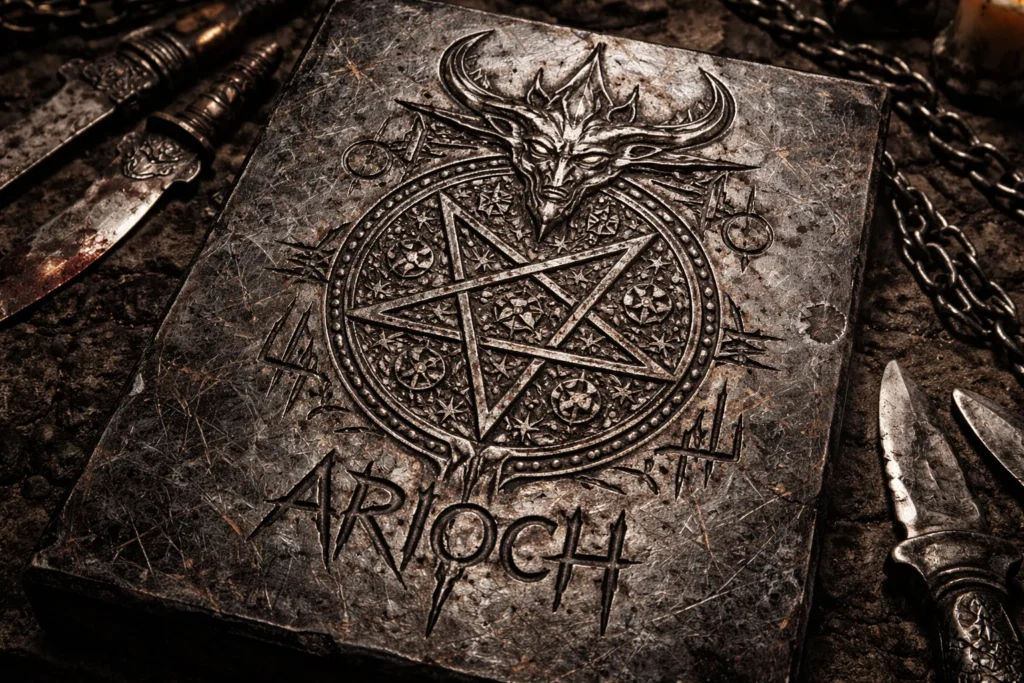
Arioch’s sigil is used to focus on the energy of revenge. Unlike the complex, round sigils of the Goetia, his symbols usually have sharp, straight lines and look like spears.
In the past, the sigil acted as Arioch’s “signature,” showing his control over vengeance. Practitioners used it to keep their focus on destruction, letting the sigil serve as a spiritual link to their power.
Summoning and Rituals
In occult history, rituals involving Arioch were mainly about gaining power for revenge. Witches and warlocks in medieval and Renaissance times called on him when they wanted to get back at someone. These rituals were often performed during the “Mars hour” on Tuesdays to align with his connection to the planet Mars.
These rituals often used iron tools and red candles to symbolize blood and battle. They are described in forbidden grimoires, but many warned against them because Arioch’s nature is unpredictable; once vengeance is set in motion, it can harm anyone, even the person who called for it. These practices were seen as the opposite of Christian prayer, replacing forgiveness with a direct request for demonic help.
You may also enjoy:
Iblis, the Jinn King of Darkness and Deception
September 29, 2025
Alû: The Mesopotamian Demon of Malevolence and Pestilence
November 10, 2025
Who Is Al-Abyad? The White King Jinn Who Rules Love and Chaos
January 26, 2026
Al-Ahmar: The Tuesday King of the Seven Jinn
February 13, 2026
Erinyes: The Chthonic Goddesses Who Enforced Blood-Guilt
November 20, 2025
Frequently Asked Questions
Is Arioch a Lord of Chaos?
In modern books and fantasy games, Arioch is often called a Lord of Chaos or a Duke of Hell. This idea primarily comes from Michael Moorcock’s Elric of Melniboné series, in which Arioch is the main character’s patron god. Although this version is fictional, it has strongly shaped how people see Arioch today, sometimes mixing him up with older demons who share his name.
What is the difference between Arioch in Judaism and Christianity?
In Judaism, Arioch is only a historical or literary figure, shown as a king or royal captain in the Tanakh, and is not seen as a demon. In contrast, Christianity, especially in later writings and works like Paradise Lost, portrayed him as a fallen angel and a demon of vengeance. This change shows how he went from a human leader to a spiritual being of malice.
Why is Arioch called the “Fierce Lion”?
The nickname “Fierce Lion” comes from the Hebrew roots of the name (‘Aryōk), which some scholars connect to the word ari‘, meaning ‘lion’. In occult stories, this title shows his aggressive, predatory side, suggesting he pursues vengeance as fiercely as a hunting animal. People often use this title in rituals to call on his strength and ferocity in battles or personal conflicts.
Is Arioch the same entity as the angel Ariel?
Although Arioch and Ariel both have names that come from the Hebrew word for “lion” (‘ari), they are different beings in Judeo-Christian tradition. Ariel is usually seen as an archangel or a spirit of Earth and nature, with a positive or neutral role. Arioch, on the other hand, is seen as a fallen spirit of destruction. Some secret texts say they were once equals before the War in Heaven, but now they stand for opposite forces: protection and revenge.
Does Arioch appear in modern video games or movies?
Yes, Arioch often appears in popular media, especially in the Shin Megami Tensei video game series. In these games, he is shown as a powerful demon with a strange look, like a large mouth on his torso, which is different from older descriptions. He also shows up as a patron god in tabletop RPGs like Dungeons & Dragons, where he keeps his role as a chaotic and vengeful force.
