

Lamia comes from ancient Greek mythology and is known as a child-devouring demon who haunts mothers and infants. She was first described as a beautiful queen of Libya and a lover of Zeus. However, after angering Hera, she was twisted into a predatory monster.
In classical folklore, Lamia became a bogeyman entity that parents used to scare children into behaving. Over time, her story transformed from a single tragic character to a group of spirits called lamiae, often linked to vampires and the seduction of young men.
Summary
Key Takeaways
| Attribute | Details |
| Names | Lamia, Sybaris (occasionally identified as the same entity) |
| Title | Child-devourer, Queen of Libya, Night-haunting Spectre |
| Origin | Greek Mythology (Libyan region) |
| Gender | Female |
| Genealogy | Daughter of Belus and Libye; lover of Zeus |
| Role | Infant-slayer and nocturnal predator |
| Associated Deity/Figure | Zeus (lover), Hera (antagonist), Hermes |
| Brings | Child mortality, nightmares, and sleeplessness |
| Weaknesses | Removable eyes (limit her vision), specific apotropaic charms |
| Realm/Domain | Libyan caves, coastal regions, and the dreams of mothers |
| Weapon/Item | Removable eyes granted by Zeus |
| Symbolism | Grief-induced madness and destructive envy |
| Sources | Diodorus Siculus, Aristophanes, Horace, Philostratus, Suidas |
Who or What is Lamia?
Lamia is a supernatural being from ancient Mediterranean folklore. At first, she was a beautiful mortal queen who ruled Libya. Her life changed after she had an affair with Zeus, the king of the gods. Hera, jealous of this relationship, destroyed Lamia’s children.
The trauma left Lamia unable to sleep and drove her insane. She hid in a cave, where her appearance became twisted and monstrous. Out of envy, she started kidnapping and killing other people’s children.
In later Greek and Roman stories, Lamia was seen as a ghost or a shapeshifter spirit called an empusa, who lured men to their deaths to eat their flesh and drink their blood.
Lamia Meaning
Scholars have different ideas about where the name Lamia comes from. One main theory is that it comes from the Greek word laimos (λαιμός), meaning “throat” or “gullet.” This fits her reputation for being gluttonous and eating people.
Some researchers think the name Lamia might come from the Lamians, an ancient tribe, or from Semitic languages, possibly linked to the Hebrew word Lilit (Lilith), though this is still debated.
In Latin, ‘lamia’ became a general word for witches or sorceresses who harmed children. Ovid also linked the name Lamia to Sybaris, a giant serpent that lived in a cave near Delphi, making her seem more like a beast than a human.
DEMONS ARE REAL — AND THE BIBLE PROVES IT Limited-Time: Up to 20% OFF!
No myths. No exaggeration. Just Scripture. Clinton Arnold’s landmark biblical theology of the powers of darkness. What the Old & New Testaments actually teach about Satan, demons, and spiritual warfare. Essential reading for every pastor, counselor, and believer facing the unseen battle. The book seminaries and deliverance ministries swear by.
Demons are real • Scripture is clear • Victory is yours • Clinton Arnold’s definitive biblical study.

How to Pronounce “Lamia” in English
In English, Lamia is usually pronounced as LAY-mee-uh (/ˈleɪmiə/). Some people say LAH-mee-uh (/ˈlɑːmiə/), which is closer to the original Greek (Λάμια).
Origins
Lamia’s story starts in Libyan myths from Greek tradition. She was the daughter of Belus, a legendary king of Egypt, and Libye. As queen, her beauty caught the eye of Zeus.
Lamia’s transformation is a story of divine punishment. When Hera found out about Zeus’s affair, she either killed Lamia’s children or made Lamia do it herself. Losing her children made Lamia’s face become ugly and twisted. Zeus felt sorry for her because she couldn’t sleep, so he gave her the power to remove her eyes and place them in a bowl.
This let her rest, but while her eyes were out, she was harmless. When she put them back in, she would hunt for children again.
Genealogy
| Relationship | Details |
| Parents | Belus and Libye (some sources cite Poseidon as a grandfather) |
| Siblings | Aegyptus, Danaus, Cepheus, and Phineus |
| Spouse | Zeus (lover/consort) |
| Children | Scylla (in some accounts), Achilleus (rarely), and many unnamed deceased infants |
Sources
Lamia appears in many classical texts, including comedies, histories, and biographies. These works show how she changed from a Libyan queen into a monster of folklore.
Important sources are Diodorus Siculus, who tells her origin story, and Philostratus, who describes her as a vampire in Life of Apollonius of Tyana. These texts help us understand how Lamia’s story changed over time and influenced later legends.
| Source | Quote |
| Aristophanes, The Wasps | …and what a stench of Lamia’s foulness did he breathe! (καὶ Λαμίας ὄζων ἀκαθαρσίας…) |
| Diodorus Siculus, Library of History | For they say that Lamia was born a queen of Libya, of surpassing beauty… but because of the cruelty of her heart, her face underwent a change to a beast-like appearance. |
| Horace, Ars Poetica | Let not a play demand belief for whatever it fancies: let it not draw a living boy out of the belly of a Lamia who has just eaten him. |
| Philostratus, Life of Apollonius of Tyana | This fine bride is one of the empusae, whom many people regard as lamiae and mormolyciae. (ἡ χρηστὴ νύμφη μία τῶν ἐμπουσῶν ἐστιν, ἃς λαμίας τε καὶ μορμολυκίας οἱ πολλοὶ ἡγοῦνται.) |
What Does Lamia Look Like?
Lamia’s appearance changes depending on the version of the myth. In early stories, she was a woman whose looks became twisted and ugly because of her actions. Diodorus Siculus even says she could make her face look frightening on purpose.
In later artistic and literary depictions, she is often portrayed as a hybrid creature. She is frequently described as having the upper body of a woman and the lower body of a serpent. This snake-like form highlights her status as an “outsider” to humanity.
A defining characteristic is her eyes, which are described as being detached or restless. When she is hunting, they are fixed in her head; when she sleeps, she removes them.
In the Life of Apollonius, she appears as a beautiful woman through illusion, hiding her true predatory, scaly form to deceive her victims.
You may also enjoy:
Who Is Astaroth in Demonology and the Ars Goetia?
February 20, 2026
Barbas: The Lion Demon Who Spreads Disease
March 3, 2026
Who Is Arioch, the Demon of War and Vengeance?
January 21, 2026
Kuchisake-onna: Folklore, Origins, and Urban Legend History
February 10, 2026
Chort: The Sinister Slavic Demon of Chaos and Bad Luck
March 10, 2026
Marid: The Ocean Jinn That Defies Heaven and Earth
September 30, 2025
Enemies, Rivals, and Allies
Hera is Lamia’s main enemy, and her jealousy led to Lamia’s transformation into a monster. In Greek mythology, Lamia is often grouped with spirits like Gello, Mormo, and the Empusae because they share similar traits. Gello was blamed for the early death of infants, and Mormo was a scary monster used to frighten children.
While these demons are all linked to tragedy and malice, each has its own way of haunting people. Lamia has no real allies and is usually a lone predator. Still, in later stories, she is closely linked to the Empusae, who were Hekate’s helpers. Like Lamia, the Empusae could change shape and were known for preying on young men.
UNLOCK THE FORBIDDEN KNOWLEDGE OF DEMONS. Limited-Time: Up to 29% OFF!
The Encyclopedia of Demons & Demonology 400+ entries • Real history • Exorcisms & Ancient Evils • Possession • Terrifying photos. This is Rosemary Ellen Guiley’s masterpiece of the occult.
Connections to Other Ancient Demons
| Name | Genealogy | Type | Appearance |
| Lamashtu | Mesopotamian | Plague Demon | Lion head, donkey teeth, hairy body |
| Lilith | Jewish/Semitic | Night Demon | Winged woman with bird talons |
| Gello | Greek/Lesbos | Child-stealing Ghost | Pale, spectral woman |
| Mormo | Greek | Nightmare Spirit | Varies; often shapeless or frightening |
| Empusa | Greek | Shapeshifter | One leg of bronze, one of a donkey |
| Alū | Akkadian | Sleep Demon | Featureless, limbless entity |
| Striga | Roman/Greek | Owl-witch | Avian-humanoid hybrid |
| Yuki-onna | Japanese | Frost Spirit | Pale woman in a white kimono |
| Kappas | Japanese | Water Imp | Turtle-like with a water-filled head |
| Vetala | Hindu | Vampiric Spirit | Bat-like humanoid hanging from trees |
Lamia Myths, Legends, and Stories
The Metamorphosis of the Queen of Libya
According to Diodorus Siculus, Lamia was a woman of extraordinary beauty who ruled as queen of Libya. Her physical grace was so profound that it attracted the attention of Zeus, the king of the gods, who took her as his mistress.
This union resulted in several children, but it also incurred the relentless wrath of Hera, Zeus’s wife. In an act of divine vengeance, Hera either murdered the children of Lamia or stole them away, leading to their deaths.
Losing her children drove Lamia mad with grief and envy. She started taking other mothers’ children and eating them. The myth says her cruelty changed her looks, turning her beautiful face into something beastly. She left society and hid in a cave, becoming a night-time predator instead of a queen.
The Gift of the Detachable Eyes
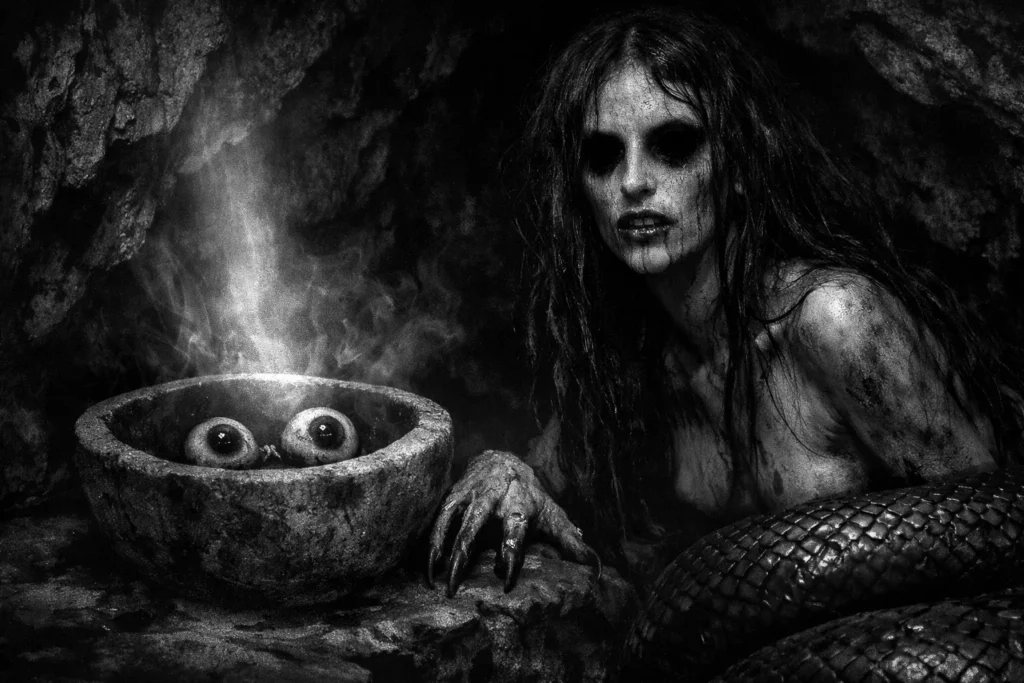
Hera’s curse meant Lamia could never sleep and was always haunted by memories of her lost children. Zeus, feeling sorry for her pain, gave her the strange power to take out her eyes whenever she wanted.
When Lamia took out her eyes and put them in a bowl, she could finally rest and escape her visions. Ancient stories often said that while her eyes were out, she was blind and easy to avoid. But once she put them back in, she could see clearly and hunt in the dark.
The Serpent of the Cave: Sybaris and the Crissaeans
In some local stories, especially near Mount Parnassus, Lamia is replaced by, or confused with, a monster called Sybaris. Sybaris was a huge, man-eating serpent that lived in a big cave. It scared the people of Crissa, who had to regularly sacrifice a young person to it.
The hero Eurybarus, son of Euphemus, saw a young man named Alcyoneus being taken to the cave as a sacrifice. Touched by his beauty, Eurybarus took his place. He fought the monster in the cave and threw it off a cliff, crushing its head on the rocks. A fountain called Sybaris appeared where it landed.
In these stories, Lamia is more like a chaos monster that a hero must defeat, not a tragic queen.
The Marriage of Menippus and the Ephesian Guest
A detailed story about Lamia’s vampire-like side appears in the Life of Apollonius of Tyana by Philostratus. In it, a young student named Menippus meets a beautiful, rich woman on the road to Corinth. She says she is Phoenician and invites him to her home, offering him a life of comfort and love. Menippus, enchanted by her looks, agrees to marry her.
At the wedding feast, the philosopher Apollonius noticed something was wrong. He saw that the gold plates, servants, and food were just illusions. He accused the bride of being an Empusa, a kind of Lamia that hunts the young.
Under his questioning, the woman started to cry and begged him to stop, but he kept pressing until she admitted she was planning to eat Menippus. After this, the woman and the whole feast disappeared, and Menippus was left safe but shocked.
The Lamia of the Sea
In later stories from sailors, Lamia became a sea monster. Sailors told tales of a creature with a woman’s head and the body of a shark or sea serpent that haunted the Libyan coast.
Unlike the cave-dwelling Lamia, this version would sink small boats and pull sailors underwater. This legend shows how Lamia changed from a single myth to a general monster that represented hidden dangers in nature.
The Rivalry of the Wet-Nurses
Another legend says Lamia was once a trusted nurse in Zeus’s household before her downfall. After she changed, she was said to haunt other nurses and mothers because she wanted her old role back. In these stories, Lamia would enter homes as a shadow to try to take the mother’s place.
People used this myth to explain sudden infant deaths and why babies sometimes cried at night for no clear reason. Lamia became a symbol of the opposite of a caring mother.
You may also enjoy:
Setcheh: Egypt’s Soul-Stealing Ancient Demon
November 11, 2025
Lamia: The Queen Cursed to Devour the Children of Others
January 7, 2026
Palis: The Foot-Licking Desert Jinn That Drinks Your Blood
December 3, 2025
Arati: The Beautiful Demon of Aversion in Buddhist Mythology
October 15, 2025
Banasura: The Thousand-Armed Demon King
October 10, 2025
What Is Qarin and Why Does It Follow Every Human Being?
October 8, 2025
Lamia Powers and Abilities
Lamia is known for being a skilled predator who can get past human defenses. Her power is usually supernatural or psychological, not physical:
- Shapeshifter: She can disguise her monstrous form to appear as a beautiful woman to lure men.
- Remove her eyes: The ability to remove and replace her eyes, a gift from Zeus.
- Stealth: She operates primarily under the cover of darkness.
- Curses: In some regional folklore, she can bring bad luck or illness to households.
- Longevity: As a spectral or semi-divine entity, she does not age.
Rituals, Amulets, and Protective Practices
People in ancient times were so afraid of Lamia that they devised many ways to protect the most vulnerable, such as newborns, women in labor, and young men. Since Lamia was thought to be a ghostly predator who could get past physical barriers, these protections often used magic, herbs, and prayers to the gods.
Incantations and Ceremonies
In addition to the standard prayers to Hekate—the goddess of the crossroads and spirits—households used specific verbal commands to “bind” or “banish” the Lamia. These ceremonies often took place at the liminal hours of dusk or midnight when the entity was believed to leave her cave.
One common ritual was to make loud noises to break the silence Lamia liked. During an eclipse or a very dark night, families would bang bronze pots together because the sound was believed to hurt night spirits. In some places, midwives would say this short Greek spell to protect a nursery:
“Away, Lamia! Out from the rafters and the floor. No child is here for your gullet; no blood is here for your thirst. By the torch of Hekate and the bow of Artemis, begone to the Libyan sands.”
BREAK THE TOUGHEST DEMONIC BONDAGE! Limited-Time: Up to 41% OFF!
Real-life deliverance secrets from Apostle Alexander Chisango – straight from the front lines in Africa. Generational curses • Witchcraft • Sexual bondages • Addiction strongholds. Step-by-step keys that actually work when everything else has failed. Hundreds set free – your breakthrough starts here!

Amulets and Talismans
The main way to protect against Lamia was the Gorgoneion, which showed the scary face of Medusa. People believed that ‘evil must fight evil,’ so putting a frightening image on a door or around a child’s neck would scare Lamia away:
- Tintinnabula: Small bronze bells or wind chimes. The “singing” of the metal in the wind served as a constant auditory ward.
- The Phylactery of Hermes: Children were given amulets dedicated to Hermes Psychopompos, the Guide of Souls. Since Hermes could travel between the underworld and the world of the living, people believed his protection would keep children safe from spirits.
- Obsidian and Jet: These black stones were linked to the night and believed to absorb bad energy. People thought putting a piece of jet under a pillow would stop nightmares and the feeling of being suffocated, which were blamed on Lamia.
Herbs and Botanical Defenses
The use of specific plants was a critical component of ancient “pharmakeia” (magic/medicine) used to repel the Queen of Libya:
- Buckthorn (Rhamnus): Called rhamnos in Greek, the branches of this thorny plant were hung over doors and windows. People believed the thorns could catch or stop ghosts from coming inside.
- Garlic (Allium sativum): Although garlic is now linked to vampires, in ancient times it was used to clean the air and keep away bad-smelling spirits. Aristophanes mentioned Lamia’s foul smell, and people thought garlic’s strong scent would hide the ‘scent of life’ that drew her in.
- Laurel (Daphne): Laurel leaves, which were sacred to Apollo, were burned to make smoke. People believed the smoke would clear the home and drive away any lingering spirits.
- Squill (Drimea maritima): Also called the ‘sea onion,’ this plant was often hung outside the front door. It was thought to be a strong purifier that kept bad spirits from entering the house.
Alternative Protective Methods
Besides using herbs and charms, Greeks also followed certain protective habits. Mothers were told not to leave baby clothes outside after sunset, since Lamia could smell the child through them. Parents were also warned not to say a child’s name loudly at night, using nicknames instead, so Lamia couldn’t use the name to find or harm the child.
You may also enjoy:
Who Is Arioch, the Demon of War and Vengeance?
January 21, 2026
Who Were the Hinn, the First Spirits of Creation?
November 12, 2025
What Is a Dīv? The Terrifying Giant Demon of Persian Myth
January 22, 2026
What Is a Yūrei? The True Meaning of Japanese Ghosts
January 30, 2026
Agubanba: The Ash-Born Demon of Japanese Folklore
October 23, 2025
Andhaka: The Blind Demon Born From Cosmic Darkness
February 6, 2026
Frequently Asked Questions (FAQ)
Is Lamia a demon?
When it comes to classical mythology, Lamia is classified as a “daemon” (spirit) rather than a fallen angel in the Judeo-Christian sense. She occupies a middle ground between a mortal human and a supernatural entity. While originally a human queen, her transformation depicted her as a malignant spectral being or a “bogeyman” used to explain infant mortality and night terrors.
What is the curse of Lamia?
The curse of Lamia is permanent sleeplessness and the loss of her offspring. Inflicted by the goddess Hera out of jealousy, the curse forced Lamia to remain perpetually awake, causing her to relive the trauma of her children’s deaths. This state of constant wakefulness and grief is what, in the end, drove her to insanity and fueled her desire to devour the children of others.
What kills a Lamia?
In ancient mythology, Lamia is rarely “killed” by physical weapons; she is typically repelled or outmaneuvered. However, in the Life of Apollonius, she is defeated through exposure and philosophical truth, which dissolves her illusions. Later folklore suggests that she can be destroyed by beheading or burning, methods commonly associated with the destruction of vampires and empusae.
Are Lamia evil?
Lamia is characterized as evil and malevolent due to her predatory nature and the intentional harm she inflicts on innocents. While her origin is tragic, her actions, such as kidnapping, cannibalism, and blood-drinking, position her as a primary antagonist in Greek folklore. She represents the ‘malicious feminine,’ driven by envy to destroy what she can no longer have. Beyond her actions, Lamia symbolized deeper fears and anxieties for the ancient Greeks, serving as a metaphor for the potential dangers and societal expectations surrounding motherhood and female power. Her myth reflects the cultural tensions around women’s roles and the fear of unchecked feminine influence.
Is Lamia a succubus?
Lamia is often considered a precursor to the succubus. While the term “succubus” is medieval, Lamia’s later depictions involve her seducing young men to consume their life force or flesh. Like the succubus, she uses a beautiful, illusory appearance to mask her true monstrous form, making her a vampiric seductress in Hellenistic tradition.
What is the difference between a Lamia and a Naga?
The primary difference lies in their cultural origin and temperament. While both can be depicted as half-human and half-serpent, the Lamia is a Greek entity defined by child-devouring and malice. The Naga is a Sanskrit/Hindu entity that acts as a guardian of water and treasure, often serving as a protective or neutral deity rather than a predatory monster.
How does Lamia relate to the modern vampire?
Lamia is one of the earliest ancestors of the modern vampire. Ancient writers like Philostratus described her as an entity that thirsted for fresh blood and targeted young victims. Her traits—immortality, metamorphosis, and the consumption of human essence—directly influenced the evolution of vampire lore in European literature.
Does Lamia appear in the Bible?
Lamia is mentioned in the Vulgate (Latin translation) of the Bible in Isaiah 34:14. While the original Hebrew uses the word Lilith, St. Jerome translated it as Lamia. The verse describes her inhabiting desolate ruins alongside other nocturnal creatures, cementing her association with wilderness and divine judgment.
What is a “Lamia” in English heraldry?
In heraldry, a Lamia is a mythical beast depicted with a woman’s head and breasts, a lion’s body, and a serpent’s tail. Unlike the tragic figure of myth, the heraldic Lamia is used as a symbol of mystery or danger, often appearing on family crests to denote a formidable or exotic lineage.
