
The Gandharva is a group of supernatural entities found in both Hindu and Buddhist mythologies.
In Hinduism, Gandharvas are primarily celestial beings known for their role as male singers and musicians in the courts of the gods, particularly Indra. They are often associated with the heavens and classified as one of the lesser classes of deities or semi-divine beings.
In Buddhism, the Gandharva is a class of demigods. On top of that, the term can also be used in a specific cosmological context: the Gandharva state is the intermediate state between death and rebirth (antarabhava) in certain schools of Buddhist thought.
The entity also appears in some Buddhist texts as a nature spirit. The word serves both as a general classification of celestial beings (see the Hindu Demons category for additional information) and as a specific concept related to the cycle of reincarnation.
Summary
Key Takeaways
| Attribute | Details |
| Names | Gandharva, Kinnara (sometimes related or synonymous), Antarabhava (referring to the state in Buddhism) |
| Title | Celestial Musician, Heavenly Singer, Smell-eater (Gandharva is Sanskrit for scent-eater) |
| Region | India, Nepal, Tibet, and throughout South and Southeast Asia |
| Type | Semi-divine celestial being (Hindu); Class of demigods or intermediate state of existence (Buddhist) |
| Gender | Predominantly Male (often with female counterparts, Apsaras) |
| Realm | Svarga or Indra’s Heaven (Hindu); Cāturmahārājika or Desire Realm (Kāmadhātu) (Buddhist) |
| Obstacle/Threat | Associated with illusions, possession, lust (minor demonic role in some texts) |
| Associated Figures | Indra (chief patron/lord), Apsaras (female companions), Nāgas |
| Weapon/Item | Musical Instruments (e.g., Vīṇā) or None |
| Weaknesses | Mantras, Vajrayana ritual protection |
| Associated Deity/Figure | Vaisravana (Buddhist guardian king) |
| Pantheon | Hinduism, Buddhism (with Hindu influences) |
| Primary Sources | Vedas, Upanishads, Mahabharata, Ramayana (Hindu); Pali Canon (Dīgha Nikāya, Saṃyutta Nikāya), Abhidharma texts (Buddhist) |
Who or What is Gandharva?
The Gandharva is a term used to represent a class of celestial beings in Hindu and Buddhist cosmology.
In Hinduism, they are generally benevolent, semi-divine beings associated with music, the arts, and the heavens. They are famed as the musicians in the court of Indra (the king of the gods), and are often paired with the Apsaras, the beautiful female cloud and water spirits.
They typically live in the celestial realm and possess knowledge of the cosmos’ secrets. Their primary role is to entertain and act as messengers between the gods and humanity.
Within Buddhism, the term Gandharva has a dual application. Firstly, it refers to a class of minor deities or demigods that inhabit the lower heavens of the Desire Realm (Kāmadhātu). They are listed as one of the eight classes of non-human beings, often residing in the realm governed by the Great King Dhṛtarāṣṭra (Pali: Dhataraṭṭha).
Secondly, and critically, the Sanskrit term gandharva (Pali: gandhabba) is used in Buddhist Abhidharma philosophy to refer to the intermediate consciousness or being that exists in the state of antarabhava—the time between death and the next rebirth. This intermediate gandharva is said to seek out its new birth-link.
“Gandharva” Meaning
The term Gandharva originates from the Sanskrit word gandharva (गन्धर्व). The etymology of the word is debated, but one common interpretation is that it is a compound meaning “scent-eater” or “smell-eater” (gandha meaning “scent” or “smell,” and harva related to har meaning “to take” or “to eat“).
Historically, the concept of the Gandharva evolved significantly from the early Vedic period through classical Hinduism and into Buddhist cosmology.
In the Ṛgveda (the earliest of the Vedic texts), a single, primary Gandharva is mentioned, often linked to solar and celestial phenomena and described as a guardian of the celestial Soma (the elixir of immortality). He is associated with the Sun, the Moon, and the waters of the atmosphere. Later Vedic and Hindu texts pluralized the term, leading to the collective term for celestial musicians.
In Buddhist contexts, the word gandharva is consistently used in the Pali Canon (gandhabba) to refer to a class of celestial beings, often grouped with other semi-divine creatures such as Yakṣas and Nāgas.
However, the distinctive meaning of gandharva as the intermediate being (antarabhava) is a prominent feature in later Buddhist schools, particularly those that adopted the Abhidharma system.
Variations across regions are primarily due to transliteration or translation, such as Kin-nar-ra (from Kinnara, a related entity) or simple rendering of the Sanskrit term.
How to Pronounce “Gandharva” in English
The preferred English pronunciation for Gandharva is GUN-dhar-vuh or GAN-dar-vuh. The emphasis is typically on the first syllable.
What Does Gandharva Look Like?
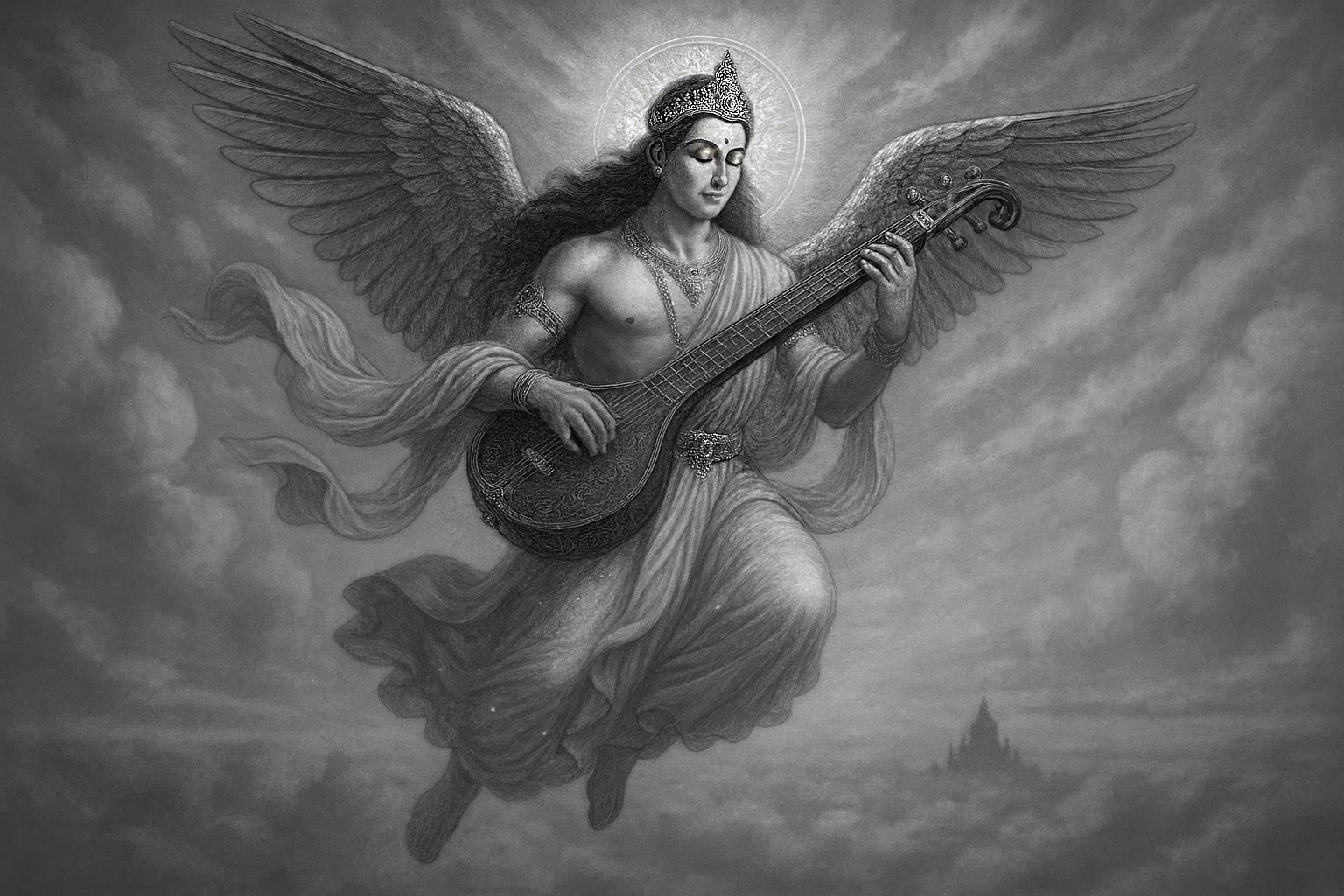
The physical descriptions of these entities can vary. However, they are generally depicted as handsome, ethereal, and often winged male figures. Their look is marked by grace and an association with music and the natural world.
In Hindu iconography, Gandharvas are frequently depicted as human-headed birds or equestrian figures (like the related Kinnaras). However, the most common portrayal is of beautifully adorned human figures holding or playing musical instruments, most often the Vīṇā (a stringed instrument).
They are seen wearing fine clothing and jewelry, often flying or floating among the clouds, which is indicative of their celestial nature. They possess an aura of serenity and are noted for their skill in both singing and instrumental music.
In Buddhist iconography, as a class of demigods, Gandharvas are largely depicted similarly to their Hindu counterparts—as celestial musicians. They are sometimes shown serving one of the four Heavenly Kings.
The Guardian King Dhṛtarāṣṭra (Sanskrit) or Dhataraṭṭha (Pali) is described as the King of the Eastern Quarter and the chief of the Gandharvas. In art, they are seen playing musical instruments or offering flowers as part of the celestial entourage of the Buddhas (or Bodhisattvas).
You may also enjoy:
Lamashtu, the Mesopotamian Demoness of Childbirth and Infant Death
November 4, 2025
Aim (Aym): The Great Duke of Hell in the Ars Goetia
November 11, 2025
What Is a Rakshasa? Meaning, Origins, and Dark Powers
January 23, 2026
Ifrit: Demon of Fire Who Serves Iblis in Islamic Tradition
September 30, 2025
Andrealphus: The Peacock Demon Who Twists Minds and Bodies
January 19, 2026
Jikininki: The Japanese Ghost That Feeds on Human Corpses
February 9, 2026
Origins
The earliest documented appearances of these celestial beings are in the Ṛgveda (circa 1500–1200 BCE). In these early hymns, the Gandharva is a complex figure, described as a cosmic being who guards the Soma and possesses knowledge of heavenly secrets. He is linked to the realm of the sky, the sun, and the celestial ocean.
One Vedic hymn describes him as a shaggy being with a radiant garment, suggesting a mystical or semi-animalistic nature, and he is the one who took the first draft of the Soma.
In the later Vedic and Brahmanic literature, the singular Gandharva evolves into a class of celestial beings (Gaṇdharvas). The Bṛhadāraṇyaka Upaniṣad references them as beings who can possess humans and are renowned for their knowledge. The Aitareya Brāhmaṇa describes them as beings who inhabit the air and are associated with magic and illusion.
The Mahabharata and the Ramayana frequently mention these entities, often associating them with the Apsaras and depicting them in Indra’s Heaven (Svarga). They are sometimes portrayed as minor antagonists or obstacles, possessing knowledge of occult arts. They are renowned warriors when necessary, though their primary function remains musical and celebratory.
In Buddhism, the concept was adopted early, likely due to the pervasive influence of Brahmanical thought at the time of the Buddha. The Gandharvas (gandhabbas) are immediately incorporated into the Buddhist cosmology, categorized as one of the Eight Classes of Non-Human Beings (Aṣṭagatayaḥ), which include Yakṣas, Nāgas, and others.
The Buddhist Gandharvas inhabit the lower tier of the heavens, residing in the four great continents. The distinct Buddhist interpretation of the gandharva as an intermediate being (antarabhava or bardo in Tibetan Buddhism) developed later within specific schools, such as the Sarvāstivāda and Sautrāntika traditions.
Regional Variations
These entities are portrayed differently across the various traditions, primarily in terms of focus (celestial musician vs. intermediate being) rather than drastic physical alteration.
| Region/Tradition | Appearance | Role |
| Hinduism (Vedic/Classical) | Handsome, humanoid, adorned, often winged, sometimes equestrian | Celestial musician and singer, messenger between gods, guardian of Soma |
| Theravada (Sri Lanka, Thailand, Myanmar) | Ethereal, celestial, musically inclined | Class of demigods in the Desire Realm, sometimes associated with spirits of trees |
| Mahayana (Tibet, China, Korea) | Celestial figures in the court of a Heavenly King | Class of minor deities (China: Kin-nar-ra); the intermediate state of consciousness (Bardo in Tibet) |
Complete List of Gandharvas
| Name | Details |
| Abhinamitā | Female Gandharva (Buddhist). |
| Āgamanagamanā | Female Gandharva (Buddhist). |
| Agniprabhā | Female Gandharva (Buddhist). |
| Alaṃkārabhūṣita | A Gandharva King (Buddhist). |
| Anādarśakā | Female Gandharva (Buddhist). |
| Arkkaparṇa | Male Gandharva (Hindu). |
| Aśvataras | A class of Gandharva (Hindu). |
| Audumbarā (or Audumvararudita) | Female Gandharva (Buddhist). |
| Bhānu | Male Gandharva, listed as having two instances (Hindu). |
| Bhīmasena | Male Gandharva (Hindu). |
| Bhūtavādika | Male Gandharva (Jain). |
| Brahmacāri | Male Gandharva, listed as having two instances (Hindu). |
| Bṛhatva | Male Gandharva (Hindu). |
| Candrabimbaprabhā | Female Gandharva (Buddhist). |
| Citrāṅgada | Male Gandharva (Hindu). |
| Citraratha | A Gandharva King (Hindu). |
| Citrasena | A Gandharva King; also among the Yaksha chiefs in Buddhist literature (Hindu, Buddhist). |
| Dānaṃdadā | Female Gandharva (Buddhist). |
| Devavacanā (or Devavaralocana) | Female Gandharva (Buddhist). |
| Dharmakāṅkṣiṇī | Female Gandharva (Buddhist). |
| Dharmaṃdadā | Female Gandharva (Buddhist). |
| Dharmapriya | A Gandharva King (Buddhist). |
| Dhṛtarāṣṭra | A Gandharva King (Hindu) and one of the Four Great Kings (Buddhist). |
| Dramila | A Gandharva King (Hindu). |
| Draviḍa | Male Gandharva (Hindu). |
| Dundubhi | Female Gandharva (Buddhist). |
| Dundubhisvara | A Gandharva King (Buddhist). |
| Dveṣaparimuktā | Female Gandharva (Buddhist). |
| Gītarasa | Male Gandharva (Jain). |
| Gītarati | A Gandharva Lord (Jain). |
| Gītayaśas | A Gandharva Lord (Jain). |
| Goman | Male Gandharva (Hindu). |
| Haṃsa | Male Gandharva (Hindu). |
| Hāhā | Male Gandharva (Hindu, Jain). |
| Huhū | Male Gandharva (Hindu, Jain). |
| Indramaghaśrī | Female Gandharva (Buddhist). |
| Indraśrī | Female Gandharva (Buddhist). |
| Janesabha | Male Gandharva; also a Yaksha chief, synonymous with Janavasabha (Buddhist). |
| Jvalantaśikharā | Female Gandharva (Buddhist). |
| Kadamba | Male Gandharva (Jain). |
| Kali | Male Gandharva (Hindu). |
| Kṣāntipriyā | Female Gandharva (Buddhist). |
| Kumudapuṣpā | Female Gandharva (Buddhist). |
| Kumāradarśana | A Gandharva King (Buddhist). |
| Madhura | A Gandharva King mentioned in the Lotus Sutra (Buddhist). |
| Madhurasvara | A Gandharva King mentioned in the Lotus Sutra (Buddhist). |
| Mahākadamba | Male Gandharva (Jain). |
| Mahāsvara | Male Gandharva (Jain). |
| Mātali | Indra’s charioteer; also among the Yaksha chiefs in Buddhist literature (Hindu, Buddhist). |
| Mauneyas | A class of Gandharva born from Muni (Hindu). |
| Mohaparimuktā | Female Gandharva (Buddhist). |
| Manojña | A Gandharva King mentioned in the Lotus Sutra (Buddhist). |
| Manojñasvara | A Gandharva King (Buddhist). |
| Manoramā | Female Gandharva (Buddhist). |
| Mṛgarājinī | Female Gandharva (Buddhist). |
| Muditapuṣpā | Female Gandharva (Buddhist). |
| Mukulitā | Female Gandharva (Buddhist). |
| Nala | Male Gandharva; also a Yaksha chief (Buddhist). |
| Nārada | A Gandharva King (Buddhist, Jain). |
| Nirnāditabhūrya | A Gandharva King (Buddhist). |
| Nirvāṇapriyā | Female Gandharva (Buddhist). |
| Opamañña | Male Gandharva (Pali); also a Yaksha chief (Buddhist). |
| Padmālaṃkārā (or Padmālaṃbā) | Female Gandharva (Buddhist). |
| Padmaśriyā | Female Gandharva (Buddhist). |
| Padmāvatī | Female Gandharva (Buddhist). |
| Pana | Male Gandharva (Hindu). |
| Panāda | Male Gandharva; also Yaksha chief (Buddhist). |
| Pañcaśikha | Male Gandharva (Buddhist). |
| Pariśobhitakāyā | Female Gandharva (Buddhist). |
| Parjanya | Male Gandharva (Hindu, Buddhist). |
| Patravān | Male Gandharva (Hindu). |
| Phalaṃdadā | Female Gandharva (Buddhist). |
| Prajāpatinivāsinī | Female Gandharva (Buddhist). |
| Prayuta | Male Gandharva (Hindu). |
| Pṛthivīṃdadā | Female Gandharva (Buddhist). |
| Priyamukhā | Female Gandharva (Buddhist). |
| Priyaṃdadā | Female Gandharva (Buddhist). |
| Pūrṇa | Male Gandharva, listed as having two instances (Hindu). |
| Pūrṇāyus | Male Gandharva (Hindu). |
| Rāgaparimuktā | Female Gandharva (Buddhist). |
| Raivata | Male Gandharva (Jain). |
| Rājaśrī | Female Gandharva (Buddhist). |
| Ratiguṇa | Male Gandharva (Hindu). |
| Ratnamālā | Female Gandharva (Buddhist). |
| Ratnāṅkurā | Female Gandharva (Buddhist). |
| Ratnapīṭhā | Female Gandharva (Buddhist). |
| Ṛṣivādika | Male Gandharva (Jain). |
| Rohitas | A class of Gandharva (Hindu). |
| Sahāpati (or Sahāṃpati) | A Gandharva King (General). |
| Sahasrabhuja | A Gandharva King (Buddhist). |
| Śailūṣa | Male Gandharva (Hindu). |
| Śailūṣas | A class of Gandharva (Hindu). |
| Śakra | Indra; Buddhist literature refers to him as a “Gandharva King,” though he is not a Gandharva proper (Buddhist). |
| Śālaśiras | Male Gandharva (Hindu). |
| Śarīraprahlādana | A Gandharva King (Buddhist). |
| Śataguṇa | Male Gandharva (Hindu). |
| Śatākārā | Female Gandharva (Buddhist). |
| Śatapuṣpā | Female Gandharva (Buddhist). |
| Satvana | Male Gandharva (Hindu). |
| Siddha | Male Gandharva, listed as having two instances (Hindu). |
| Siṃhagāminī | Female Gandharva (Buddhist). |
| Sphurantaśrī | Female Gandharva (Buddhist). |
| Subāhu | A Gandharva King in Kailāsa (Hindu); also listed as a son of Krodhā (Hindu). |
| Subāhuyukta | A Gandharva King (Buddhist). |
| Śubhamālā | Female Gandharva (Buddhist). |
| Sucandra | Male Gandharva (Hindu). |
| Sujanaparivārā | Female Gandharva (Buddhist). |
| Sukukṣi | Female Gandharva (Buddhist). |
| Sumālinī | Female Gandharva (Buddhist). |
| Sunda | Male Gandharva (Hindu). |
| Supāṇḍu | Male Gandharva (Hindu). |
| Suparṇa | Male Gandharva, listed as having several instances (Hindu). |
| Sūryalocanā | Female Gandharva (Buddhist). |
| Sūryavarcas | Male Gandharva (Hindu). |
| Suvarṇa | Male Gandharva (Hindu). |
| Suvarṇāvabhāsā (or Suvaca) | Female Gandharva (Buddhist). |
| Taraṇya | Male Gandharva (Hindu). |
| Tumbara (or Tumburu) | A renowned Gandharva (Hindu, Buddhist, Jain). |
| Uccaiśrvas | A class of Gandharva and Vājin, born of Bhadrā (Hindu). |
| Ugrasena | Male Gandharva (Hindu). |
| Upabarhaṇa | Male Gandharva (Hindu). |
| Ūrṇāyu | Male Gandharva, listed as having two instances (Hindu). |
| Vajramālā | Female Gandharva (Buddhist). |
| Vajravān | Male Gandharva (Jain). |
| Vajraśrī | Female Gandharva (Buddhist). |
| Vāleyas | A class of Gandharva born from Vikrānta (Hindu). |
| Vanaspati | Female Gandharva (Buddhist). |
| Varuṇa | Male Gandharva (Hindu). |
| Vāsava | Male Gandharva (Jain). |
| Vahvī | Male Gandharva (Hindu). |
| Vibhūṣitālaṃkārā | Female Gandharva (Buddhist). |
| Vilāsendragāminī | Female Gandharva (Buddhist). |
| Virādha | A Gandharva who was cursed to be reborn as a Rākṣasa (Hindu). |
| Viśvāvasu | A Gandharva King (Hindu, Jain). |
Buddhist Cosmology
In Buddhist cosmology, they belong to the Desire Realm (Kāmadhātu). They specifically inhabit the first, lowest celestial world, the Cāturmahārājika-kāyika (Realm of the Four Great Kings).
The Gandharvas are one of the classes of beings under the rule of the Great King Dhṛtarāṣṭra, the Guardian of the East. They are generally considered benevolent but are still subject to the cycle of rebirth (saṃsāra) and the defilements of the Desire Realm, unlike the gods of higher heavens.
The second major cosmological role is their specific designation as the intermediate being (gandharva or antarabhava). In schools that teach antarabhava, such as the Sarvāstivāda, the gandharva is the entity that exists between the moment of death and the moment of conception for the next life.
This consciousness is a manifestation of karma, and it seeks out the circumstances for its next rebirth, making it a critical step in the cosmic process of dependent origination.
You may also enjoy:
Aeshma: The Zoroastrian Demon of Wrath and Fury
January 13, 2026
Andrealphus: The Peacock Demon Who Twists Minds and Bodies
January 19, 2026
Who Was Mahishasura, the Buffalo Demon Slain by Goddess Durga?
October 3, 2025
Gandharva: God, Spirit, or Demon?
November 13, 2025
Chort: The Sinister Slavic Demon of Chaos and Bad Luck
March 10, 2026
Marid: The Ocean Jinn That Defies Heaven and Earth
September 30, 2025
Gandharva in the Pali Canon
Gandhabba is frequently mentioned in the Pali Canon, primarily as a class of celestial beings and less explicitly as the intermediate state between lives. However, the term is used in the context of conception. The gandhabba is typically grouped with the Yakkhas (Yakṣas) and Nāgas as a form of non-human being.
| Source | Quote |
| Dīgha Nikāya, DN 20 (Mahāsamaya Sutta) | “The Gandhabbas come with their great retinues of the shining, the luminous, the glorious. And the Nāgas come, and the Supaṇṇas come.” |
| Saṃyutta Nikāya, SN 1.25 (Devatāsaṃyutta, Gandhabba Sutta) | “The Gandhabba is among the devas, the Gandhabba is the best of the devas, the Gandhabba has no fear from anywhere.” |
| Majjhima Nikāya, MN 38 (Mahātaṇhāsaṅkhaya Sutta) | “When the mother and father are in union, and it is the mother’s period, and the gandhabba is present, then the embryo is conceived.” |
| Dhammapada, Verse 419 | “When the world is burning, by what means is there refuge? By what means is there no fear? O gandhabba, tell me this.” |
Gandharva in Mahayana Sutras
These entities are mentioned in Mahayana Sutras, predominantly as members of the celestial audience present when the Buddha preaches, thereby affirming their status as minor deities/demigods. In this context, they are often grouped with Kinnaras and other heavenly beings.
| Source | Quote |
| Saddharmapuṇḍarīka Sūtra (Lotus Sūtra), Chapter 1 | “There were… fifty million Gandharvas and Kinnaras… together with their followers, who were all listening to the Dharma.” |
| Vimalakīrti Nirdeśa Sūtra, Chapter 1 | “And the assembly was filled with devas, gandharvas, yakṣas, and rākṣasas… all seated on thrones, seeking the Dharma.” |
| Laṅkāvatāra Sūtra, Chapter 1 | “O Lord, there are also the Gandharvas, who are attached to the music and dance, seeking their birth-place, having died in their previous life.” |
Gandharva in Chinese or Korean Folklore
The concept of celestial musicians entered Chinese Buddhist traditions, where it is known as Kin-nar-ra (which generally refers to Kinnara but often overlaps with Gandharva).
However, the specific Gandharva as the intermediate being is not a feature of Chinese or Korean folklore in the same way, but is strictly a doctrinal term.
Powers and Abilities
The Gandharvas are generally considered less powerful than the major gods (Devas) but of a higher order than many terrestrial spirits or lower demons, such as the Rākṣasas. Their power level is comparable to that of other semi-divine classes, such as Yakṣas and Kinnaras.
Their abilities are primarily linked to the arts, the atmospheric elements, and certain forms of mental influence.
Their powers and abilities include:
- Musical Mastery: The principal power is exceptional skill in music, song, and dance. They are the supreme celestial performers.
- Aura and Illusion: They can exude a mystical aura that can influence the minds of others, creating glamours or illusions linked to sensory perception.
- Atmospheric Movement: They possess the ability to fly or move freely through the atmosphere and celestial regions.
- Ethereal Existence: As intermediate beings (antarabhava), they possess a subtle body (manomayakāya) that is invisible and can pass through objects.
- Possession: In some Hindu traditions and later folklore, they are said to be capable of possessing humans, often manifesting as madness or diseases.
- Knowledge of Secrets: They possess knowledge of celestial and occult secrets, including the preparation of the Soma (Hindu context).
- Sustenance on Scent: As the antarabhava being, the gandharva sustains its existence by subsisting on odors (gandha).

Gandharva Myths, Legends, and Stories
The Capture of the Sun God Sūrya’s Charioteer
In the Mahabharata, in the Adi Parva (Book of the Beginning), there is a narrative detailing a clash between the Gandharvas and human figures. The Gandharvas, as a collective, were known to be fierce warriors when their domain was threatened.
Arjuna, one of the five Pāṇḍava brothers, once fought a multitude of Gandharvas led by the King Citrasena. The Gandharvas were guarding the Sun God Sūrya’s chariot. They attempted to prevent Arjuna from approaching it, as only those who had performed great austerities were permitted near the sun.
The Gandharvas used their powers of illusion and celestial weapons, fighting with great ferocity. The conflict highlighted the Gandharvas’ martial abilities, proving them formidable opponents even against the greatest human heroes, despite their primary association with the arts.
Arjuna eventually defeated them, but only after receiving celestial weapons from the gods.
Viśvāvasu and the Apsaras
The Ramayana features several Gandharvas, often in romantic or supporting roles. One notable Gandharva is Viśvāvasu, who is sometimes described as one of the chief Gandharvas. The texts describe his association with the Apsaras (celestial maidens).
Viśvāvasu is often depicted in narratives of seduction or musical performances, embodying the Gandharvas’ role as patrons of the arts and the pleasures of the senses.
In one instance, a curse story concerns a sage’s attraction to the music and beauty of the Gandharvas and Apsaras, highlighting the potent, often distracting nature of their artistic allure.
Viśvāvasu’s presence highlights the Gandharvas’ connection to the Desire Realm and their role as constant companions of the Apsaras, often involved in gandharva-vivaha (marriage by mutual consent), a common form of marriage mentioned in ancient Hindu law texts.
The Intermediate Being in the Buddhist Abhidharma
The concept of the Gandharva as the antarabhava being, though abstract, is a key narrative point in Buddhist scholasticism. Texts like the Abhidharmakośabhāṣya by Vasubandhu discuss the subtle existence of the gandharva in great detail.
The text describes how, at the moment of death, the last moment of consciousness gives rise to the antarabhava gandharva. This subtle being wanders for a maximum of seven days, which can be extended up to seven times, for a total of forty-nine days, seeking its destined parentage and the conditions for rebirth: “The antarabhava gandharva has the same shape as the being it is destined to be born as.”
The narrative explains that the gandharva possesses a divine eye and divine ear, enabling it to perceive its future parents’ union and the circumstances of its next life.
The inability of the gandharva to find the right conditions for rebirth leads to its immediate death and another antarabhava existence until the destined moment.
Gandharva vs Other Buddhist Demons
The Gandharva is primarily a semi-divine entity, not necessarily a demon. Its role as an obstacle is minor, mainly through illusion, possession, or representing attachment to the sensory world. It contrasts with truly malignant Buddhist entities.
| Demon Name | Associated Obstacle/Role | Origin/Source | Key Traits/Powers |
| Māra | Temptation, delusion, death | Pali Canon, Mahayana Sutras | Illusion creation, army command, mind manipulation |
| Rākṣasa | Cannibalism, violence, night-prowling | Vedas, Pali Canon (Rakkhāsa) | Shape-shifting, physical strength, magic |
| Preta (Hungry Ghost) | Greed, suffering from hunger and thirst | Pali Canon, Abhidharma | Large belly, pin-hole mouth, perpetual suffering |
| Yakṣa (Yakkha) | Protection (good), malicious spirits (bad) | Vedas, Pali Canon | Guardians of treasure, can possess/eat people (malicious) |
| Aśura (Asura) | Jealousy, war, wrath | Vedas, Pali Canon | War-like, powerful demigods, constantly battle Devas |
| Nāga | Water spirits, snakes, possessiveness | Vedas, Pali Canon | Shape-shifting (snake/human), control of rain, guardians of the deep |
| Piśāca (Pisāca) | Flesh-eating, demonic possession | Hindu texts, Pali Canon | Invisibility, feeding on corpses, madness |
| Vetāla | Corpse-possessing spirit | Katha-sarit-sāgara, folklore | Animation of corpses, deception |
| Kiṃnara (Kinnara) | Celestial musicians (close to Gandharva) | Hindu texts, Pali Canon | Half-human/half-bird, musical talent |
| Moksha-dosa | Obstruction of liberation | Tibetan Buddhist texts | Interference with meditation, creating obstacles |

Mystical Correspondences
| Attribute | Details |
| Planet | Venus (association with arts, pleasure, and sensory desire) |
| Zodiac Sign | Libra (harmony, art, balance) |
| Element | Ākāśa (Ether or Space) (celestial residence, subtle body) |
| Direction | East (governed by Dhṛtarāṣṭra, the Gandharvas’ king) |
| Color | White or Silver (celestial, ethereal nature) |
| Number | Seven (maximum number of weeks the antarabhava state lasts) |
| Crystal/Mineral | Lapis Lazuli (celestial blue, associated with high realms) |
| Metal | Silver (purity, moon, and ethereal essence) |
| Herb/Plant | Soma (or plants associated with gandha or scent) |
| Animal | Horse or Swan (celestial movement, elegance) |
| Trait/Role | Music, Scent, Intermediate State, Illusion |
The Gandharva is mystically associated with the realm of celestial arts and the senses. The connection to Venus and Libra reflects their primary role as purveyors of aesthetic pleasure and harmony. Their core attribute, gandha (scent), is tied to the concept of sustenance and perception in the intermediate state (antarabhava), which is one of the five sense-objects.
The Ether/Space element is a natural correspondence, reflecting their aerial and subtle existence. The number 7 is directly linked to the maximum duration of the intermediate gandharva state (7 x 7 = 49 days) in certain Buddhist traditions.
Gandharva’s Items & Symbolism
The primary object associated with the Gandharvas is the Vīṇā (a plucked string instrument), which symbolizes their mastery of music and their role as celestial entertainers.
The Vīṇā represents harmony, rhythm, and the heavenly sounds that are said to permeate the higher realms. Its symbolism is entirely positive, reflecting the beauty and grace of the divine cosmos.
In the Hindu context, the Soma (the ritual drink or nectar of immortality) is also symbolically linked to the Gandharva, as a singular Gandharva is credited in Vedic texts with guarding it. This association symbolizes their knowledge of esoteric and celestial secrets.
In the Buddhist context, the gandharva, as the intermediate being, is associated with Scent (gandha). This is not an item but a symbolic means of sustenance, which represents the being’s reliance on non-physical, subtle means during the transition between rebirths.
Furthermore, the Gandharvas, as a class of demigods, are sometimes depicted carrying flowers or garlands as offerings to the Buddhas and Bodhisattvas, symbolizing reverence and the fragrance of good conduct.
You may also enjoy:
Demon Alastor: The Grand Executioner of Hell
November 17, 2025
Hitotsume kozō: One-Eyed Yōkai of Japanese Folklore
February 4, 2026
Mahakala: The Dark Guardian Who Consumes Evil
October 16, 2025
Jikininki: The Japanese Ghost That Feeds on Human Corpses
February 9, 2026
Alû: The Mesopotamian Demon of Malevolence and Pestilence
November 10, 2025
Frequently Asked Questions
What is Gandharva Vivaha?
Gandharva Vivaha is one of the eight classical types of marriage recognized in ancient Hindu law texts (Dharmashastras), such as the Manusmriti. It is a marriage based purely on mutual love and consent between the bride and the groom, without the need for traditional rituals, parental approval, or witness testimonies. It is named after the Gandharvas, associated with romance and sensory pleasures.
What is the relationship between Gandharvas and Kinnaras?
Kinnaras are closely related to Gandharvas in both Hindu and Buddhist traditions and are often grouped with them. Both are classes of celestial musicians. While Gandharvas are typically depicted as humanoid or ethereal, Kinnaras are usually portrayed as half-human, half-bird figures, like centaurs, emphasizing their connection to both the wild and the divine.
What is the story of Gandharva?
Gandharvas are often featured in supporting roles rather than having a single central narrative. A key story involving them is their battle with Arjuna in the Hindu epic, the Mahabharata. The Gandharva king, Citrasena, confronted Arjuna over the possession of certain celestial powers and weapons. Citrasena fought fiercely, using celestial illusion (Māyā) and divine arms, demonstrating the Gandharvas’ warrior skills. However, he was ultimately defeated by Arjuna.
Who is the god of the Gandharvas?
The Gandharvas are generally subservient to the gods, and their direct chief or king is Indra, in whose celestial court they live and perform. They are also said to be under the leadership of their own king, such as Citrasena or Viśvāvasu. Still, they ultimately owe allegiance to Indra, the king of the Devas.
Who was killed by Gandharva?
The Gandharvas themselves are typically not the primary killers in major myths, but they are formidable fighters. In one instance mentioned in the Mahabharata, the Gandharva king Citrasena and his army captured the Kaurava chief Duryodhana and his brothers during a hunting expedition. Citrasena fought and humiliated the Kauravas, proving the Gandharvas’ military strength. Still, he did not ultimately kill Duryodhana, who was later freed by the Pāṇḍavas.
Is Gandharva male or female?
The term Gandharva is generally used to refer to a male celestial being. Their female counterparts are the Apsaras (heavenly nymphs), who accompany them in performing music and dance in the heavens.
Is Kali a Gandharva?
No, Kali is not a Gandharva. Kali is a powerful and prominent Hindu goddess, often associated with time, change, destruction, and liberation. The Gandharvas are a distinct class of minor, semi-divine celestial beings.
What is the Gandharva curse?
Because Gandharvas are associated with desire, art, and possession, curses involving them usually relate to loss of musical ability, madness, or being forced into an unfavorable rebirth due to excessive attachment to sensual pleasures.
Why did Karna lose to Gandharva?
In the Mahabharata, Karṇa did not directly lose to the Gandharvas. During the battle in which Duryodhana was captured, Karṇa attempted to fight the Gandharva King Citrasena. Despite Karṇa’s great strength, Citrasena utilized celestial weapons and magical illusions (Māyā) that Karṇa could not counter effectively at that time. Karṇa was forced to retreat, and the Gandharvas successfully captured Duryodhana. This incident highlighted the superiority of celestial arms and magic over conventional warrior skills.
