
Al-Ahmar, also called Abu Mihriz, is an important entity in Islamic occultism and Middle Eastern folklore. He is one of the seven Jinn kings, each ruling a day of the week, a planet, and a celestial spirit.
Al-Ahmar rules Tuesday and is linked to the planet Mars and the element of fire. In magical traditions, he is usually seen as a powerful and dangerous being.
Summary
Key Takeaways
| Attribute | Details |
| Names | Al-Ahmar (The Red One), Abu Mihriz, Abu Ya’qub al-Ahmar |
| Type | Ifrit / Marid (Often classified among the high-ranking fire Jinn) |
| Title | King of Tuesday, The Red King, Servant of Mars |
| Gender | Male |
| Servitors | Various red Jinn, lesser spirits of Tuesday, and marids of fire |
| Superior Jinn | None specified (Acts as a sovereign king of his day) |
| Powers | Inducing bloodshed, causing fevers, inciting anger, and presiding over war |
| Appearance | A towering figure dressed in red, often with red skin or carrying a spear |
| Etymology | Arabic “al-Ahmar” meaning “The Red” |
| Associated Figures | Samsama’il (the overseeing Angel), King Solomon (Sulayman) |
| Weaknesses | Divine names of God, specific protective talismans, and the authority of Solomon |
| Opposing Holy Figure | Archangel Samsama’il (or Cassiel in some syncretic traditions) |
| Social Structure or Tribe | King of the Tuesday tribe of Jinn |
| Followers/Tribe Size | Commands a vast legion of fire-based Jinn and red spirits |
| Primary Sources | Shams al-Ma’arif (The Sun of Knowledge), Manba’ Usul al-Hikmah |
Who or What is Al-Ahmar?
Al-Ahmar is a Jinn King who plays a key role among the “Seven Kings of the Earth” in Arabic grimoires. Unlike ordinary Jinn, he is a planetary spirit whose power is connected to the movement of Mars.
He is known as a “terrestrial king,” which means he oversees the physical world on his day, Tuesday. In occult beliefs, he is not just a spirit but a ruler with a court, an army, and control over fire, iron, and violence.
He is seen as destructive, reflecting the traits of the planet Mars. In the past, people often called on him in “black” or “red” magic to harm enemies or start conflicts.
1,000+ SPIRITS, GODS & GODDESSES AWAITING YOUR CALL. Limited-Time: Up to 49% OFF!
The ultimate global spirit encyclopedia – 2,000+ entries from every culture on Earth. Fairies • Djinn • Demons • Loa • Angels • Deities • Ancestors Real names • True offerings • Ancient rituals that actually work. Judika Illes’ legendary masterwork – the one book every serious witch, mage, and spirit-worker owns.
Al-Ahmar Meaning
The name Al-Ahmar comes from the Arabic root H-M-R, which means “The Red.” This root is found in many Semitic languages. The title “Red” has several meanings: it points to his link with fire, his connection to Mars (the Red Planet), and his ties to blood and war.
Over time, his name has appeared in different forms, such as Abu Mihriz. This is a patronymic used in grimoires to show respect or to note his place in the Jinn hierarchy.
Another version of his name is Abu Ya’qub al-Ahmar, found in some North African and Levantine texts. These different names do not change who he is, but show how various regions have their own traditions. The use of “red” in all his titles highlights his link to heat, aggression, and physical power.
In ancient Arabic culture, red was the color linked to the most dangerous and unpredictable spirits. This set Al-Ahmar apart from other kings, like the “Green King” or “White King.”
How to Pronounce Al-Ahmar in English
The name is pronounced al-AH-mar. The “al” is short, the “Ah” is stressed like the “ah” in “father,” and “mar” rhymes with “car.” The “h” in the middle should be said with a clear, breathy sound.
What Does Al-Ahmar Look Like?
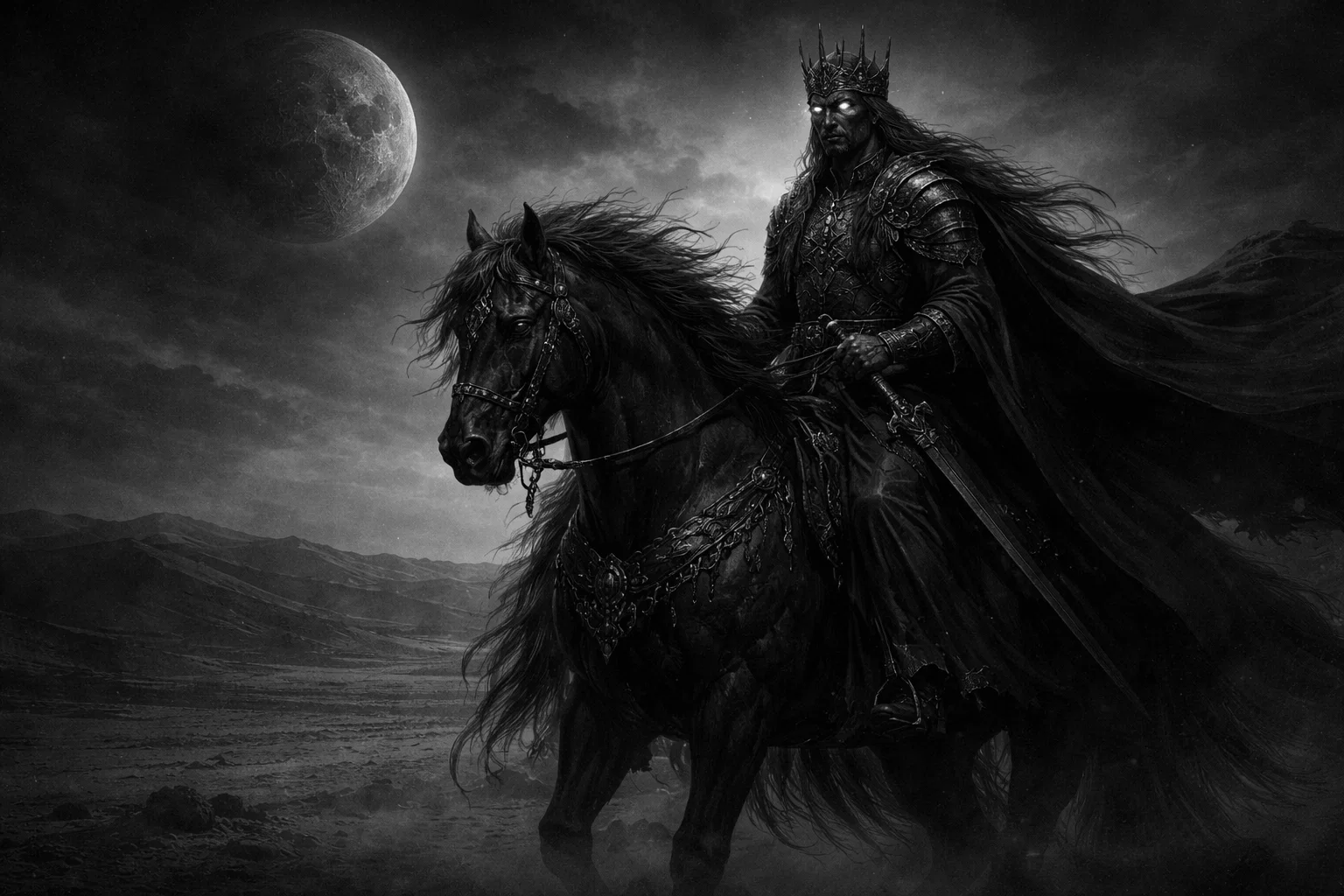
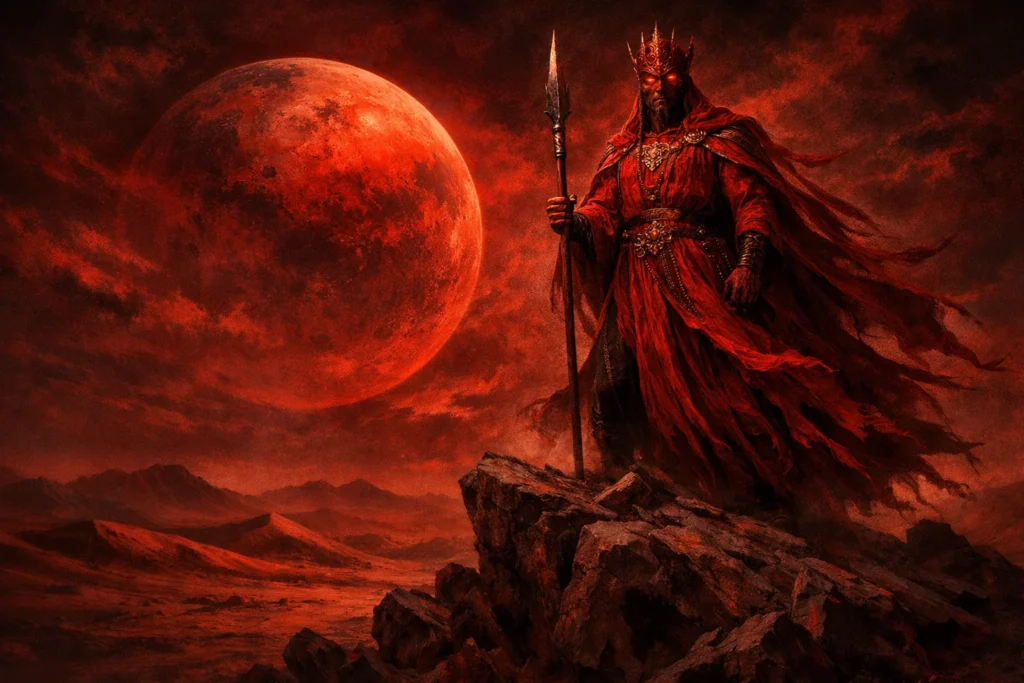
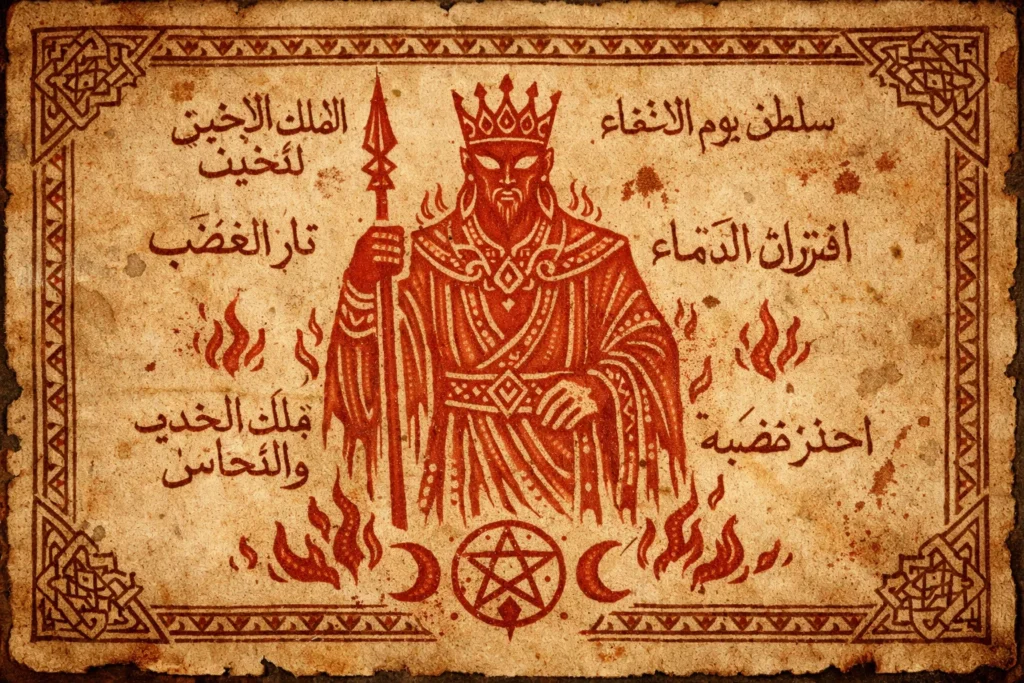
Classical Arabic grimoires, such as the Shams al-Ma’arif, describe Al-Ahmar as a tall and fearsome entity. He is usually shown wearing red clothes, a red crown, and a red silk robe. His skin is often said to be reddish or copper-colored, showing his link to fire and metals like copper or iron.
Some stories say his eyes glow like embers and his breath smells of sulfur or burning wood. He is often shown holding a spear or sword, which stands for his control over war and the conflict linked to Tuesday.
Some sources say he rides a red animal, like a horse or lion, which shows his warlike and fierce nature. Unlike the more monstrous Ifrits, Al-Ahmar looks regal and human-like, fitting his role as a Jinn king.
You may also enjoy:
Ammit: Devourer of the Dead in Ancient Egyptian Mythology
November 10, 2025
Who Was Ravana in Hindu Mythology and Why Was He Feared?
October 3, 2025
Who Is Adrammelech in Demonology and the Bible?
October 1, 2025
What Is a Tengu? Origins, Powers, and Dark Folklore
January 29, 2026
What Is Qarin and Why Does It Follow Every Human Being?
October 8, 2025
Abura-akago: The Oil-Licking Demon Baby
October 22, 2025
Origins
Al-Ahmar’s origins come from a mix of pre-Islamic Arabian folklore and later Islamic astrological magic. Before Islam, Arabs believed the desert was home to many Jinn tribes, each linked to natural events. When Islam spread, and new ideas were translated, these beliefs blended with Hellenistic astrology and Persian demon stories.
Al-Ahmar became a well-defined creature in the medieval period, when scholars organized the “Seven Kings.” Each king was linked to a day of the week, matching the seven known planets and seven archangels.
The Quran says that Jinn exist and are made from smokeless fire, but it does not mention the seven kings by name. Writers like Ahmad al-Buni helped make figures like Al-Ahmar well-known by adding tribal Jinn stories to a larger spiritual system.
Over time, Al-Ahmar changed from a local desert spirit to the “Red King,” known throughout the Islamic world as the ruler of Tuesday’s spiritual forces.
NAME THEM. BIND THEM. CAST THEM OUT! Limited-Time: Up to 40% OFF!
The ultimate deliverance thesaurus by Apostle John Eckhardt. Hundreds of demonic names & attributes exposed alphabetically – from Jezebel to Python, infirmity to poverty. Hundreds of demons named & defeated Identify → Bind → Cast Out!
The essential weapon for every prayer warrior, intercessor, and deliverance minister. Victory starts with identification.

Was Al-Ahmar Ever Mentioned in the Quran or Hadith?
Al-Ahmar is not mentioned in the Quran or in the main Hadith collections, such as Sahih Bukhari or Sahih Muslim. The Quran talks about Jinn as a group and mentions some individuals, such as Iblis, but does not describe the seven planetary kings.
These figures are part of Ilm al-Ghayb (knowledge of the unseen) and Sihr (magic), topics found in special occult books rather than main religious texts.
Al-Ahmar in Other Texts
Al-Ahmar is a key entity in medieval Arabic grimoires and “books of wonders.” He is especially featured in the Shams al-Ma’arif al-Kubra by Ahmad al-Buni and the Manba’ Usul al-Hikmah.
| Source | Quote |
| Shams al-Ma’arif | “The fourth of the kings is Al-Ahmar, and he is the servant of Tuesday and the planet Mars, and the angel who compels him is Samsama’il.” |
| The Picatrix (Ghayat al-Hakim) | “The spirits of Mars are red of color, high of stature, and they move with the speed of fire, being led by their king in the hour of Tuesday.” |
Powers and Abilities
Al-Ahmar is much more powerful than the lesser Jinn because he is a King who leads many followers. While ordinary Jinn might cause small problems, Al-Ahmar controls big events like wars, epidemics, and major accidents.
He is considered the “Executioner” among the seven kings.
- Pyrokinesis: The ability to control and manifest heat and fire.
- Inducing Bloodshed: He is believed to incite violence, anger, and physical conflict between individuals or groups.
- Affliction of Disease: Specifically associated with “red” ailments, such as high fevers, rashes, and blood disorders.
- Command over Iron: As Mars rules iron, Al-Ahmar can influence weapons and tools made of this metal.
- Invisibility and Metamorphosis: Standard Jinn abilities, though he prefers appearing in his red regal form.
- Granting Military Success: Historically, he was sought by those wishing to defeat enemies in battle, though this comes with a heavy price.
Influence on Humans and Possession
Al-Ahmar’s influence is said to show up mainly through emotions. Someone affected by him might feel sudden anger, want to be violent, or become fixated on sharp objects.
Unlike the “waswas” (whispers) of ordinary devils, the Red King’s influence is felt as heat in the body. Signs of his presence or possession often include ongoing high fevers that don’t get better with medicine, unexplained red marks or burns on the skin, and strong nightmares about fire or war.
You may also enjoy:
Alû: The Mesopotamian Demon of Malevolence and Pestilence
November 10, 2025
What Is a Dīv? The Terrifying Giant Demon of Persian Myth
January 22, 2026
Who Is Asmodeus in Demonology and the Bible?
February 18, 2026
Amaymon: The Infernal King Who Commands Death and Decay
November 17, 2025
What Is Baku? The Japanese Yōkai That Eats Nightmares
January 28, 2026
Who Is the Infernal King Balam? Origins, Powers, and Occult History
February 26, 2026
Protection and Exorcism Methods
Traditional ways to protect against Al-Ahmar aim to reduce the “heat” linked to his nature.
- Specific Verses: Reciting Ayat al-Kursi (The Throne Verse) is the primary defense against any Jinn.
- Cooling Elements: In the past, people used water blessed by the gods to fight their fiery nature.
- Lead and Iron Amulets: Talismans with the name of his opposing angel, Samsama’il, are used to control him.
- Color Avoidance: Some traditions say to avoid wearing red on Tuesdays to stay safe from his influence.
- Incense: Grimoires suggest avoiding strong, “hot” smells and using cooling scents, such as sandalwood, instead.
Al-Ahmar vs Other Jinn
| Jinn Name | Associated Traits/Influence | Rank/Origin | Key Traits/Powers |
| Al-Mudhib | Greed and gold | King of Sunday | Commands the sun’s influence |
| Murrah | Pride and deception | King of Monday | Associated with the Moon |
| Barqan | Knowledge and secrets | King of Wednesday | Associated with Mercury |
| Shamhurish | Justice and law | King of Thursday | Associated with Jupiter |
| Zawba’a | Storms and dust | King of Friday | Associated with Venus |
| Maymun | Pain and darkness | King of Saturday | Associated with Saturn |
| Iblis | Ultimate rebellion | Father of Shayatin | Leading humanity astray |
| Pazuzu | Famine and locusts | Ancient Mesopotamian | Wind manipulation |
| Hinn | Weakness and shadows | Lowest Jinn class | Often appear as dogs |
| Si’lat | Seduction/Forests | Shape-shifter | Expert at mimicking humans |
| Marid | Arrogance | High-ranking | Water-based, immense strength |
| Ifrit | Malice | Underworld spirits | Immense cunning and fire |
Position Among Jinn
Al-Ahmar has a high rank among the Jinn. He is one of the Muluk al-Arba’a (Kings of the Four) or, more often, the Muluk al-Sab’a (Seven Kings). He is not a servant of Iblis, but a ruler of the earth who follows the divine laws of the heavens and planets.
He has a strict relationship with the other kings. Shamhurish, the King of Jupiter and Thursday, balances Al-Ahmar’s destructive side with justice and growth. This “divine tension” among the kings keeps Mars’s influence from taking over the world too soon.
Mystical Correspondences
| Attribute | Details |
| Planet | Mars |
| Zodiac Sign | Aries / Scorpio |
| Element | Fire |
| Direction | South / East (depending on the ritual system) |
| Color | Red / Crimson |
| Number | 9 (The number of Mars) |
| Crystal/Mineral | Ruby, Garnet, Red Jasper |
| Metal | Iron / Copper |
| Herb/Plant | Garlic, Mustard, Hawthorn, Tobacco |
| Animal | Ram, Wolf, Lion, Horse |
Al-Ahmar’s mystical connections show his wild and aggressive nature. His links to Mars and the signs Aries and Scorpio make him a symbol of action and destruction. Aries represents outward fighting, while Scorpio represents inner struggles and strong feelings. He is most powerful during the hour of Mars.
His fire element connects him to the South, a direction often linked to heat. Iron is used in his talismans to control his wild energy, since iron is the metal of warriors.
His red color and the number 9 show his high rank. Herbs like garlic or mustard, which are known for their strong and hot qualities, also highlight his role as a force that destroys both obstacles and peace.
THE BOOK THEY BANNED FROM THE BIBLE Limited-Time: Up to 90% OFF!
Why was Enoch removed? The fallen Watchers • The birth of the Nephilim • Origin of demons • Names of the angels who became demons • Apocalyptic visions. The original source text that inspired all demonology. Read the apocalyptic visions the church didn’t want you to see.
Al-Ahmar’s Sigil
Al-Ahmar has several known sigils and seals in the Shams al-Ma’arif. These are complex geometric designs that often include Arabic letters linked to Mars. In the past, people drew these sigils on iron plates or red parchment to make talismans. They were used to call on his power for protection in war or to keep him from causing fevers or harm at home.
Summoning and Rituals
Old grimoires describe ways to contact Al-Ahmar. These rituals usually involved wearing red clothes, burning strong incense such as sulfur or asafoetida, and performing the ceremony on a Tuesday during the hour of Mars.
A magic circle was needed for safety, often marked with the name of the archangel Samsama’il to control the Jinn king. The person performing the ritual would use special words to “call the King of the Red,” asking for his presence by using the authority of the Ring of Solomon.
You may also enjoy:
Palis: The Foot-Licking Desert Jinn That Drinks Your Blood
December 3, 2025
Bali: The Benevolent Asura King of Hindu Mythology
October 10, 2025
What Is a Rakshasa? Meaning, Origins, and Dark Powers
January 23, 2026
Iblis, the Jinn King of Darkness and Deception
September 29, 2025
Who Is Abalam in Demonology? The Demon King That Serves Paimon
September 30, 2025
Who Is Baal in Christian Demonology?
February 25, 2026
Frequently Asked Questions
Which part of the human body does Al-Ahmar specifically target?
Classical Arabic grimoires and folk medicine say Al-Ahmar targets the head and uterus. For “red” illnesses, he is blamed for bad migraines, brain bleeds, and problems with menstruation or fertility. Healers would focus their protective spells on these areas when they thought someone was affected by the King of Tuesday.
Does Al-Ahmar have a deputy or second-in-command?
Yes, Al-Ahmar has a strong Ifrit deputy named Sughal (sometimes spelled Saghal). Among the seven Jinn kings, each has a top “strongman” who carries out their orders. Sughal is known as a fierce and rebellious spirit who leads the smaller Tuesday Jinn tribes under the Red King’s command.
Who is the eldest son of Al-Ahmar?
In Jinn stories, Al-Ahmar is often called Abu al-Tawabi’, meaning “Father of the Qarins.” Usually, “Qarin” means a personal spirit companion, but here it means his family line is the source of the male spirits called Tawabi’. These spirits are seen as his children and are thought to be as destructive as he is.
Can Al-Ahmar be identified by a specific physical sound?
Old stories and folk beliefs say that Al-Ahmar’s presence is often marked by the sound of clashing metal or ringing iron. Since he is linked to Mars and iron, his arrival is said to bring a “martial” feeling, with metal sounds happening for no clear reason, showing his connection to war and weapons.
Is Al-Ahmar related to modern pop culture figures?
The name Al-Ahmar appears in modern entertainment, especially in the video game Genshin Impact, where King Deshret is also called Al-Ahmar. In the game, he is a made-up god of a desert people. Still, his title and “Red King” image are based on the real and mythical Red King of the Jinn, mixing old occult stories with modern fantasy.
