
Aim (or Aym) is a powerful demonic entity in Christian demonology. He is prominently mentioned in various grimoires that detail the summoning and commanding of infernal spirits. He is cataloged as the 23rd spirit among the 72 demons listed in the Ars Goetia, the first book of the Lesser Key of Solomon.
In this hierarchy, Aim is a Great Duke of Hell. His primary dominion involves bringing about destruction through fire, granting knowledge about private affairs, and increasing malice or cunning in men.
His traditional descriptions emphasize his terrifying, yet composite, physical form, reflecting his destructive and secretive nature within the demonological tradition.
Summary
Key Takeaways
| Attribute | Details |
| Names | Aim, Aym, Aini, Haborym |
| Title | Great Duke |
| Gender | Male |
| Role | Destroyer, arsonist, tempter through fire and secrets, inciter of malice |
| Rank | Duke (High-ranking noble of Hell) |
| Hierarchy | Autonomous Duke, subject to Lucifer/Satan |
| Legions | Twenty-six legions of spirits |
| Powers | Causes the destruction of cities, castles, and great places by fire; grants true answers about private matters; bestows wit and cunning; grants temporary invisibility |
| Associated Figures | King Solomon (as the summoner) |
| Weaknesses | Bound by the Solomonic Triangle and Ring; constrained by the True Name of God; repelled by the Pentagram of Solomon |
| Opposing Angel/Saint | Angel Nelchael (governs the time of his appearance) |
| Pantheon | Christian Demonology (Solomonic tradition) |
| Primary Sources | Ars Goetia (Lesser Key of Solomon), Pseudomonarchia Daemonum (Weyer’s Catalog), Dictionnaire Infernal |
Who or What is Aim?
Aim is identified in esoteric and occult texts, specifically the Solomonic grimoires, as a Great Duke of the infernal hierarchy.
He is one of the 72 spirits supposedly bound and confined by King Solomon in a brazen vessel, whose secrets and powers were later compiled in the Lesser Key of Solomon. His authority places him high in the demonic order, enabling him to command a substantial force of lesser spirits.
His core function is intrinsically tied to destruction by conflagration and the manipulation of hidden knowledge. Aim is considered a dangerous spirit due to his control over fire, which he uses to raze large structures and settlements.
He also holds a more subtle, yet malign, influence by providing precise, truthful information on deeply private matters and by enhancing the malice and cunning of those who summon him.
“Aim” Meaning
The name Aim (variations include Aym, Aini, and Haborym) has an uncertain etymology in the context of demonology. The most significant variant, Haborym, appears in the Pseudomonarchia Daemonum by Johann Weyer, published in 1563, where the entry states the spirit is called “Haborym or Aym.”
The name Haborym may be a corruption or phonetic transliteration of an earlier source, possibly linking to a Semitic or Hebrew root. One speculative interpretation links the name to Hebrew terms related to destruction or fire, aligning directly with his core power.
Another theory posits that it may be derived from Aini, another listed variant, which may have roots in various ancient names. However, no definitive linguistic source is established in the grimoires themselves.
The continued use of the simpler form, Aim or Aym, across multiple authoritative texts (including the infamous Ars Goetia), suggests that this spelling became the most widely accepted terminology within the occult tradition.
Overall, the ambiguity of the name’s origin adds to the demon’s mysterious and ancient nature.
You may also enjoy:
Edimmu: The Mesopotamian Wind Demon That Steals Life
November 6, 2025
Rokurokubi: The Yokai That Looks Human Until Midnight
February 3, 2026
Yuki Onna: The Terrifying Demon Bride Who Feeds on Travelers
December 9, 2025
Iblis, the Jinn King of Darkness and Deception
September 29, 2025
Al-Ahmar: The Tuesday King of the Seven Jinn
February 13, 2026
Abura-sumashi: The Potato-Headed Yōkai That Punishes Greed
October 23, 2025
How to Pronounce “Aim” in English
The name Aim is typically pronounced the same way as the English word “aim,” which is AYM (rhymes with tame or claim). The variant Aym is pronounced identically. The other major variant, Haborym, is usually pronounced as HA-bor-im.
What Does Aim Look Like?
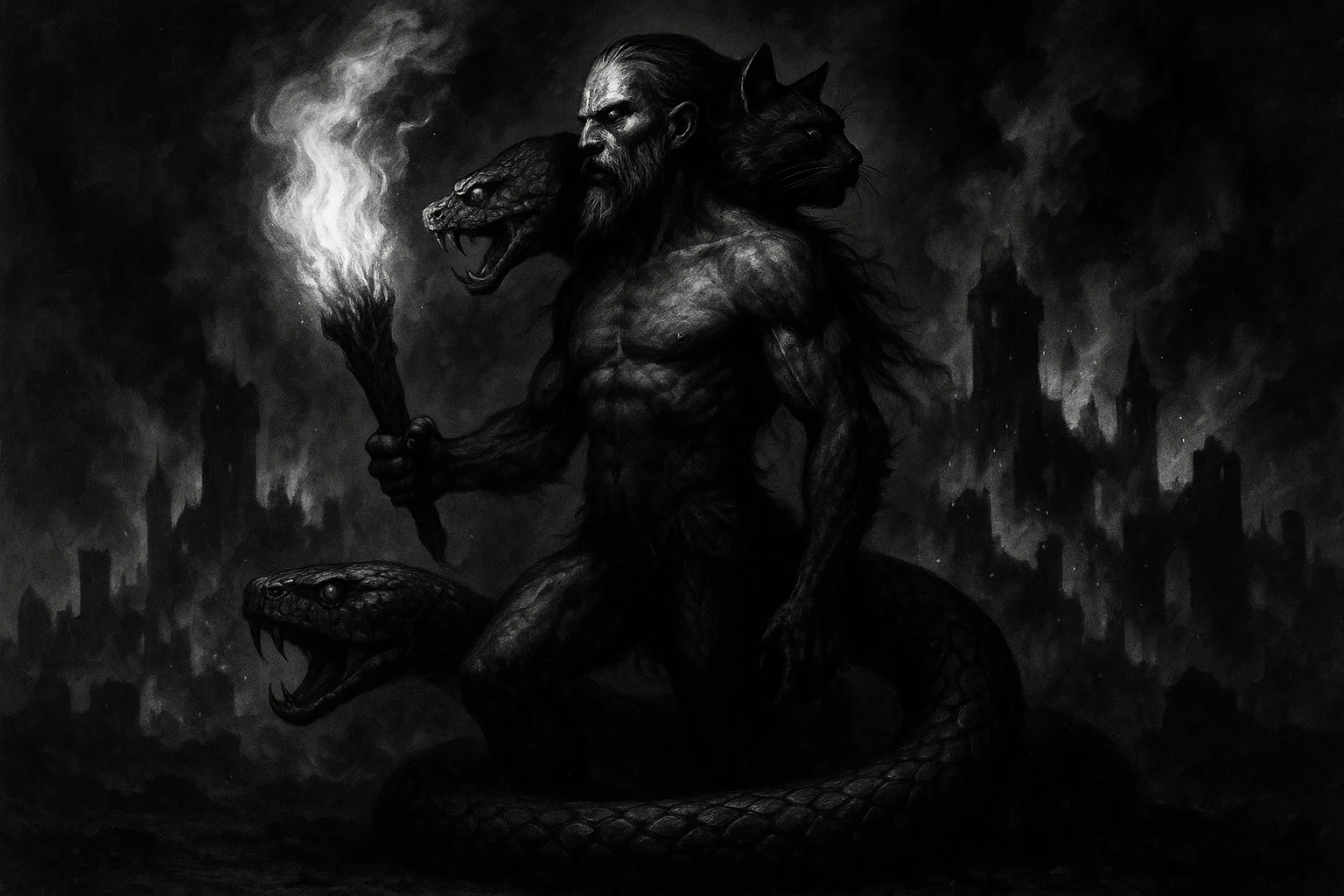
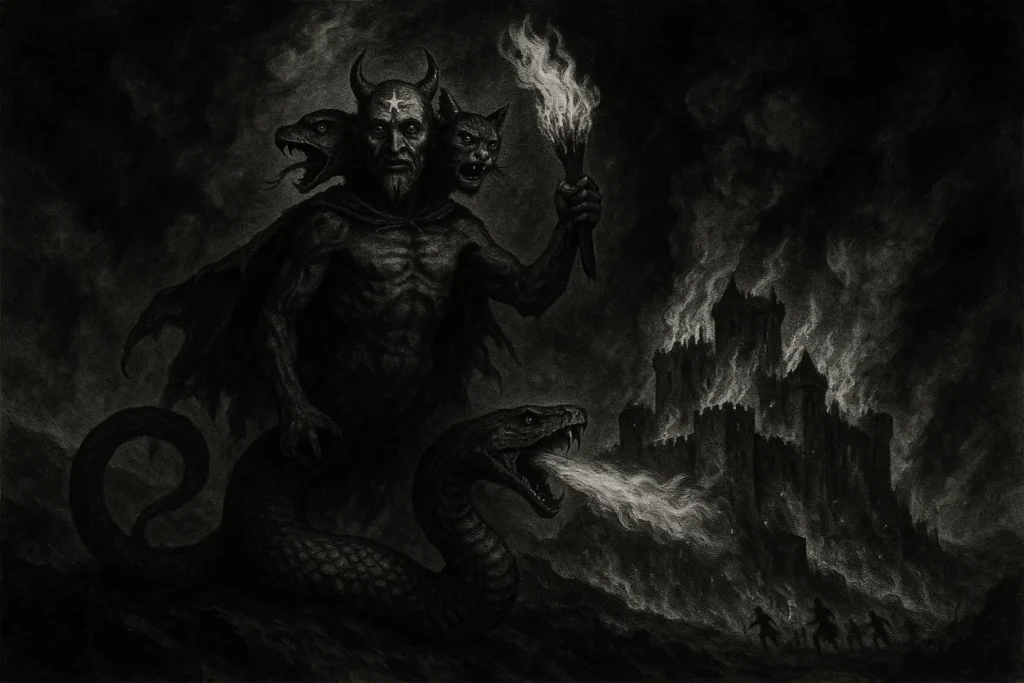
Aim’s physical appearance is consistently described across the primary grimoires as a strange and fearsome composite figure. The Ars Goetia and Pseudomonarchia Daemonum both provide similar key details regarding his form. In these grimoires, Aim is depicted as a very powerful man with three heads.
The first head is that of a serpent (symbolizing deceit and ancient evil). The second head is that of a man with two stars on his brow (possibly indicating a perverse wisdom or connection to the stars). The third head is that of a cat (or, in older translations, a calf), perhaps symbolizing cunning, agility, or the unpredictability of destruction.
Aim is also often shown riding upon a viper (or sometimes a bear). The most telling detail, which relates directly to his powers, is that he holds a burning brand (a firebrand) in his hand, which he uses to enact the destruction he commands.
This composite, chimeric form is typical of higher-ranking demons in Solomonic lore, stressing their unnatural, multifaceted evil.
Origins
The documented origin of Aim is primarily within the specific tradition of Solomonic magic, an esoteric body of work that claims to derive its authority from the Biblical King Solomon.
There is no known genealogy for this Christian demon. But that is the case with most individual Goetic demons. Their creation is simply ascribed to the initial fall of the angels, and they become part of the collective infernal host.
Aim’s earliest documented appearances are in the texts that form the Solomonic cycle. The first major appearance is in the 16th-century texts that codified the demonic hierarchy, namely the Pseudomonarchia Daemonum (1563) by Johann Weyer and the later and more influential (but anonymous) Lesser Key of Solomon (Ars Goetia), likely compiled in the mid-17th century.
These works solidified his name, rank (Duke), power (fire and secrets), and legion count (26). Over time, Aim’s depiction has remained remarkably stable. His role as the duke of fire and secret knowledge has not significantly evolved in the demonological literature, cementing his place as a specialized figure of arson and malice.
Was Aim Ever Mentioned in the Bible?
Aim is not mentioned in the Bible (either the Old Testament, the New Testament, or the Apocrypha). The names Aim, Aym, or Haborym do not appear in any standard scriptural translation or traditional theological context.
Aim is an entity specific to the later traditions of Christian demonology and occultism, particularly the grimoires associated with the legendary magic of King Solomon.
Aim in Grimoires and Other Texts
Aim’s primary documentation comes from two key grimoires that list the 72 spirits of Solomon. His descriptions across these sources are highly consistent, which is characteristic of the Solomonic tradition’s structured approach to cataloging the infernal hosts.
| Source | Quote |
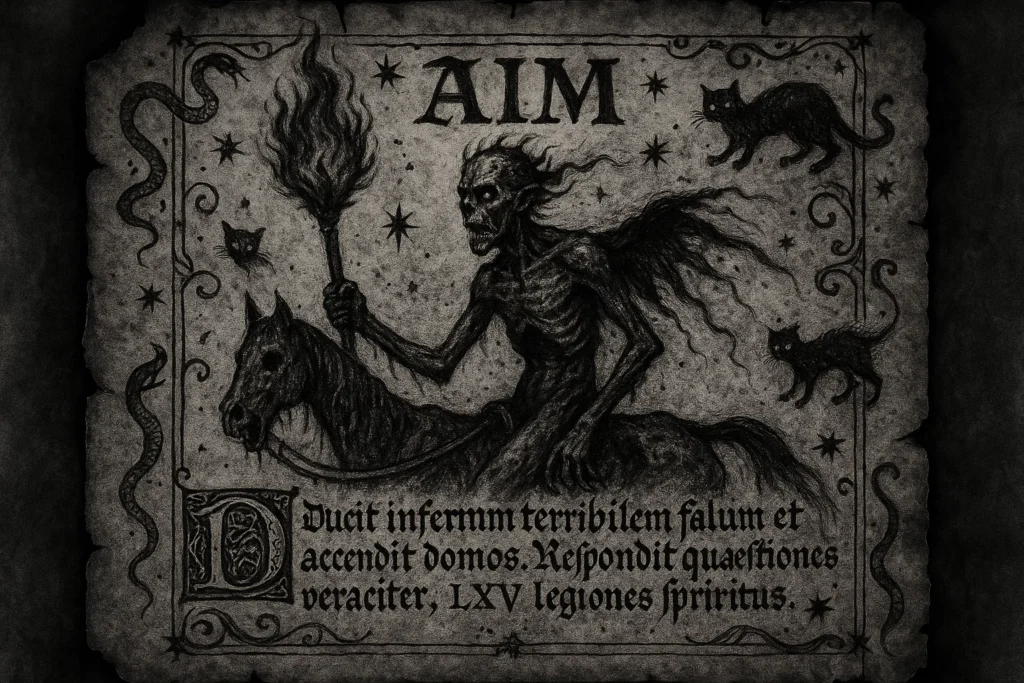
| Pseudomonarchia Daemonum | The two and twentith spirit is called Haborym, or Aym, a great Duke, he commeth foorth with three heads, the first like a serpent, the second like a man with two starres in his forehead, the third like a cat: he rideth on a viper, having a fierbrand in his hand, which he useth to set cities, castles, and great places on fire; he maketh a man wittie in all manner of waies, and gives true answers of private things; he hath under him six and twentie legions. |
| Lesser Key of Solomon (Ars Goetia, Spirit 23) | The Twenty Third Spirit is called Aim, or Aym. He is a Great Strong Duke. He appeareth in the form of a very handsome Man, but with Three Heads; the first, like a Serpent, the second like a Man with Two Stars on his Forehead, and the third like a Cat. He rideth upon a Viper, having a great Fire-brand in his hand, wherewith he setteth all the Places that are about him on Fire. He maketh one Witty in all manner of ways, and giveth true answers unto private matters. He ruleth over Twenty-six Legions of Spirits. His Seal is this, which wear thou as aforesaid, etc. |
Powers and Abilities
Aim’s documented powers and abilities are almost entirely malign or focused on enhancing human malice, in line with his nature as a Great Duke of Hell:
- Arson and Destruction: His most feared ability is his power to cause massive conflagrations. He uses the firebrand he carries to burn and destroy cities, castles, and great places, reflecting a domain over widespread, destructive acts of fire.
- Granting Cunning: Aim is said to make a man witty in all manner of ways or to make one cunning and quick-witted. This ability is generally viewed negatively, implying that the wit is used for malicious or selfish purposes.
- Divination of Secrets: He gives true answers unto private matters (or private things). This power allows the summoner to learn concealed truths about personal affairs, scandals, or hidden information, which can then be used for manipulation, blackmail, or destructive means.
- Command over Legions: As a Great Duke, Aim commands twenty-six legions of lesser spirits, utilizing them to carry out his destructive and secretive dictates across the material world.
Aim Myths, Legends, and Stories
Aim is a figure deeply embedded in the Solomonic grimoire tradition, which is primarily a technical catalog of spirits and their powers rather than a collection of detailed narratives. As such, he is not the subject of extensive myths, parables, or folklore outside of his inclusion in the Ars Goetia and similar texts.
The existing “story” is the foundational legend of the Seventy-Two Spirits of Solomon.
You may also enjoy:
Who Is Taṇhā, the Seductive Demon of Craving in Buddhist Mythology?
October 15, 2025
Vaisravana: The Golden Guardian King Who Rules the North
October 16, 2025
Who Was Hiranyaksha, the Golden-Eyed Asura?
October 7, 2025
Tarakasura: The Dark Demon Who Ruled Hell on Earth
December 4, 2025
Mara: The Buddhist Demon King of Desire and Death
October 13, 2025
Who Is Abaddon, the Demon of the Abyss, in the Bible?
September 29, 2025
Aim’s Binding in the Lesser Key of Solomon
Aim’s appearance in the Ars Goetia is part of the overarching legend in which King Solomon used his divine wisdom and God-granted power over spirits to capture and bind 72 powerful demons into a brass vessel.
This act was not meant to destroy the demons but to compel them to serve him, forcing them to reveal their powers, grant knowledge, or perform services for the King.
Aim, as the 23rd spirit, was thus subjected to Solomon’s authority. His specific mention outlines his rank, appearance, and powers—the ability to destroy with fire and to reveal secrets—which Solomon would then have extracted and utilized.
The central narrative is a testament to the magician (Solomon) ‘s power to control the demon, with the grimoire serving as a subsequent instruction manual for repeating this magical subjugation.
Aim vs Other Christian Demons
| Demon Name | Associated Sin/Temptation | Rank/Origin | Key Traits/Powers |
| Bael | Idol Worship/Self-worship | King (Ars Goetia) | Commands 66 legions; appears with three heads (man, toad, cat); grants invisibility. |
| Purson | Lawlessness/Falsehood | Great King (Ars Goetia) | Reveals all things past, present, and to come; can find treasure; appears as a lion-headed man riding a bear. |
| Asmodeus | Lust/Gambling | King (Binsfeld’s 7 Deadly Sins) | Tempter; teaches geometry and astronomy; can make a man invisible. |
| Mammon | Greed/Materialism | Prince (New Testament/Theology) | Personification of wealth; tempts through avarice and worldly gain. |
| Vassago | Secrets/Divination | Prince (Ars Goetia) | Declares past, present, and future; reveals things hidden or lost; benign reputation in some traditions. |
| Paimon | Pride/Ritual | King (Ars Goetia) | Commands 200 legions; teaches all arts and sciences; appears riding a dromedary. |
| Beelzebub | Gluttony/Idolatry | Prince (New Testament/Theology) | Lord of the Flies; one of the highest-ranking fallen angels; tempter toward false gods. |
| Gremory | Lust/Secrets | Duke (Ars Goetia) | Tells of all things past and to come; shows where treasure lies; appears as a beautiful woman riding a camel. |
| Glasya-Labolas | Homicide/Bloodshed | President/Earl (Ars Goetia) | Instigator of murder; causes love and bloodshed; appears as a dog with griffin wings. |
| Belial | Corruption/Lawlessness | King (Lesser Key of Solomon) | Lies unless compelled; commands 80 legions; grants high-ranking titles and favor. |
| Sallos | Immoral Love/Lust | Great Duke (Ars Goetia) | Causes men to love women and women to love men; appears as a soldier riding a crocodile. |
| Bifrons | Necromancy/Astronomy | Earl (Ars Goetia) | Changes corpses’ places; teaches geometry and astronomy; appears as a monster until commanded. |
Rank in the Hierarchy of Hell
Aim holds the rank of a Duke (or Great Duke) in the infernal hierarchy, a position of considerable power and nobility. Within the system established by the Ars Goetia, the Dukes rank among the highest echelons of Hell’s nobility, second only to the Kings.
As a Duke, Aim commands a substantial military force, specifically twenty-six legions of lesser spirits. This large contingent highlights his significant capacity for global influence and destructive acts.
His primary function is to serve the higher-ranking powers of Hell, ultimately Lucifer/Satan, by carrying out specific, high-impact tasks in the mortal world. His focus on destruction by fire and the manipulation of private knowledge suggests a specialized role as both an engine of chaos and a purveyor of tools for human manipulation and corruption.
While he does not serve directly under another specific demon according to the texts, his title implies independence and dominion over his own legions within the broader, structured bureaucracy of Hell.
Mystical Correspondences
| Attribute | Details |
| Planet | Jupiter |
| Zodiac Sign | Cancer |
| Element | Water |
| Direction | West |
| Color | Purple, Blue |
| Number | 23 (His spirit number) |
| Crystal/Mineral | Sapphire |
| Metal | Tin |
| Herb/Plant | Agrimony, Peony |
| Animal | Cat, Serpent, Viper |
Aim’s mystical correspondences, drawn from the Solomonic tradition’s system of planetary and zodiacal hours, are crucial for understanding the timing and context of his summons.
He is generally associated with the planet Jupiter and the zodiac sign of Cancer. Jupiter, traditionally linked to dominion and expansion, perversely fuels Aim’s power to expand his destructive influence and command his numerous legions. It also relates to the ‘Great Duke’ title, a noble rank.
The sign of Cancer, associated with hidden things, the past, and home, aligns with Aim’s power to grant true answers to private matters, suggesting an infernal capacity to invade and reveal the deepest secrets of one’s personal life and domestic domain.
The elemental association of Water for a demon of Fire is a paradoxical coupling, likely representing the demonic inversion of natural order. Water, which typically controls fire, may symbolize the hidden emotional depths and secrets Aim reveals, which, when brought to light, have the capacity to burn and destroy.
These celestial and elemental ties were believed to concentrate his evil nature, making rituals performed during Jupiter’s hours or during the Cancer zodiac period particularly potent for invoking his destructive and deceitful assistance.
Aim’s Sigil
The sigil, or seal, of Aim is a unique magical character used in the summoning rituals. It is an intricate, non-representational symbol designed to visually represent the essence and true name of the demon, acting as a mandatory talisman for the operative magician.
In the Ars Goetia, the instruction is to create a seal, wear it as a lamen (a magical breastplate), and show it to the spirit upon his appearance. This action is not a mark of worship. Still, a symbol of authority, used to bind and compel the demon to obey the commands of the summoner.
The seal’s construction must be accurate; its geometrical pattern is believed to hold the demon’s essence and, when correctly consecrated, offers the magician protection from Aim’s considerable power.
Summoning and Rituals
The process of summoning Aim, as detailed in the Solomonic grimoires, is a highly structured and dangerous ritual designed to compel obedience from the Great Duke of Hell without succumbing to his destructive powers.
The central component of the ritual is the Magic Circle drawn on the ground, within which the magician stands for protection. Aim is then summoned to appear in the Triangle of Art, placed outside the circle, which serves as a temporary, constrained vessel for the demon.
The magician must wear the Sigil of Aim (often engraved on a metal disk or inscribed on parchment) as a lamen around their neck, symbolizing the authority derived from King Solomon. The summoning process involves reciting a series of incantations or consecrated prayers that invoke the True Name of God to overpower and bind Aim.
The purpose of compelling Aim was strictly utilitarian: to force him to use his abilities—either to burn cities and castles or to reveal hidden truths about private matters—under the strict control of the magician.
You may also enjoy:
What Is a Rakshasa? Meaning, Origins, and Dark Powers
January 23, 2026
Setcheh: Egypt’s Soul-Stealing Ancient Demon
November 11, 2025
Demon Amy, the 58th Goetic Spirit: Origin, Powers, and Rank
January 12, 2026
Alû: The Mesopotamian Demon of Malevolence and Pestilence
November 10, 2025
Si’la: The Seductive Jinn Who Lures Travelers to Their Doom
October 9, 2025
Who Was Ravana in Hindu Mythology and Why Was He Feared?
October 3, 2025
Frequently Asked Questions
Is Aim a major demon in Christian theology or the Bible?
Aim (Aym or Haborym) is not considered a major figure in traditional Christian theology or the Bible. His prominence is strictly confined to the occult tradition of Christian demonology, specifically the Ars Goetia grimoire. Aim is classified as a Great Duke of Hell in these esoteric texts. Still, it holds no doctrinal importance in mainstream religious practice.
What is the difference between Aim and Haborym?
Aim and Haborym are two names for the same demonic entity in Solomonic lore. The name Haborym appears in the earlier source, the Pseudomonarchia Daemonum (1563), by Johann Weyer, who listed him as “Haborym or Aym.” The later, more widely known Ars Goetia uses the name Aim (or Aym) primarily. Both names refer to the same spirit, which is the 23rd Great Duke, who commands 26 legions.
Which angel from the Shem HaMephorash is associated with neutralizing the demon Aim?
The demon Aim is countered by the Holy Angel Nelchael (or Nelkhael) from the Shem HaMephorash (the 72 Names of God). In some occult traditions, specifically those compiled by Thomas Rudd, each of the 72 Goetic demons is paired with a specific angel to grant the summoner authority and protection. Nelchael’s influence governs the time when Aim can be summoned and is believed to constrain the Duke’s destructive nature.
What is the specific meaning of the two stars on Aim’s forehead?
The meaning of the two stars on the man’s head (one of Aim’s three heads) is debated among esoteric researchers. They are generally interpreted as symbolizing a perverse or infernal wisdom or a false illumination. The stars may reference a distorted connection to celestial knowledge, reflecting his power to give “true answers unto private matters.” However, this knowledge is used to increase malice.
Why is the metal Tin associated with the demon Aim?
The metal Tin is associated with Aim because of his ruling planet, Jupiter. In classical and occult planetary correspondences, Jupiter rules over the metal Tin. For rituals involving Aim, the Talismans or lamen used to constrain him, while typically gold or silver, could be made of or marked with Tin during Jupiterian hours to align the operation with the demon’s celestial influence, theoretically maximizing control over his destructive domain.
Which other demonic figures have powers similar to Aim’s control over fire?
The power to command or utilize fire is shared by several Goetic demons. However, Aim is noted for its scale (burning cities and castles). Other figures with strong fire associations include:
– Flauros (Duke, 64th Spirit): Commanded to burn the magician’s enemies.
– Vepar (Duke, 42nd Spirit): Causes the sea to be “full of ships” and often has power over destructive storms, which can include lightning and fire.
However, Aim’s destructive influence on human structures, specifically via fire, is generally considered his primary and defining power.
