
Al-Abyad is an important entity in Islamic occultism and Arabic grimoires, known as one of the seven great Jinn kings. He is linked to Friday and the planet Venus. Al-Abyad is associated with the color white and is usually shown as a powerful king who leads many spirits and is influenced by certain celestial and angelic forces.
Summary
Key Takeaways
| Attribute | Details |
| Names | Al-Abyad, Abu Afif, the White King, al-Malik al-Abyad |
| Type | Planetary Jinn King |
| Title | King of Friday, Servant of the Planet Venus |
| Gender | Male |
| Servitors | Zoba’ah (in some traditions), various lower spirits of Friday |
| Superior Jinn | None specified (Independent King) |
| Powers | Induces obsessive love, governs lust, creates discord or harmony in relationships, influences beauty and attraction. |
| Appearance | A regal figure dressed entirely in white, often wearing a white crown and riding a white horse. |
| Etymology | Arabic for “The White One.” |
| Associated Figures | Archangel Anyail (Anael), King Solomon. |
| Weaknesses | Divine names of God, specific Quranic recitations, authority of the Archangel Anyail. |
| Opposing Holy Figure | Archangel Anyail (Anael). |
| Social Structure or Tribe | Monarch of the Jinn of Friday. |
| Followers/Tribe Size | Commands a vast legion of spirits associated with the day of Friday. |
| Primary Sources | Shams al-Ma’arif (The Sun of Knowledge), Manba’ Usul al-Hikmah, various Arabic magical treatises. |
Who or What is Al-Abyad?
Al-Abyad is a unique entity in the Middle Eastern spiritual hierarchy. It is one of the seven Jinn kings on earth. Unlike the Shayatin, who are always harmful, Al-Abyad rules over a specific day of the week, which is Friday.
He is called a “Planetary King” because his actions and power are closely tied to the planet Venus. In Islamic magic, Al-Abyad is not just a wandering spirit but a ruler with his own court, ministers, and area of control. His job is to oversee the spiritual forces that appear on his day, serving as a link between higher angelic realms and the physical world.
1,000+ SPIRITS, GODS & GODDESSES AWAITING YOUR CALL. Limited-Time: Up to 49% OFF!
The ultimate global spirit encyclopedia – 2,000+ entries from every culture on Earth. Fairies • Djinn • Demons • Loa • Angels • Deities • Ancestors Real names • True offerings • Ancient rituals that actually work. Judika Illes’ legendary masterwork – the one book every serious witch, mage, and spirit-worker owns.
“Al-Abyad” Meaning
The name Al-Abyad comes from the Arabic root a-b-y-ḍ, which means “the white” or “the white one.” This name describes his favorite color for clothing, his mount, and his bright appearance in spiritual visions. In the past, color-coded names for the seven Jinn kings, like Al-Ahmar (“the Red”) for Tuesday, helped people remember and organize their links to planets and elements.
Some manuscripts call him by his honorific, Abu Afif, which shows a more personal or familiar way of addressing him in certain talismanic traditions. Although Al-Abyad is the main name used in important works like the Shams al-Ma’arif, his name has stayed mostly the same throughout centuries of Arabic occult writings.
The name highlights his pure appearance, but this does not mean he is morally pure. Instead, it points to the bright and shining qualities of the planet Venus, which he is connected to.
How to Pronounce “Al-Abyad” in English
The name is pronounced ahl-ah-be-yad. The first part, “Al,” is like a short version of “all.” “Ab” is like the “ab” in “absolute,” and “yad” rhymes with “bad.” The stress is usually on the second syllable.
What Does Al-Abyad Look Like?
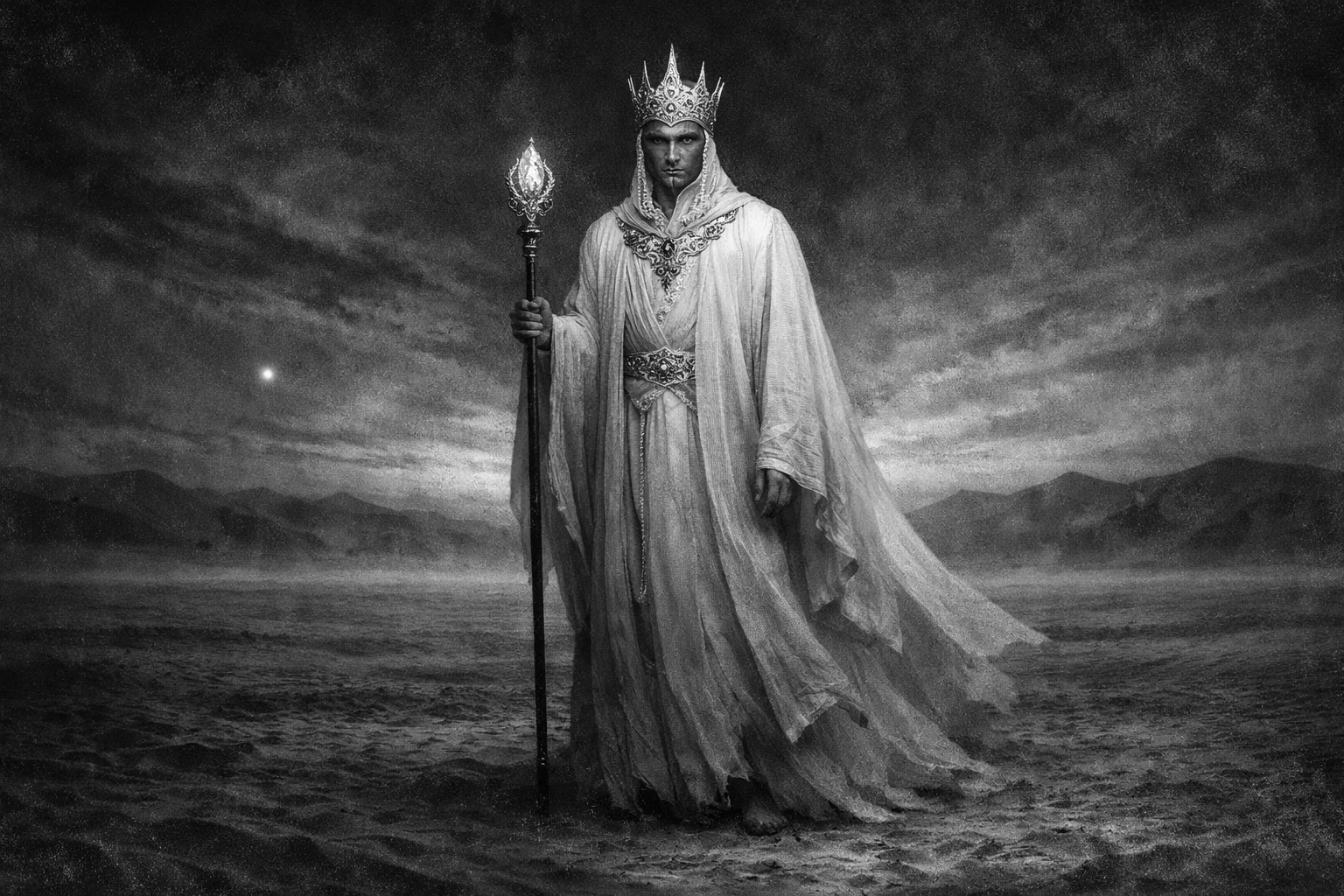
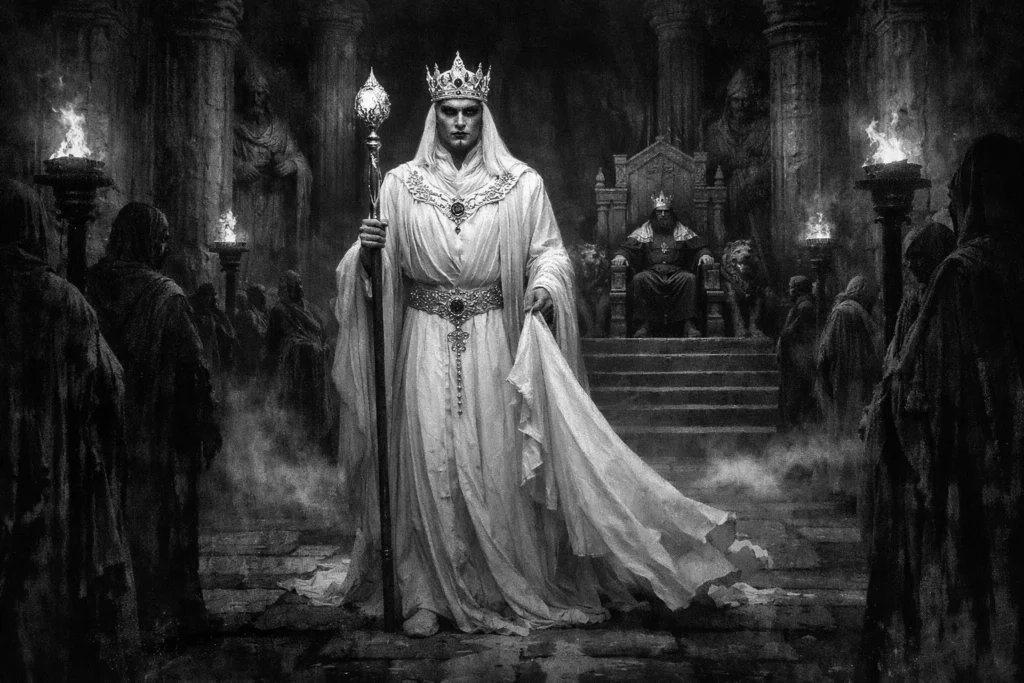
Classical Arabic grimoires and medieval occultists describe Al-Abyad as a regal and majestic king. The color white stands out in his appearance. He is usually shown wearing a pure white robe and a white crown decorated with jewels that shine like the planet Venus.
Many stories show him riding a white horse, which marks him as a warrior-king and a leader. He is usually described as having human features, with a dignified and handsome look that matches the beauty linked to his planetary ruler.
Some sources say he carries a white banner or a scepter, showing his role as a ruler of the Jinn. Unlike other spirits such as the Ghul or Ifrit, who are often described as monstrous, Al-Abyad keeps a human-like and noble appearance that reflects the refined influence of Venus.
Origins
Al-Abyad’s story comes from a mix of pre-Islamic Arabian folklore, Hellenistic astrology, and Islamic cosmology. Before Islam, Arabs believed in many spirits living in the desert and linked them to natural events. As Islamic civilization grew, these ideas became part of a more structured religious and occult system.
In the Abbasid Period, Greek and Persian astrology was introduced to the Arabic-speaking world through translations. This led to the creation of the “Seven Kings” system, where each day of the week had a Jinn king, an angel, and a planet. Al-Abyad became the ruler of Friday in this system.
This new way of thinking led people to see the Jinn as beings whose powers obeyed the laws of the heavens, not mere random forces. Al-Abyad is part of the “Lawful Jinn” group described in later occult books, which separates them from the chaotic Marid and highlights the organized rule of the seven kings.
You may also enjoy:
Abadir: The Demon Servant of Chaos and Dispersion
September 30, 2025
Who Is Azazel, the Demon Blamed for Human Corruption?
February 24, 2026
Palis: The Foot-Licking Desert Jinn That Drinks Your Blood
December 3, 2025
Aeshma: The Zoroastrian Demon of Wrath and Fury
January 13, 2026
What Is a Bhuta? The Backward-Footed Ghosts of Hindu Horror
February 5, 2026
What Is a Rakshasa? Meaning, Origins, and Dark Powers
January 23, 2026
Was Al-Abyad Ever Mentioned in the Quran or Hadith?
Al-Abyad is not named in the Quran or the Sahih Hadith. The Quran speaks of Jinn as a group and mentions their tribes and kings in general (as in Surah Al-Jinn), but it does not list the names of the seven planetary kings. These names and their details come from Islamic occult writings and folklore.
Al-Abyad in Other Texts
Al-Abyad is often mentioned in Shams al-Ma’arif al-Kubra, written by Ahmad al-Buni, and in Manba’ Usul al-Hikmah. These books are the main sources for learning about his part in talismanic magic.
| Source | Quote |
| Shams al-Ma’arif | “The king of Friday is Al-Abyad, and his companion from the angels is Anyail, and his planet is Venus.” |
| Arabic Magic MS | “Know that Al-Abyad is the servant of the day of Friday, clothed in white, and he is a mighty king among the Jinn.” |
SPEAK THEIR TRUE NAMES… IF YOU DARE
Limited-Time: Up to 40% OFF!
Over 1,700+ demons – true names, ranks, infernal seals, powers & forbidden histories. The expanded & revised masterpiece by occult legend Michelle Belanger. Now with 200+ new entities, dozens of never-before-seen illustrations from ancient grimoires. The ultimate arsenal for demonologists, magicians, and the deliciously curious.
Powers and Abilities
Al-Abyad is seen as a high-ranking being, much stronger than ordinary Jinn or minor spirits. His power is unique; while an Ifrit might be known for destruction, Al-Abyad has a special influence over human emotions and social situations:
- Emotional Manipulation: He has the power to incite intense feelings of love, passion, or lust between individuals.
- Social Harmony/Discord: He can influence the way people perceive one another, either smoothing over conflicts or creating deep-seated enmity.
- Beauty and Glamour: He is believed to be able to grant “charms” that make a person appear more attractive or persuasive to others.
- Artistic Inspiration: Due to his Venusian nature, he is often linked to the mastery of music and the arts.
- Command over Legions: He can dispatch lower-ranking Jinn to carry out specific tasks related to his domain.
Influence on Humans and Possession
Al-Abyad’s effect on people is not usually described as violent or physical possession, like with Ghouls. Instead, his influence is more about the mind and emotions. Someone affected by him might suddenly become obsessed with another person, sometimes losing self-control or feeling “love-sick.”
His influence can show up as unusual vanity, a strong desire for sensory pleasures, or a focus on beauty. In serious cases, according to lore, it may cause “melancholy of the heart,” where someone is overwhelmed by desires they cannot satisfy.
Protection and Exorcism Methods
In the past, people tried to protect themselves from Al-Abyad by blocking his planetary influence and calling on his angelic superior:
- Divine Names: Reciting specific names of God associated with restraint and majesty.
- Angel Anyail: Invoking the name of the Archangel Anyail is considered the most effective way to bind or dismiss Al-Abyad, as the angel is his direct spiritual overseer.
- Materials: Using iron (associated with Mars, the opposite of Venus) is often cited as a general deterrent for all Jinn.
- Spiritual Cleansing: Historical remedies include the use of incense, such as frankincense or camphor, to clear the “heavy” emotional atmosphere associated with his presence.
Al-Abyad Myths, Legends, and Stories
The Covenant of the Seven Kings
According to occult stories in medieval manuscripts, Al-Abyad was one of the seven kings who made a binding agreement before the prophet Sulayman (Solomon). In this story, Solomon called all the Jinn leaders to his court. Al-Abyad arrived in his grand white clothing and stood before the King of Israel.
Solomon asked each king to swear to follow certain laws and to help when called by the right divine names. Al-Abyad agreed to rule on Friday and to ensure his spirits would not harm good people. This story shows Al-Abyad as an organized and controlled being in the cosmic order, not a wild demon.
The King of the White Palace
In some folk tales, Al-Abyad lives in a White Palace in a spiritual world that connects with the physical world on Fridays. The legend says his court is full of music and beauty, reflecting the qualities of Venus.
Desert travelers who got lost on a Friday evening sometimes said they saw a far-off, shining city made of white marble. According to the stories, this was Al-Abyad’s court. Unlike the tricks of other Jinn, the White King’s palace was not always a trap, but showed his royal status and his role as the ruler of the “bright” day.
Al-Abyad vs Other Jinn
| Jinn Name | Associated Traits/Influence | Rank/Origin | Key Traits/Powers |
| Al-Ahmar | War and bloodshed | King of Tuesday (Mars) | Commands fire; induces anger. |
| Murrah | Grief and mourning | King of Monday (Moon) | Influences the tides and emotions. |
| Shamhurish | Justice and law | King of Thursday (Jupiter) | Acts as a judge among Jinn. |
| Maymun | Misfortune and delay | King of Saturday (Saturn) | Extreme longevity; black-skinned. |
| Barqan | Knowledge and secrets | King of Wednesday (Mercury) | Swift movement; mental acuity. |
| Al-Mudhib | Gold and wealth | King of Sunday (Sun) | Radiant appearance; grants riches. |
| Iblis | Ultimate rebellion | Fallen Jinn (Quran) | Leader of all Shayatin. |
| Pazuzu | Famine and locusts | Ancient Mesopotamian | Wind demon; king of wind demons. |
| Asmodeus | Lust and wrath | Jewish/Solomonic lore | King of demons; destroys marriages. |
| Hinn | Low-level mischief | Pre-Islamic folklore | Weak, often appears as animals. |
| Si’lat | Deception/Shape-shifting | Arabian Folklore | Highly intelligent female Jinn. |
| Ifrit | Rebellion and strength | Quranic classification | Immense physical power and fire. |
You may also enjoy:
Who Is Shiva, the Destroyer and the Lord of the Universe?
November 12, 2025
Lamashtu, the Mesopotamian Demoness of Childbirth and Infant Death
November 4, 2025
Who Is Taṇhā, the Seductive Demon of Craving in Buddhist Mythology?
October 15, 2025
Who Was Hiranyaksha, the Golden-Eyed Asura?
October 7, 2025
Who Is Abalam in Demonology? The Demon King That Serves Paimon
September 30, 2025
Kuchisake-onna: Folklore, Origins, and Urban Legend History
February 10, 2026
Position Among Jinn
Al-Abyad is a top ruler in the Jinn hierarchy. He is not a servant of Iblis, but a “Planetary King” who works within the order set by the heavens. He and the other six kings each rule their own day and do not interfere with each other.
He is often linked with Shamhurish, the King of Thursday, because their days and planets (Jupiter and Venus) are both seen as “Benefics” in astrology. This puts Al-Abyad among the “Noble” Jinn, who are more likely to deal with humans in a formal or business-like way, not just out of malice.
Mystical Correspondences
| Attribute | Details |
| Planet | Venus (Al-Zuhara) |
| Zodiac Sign | Taurus and Libra |
| Element | Air (or Earth in some variations) |
| Direction | North (in specific summoning circles) |
| Color | White |
| Number | 7 (Representing the Seven Kings) |
| Crystal/Mineral | Lapis Lazuli or White Quartz |
| Metal | Copper (associated with Venus) |
| Herb/Plant | Myrtle or Rose |
| Animal | White Horse or Dove |
Al-Abyad’s mystical connections focus on beauty, attraction, and refinement. Because he is linked to Venus, his power is strongest when Venus is well-placed in the sky. The color white is not just for looks; it is required in rituals. People would wear white clothes and use white candles when trying to contact him.
These connections show his dual nature. As a Jinn, he can cause harm or lead people astray through desire, but his ties to Copper and Rose point to a more refined spirit. His influence is found in the space between pure spiritual light and the material world, and the number 7 marks his role in finishing the weekly cycle of spiritual rule.
THE BOOK THEY BANNED FROM THE BIBLE Limited-Time: Up to 90% OFF!
Why was Enoch removed? The fallen Watchers • The birth of the Nephilim • Origin of demons • Names of the angels who became demons • Apocalyptic visions. The original source text that inspired all demonology. Read the apocalyptic visions the church didn’t want you to see.
Al-Abyad’s Sigil
Al-Abyad has a special sigil made of numbers and letters, found in the Shams al-Ma’arif. This seal usually combines Arabic letters, magic square numbers (Wafq), and symbols showing his rule over Friday.
In the past, people engraved this sigil on copper or wrote it in saffron ink on white paper to make talismans. The seal was used to bind his influence to an object, giving the wearer protection from emotional trouble or helping them gain social respect.
Summoning and Rituals
Old grimoires say that summoning Al-Abyad is a very formal process that must happen on a Friday at dawn, during the hour of Venus. The person performing the ritual had to be ritually pure, often by fasting and wearing white clothes.
A magic circle was drawn, and special incantations, often using the names of the Archangel Anyail, were spoken to gain the King’s cooperation. Sweet-smelling incense, like sandalwood or rose, was required to attract Venusian spirits.
The ritual was not meant to enslave the King, but to ask him or his ministers for help with love or social matters, always under the authority of divine names.
You may also enjoy:
Amdusias in the Ars Goetia: The Demon of Dark Music
December 2, 2025
Lamashtu, the Mesopotamian Demoness of Childbirth and Infant Death
November 4, 2025
Who Is Taṇhā, the Seductive Demon of Craving in Buddhist Mythology?
October 15, 2025
Yuki Onna: The Terrifying Demon Bride Who Feeds on Travelers
December 9, 2025
What Is a Tengu? Origins, Powers, and Dark Folklore
January 29, 2026
Frequently Asked Questions
What is the relationship between Al-Abyad and the Archangel Anyail?
In Islamic cosmology, Al-Abyad is the Jinn king on earth who is spiritually under the Archangel Anyail (also called Anael). Al-Abyad rules Friday’s earthly matters, while Anyail is the heavenly overseer who makes sure the Jinn king follows divine law. This order is a key idea in Shams al-Ma’arif, in which the angel is called on to control or restrain the Jinn.
Does Al-Abyad have a specific day and hour of maximum power?
Al-Abyad is most powerful during the first hour of Friday, right after sunrise, which is the hour of Venus. In Arabic talismanic tradition, this is the best time to make charms linked to him. His power also increases when Venus is in its exaltation in Pisces.
Which specific perfumes and incenses are associated with Al-Abyad?
The main incense used to attract Al-Abyad’s influence is Mastic (liquidambar) and White Sandalwood. Some occult texts also mention Camphor and Musk. These scents are picked for their light, cool, and pleasant qualities, which are thought to match his “white” and Venusian nature.
Is Al-Abyad considered a “Muslim Jinn” or a “Shaytan”?
Classical grimoires list Al-Abyad as one of the Muminun (Believing Jinn) or “Muslim Jinn.” Unlike the Shayatin (devils), who are only destructive, Al-Abyad is seen as a king who respects the prophets and divine names. Because of this, he is often shown as more approachable for people practicing white magic than other, more unpredictable spirits.
What is Al-Abyad’s “Magic Square” (Wafq) used for?
Al-Abyad’s Magic Square is a 7×7 grid, since he is the 7th king or linked to the 7th day in some systems. The grid has special numbers that add up to a “holy” total. In Middle Eastern talismanic art, this square is used to help reconcile enemies, boost someone’s prestige (hayba), and win favor from powerful people.
