
Akashita (赤舌, Akashita), which literally means “red tongue,” is a strange and quite dangerous Japanese yōkai (obake) known primarily for its appearances in the yōkai emaki (illustrated demon scrolls) of the Edo Period (1603–1868).
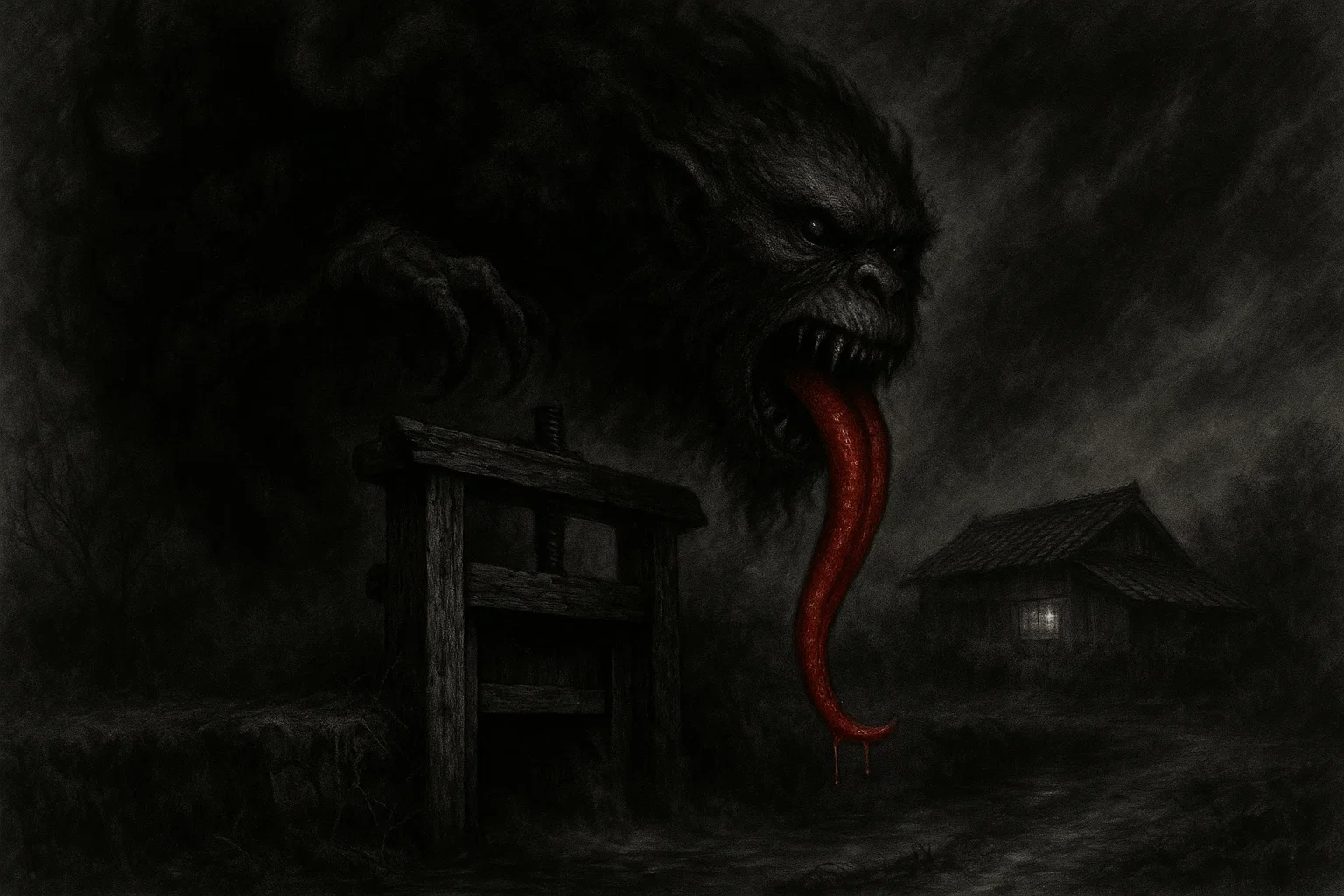
This entity is characterized by its terrifying, beast-like features: sharp claws, a hairy face, and the supposed long, bright red tongue that prominently lolls from its open mouth.
Interestingly, the Akashita’s full form is largely unknown. Its body is perpetually hidden within a swirling, dark, black cloud, suggesting an elemental or atmospheric origin.
Summary
Key Takeaways
| Attribute | Details |
| Names | Akashita (赤舌), Aka shita; Alternate: Akaguchi (赤口), Aka kuchi (“red mouth”) |
| Translation | Red Tongue |
| Title | Arbiter of Water Rights, Punisher of Water Thieves, Red-Tongued Calamity |
| Type | Yōkai (Obake/Mysterious Spirit); Classified conceptually as a spiritual manifestation of a cosmological principle |
| Origin | Evolved from the older Akaguchi entity in Bakemono no e; fundamentally linked to the Onmyōdō deities Shakuzetsujin (Red-Tongued God) and Shakuzetsunichi (Calamity Day) |
| Gender | Ambiguous, generally perceived as a monstrous, elemental force |
| Appearance | Hairy, bestial face and sharp claws, perpetually obscured by dark, black clouds; defined by its long, prominent, lulling bright red tongue |
| Powers/Abilities | Hydrokinesis (draining water from fields), Cloud Conjuration, Retributive Judgment, Physical attack (snatching victims with the powerful tongue) |
| Weaknesses | Moral integrity; avoidance of water theft and resource conflict; absence of explicit physical weaknesses in classical lore |
| Habitat | Rice fields and farming villages, specifically found looming over sluice gates or floodgates (e.g., Tsugaru region of Aomori Prefecture) |
| Diet/Prey | Wicked farmers who illegally steal water, or water bandits |
| Symbolic Item | The Sluice Gate or Floodgate; The Red Tongue |
| Symbolism | The dangers of greed and social conflict over vital resources; the cosmological enforcement of moral law; the manifestation of bad luck or calamity |
| Sources | Gazu Hyakki Yagyō (Toriyama Sekien), Bakemono no e, Jikkai Sugoroku, Hyakki Yagyō Emaki, Tōhoku Kaidan no Tabi (Norio Yamada) |
Who or What is the Akashita?
Akashita is a true terror in Japanese yōkai stories, a spectral creature whose monstrous form belies a highly specific and punitive function. It is classified as a mysterious spirit whose nature is often considered more elemental and abstract than that of many common animal or ghost yōkai.
According to lore, this creature’s existence is inherently tied to the agrarian landscape of pre-modern Japan, where rice was the economic foundation and water management was a matter of life and death.
In this landscape, Akashita primarily serves as the spiritual guardian of the complex irrigation systems required to grow rice. The monster allegedly appears during the severe summer drought, a time of maximum resource demand when communal sharing is strained and the temptation to individual greed is highest.
Once it appears, the creature will specifically target the wicked farmer—the one who secretly opens the floodgates to siphon water beyond their rightful allocation, committing a crime that could lead to a neighbor’s ruin. When these water bandits escape human justice or the violent wrath of their neighbors, the yōkai appears.
Its supernatural role is to deliver cosmic retribution. This way, the balance is restored by draining the stolen water and then punishing the perpetrator with its signature red tongue. Based on this behavior, the creature is not a force of chaos but a terrifying, supernatural supervisor of agricultural ethics.
“Akashita” Meaning
The name Akashita (赤舌) is linguistically rich, with an etymology that reveals layers of meaning related to pollution, moral failure, and cosmic judgment. While the literal translation is “red tongue,” the true significance lies in the underlying characters and associations.
The critical component is the character aka (赤, red). In Japanese etymology, this sound can refer not only to the color red but is homophonous with aka (垢, filth or dirtiness) and aka (淦, bilge water—the dirty water that collects at the bottom of ships). This confluence imbues Akashita with the symbolism of moral and physical pollution.
Similarly, shita (舌, tongue) is often understood in context with shita (下, down or depth). This interpretation suggests the yōkai represents the filth and malicious intent originating from the depths of one’s mind, aligning with the popular Japanese proverb, “the tongue is the gate to calamities“.
Thus, the spirit is perceived as the ultimate divine punishment for wickedness spoken or secretly acted upon, such as the malicious planning required to steal water.
The most profound layer of meaning connects Akashita directly to the esoteric Japanese system of Onmyōdō (The Way of Yin and Yang). The name is correlated with the Shakuzetsujin (赤舌神), the “Red-Tongued God,” a powerful figure who guards the western gate of Tai Sui (the spirit of Jupiter).
This association suggests Akashita is a demonized manifestation of this cosmological gatekeeper. Furthermore, it is linked to Shakuzetsunichi (赤舌日), a specific day in the traditional calendar marked by extreme bad luck and calamity, reinforcing Akashita’s status as a spiritual embodiment of ill fortune and inescapable judgment.
How to Pronounce “Akashita” in English
The Japanese name Akashita (赤舌) is pronounced Ah-kah-SHEE-tah. This pronunciation follows standard Japanese phonetics, stressing clarity across all syllables.
What Does the Akashita Look Like?
Akashita’s physical appearance is defined by its mystery and its visceral, monstrous features, largely known through the iconic illustration in Toriyama Sekien’s Gazu Hyakki Yagyō (1776).
The fundamental characteristic of Akashita is that its full body is unknown. Instead, the yōkai exists perpetually cloaked and concealed within a massive elemental mass of dark, black clouds.
This endless concealment emphasizes its mysterious nature, suggesting that the creature may be merely a fragment of a larger, unseen force or a spirit that has fully merged with the natural phenomenon of a looming storm or drought.
Nevertheless, the parts that are visible are unequivocally monstrous: it possesses a hairy, bestial face and sharp, beastly claws. These characteristics place it firmly within the visual tradition of high-threat yōkai, such as oni (mountain demons).
The most defining and terrifying feature is the eponymous long, bright red tongue that lolls conspicuously from its gaping mouth. The intense red color connects directly to its symbolic association with calamity and filth (aka), serving as the physical instrument of its namesake and the weapon used for punishment.
You may also enjoy:
Who Is Adrammelech in Demonology and the Bible?
October 1, 2025
Yuki Onna: The Terrifying Demon Bride Who Feeds on Travelers
December 9, 2025
Setcheh: Egypt’s Soul-Stealing Ancient Demon
November 11, 2025
What Is a Tengu? Origins, Powers, and Dark Folklore
January 29, 2026
Si’la: The Seductive Jinn Who Lures Travelers to Their Doom
October 9, 2025
Ambri: The Imperial Duchess of Caspiel’s Empire
December 1, 2025
Habitat
Akashita’s habitat is uniquely specific, dictated entirely by its role as a judicial spirit of agriculture. Its “home” is concentrated in areas where resource conflict is most likely to erupt.
The spirit’s primary domain is the rice fields and farming villages of Japan. It is naturally tied to the complex series of interconnected aqueducts and canals that interlaced Japan’s farmlands, essential for maintaining the flooded rice paddies.
Unlike forest-dwelling yōkai or sea spirits, Akashita is a feature of the organized, human-managed natural world. Its specific site of manifestation is the sluice gate (or floodgate). This structure—which regulates the shared distribution of irrigation water—is the functional nexus of the conflict Akashita seeks to resolve.
The creature appears to loiter above the gate, waiting to catch the water bandit in the act or immediately after the transgression, making the sluice gate a psychological and physical danger zone for the guilty.
Regionally, Akashita is strongly associated with the Tsugaru region in Aomori Prefecture. The folklore of this specific northern area provided a crucial narrative framework for Akashita’s behavior, detailing its involvement in resolving local water disputes.
Furthermore, Akashita is a seasonal phenomenon. It typically appears during the summer months, which are characterized by the highest demand for water and the greatest risk of drought.
Origins and History
The history of Akashita demonstrates a transition from a vague concept of ill fortune to a highly specific, visually codified figure during the flourishing of yōkai scholarship and art in the Edo period.
Akashita’s origins can be traced to older Edo-period scrolls, such as Bakemono no e, where an entity known as Akaguchi (“red mouth”) appears. This early figure established the core theme: a malevolent entity associated with redness, calamity (aka), and potentially water or ritual impurity. Most likely, this precursor entity provided the raw material for later artistic definition.
The definitive form and name were established by the polymath artist Toriyama Sekien in his 1776 work, Gazu Hyakki Yagyō. Sekien is credited with transforming the abstract concept into the recognizable figure we know today.
Although Sekien did not attach an explanatory note, his decision to depict the Akashita looming over a sluice gate provided the essential context linking the “red tongue” figure to agrarian conflict and water regulation.
Sekien’s compilation was widely disseminated, ensuring that the name Akashita (red tongue) eventually superseded the older Akaguchi (red mouth) in popular imagination. Subsequent publications, including the Jikkai Sugoroku and the Hyakki Yagyō Emaki (1832), adopted Sekien’s Akashita name and iconography.
Another vital element in Akashita’s history is its non-folkloric, esoteric background. The creature is profoundly influenced by Onmyōdō cosmology, a system derived from Chinese Yin-Yang and Five Elements philosophy.
As mentioned above, researchers widely agree that the name Akashita is derived from the Shakuzetsujin (赤舌神), the “Red-Tongued God”. Shakuzetsujin protects the western gate associated with the planet Jupiter, giving Akashita a celestial, judicial origin that elevates its status above that of mere ghosts or mundane objects that acquire life.
In the Shōwa era (post-1926), Norio Yamada’s 1974 text, Tōhoku Kaidan no Tabi, documented a specific regional legend concerning an Akaguchi that resolved a water dispute in the Tsugaru region.
This popular account was subsequently retrofitted onto Sekien’s Akashita image, giving the creature the widely known cautionary tale of the water thief and solidifying its role as the quintessential punisher of water resource violations.

Famous Akashita Legends and Stories
The most prominent narrative involving Akashita is the tale originating from the Tsugaru region, which defines its specific function as a supernatural adjudicator of agricultural resources.
The Retribution of the Water Thief in Tsugaru
This engaging story takes place in the Tsugaru region of Aomori Prefecture. In this area, farming is tough and relies heavily on a complex irrigation system.
One summer, the region experienced a severe drought, making it incredibly difficult to keep the rice fields adequately watered. Water is considered the most valuable resource here, and stealing it from a neighbor can ruin that family’s crops and livelihood. If caught, the thief would often face the community’s anger, but some clever farmers found ways to avoid being noticed.
One such farmer, driven by greed and fear of losing his own crops, took desperate measures. In the dead of night, he would sneak to a sluice gate—a place where water is controlled—and illegally adjust the flow to take more water than he was allowed. This allowed him to fill his own fields by draining his neighbors’ supply.
Since he was never caught, he thought he was clever—until his actions caught the attention of something far greater than human authority.
One evening, as he approached the sluice gate again, the mood shifted dramatically. An enormous, dark cloud appeared out of nowhere and engulfed the area. From within this storm, a fearsome creature known as the Akashita appeared.
The Akashita, a spirit known for protecting water and restoring balance, acted quickly. It started to drain water from the greedy farmer’s fields, undoing all the harm he had caused. Realizing that he was about to face the consequences of his actions, the farmer grew terrified.
In a final act of retribution, the Akashita used its long, red tongue to capture him, whisking him away and ensuring that not only was the water situation restored, but that the source of the problem was gone for good.
You may also enjoy:
Who Were the Hinn, the First Spirits of Creation?
November 12, 2025
Andrealphus: The Peacock Demon Who Twists Minds and Bodies
January 19, 2026
Hitotsume kozō: One-Eyed Yōkai of Japanese Folklore
February 4, 2026
Nasnas: The Monstrous Demon Hybrid That Haunted Pre-Human Earth
November 12, 2025
Who Is Shiva, the Destroyer and the Lord of the Universe?
November 12, 2025
What Is a Tengu? Origins, Powers, and Dark Folklore
January 29, 2026
Akashita Powers and Abilities
Akashita is an exceptionally powerful yōkai, though its power is narrowly defined by its punitive and elemental function. Its strength is not measured in brute combat but in its absolute control over a critical resource and its ability to materialize at the precise location of moral failure.
Compared to more powerful chaotic yōkai, Akashita operates with a judicial precision derived from its Onmyōdō roots as a demonized celestial figure.
Akashita’s powers and abilities include:
- Cloud Conjuration: The ability to spontaneously generate and reside within a massive, pervasive dark, black cloud, ensuring its body remains hidden and granting it an elemental presence at the moment of retribution.
- Hydrokinetic Retribution: It possesses the power of localized water control, used specifically to drain stolen water from the fields of the wicked farmer and restore balance to the shared irrigation system.
- Physical Snatching (Tongue Smash): The Akashita utilizes its long, powerful red tongue as its primary physical weapon, capable of swiftly scooping up and seizing human victims.
- Retributive Judgment: Akashita demonstrates an inherent ability to discern moral transgression (potentially analogous to the capacity to discern lies in some interpretations) and only targets those guilty of water theft, acting as a flawless cosmic judge.
- Calamity Manifestation: As a spiritual manifestation linked to Shakuzetsunichi, the day of ill-fortune, Akashita is conceptually capable of bringing generalized calamity and misfortune to a location, ensuring poor outcomes for the dishonest.
How to Defend Against Akashita
The nature of Akashita as a cosmological arbiter dictates that defense against it is almost entirely moral and preventative, rather than reliant on physical countermeasures. Once the crime of water theft is committed, Akashita’s appearance signifies the arrival of unavoidable fate.
The most reliable method of defense is simply to abstain from the crime of water theft and to maintain communal ethics. Since Akashita exclusively targets farmers who secretly divert shared water, an honest farmer has no reason to fear its wrath. By avoiding the temptation of greed, the necessary conditions for the yōkai‘s manifestation are eliminated.
Defense can also be communal. Ensuring that the village or community maintains strict, fair, and effective governance over the sluice gates—and resolves water disputes peaceably—removes the impetus for the creature’s intervention. If human justice and equitable sharing succeed, Akashita remains absent.
Due to its association with Shakuzetsunichi (the day of bad luck), practitioners of Onmyōdō traditionally used divination to identify and avoid performing critical, risky, or malicious actions on that day.
While no specific charms (like ofuda) against Akashita are commonly mentioned in classic lore, the underlying principle is to manage one’s fate by avoiding the temporal window when cosmic judgment is strongest.
Once Akashita is confirmed to be present, there are no known escape methods; the only documented end to the encounter is the snatching of the guilty party.
Akashita vs Other Yōkai
Akashita is often conceptualized alongside other yōkai associated with water, filth, or social control. However, its role as a resource adjudicator is unique.
| Name | Category of Yōkai | Origin | Threat Level | Escape Difficulty |
| Kappa | Water Spirit (Suijin) | Corrupted local deity or spirit of a drowned person | High | Moderate; Can be tricked into bowing, spilling the vital water (sara) on their head. |
| Akaname | Filth Licker (Obake/Tsukumogami) | Born from human neglect and unsanitary bathroom environments | Low | Easy; Primarily nocturnal; repelled by scrupulous housekeeping and cleanliness. |
| Oni | Demon/Ogre | Fallen Kami, tormented souls from Buddhist hell, or mountain dwellers | Extreme | Moderate to High; Often repelled by roasted beans (Setsubun ritual) but extremely dangerous in combat. |
| Yamauba | Mountain Crone (Kijo) | Abandoned, exiled, or vengeful elderly woman transformed into a demon | Extreme | High; Possesses immense strength and magical camouflage; requires great cunning to escape. |
| Tengu | Mountain Master (Kami/Obake) | Fallen proud monks, or anthropomorphized mountain spirits (often crow-like) | High | Moderate; Can be deterred by specialized Shinto charms, proper martial respect, or certain offerings. |
| Nekomata | Cat Spirit (Hengeyōkai) | A house cat that lived to great age, growing a forked tail and magical powers | Moderate | Low to Moderate; Dependent on its age and power; can often be placated or banished through respect for cats. |
| Kuchisake-onna | Slit-Mouthed Woman (Yūrei/Goryō) | Vengeful spirit from modern urban legends; usually a murdered woman | High | Low to Moderate; Can be evaded by confusing her with rhetorical questions or offering candy/pomade. |
| Ushi-oni | Ox Demon (Oni/Sea Monster) | Coastal sea monster, often tied to ancient rock formations; harbinger of disease | Extreme | High; Immensely powerful and resistant; specialized ritualistic defenses or divine intervention needed. |
| Nurikabe | Wall Spirit (Obake) | Invisible, intangible wall that suddenly blocks travelers on the road | Low | Easy; Tapping the lower part of the wall with a stick typically causes it to dissipate. |
| Gashadokuro | Starving Skeleton (Yōkai/Yūrei) | Collection of bones from those who died of starvation, seeking human souls | Extreme | High; Difficult to see or detect; escape relies on awareness and outrunning the massive entity. |
Symbolism
Akashita functions as a powerful, multi-layered symbol in Japanese culture, representing ecological pressure, cosmic order, and the societal dangers of personal corruption.
| Attribute | Details |
| Element | Water (Specifically agricultural, channeled, and scarce irrigation water) |
| Animal | None explicitly; visual appearance is generic bestial/monstrous 2 |
| Cardinal Direction | West (Tied to Shakuzetsujin, the protector of the Western Gate of Tai Sui/Jupiter) 1 |
| Color | Red (Aka), symbolizing calamity, ritual impurity (aka 垢), ill fortune, and blood 1 |
| Plant | Rice (Its existence is intrinsically linked to the preservation of rice agriculture) 2 |
| Season | Summer (The time of drought and critical resource management conflict) 2 |
| Symbolic Item | Sluice Gate or Floodgate (The critical juncture of water control and moral failure) 1 |
The core symbolism of Akashita is the inescapable consequence of greed in a communal society. The entity embodies the anxiety surrounding the management of shared, life-sustaining resources.
In pre-modern Japan, rice was the currency of life, and water was its bloodline; Akashita personifies the terrible spiritual costs incurred when an individual prioritizes personal wealth over the community’s survival.
Furthermore, its link to Onmyōdō cosmology ensures Akashita represents universal, predictable judgment. Its derivation from the Shakuzetsujin confirms that its retribution is not random, but an expression of the cosmic order, connecting human ethical failure directly to celestial ill-fortune.
The specific day Shakuzetsunichi serves as a temporal warning, suggesting that wickedness committed during times of cosmological vulnerability will be punished.
Finally, the interpretation of Akashita as the embodiment of filth and malicious intent originating from the depths of one’s mind demonstrates its role as a moral thermometer for the community.
You may also enjoy:
Andrealphus: The Peacock Demon Who Twists Minds and Bodies
January 19, 2026
Who Is Ahriman, and Why Is He Pure Evil Incarnate?
January 8, 2026
Azhi Dahaka: The Three-Headed Dragon of Zoroastrian Mythology
January 14, 2026
What Is a Pishacha, the Flesh-Eating Demon of the Dead?
February 11, 2026
What Is Akaname, The Filth-Licking Yōkai?
October 28, 2025
Who Is Abalam in Demonology? The Terrifying King That Serves Paimon
September 30, 2025
Frequently Asked Questions
Does the Akashita have any special powers?
The Akashita’s power is generally considered to be the ability to manifest curses and bring misfortune rather than engaging in direct combat. Its presence over a location signifies that a disaster or administrative failure has occurred or is imminent, serving as a terrifying divine or supernatural warning to the local population.
How is Akashita related to other Japanese yōkai?
Akashita belongs to a recognized category of yōkai that utilize an exaggerated tongue as their defining characteristic. This places it in a thematic cluster with other entities, such as the Chōchin obake (Lantern Yōkai), which are also frequently depicted with an extended tongue. Its specific taxonomy relates it to creatures symbolizing warnings about local administration and resources.
Where does the Akashita typically appear?
The Akashita is traditionally associated with structures that govern water flow, such as floodgates, irrigation canals, and sluices, particularly during periods of drought or flooding. Its appearance was seen as a warning or a curse, aimed at revealing corruption or misdeeds in water distribution, threatening crops and livelihoods.
What does the Akashita’s red tongue symbolize?
The highly visible red tongue is the defining feature of the Akashita. It is often interpreted as the physical manifestation of a curse or spoken complaint. In traditional lore, the tongue symbolizes aggressive or vocal misfortune, usually associated with disputes over land, corruption, or failures in water control systems.
