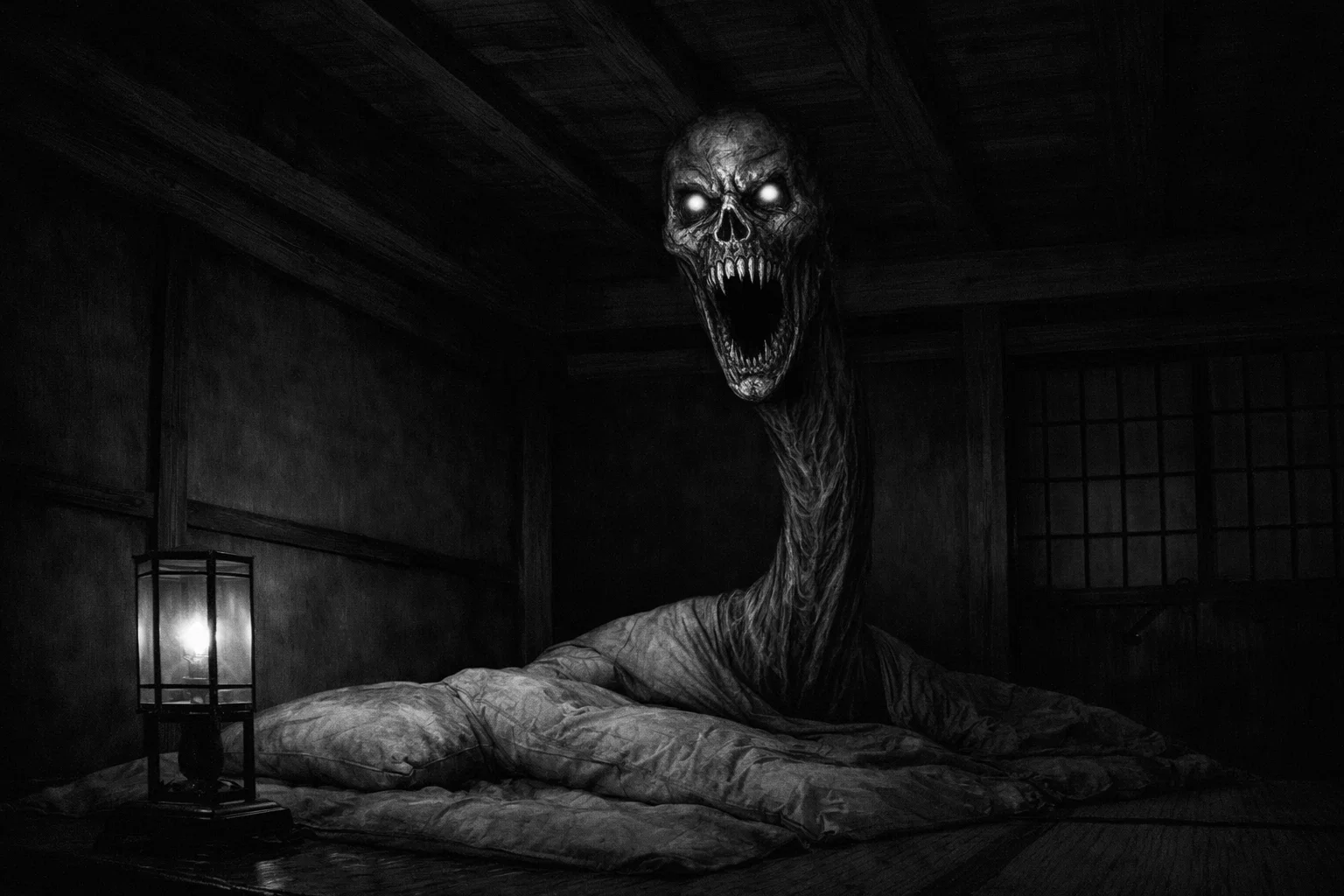

The Rokurokubi is a Japanese yōkai that looks like a regular person by day, but at night its neck can stretch to amazing lengths. There are two main types: one with a neck that stays attached but stretches, and the Nukekubi, whose head comes off and flies on its own.
Many stories describe Rokurokubi as regular women who are cursed or changed by strong karma or obsession. Some do not know what they do at night, while others are dangerous and scare or even harm people.
Summary
Key Takeaways
| Attribute | Details |
| Names | Rokurokubi, Nukekubi (detachable head variant) |
| Translation | Pulley-neck or whirling-neck |
| Title | The Long-Necked Woman |
| Type | Obake (shapeshifter) or Onryō (vengeful spirit) |
| Origin | Humans transformed by karmic debt, obsession, or a spiritual curse |
| Gender | Predominantly female, though rare male accounts exist |
| Appearance | Normal human appearance by day; a neck that extends several meters at night |
| Powers/Abilities | Neck elongation, head detachment, flight (Nukekubi), and soul draining |
| Weaknesses | Disturbing the body while the neck is extended; blocking the path back to the torso |
| Habitat | Human settlements, urban Edo-period streets, and private homes |
| Diet/Prey | Human life force, small animals, or oil from lamps |
| Symbolic Item | Andon (oil lamp) |
| Symbolism | The duality of human nature and the consequences of hidden sin |
| Sources | Konjaku Hyakki Shūyū, Kasshi Yawa, Shokusanjin Hyakumonogatari |
Who or What is Rokurokubi?
Rokurokubi are well-known in Japanese folklore and are seen as a link between everyday life and the world of yōkai. They are usually shown as women who blend into society, often married and doing household chores. Their real form appears only when they sleep, as their necks stretch out and their heads move around the house or outside.
Historical texts make a clear difference between the type with a stretching neck and the Nukekubi, whose head detaches. Early stories often saw them as the same, thinking the spirit showed itself by stretching the body. Later, during the Edo period, Rokurokubi stories became popular as ways to explain odd illnesses or punishments for family karma.
1,000+ SPIRITS, GODS & GODDESSES AWAITING YOUR CALL. Limited-Time: Up to 49% OFF!
The ultimate global spirit encyclopedia – 2,000+ entries from every culture on Earth. Fairies • Djinn • Demons • Loa • Angels • Deities • Ancestors Real names • True offerings • Ancient rituals that actually work. Judika Illes’ legendary masterwork – the one book every serious witch, mage, and spirit-worker owns.
“Rokurokubi” Meaning
The name Rokurokubi comes from the Japanese word ‘rokuro,’ which can mean a potter’s wheel, a pulley, or an umbrella handle. All these things can stretch or turn. The rokuro pulley, used to pull up water from a well, has a rope that goes in and out, much like the yōkai’s neck. ‘Kubi’ means neck or head.
Over time, as the yōkai’s image became common in ukiyo-e art, the name changed. Early stories focused more on the Nukekubi, or ‘rootless head.’ Still, later, Rokurokubi became the main name for the type with a stretching neck.
This change happened because a stretched neck looks like the long handle of an open umbrella. In some areas, the name also referred to the way the head moved around while looking for something.
How to Pronounce “Rokurokubi” in English
You say the name as ‘Roh-koo-roh-koo-bee.’ The Japanese’ R’ sounds like the ‘tt’ in ‘butter.’ The vowels are short, with ‘o’ like in ‘boat’ and ‘u’ like in ‘flute.’
What Does the Rokurokubi Look Like?
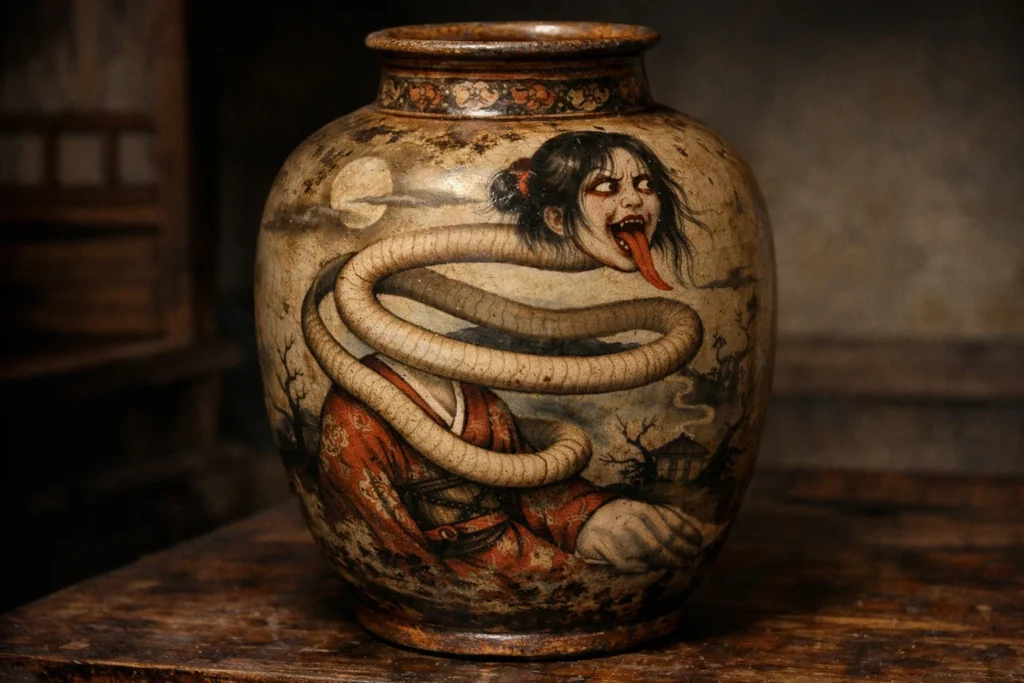
During the day, a Rokurokubi looks just like any other person. They are often shown as pretty young women in traditional kimono. The only clue might be some pale lines or rings around their neck, but these are easy to hide with clothes or makeup.
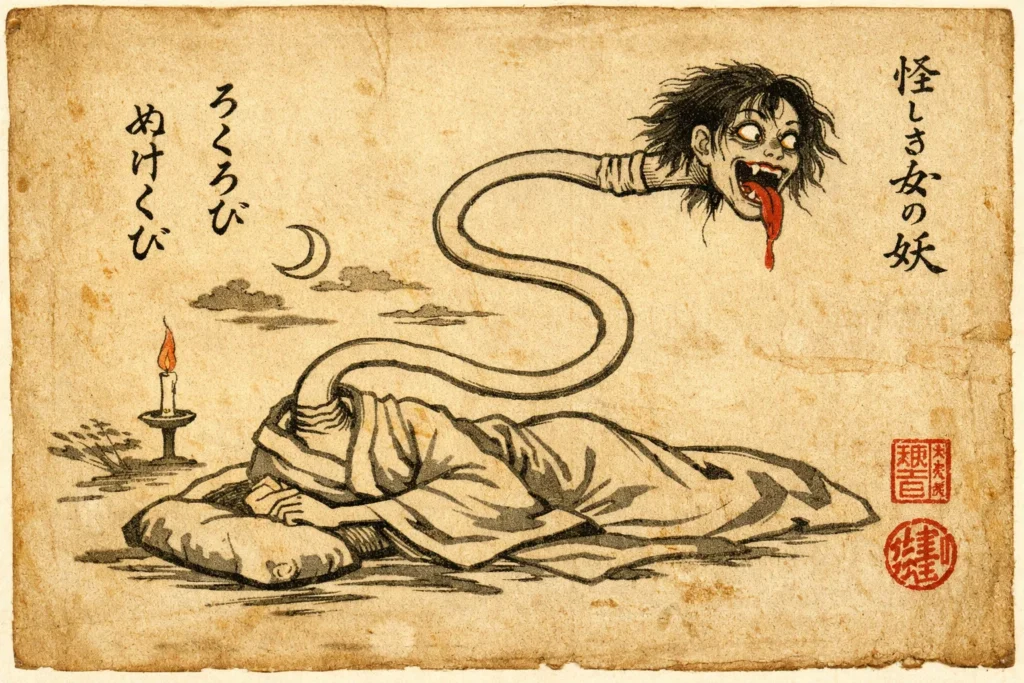
At night, they change. Their necks stretch out, sometimes for several meters, staying thin and bendy like a snake or a cord. For the Nukekubi type, the head comes off completely.
When the head is off or the neck is stretched, the body stays still, almost like it is in a trance. The head’s face can look scarier, with big eyes and a tongue sticking out to lick lamp oil or scare people.
You may also enjoy:
Lamia: The Queen Cursed to Devour the Children of Others
January 7, 2026
Ifrit: Demon of Fire Who Serves Iblis in Islamic Tradition
September 30, 2025
What Is a Dīv? The Terrifying Giant Demon of Persian Myth
January 22, 2026
Who Is Ahriman, and Why Is He Pure Evil Incarnate?
January 8, 2026
Rāga: The Seductive Demon of Passion and Desire in Buddhist Lore
October 16, 2025
Who Is Ariton, the Infernal King of the Eastern Gate?
February 17, 2026
Habitat
Unlike other yōkai, Rokurokubi do not live in wild places or forests. They stay in people’s homes, either in cities or villages. Most stories place them in Edo (now Tokyo) and nearby areas, living in regular wooden houses.
They live in homes because they started as humans. They need a bed or a futon for their body to rest while their head moves around. At night, they usually stay inside the house or close by.
They are often linked to dark rooms lit by the soft glow of an andon lamp, since they are drawn to the oil in these lamps.
Origins and History
Rokurokubi stories go back to early Japanese folklore, but they became most popular during the Edo period (1603–1868). At first, these legends were the same as Nukekubi tales, which described people whose souls left their bodies in old Chinese and Japanese texts.
The idea of the ‘stretching neck’ type mostly came from Edo-period books and the rise of yōkai art in ‘monster scrolls’ (Emaki). Writers and artists started to show Rokurokubi as women suffering from a disease or curse called rokuro-kubi-byō, or long-neck disease. People believed this could be caused by strong feelings like unrequited love, jealousy, or the sins of a family member.
MEET THE MONSTERS THAT HAUNT JAPAN Limited-Time: Up to 28% OFF!
Kappa • Yuki-onna • Tanuki • Kitsune • Hundreds more legendary spirits Hilarious, horrifying, and downright bizarre tales from Japan’s shadow side. Fully illustrated encyclopedia by Thersa Matsuura – your passport to the world of yōkai. Anime origins • Real folklore • Things that go bump in the tatami. Dare you invite them in?
Sources
Many Edo-period books and collections of strange stories include accounts of the Rokurokubi.
| Source | Quote |
| Konjaku Hyakki Shūyū (Toriyama Sekien) | “It is said that their necks stretch out like a rope, and they move their heads freely to lick the oil of the lamps.” |
| Kasshi Yawa (Matsura Seizan) | “A maidservant’s neck was seen to stretch during her sleep, reaching toward the ceiling while her body remained still on the futon.” |
| Shokusanjin Hyakumonogatari | “The woman’s head detached and flew through the air, but when the body was moved, the head could not reconnect and she died.” |
Famous Rokurokubi Legends and Stories
The Maidservant of Echizen
In the historical essay collection Kasshi Yawa, written by Matsura Seizan, a detailed account is given regarding a samurai residing in the Echizen province who employed a young, diligent maidservant. One night, while the girl was deep in sleep, the samurai observed a pale, cord-like object rising from her bedding.
After closer inspection, he realized it was her neck, which began to stretch upward with fluid, rhythmic movements. The neck extended several meters, allowing her head to glide silently across the room. The head did not seem to be hunting; rather, it moved with a curious, searching motion, sniffing at the corners of the ceiling and the shadows of the sliding doors.
The samurai remained paralyzed in his corner, watching as the neck eventually coiled back down, retracting into the girl’s shoulders until she appeared as a normal sleeper once more. The next morning, the samurai questioned her subtly, but it became clear she had no memory of the event.
Folklorists often use this story to show that Rokurokubi may not know about their own condition. People believed her ekitai, or fluid soul, was too restless to remain in her body while she slept, which caused her body to change shape.
The Nukekubi of Mount Kage
A famous tale recorded in the Shokusanjin Hyakumonogatari tells of a traveling priest who sought refuge from a storm in a lonely hut on Mount Kage. The hut was occupied by five woodcutters who offered him a humble meal and a place to rest.
However, the priest, being a man of high spiritual discipline, woke in the middle of the night to find five headless torsos lying where the men had been. Their heads were nowhere to be seen. Recognizing these as Nukekubi, the priest remembered a passage from an ancient scroll stating that if the body is moved, the head cannot find its way back.
The priest dragged one of the headless bodies away from its original spot and hid it behind a pile of firewood outside. Shortly before dawn, the five heads returned, flying through the air with a whistling sound. Four of the heads successfully reattached to their necks, but the fifth head—that of the leader—frantically searched for its body.
When it realized the torso had been moved, the head began to shriek, its face contorting into a demonic visage with fangs and glowing eyes. The head struck the ground repeatedly in a blind rage until it finally collapsed and died from exhaustion. The surviving woodcutters, realizing they had been discovered, fled into the mountains, leaving behind their wealth and tools.
DEMONS ARE REAL — AND THE BIBLE PROVES IT Limited-Time: Up to 20% OFF!
No myths. No exaggeration. Just Scripture. Clinton Arnold’s landmark biblical theology of the powers of darkness. What the Old & New Testaments actually teach about Satan, demons, and spiritual warfare. Essential reading for every pastor, counselor, and believer facing the unseen battle. The book seminaries and deliverance ministries swear by.
Demons are real • Scripture is clear • Victory is yours • Clinton Arnold’s definitive biblical study.
The Cursed Daughter of the Merchant
In various Edo-period urban legends, a story is told of a wealthy merchant in the Yotsuya district who had a marriageable daughter. Despite her beauty, every man who attempted to court her would flee the house in terror after the first night.
The merchant eventually discovered the truth: his daughter was a Rokurokubi. Every night, as the household grew quiet, her neck would stretch out, and her head would travel to the kitchen to lick the oil from the andon (paper lamps). The oil, made from fish or vegetables, acted as a spiritual lure for the creature.
The merchant sought counsel from a local monk, who revealed that the daughter’s condition was a manifestation of karmic retribution for the merchant’s past sins.
Years earlier, the merchant had cheated a business partner and left him to die in poverty. The partner’s dying grudge had attached itself to the merchant’s bloodline, appearing in the next generation as this physical deformity.
When the girl found out about her father’s actions and her own nightly changes, she felt deep shame. In many versions of the story, she went to live in a nunnery, where she prayed and lived simply to stop her neck from stretching.
You may also enjoy:
Apophis: The Great Serpent of Egyptian Chaos
November 11, 2025
What Is a Yūrei? The True Meaning of Japanese Ghosts
January 30, 2026
Amdusias in the Ars Goetia: The Demon of Dark Music
December 2, 2025
Barbas: The Lion Demon Who Spreads Disease
March 3, 2026
Who Is Andromalius and Why Is He the Last Demon of the Goetia?
January 20, 2026
Who Was Abezethibou, the Fallen Angel Who Opposed Moses?
October 1, 2025
The Rokurokubi of the Yoshiwara District
A legend from the Edo pleasure districts involves a high-ranking courtesan who was secretly a Rokurokubi. A regular patron, a young man of noble birth, grew suspicious when he noticed that the courtesan always insisted on sleeping behind a heavy silk screen and never allowed the lamps to be fully extinguished.
One night, he feigned sleep and watched through a small gap in the screen. He saw the woman’s neck grow thin and white, stretching like a serpent. The head floated over the screen and hovered above the lamp, its long tongue flicking out to drink the oil.
The young man was so horrified that he drew his sword and slashed at the extended neck. The head shrieked and flew out of the window into the night, while the body remained behind, gushing blood from the stump of the neck.
The next day, people found the head in a temple garden, where it had bitten into a pine tree before dying. This story was told to warn young men about the dangers of the nightlife, showing that beauty can sometimes hide something frightening.
Rokurokubi Powers and Abilities
The Rokurokubi’s main power lies is its neck, which can stretch supernaturally. This stretching is sometimes seen as the soul or life energy reaching out. Compared to other yōkai, they are usually not very dangerous, since they rarely attack healthy, awake people.
- Neck Elongation: The ability to stretch the neck to lengths exceeding ten feet.
- Nocturnal Autonomy: The head can act independently while the body is in a deep sleep.
- Flight (Nukekubi): The detached head can fly through the air and bypass physical obstacles.
- Oil Consumption: They possess a strange craving for the oil used in traditional lamps.
- Soul/Energy Draining: In some versions, they can drain the life force of those they encounter.
How to Defend Against Rokurokubi
How you defend against a Rokurokubi depends on its type. The stretching kind is usually harmless if you leave it alone. If you want to stop the transformation, Shinto prayers or rituals can help remove the curse.
For the Nukekubi, or the type with a flying head, you need a physical defense. Its weak spot is the body. If you move or hide the body while the head is gone, the head cannot return.
Stories say that if the head does not find the body before sunrise, the yōkai will die. You can also mark the neck with Buddhist symbols or with salt to prevent the head from returning.
Nukekubi vs Other Yōkai
| Name | Category | Origin | Threat Level | Escape Difficulty |
| Yuki-onna | Yūrei | Spirit of a woman who died in snow | High | Hard; she freezes victims instantly. |
| Kappa | Suijin | Water deity/creature | Medium | Moderate; can be tricked with a bow. |
| Tengu | Kami/Obake | Mountain spirit/fallen monk | High | Very Hard; they possess great speed. |
| Gashadokuro | Yūrei | Gathered bones of the starved | Extreme | Near Impossible; they are giant. |
| Kuchisake-onna | Onryō | Mutilated woman | High | Moderate; requires specific answers. |
| Kitsune | Obake | Magical fox | Variable | Hard; they are masters of illusion. |
| Jorōgumo | Obake | Spider that reaches 400 years | High | Hard; they use webs and seduction. |
| Aka Manto | Yūrei | Urban legend spirit | Extreme | Impossible; a trap with no escape. |
| Noppera-bō | Obake | Faceless shapeshifter | Low | Easy; they only seek to frighten. |
| Ubume | Yūrei | Woman who died in childbirth | Medium | Moderate; requires helping her. |
Symbolism
| Attribute | Details |
| Element | Air (associated with the drifting head) |
| Animal | Snake (due to the neck’s appearance) |
| Cardinal Direction | Center (the domestic home) |
| Color | White (pale skin/kimono) and Red (the flesh of the neck) |
| Plant | Willow (supple and bending) |
| Season | Summer (the season of ghost stories) |
| Symbolic Item | Andon (oil lamp) |
The Rokurokubi stands for hidden faults and the ‘shadow self’ in Japanese culture. It is a symbol for people who seem normal but have something twisted inside. This yōkai often shows the dangers of strong feelings like jealousy, love, or greed, suggesting that these emotions can change a person in scary ways.
During the Edo period, the Rokurokubi was used as a warning for women, suggesting that their actions and spiritual purity would show up in their bodies. The Rokurokubi is still popular in art and theater, often used to unsettle viewers by turning the image of a gentle woman into something strange.
You may also enjoy:
Who Is Baal in Christian Demonology?
February 25, 2026
Who Is Asmodeus in Demonology and the Bible?
February 18, 2026
Kuchisake-onna: Folklore, Origins, and Urban Legend History
February 10, 2026
Jikininki: The Japanese Ghost That Feeds on Human Corpses
February 9, 2026
Who Was Hiranyakashipu, the Demon King of Hindu Mythology?
October 6, 2025
Andhaka: The Blind Demon Born From Cosmic Darkness
February 6, 2026
Frequently Asked Questions About Rokurokubi
Are there male Rokurokubi in Japanese folklore?
Most stories are about women, but there are records of male Rokurokubi, too. The Edo-period book Kasshi Yawa tells of male shopkeepers and monks whose necks stretched while they slept. These cases were usually blamed on illness or a wandering soul, not on jealousy or social rules, as with women.
What is the “long-neck disease” (Rokurokubi-byō)?
In late Edo-period medical stories, Rokurokubi-byō was seen as a genuine spiritual problem in which the soul, or reikon, partly left the body at night. This made the neck stretch as the spirit tried to get out. People often treated it with traditional medicine or by changing their lifestyle, not with exorcism.
How do you tell if someone is a Rokurokubi during the day?
Urban legends say you can spot a Rokurokubi by looking for faint rings or white marks around their neck. These are said to be stretch marks from their nightly changes. They might also be very tired during the day because their spirit has been active all night.
Can a Rokurokubi be cured?
Yes, stories say a Rokurokubi can be cured with strong prayer or by passing their karmic debt to someone else. In some tales, a priest can help by doing a ritual to break the link to the desires causing the problem. But if the neck is hurt while stretched, the person will probably die instead of being healed.
Is the Rokurokubi related to the Penanggalan?
The Rokurokubi, especially the Nukekubi type, is a lot like the Southeast Asian Penanggalan or Manananggal. Both have heads that fly at night, but the Penanggalan’s head drags its organs and is a blood-drinker. At the same time, the Rokurokubi’s change is usually spiritual and not bloody.
