
Pazuzu is a demonic deity from the ancient Mesopotamian religion, recognized among the Babylonians and Assyrians during the first millennium BCE. He functions as the king of the lilû wind demons and embodies the southwestern wind, which carries famine, drought, locusts, and plague.
In ancient texts, the demon is both a bringer of harm and a protective force. He is also one of Lamashtu’s fiercest opponents.
Summary
Key Takeaways
| Attribute | Details |
|---|---|
| Names | Pazuzu (primary Akkadian name); also invoked as the king of lilû demons or the demon of the southwest wind; no additional epithets consistently attested beyond contextual titles like Agony of Mankind or Suffering of Mankind in ritual texts. |
| Title | King of the wind demons; personification of the southwestern wind; apotropaic protector against plague and Lamashtu. |
| Origin | Mesopotamian (Assyrian and Babylonian traditions, first millennium BCE); sudden emergence in Early Iron Age with no prior evolutionary iconography. |
| Gender | Male. |
| Genealogy | Son of Hanbi (also Hanbu or Hanpa), king of the underworld demons; brother to Humbaba (Huwawa), guardian of the Cedar Forest in the Epic of Gilgamesh. |
| Role | Wind demon who brings pestilence but serves as repellant to other demons; domestic protector of homes, pregnant women, and infants. |
| Associated Deity/Figure | Rival to Lamashtu (demoness of childbirth harm); allied with protective figures like Ugallu and Lulal on amulets; opposed by major gods like Marduk in broader cosmology. |
| Brings | Famine, drought, locusts, plague, and destructive winds; also misfortune and disease when uncontrolled. |
| Weaknesses | Repelled or redirected by invocations to higher gods like Ea or Marduk; bound by apotropaic rituals and amulets invoking his own image against himself. |
| Realm/Domain | Southwestern winds and mountains; traverses the underworld and earthly realms as a wandering spirit. |
| Weapon/Item | Scorpion tail and snake-headed penis as symbolic weapons; no specific artifact beyond his own statuettes and amulets used against foes. |
| Symbolism | Duality of chaos and order; uncontrollable natural forces harnessed for protection; fear as a barrier against greater evils. |
| Sources | Cuneiform tablets from Nineveh, Uruk, and Sultantepe; ritual incantations like the Standard B incantation; amulet inscriptions from Nimrud tombs; bilingual Sumerian-Akkadian compendia; Late Babylonian anti-Lamashtu texts. |
Who or What is Pazuzu?
Pazuzu is a powerful demon in ancient Mesopotamian religion. He is typically classified as a lilû wind demon who rules over destructive southwestern gales.
He appears in texts and artifacts from the 8th century BCE onward, primarily in Assyrian and Babylonian contexts. As king of the evil lilû demons, Pazuzu personifies the winds that bring famine through drought in dry seasons and swarms of locusts in rainy seasons.
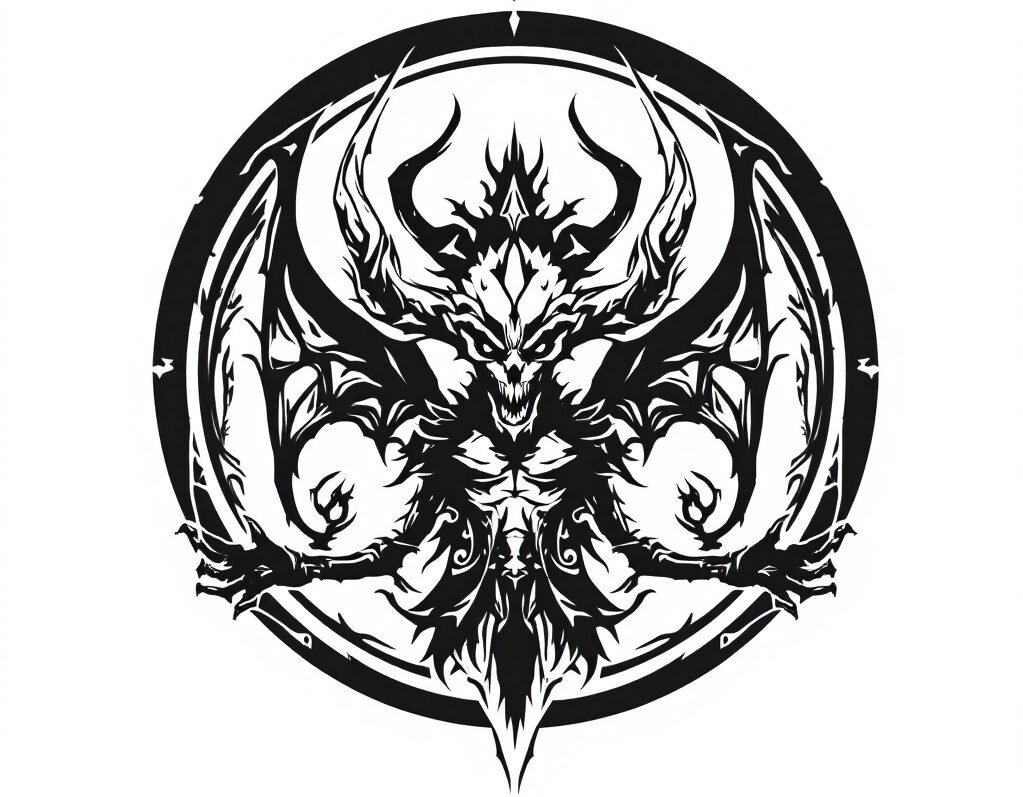
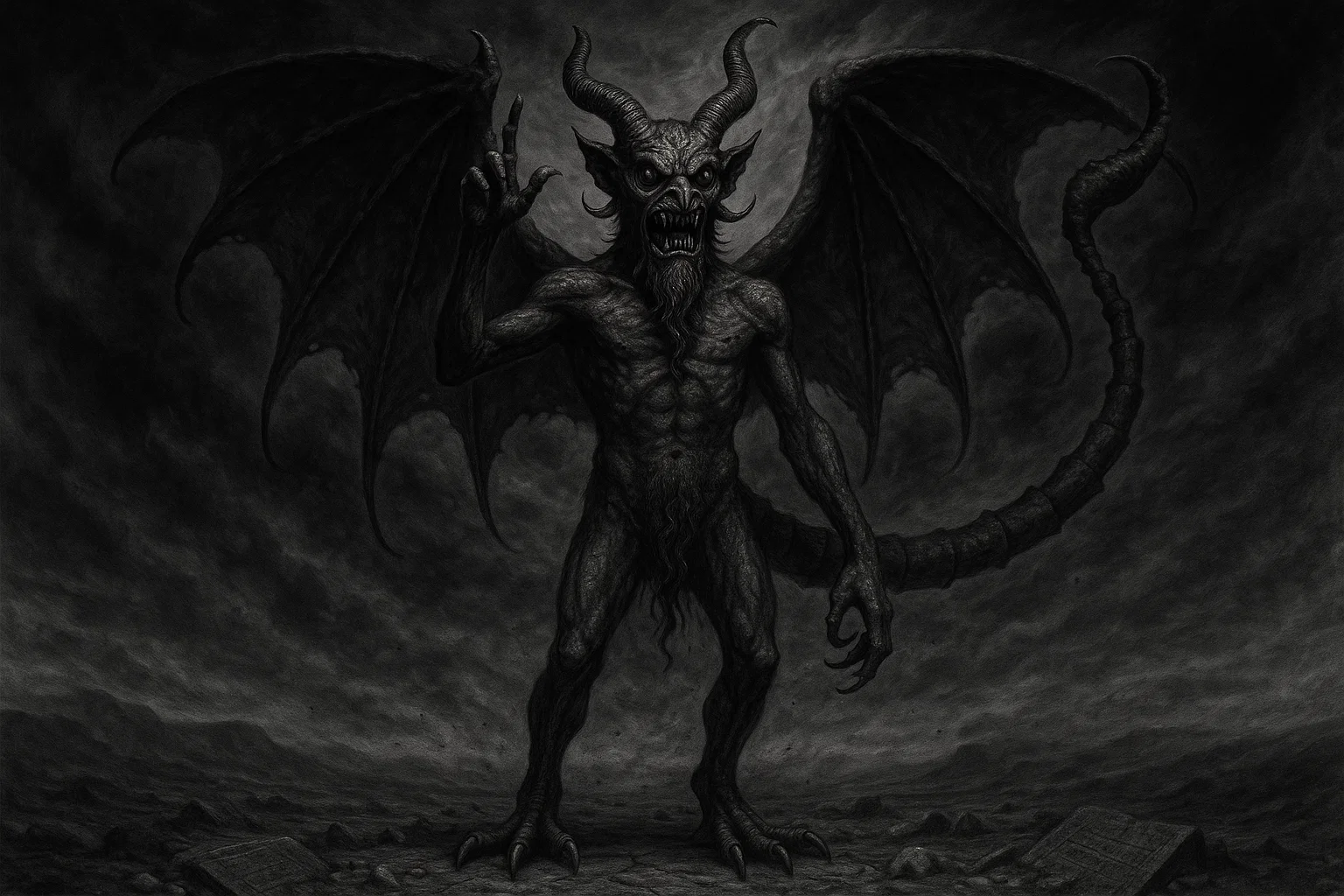
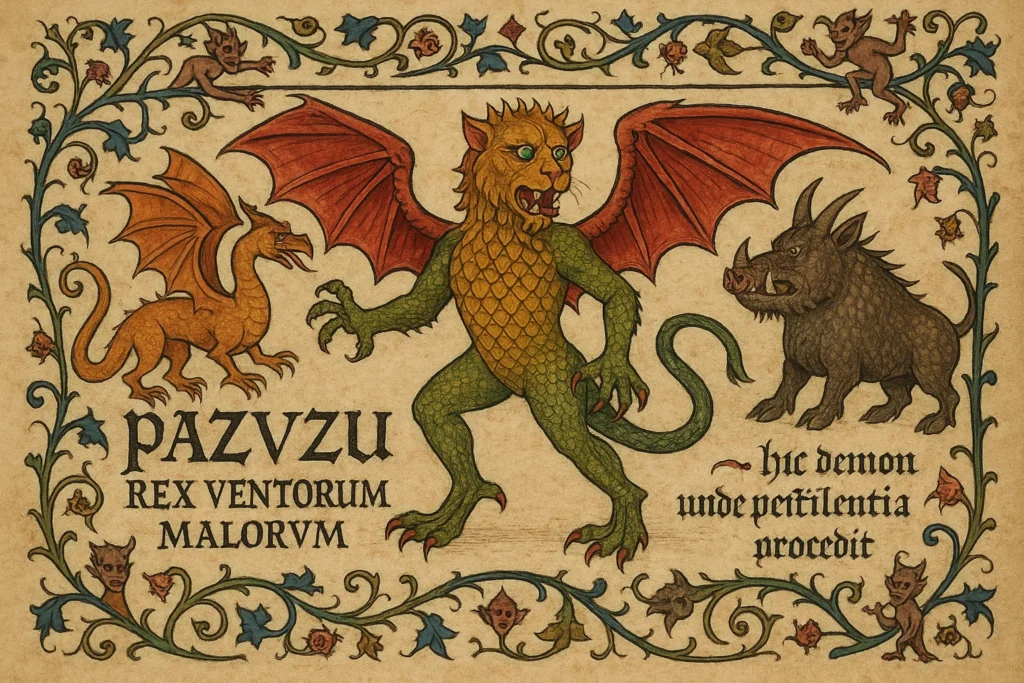
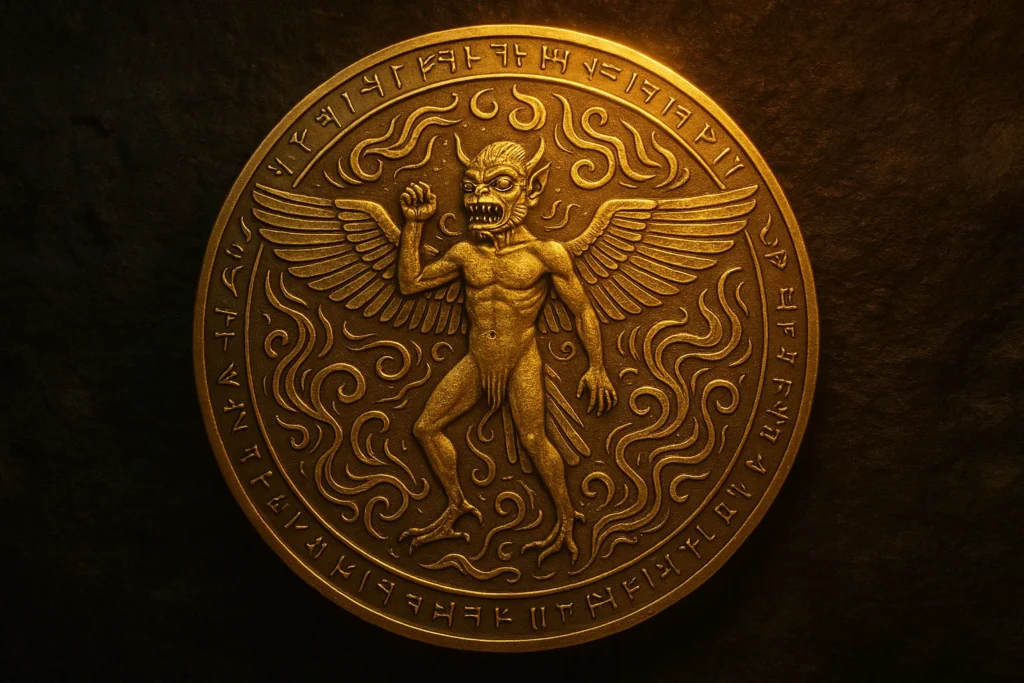
His form combines elements of multiple creatures, including a canine or leonine head with bulging eyes and horns, a scaly, emaciated body, avian talons, wings, and a scorpion tail. This grotesque appearance highlights his role in apotropaic magic, where his image frightens away lesser spirits.
Despite his malevolent potential, Pazuzu functions as a protector when invoked correctly. He counters threats from other demons (including the terrifying demoness Lamashtu, who causes miscarriages and infant deaths) by driving them back to the underworld.
“Pazuzu” Meaning
The name Pazuzu derives from Akkadian cuneiform, rendered as dpa.zu.zu, where the initial dingir sign (d) indicates divine or demonic status.
Etymological analysis links it to wind-related concepts, possibly from Sumerian roots denoting “hot” or “furious” breath, aligning with his association as the southwestern wind demon.
One speculation connects Pazuzu to historical kings in the Sumerian King List from Tell Leilan: Bazi, followed by Zizi, with Bazi’s father Anbu evolving into Hanbu (Pazuzu’s parent).
This constructs Pazuzu as a conflation: Ba-zi-Zi-zi, transforming royal names into a demonic epithet during the Late Bronze Age transition to Iron Age iconography.
How to Pronounce “Pazuzu” in English
In English, Pazuzu is pronounced as “puh-ZOO-zoo,” with the stress on the second syllable. The initial “pa” sounds like “puh” in “put,” followed by a long “oo” as in “zoo” for both “zu” sounds, creating a rhythmic repetition.
Origins
Pazuzu appears in the archaeological record during the Early Iron Age, with the earliest depictions from 8th-century BCE tombs at Nimrud in northern Iraq. No prior evolutionary forms exist, indicating a deliberate invention around 1000 BCE in Assyrian or Babylonian territories.
His iconography appears fully formed on fibulae, seals, and amulets, spreading to the Levant, western Iran, and even the Greek island of Samos by the Seleucid period.
Texts first mention him in the 7th century BCE, within exorcistic incantations from Nineveh’s libraries. This timing coincides with Lamashtu’s reassignment as a lilû demon, likely suggesting Pazuzu’s creation as her specific counterforce.
Researchers attribute his origins to the need for a potent apotropaic entity amid rising fears of plague and infant mortality. Unlike earlier wind personifications on cylinder seals—winged figures representing the cardinal directions—Pazuzu integrates multiple animal traits, evolving from single-hybrid motifs such as lion-headed humans.
His association with Hanbi (king of underworld demons) ties him to pre-existing storm lore. Still, his protective role marks a shift toward domestic magic.
Genealogy
Pazuzu is the son of Hanbi, a powerful and chaotic force, which helps explain why Pazuzu has control over winds and diseases.
Pazuzu also has a brother named Humbaba, a giant monster who guarded the Cedar Forest and was defeated by the legendary heroes Gilgamesh and Enkidu. Humbaba is described as having unusual features, such as bulging eyes and traits resembling those of a lion.
Interestingly, Pazuzu doesn’t have a spouse or children. His family connections show that he is a significant demon in the mythology, but still below major gods like Anu or Enlil in terms of power.
| Relationship | Details |
|---|---|
| Parents | Hanbi (Hanbu/Hanpa), king of the underworld demons and personification of chaotic winds. |
| Siblings | Humbaba (Huwawa), demon-god protector of the Cedar Forest in the Epic of Gilgamesh. |
| Spouse | None; no marital or romantic ties documented in texts. |
| Children | None; Pazuzu sires no offspring in surviving lore. |
You may also enjoy:
Who Is Ahriman, and Why Is He Pure Evil Incarnate?
January 8, 2026
Who Is Ambolin, the Demon of Nighttime Dread
December 1, 2025
Edimmu: The Mesopotamian Wind Demon That Steals Life
November 6, 2025
Who Is Andromalius and Why Is He the Last Demon of the Goetia?
January 20, 2026
Who Is Asmodeus in Demonology and the Bible?
February 18, 2026
Lamashtu, the Mesopotamian Demoness of Childbirth and Infant Death
November 4, 2025
Sources
Pazuzu appears primarily in ritual and magical texts from the Neo-Assyrian and Neo-Babylonian periods, including cuneiform tablets from Ashurbanipal’s library at Nineveh and incantation series from Uruk. These include apotropaic spells, amulet inscriptions, and bilingual compendia detailing his self-proclamations and combats.
| Source | Quote |
|---|---|
| Bilingual Sumerian-Akkadian Compendium (Standard B Incantation, ca. 7th century BCE) | I am Pazuzu, son of Ḫanbu, king of the evil lilû-demons. I was enraged (in violent motion) against the strong mountains and ascended them. |
| Bilingual Sumerian-Akkadian Compendium (Wind Combat Text, ca. 7th century BCE) | I ascended a mighty mountain that shook, and the (evil) winds I encountered there were heading West; One by one I broke their wings. |
| Late Babylonian Anti-Lamashtu Ritual Tablet (ca. 6th century BCE) | Agony of Mankind, Suffering of Mankind, Disease of Mankind: do not enter the house I enter, do not come near the house I come near, do not approach the house I approach. |
| Nimrud Amulet Inscription (8th century BCE) | Pazuzu, son of Hanpa, king of the wind demons: who causes the world regions to quake. |
| Uruk Ritual Tablet (W 22729/18, ca. 3rd century BCE) | Mighty Pazuzu, dark angel of the four winds, horned, with rotting genitalia: ascend the mountains and break the wings of the contrary winds. |
| Sultantepe Exorcistic Tablet (K 2547+, ca. 7th century BCE) | Šam-ru ez-zu: the raging storm of Pazuzu, presaging the baneful wind. |
What Does Pazuzu Look Like?
Pazuzu’s physical form is a composite of human and animal features, designed for terror and consistent across artifacts from the 8th century BCE.
His head is rectangular, with capricious horns curving backward, massive, furrowed eyebrows arching over deep-set, bulging, round eyes that convey an unrelenting glare.
The face features a canine muzzle with protruding ears, wrinkled cheeks, and an open snarling mouth exposing sharp teeth and a protruding tongue. A long two-pronged beard divides the chin, marked by horizontal lines. At the same time, the overall head blends lion and dog traits, marking the earliest Mesopotamian multi-animal hybrid.
The body is emaciated and scaly (like a lizard or serpent), standing bipedally on bird-like talons that grip the ground. Two pairs of wings sprout from the back, folded or spread to emphasize motion, paired with a long scorpion tail curving upward, tipped with a venomous stinger.
His arms end in clawed hands: the right raised in blessing or command, the left lowered in warding. Most distinctive is the erect snake-headed penis, symbolizing fertility twisted into peril.
Enemies, Rivals, and Allies
Pazuzu’s interactions with other demonic entities revolve around rivalry and reluctant alliance in Mesopotamian magic.
As king of lilû wind demons, he combats subordinate winds and chaotic spirits that threaten human order, breaking their wings in mountain ascents to curb their flight.
His primary foe is Lamashtu, the child-devouring demoness hurled from Heaven by Anu. Various texts and amulets depict Pazuzu chasing her to the underworld, suffocating her allies with pestilential clouds, or shattering her form.
This antagonism originates from shared lilû classification, with Pazuzu’s greater malice overpowering hers to protect births. He also opposes generic evil winds and galla demons that drag souls below, invoked to repel them from thresholds.
Allies include apotropaic figures such as Ugallu (lion-demon) and Lulal (human-headed spirit), inscribed on the backs of Pazuzu amulets to temper his destructive tendencies toward humans.
In broader lore, major gods like Marduk or Ea bind him indirectly, redirecting his storms.
Pazuzu’s network reflects hierarchical demonology: he dominates lesser evils. Still, he submits to divine oversight, used by exorcists to counter threats—like Alu (nightmare spirit) or Namtar (fate demon).
Connections to Other Entities
| Name | Folklore | Type | Appearance |
|---|---|---|---|
| Lamashtu | Mesopotamian | Childbirth demon | Lion head, donkey teeth, hairy body with talons, suckling dog and pig. |
| Humbaba | Sumerian | Forest guardian demon | Gigantic with lion face, staring eyes, dragon scales, cedar-like horns. |
| Lamassu | Assyrian | Protective spirit | Winged bull or lion with human head and five legs. |
| Apep | Egyptian | Chaos serpent | Colossal serpent uncoiling in the underworld. |
| Set | Egyptian | Storm desert god | Unspecified animal head (sha), red-haired humanoid. |
| Tiamat | Babylonian | Primordial monster | Dragon or serpent with multiple heads and scorpion tail. |
| Ereshkigal | Sumerian | Underworld queen | Pallid corpse-like woman in dusty robes. |
| Nergal | Mesopotamian | Plague war god | Lion-headed man with saw-toothed sword. |
| Anzu | Mesopotamian | Storm bird demon | Lion-headed eagle with massive wings. |
| Gallu | Sumerian | Underworld hauler | Horned bull-men with clubs and ropes. |
| Ugallu | Assyrian | Door guardian | Lion-man with bird talons and snake tail. |
| Lilitu | Sumerian | Wind succubus | Winged woman with bird talons and owl feet. |
| Namtar | Mesopotamian | Fate plague demon | Emaciated figure with skeletal limbs. |
Pazuzu Myths, Legends and Stories
Pazuzu’s Ascent and Combat Against the Winds
A long time ago, the demon named Pazuzu spoke directly to an exorcist. He introduces himself, sharing his background and fierce nature to show his power. Pazuzu describes his travels through wild, chaotic landscapes. Angered by high mountains, he climbs them with such force that the ground shakes beneath him.
As he moves, he encounters malicious winds, known as lilû spirits, which bring sickness and drought to the lands. Pazuzu confronts these winds one by one as they rush toward the west. He grabs hold of their flowing wings, which help them spread their destructive energy.
With determination, he tears their wings apart, making them unable to fly and trapping them on the ground. Because of this, their dangerous powers are weakened, preventing the devastation caused by droughts and plagues.
You may also enjoy:
Empusa: The Blood-Drinking Wraith of Greek Mythology
November 20, 2025
Gandharva: God, Spirit, or Demon?
November 13, 2025
Who Is Azazel, the Demon Blamed for Human Corruption?
February 24, 2026
What Is a Pishacha, the Flesh-Eating Demon of the Dead?
February 11, 2026
Agubanba: The Ash-Born Demon of Japanese Folklore
October 23, 2025
Aim (Aym): The Great Duke of Hell in the Ars Goetia
November 11, 2025
The Rivalry with Lamashtu
Lamashtu, known as the daughter of the sky god Anu, is a dangerous creature. With the head of a lion, she stalks around homes at night, searching for the scent of newborn babies.
She’s known for slipping through cracks and stealing infants from their cradles or causing women in labor to experience terrifying complications. Her appearance is fearsome, with hairy limbs, donkey-like teeth, and bird claws, and she is said to pull unborn babies out of their mothers, leaving destruction in her wake.
To combat her threats, Pazuzu is summoned through protective amulets. He is depicted as a powerful demon, standing tall and fierce, ready to confront Lamashtu.
In one artwork on a bronze plaque, you can see Pazuzu looming over Lamashtu, his scorpion-like tail ready to strike. He spreads his mighty wings and, with a loud crack, stops her from escaping. As she flees down a river in the underworld, Pazuzu sends his fierce winds against her, creating a storm that hinders her allies, who are ghostly creatures.
He chases Lamashtu through barren lands, striking out to catch her. The rituals suggest placing an image of Pazuzu’s head above the bed, where it stands guard and keeps Lamashtu away from those in danger.
Other protective beings, like fish-men and lion figures, flank him on the back of the amulet to strengthen this defense. Ultimately, Pazuzu drives Lamashtu away, and her howls fade as the rituals seal off any threats, ensuring the child’s safety until morning.
Invocation Against Household Plagues
In ancient Assyrian culture, there were special rituals to address the challenges posed by powerful spirits, such as Pazuzu. According to a ritual tablet found in Sultantepe, when people suffered from serious conditions like fever or impotence, they believed it was due to harmful influences from Pazuzu and his minions.
The text begins by referring to Pazuzu with titles that reflect the pain and suffering he can bring—calling him the “Agony of Mankind” and “Disease of Mankind.”
To combat Pazuzu’s influence, a priest, an ašipu, performed a specific ritual. He created a small clay head to represent Pazuzu and wrote incantations on its base.
The ritual started at dusk. The priest hung the head at the entrance of a home, using loops and cords to keep it in place. He then placed offerings like bread, water, and even the hearts of small pigs—symbolic gifts meant to deny life to harmful spirits—around it.
As part of the ritual, the priest called out to Pazuzu, asking him not to enter the house they were protecting. He commanded the spirits under Pazuzu’s control to stay away, emphasizing that they could not cross the threshold thanks to the protective power of Pazuzu himself. To enhance the warding effect, black dogs were positioned nearby, their howls mimicking the fearsome sound of Pazuzu.
By the next morning, the sickness began to fade, and the winds turned gentle, bringing the refreshing scent of rain instead of dust and pests.
Pazuzu’s Powers and Abilities
Pazuzu possesses command over elemental and supernatural forces tied to wind and plague, making him a formidable entity in Mesopotamian lore.
As king of the lilû demons, he summons southwestern gales that carry famine, drought, and locusts, capable of scouring the land or infiltrating homes to induce illness and impotence.
His strength lies in duality: unchecked, he inflicts widespread harm, but rituals harness him to repel greater threats, positioning him as a mid-level power below major gods yet above minor spirits.
Pazuzu’s powers and abilities include:
- Wind Manipulation: Controls southwestern winds to bring drought, locusts, or plague; redirects them to suffocate rival demons like Lamashtu’s allies.
- Wing-Breaking: Physically snaps the wings of evil lilû winds encountered on mountains, grounding them and preventing flight-borne harm.
- Plague Infliction: Spreads disease and fever as “Agony of Mankind,” entering homes to cause misfortune unless warded.
- Apotropaic Repulsion: His image frightens away lesser demons, protecting pregnant women and infants from Lamashtu’s grasp.
- Mountain Ascension: Scales and shakes mighty peaks, asserting dominance over chaotic terrains and binding winds to his will.
- Possession Resistance: Invoked to counter other possessions, channeling his grotesque form to expel intruders like Alu nightmares.
Rituals, Amulets, and Protective Practices
Ancient Mesopotamians used Pazuzu in white magic rituals to avert his harm while leveraging his terror against foes. Exorcists (ašipu) used his figurines in household rites, placing them at entrances or wearing them to invoke protection during plagues or births.
Offerings like incense, libations, and animal hearts appeased him, ensuring his winds guarded rather than ravaged.
Incantations and Ceremonies
Incantations against Pazuzu or invoking him were part of many ancient exorcisms, often recited over his head during ceremonies at doorways or at sickbeds.
Priests purified the space with fumigation, then positioned the artifact facing outward. For Lamashtu threats, a Late Babylonian rite involved crafting a Pazuzu necklace from bronze and hanging it on the afflicted while chanting to drive her down.
Ceremonies also included sacrifices: bread and water for sustenance denied demons, piglet hearts symbolizing devoured vitality, and black dogs led around the home to echo his roar.
The Standard B incantation, inscribed on amulets from Nimrud and Uruk, forms the core text, recited verbatim: igi-ir kal-’a-a šam-ru ez-zu munā’i[šu]. It translates as “who causes the world regions to quake, the raging storm, [his] shaking.”
A full variant from Sultantepe tablets (K 2547+) expands:
Mighty Pazuzu, son of Hanbu, king of the lilû-demons: I am Pazuzu… enraged against the strong mountains, I ascended them. The mighty mountain shook; the evil winds heading westward, I encountered—one by one, I broke their wings. Agony of Mankind, do not enter the house; Suffering of Mankind, approach not the threshold.
Amulets and Talismans
Throughout history, people have created various amulets and charms to protect against negative influences. One of the most popular figures for these protective items was Pazuzu.
Starting around the 8th century BCE, amulets featuring Pazuzu’s head were made from clay, metal, glass, and bone. They were commonly worn as necklaces by pregnant women to safeguard their babies.
In addition to necklaces, people also crafted rectangular plaques and small figures for hanging on walls. For instance, one such piece, found in an ancient reception room at Dur-Katlimmu, faced the entrance, serving as a guardian against evil. The back of these items often included symbols or names of other protective figures, enhancing their power.
In burial sites like Nimrud, fibulae—decorative pins used to hold clothing together—also depicted Pazuzu, making them another form of portable protection. Larger stone amulets were created for places to help protect against general bad luck.
Ancient texts from Uruk even mentioned that bronze versions of these charms were specifically made to prevent miscarriages, highlighting the importance of their design and placement.
You may also enjoy:
What Is a Tengu? Origins, Powers, and Dark Folklore
January 29, 2026
Setcheh: Egypt’s Soul-Stealing Ancient Demon
November 11, 2025
Andhaka: The Blind Demon Born From Cosmic Darkness
February 6, 2026
Who Was Mahishasura, the Buffalo Demon Slain by Goddess Durga?
October 3, 2025
Bakeneko: A Supernatural Cat Yōkai in Japanese Folklore
January 27, 2026
Si’la: The Seductive Jinn Who Lures Travelers to Their Doom
October 9, 2025
Frequently Asked Questions
What are the Pazuzu demons?
Pazuzu is a singular demonic entity from Assyrian and Babylonian mythology, not a group of demons, serving as the king of the lilû wind spirits that bring famine, locusts, and plague via southwestern gales. In Mesopotamian lore, he is invoked through amulets to ward off threats such as Lamashtu, the demoness who harms infants, highlighting his paradoxical role as both destroyer and protector. This duality persists in modern interpretations, where his image shields households from supernatural ills, as seen in cuneiform incantations from Nineveh.
What is Pazuzu’s reason for wanting to possess Regan in ‘The Exorcist’?
In the novel and film, Pazuzu targets Regan to lure Father Merrin into a rematch after a prior exorcism defeat, using possession as psychological warfare to erode the priest’s faith and claim a spiritual victory. This motive draws on his mythological wind-demon nature, infiltrating homes like gales carrying disease, but flips his protective role against Lamashtu into pure malice for dramatic effect.
Is Pazuzu from “The Exorcist” a fallen angel?
No, Pazuzu originates as a wind demon in Mesopotamian mythology, predating Abrahamic concepts like fallen angels by millennia, with no ties to biblical rebellion against God. He rules lilû spirits, causing drought and storms, but is harnessed in incantations to repel Lamashtu, reflecting a non-dualistic worldview where entities serve protective roles.
Who is Pazuzu in relation to Satan?
Pazuzu has no direct relation to Satan, as he appeared from Mesopotamian polytheism as a lilû, king of destructive winds, independent of monotheistic hierarchies like the Abrahamic devil. While both evoke chaos—Pazuzu through famine-bringing gales, Satan via temptation—Pazuzu’s invocations in anti-Lamashtu rituals position him as a chaotic neutral force, not an adversary to a singular deity. Modern media like “The Exorcist” conflates them for narrative simplicity. Still, primary sources such as the Nineveh tablets maintain his distinct, pre-Abrahamic identity.
Why is Pazuzu considered a demon?
Pazuzu is deemed a demon in Assyrian-Babylonian lore for his dominion over southwestern winds that unleash locusts, drought, and fevers, and for embodying natural calamities as malevolent spirits. Yet this classification originates from his lilû status, in which destructive power is redirected through amulets to counter threats such as infant mortality from Lamashtu, as detailed in the Sultantepe incantations.
Is Pazuzu an evil Anunnaki?
Pazuzu is not an Anunnaki—the high Sumerian gods like Anu or Enlil—but a lower-tier lilû demon, son of the underworld king Hanbi, associated with southwest winds that bring famine rather than cosmic order. While capable of evil through disease-bringing storms, his apotropaic use in amulets against Lamashtu tempers this, as per Uruk tablets, making him a harnessed force rather than an inherent source of malice.
Why are gods in other religions (Pazuzu, Baal, etc.) viewed as demons in Christianity?
Early Christians demonized foreign deities like Pazuzu to consolidate monotheism, recasting Mesopotamian wind demons as satanic idols tempting believers from Yahweh, as seen in biblical polemics against paganism. Pazuzu’s plague-bringing aspect aligned with devilish affliction, ignoring his protective invocations in Babylonian rituals against Lamashtu.
Is the worship of the four-winds demon king Pazuzu for protection against other demons dangerous?
In ancient Zoroastrian traditions, invoking Pazuzu as a wind demon king was not inherently dangerous when ritualized correctly, as he served Enlil to shield against Lamashtu’s vampiric chaos, according to Late Babylonian texts. Modern neopagan adaptations, like altar dedications, harness this apotropaic role safely through offerings, avoiding backlash by honoring his hierarchy.
