
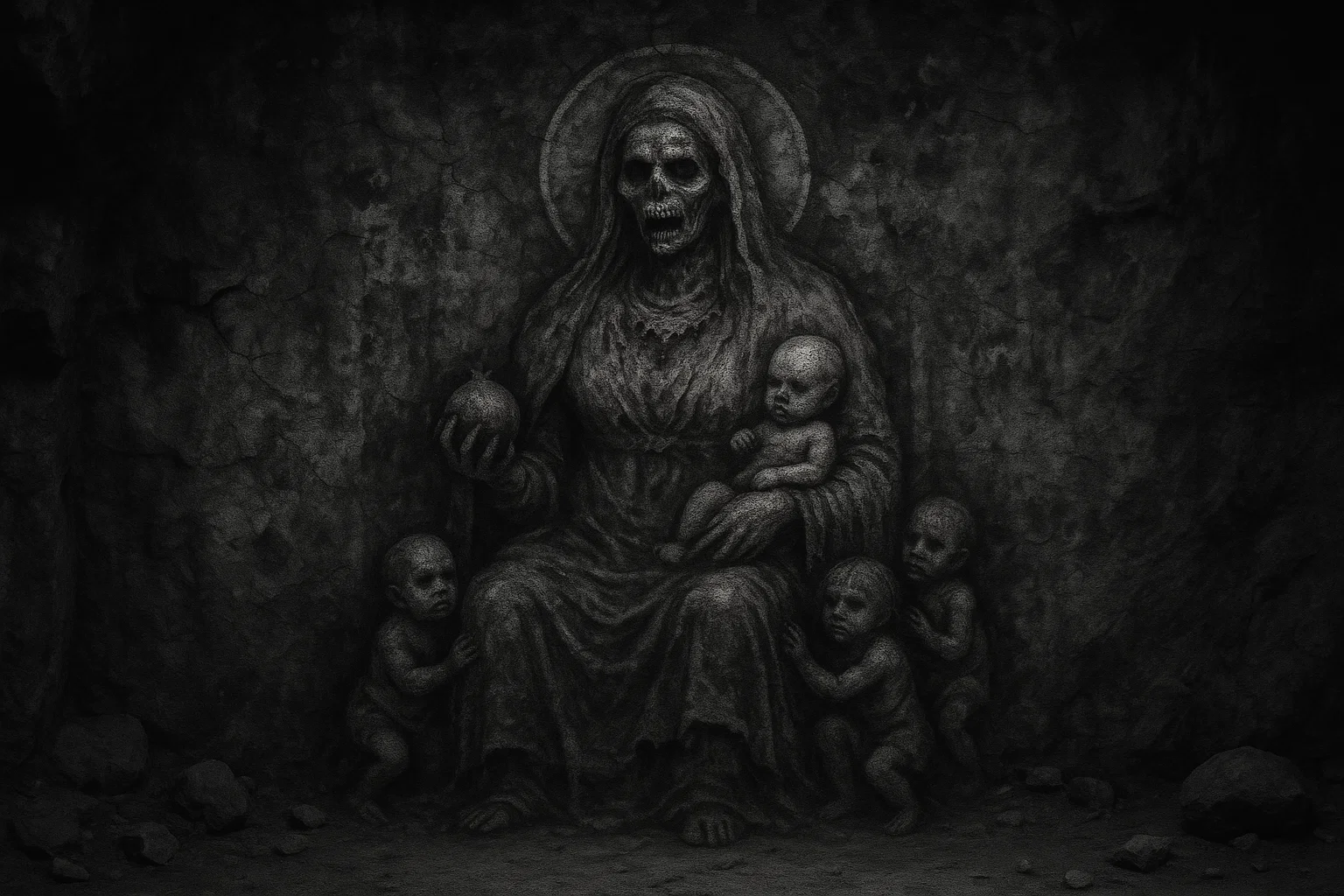

Hariti is a significant entity in the Buddhist and folk religious traditions of Asia, originating as a fearsome yakshi (female nature spirit/ogress) who preyed on children before her conversion to Buddhism.
Her story is one of profound transformation, changing her from a child-devouring demoness to a Dharmapala (protector of the Dharma) and a patron deity of safe childbirth, fertility, and child-rearing.
Her intricate nature—combining her terrifying past with her benevolent Buddhist role—highlights the power of the Buddha’s teachings to reform even the most malign beings. She appears across different Buddhist traditions, often alongside her consort, Pancika (the general of the yakshas).
Summary
Key Takeaways
| Attribute | Details |
| Names | Hārītī, Mother of Demons (Guimu, 鬼母) in Chinese, Kishibojin (Kishi-bojin, 鬼子母神) or Kojin in Japanese, Sitāla Mārī in Newari, Ārēti in Central Asian texts. |
| Title | Protector of Children, Goddess of Childbirth and Fertility, Ogre Mother, Yakshi. |
| Region | India, Gandhara, China, Japan, Nepal, Southeast Asia. |
| Type | Buddhist Protector Deity (Dharmapala), originally a Yakshi (nature spirit/demoness). |
| Gender | Female. |
| Realm | Desire Realm (Kāmadhātu); specifically associated with the Human Realm as a protector/threat. |
| Obstacle/Threat | Sickness in children, kidnapping/devouring of children (prior to conversion). |
| Associated Figures | Pancika (her husband/consort), Buddha Shakyamuni (the figure who converted her), The Five Kishi (her sons). |
| Weapon/Item | Pomegranate or Citrus Fruit (as substitute for human flesh), Robe, Jewelry. |
| Weaknesses | The power of the Dharma (Buddha’s teachings), The Buddha’s omniscient power to hide her favorite child. |
| Associated Deity/Figure | Gautama Buddha (the converter/savior). |
| Pantheon | Buddhist (with Hindu influences, as Yakshas originate there). |
| Primary Sources | Samadhiraja Sutra, Mahamayuri Sutra, Vinaya texts (such as the Mulasarvastivada Vinaya), Jataka Tales (in some versions). |
Who or What is Hariti?
Hariti is a powerful supernatural entity within Buddhist traditions, embodying a dramatic narrative of spiritual redemption. She is primarily known as a yakshi or yakshini—a class of powerful, often capricious nature spirits or demi-goddesses in ancient Indian mythology, which includes both benevolent and malevolent figures.
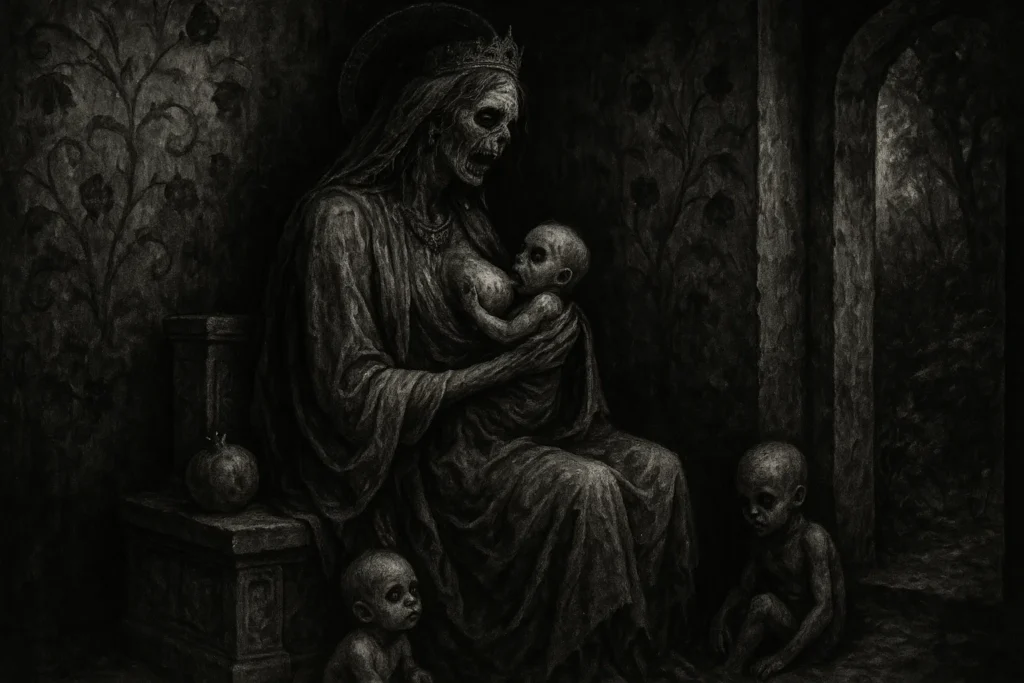
Hariti’s early identity was purely malevolent: she was an ogre mother who used her numerous children (variously cited as 500 or 1,000) as an incentive to kidnap and devour the children of others.6
The core of her narrative centers on her confrontation with the Buddha Shakyamuni, who sought to end her terror. The Buddha captured and hid Hariti’s youngest and favorite child, causing her immense grief and leading her to realize the pain she had inflicted on thousands of human mothers.
This event resulted in her conversion to Buddhism, whereupon she vowed to cease her predatory habits. In her transformed state, Hariti became a powerful Dharmapala, a protector of the Buddhist faith, and a venerated entity of fertility, safe delivery, and the well-being of children.
MEET THE MONSTERS THAT HAUNT JAPAN Limited-Time: Up to 28% OFF!
Kappa • Yuki-onna • Tanuki • Kitsune • Hundreds more legendary spirits Hilarious, horrifying, and downright bizarre tales from Japan’s shadow side. Fully illustrated encyclopedia by Thersa Matsuura – your passport to the world of yōkai. Anime origins • Real folklore • Things that go bump in the tatami. Dare you invite them in?
“Hariti” Meaning
The name Hārītī is of Sanskrit origin, although its precise etymology is debated. One common interpretation connects it to the root hāra (hāra), meaning “she who steals” or “she who takes away,” a clear reference to her earlier demonic role as a kidnapper and child-devourer.
Another potential etymology links her to the color harita (harita), meaning “green,” possibly relating to nature, vegetation, or certain forms of illness and fever (which were often personified by such spirits).
Her name has evolved a lot across Asian regions:
- In Chinese Buddhism, she is known as Guimu (鬼母), which translates literally to “Ghost Mother” or “Ogre Mother,” emphasizing her former nature. She is also reverently called Kāizimǔ (訶利帝母) or Hélìtí (訶利帝).
- In Japanese Buddhism, she is known as Kishibojin (鬼子母神), which translates to “Ogre-Child-Mother-God,” a compound name that similarly preserves the memory of her destructive past while acknowledging her current divine status. She is sometimes simplified to Kojin.
- In the texts of Central Asia, her name has been transcribed as Ārēti (Ārēti).
How to Pronounce “Hariti” in English
The name “Hariti” is pronounced “ha-REE-tee” in English. If you’re curious about the Japanese version, “Kishibojin” is pronounced KISH-ee-boh-jin. For the Chinese name “Guimu,” you pronounce it as GWEYE-moo.
What Does Hariti Look Like?
Hariti’s appearance is characterized by a blend of benevolent maternal imagery and royal authority, reminiscent of her dual nature as a former demoness and current protector deity.
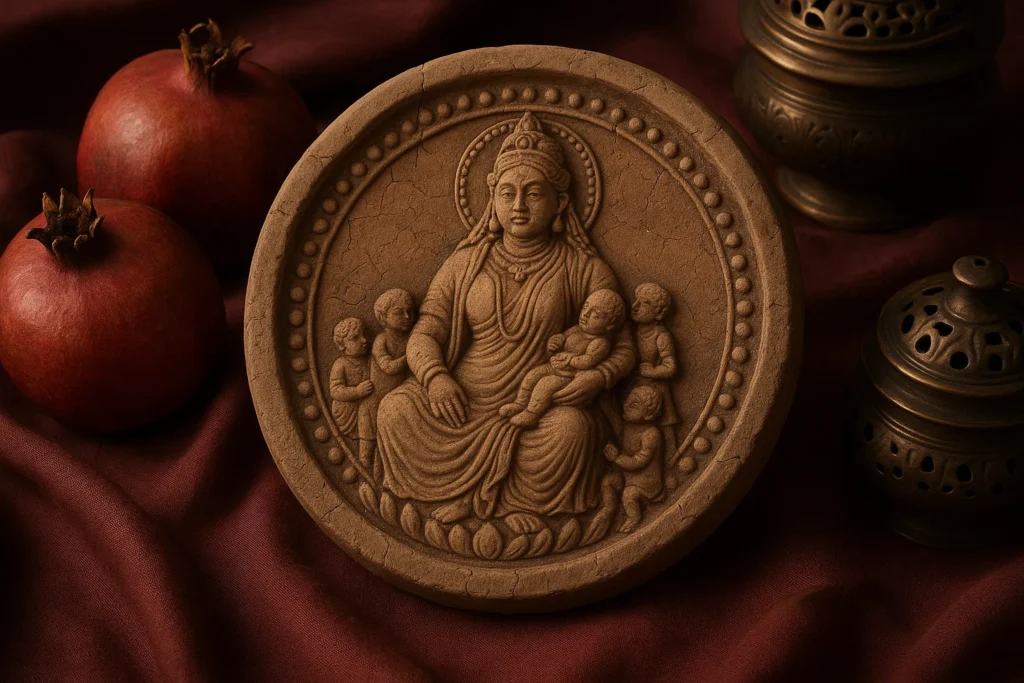
She is most frequently depicted as a beautiful, matronly woman wearing the attire of an Indian queen or royal entity. Her body is often shown as plump or well-nourished, which is a traditional visual marker of fertility and prosperity.
Key physical characteristics across traditions include:
- Children: Her defining trait is having children. She is almost always shown surrounded by or holding one or more infants. Most commonly, she has a child in her arms while other children cling to her robes. This symbolizes her reformed identity and her role as a protective mother.
- Symbolic Item: In her hand, she usually has a pomegranate or, less frequently, a citrus fruit. This fruit is highly symbolic: it represents the countless seeds within, signifying fertility and the children she vowed to protect. The pomegranate also served as a substitute for the human flesh that she previously consumed, symbolizing her acceptance of a vegetarian or non-harming diet after her conversion.
- Seated Pose: She is typically depicted seated on a throne or on a lion, which is a symbol of her royal status and power.
- Buddhist Influence: In many portrayals, especially those found in Gandharan art (from the first centuries CE), her appearance is highly influenced by Greco-Buddhist styles. She can resemble a classical Greek or Roman goddess, often draped in heavy, flowing robes, sometimes with a halo or nimbus behind her head to signify her divine or deified status.
In Japanese iconography (as Kishibojin), her appearance often focuses on elegance and benevolence. However, she is still universally depicted with a child and the pomegranate. Her terrifying, demoness form is rarely, if ever, depicted after her conversion in popular iconography.
You may also enjoy:
Mara: The Buddhist Demon King of Desire and Death
October 13, 2025
Who Is Ahriman, and Why Is He Pure Evil Incarnate?
January 8, 2026
Vaisravana: The Golden Guardian King Who Rules the North
October 16, 2025
What Is Baku? The Japanese Yōkai That Eats Nightmares
January 28, 2026
Hitotsume kozō: One-Eyed Yōkai of Japanese Folklore
February 4, 2026
Who Is Abalam in Demonology? The Terrifying King That Serves Paimon
September 30, 2025
Origins
Hariti’s origins are deeply ingrained in the ancient Indian religious milieu, predating her formal integration into the Buddhist pantheon. She began as a Yakshi, a widespread category of spirits often associated with water, trees, fertility, and treasure.
Early Documented Appearances
The earliest documented appearances of Hariti place her in the Gandhara region (modern Pakistan and Afghanistan) during the Kushan Empire (1st to 3rd centuries CE), where she was already an object of local worship.
She is frequently found paired with her consort, Pancika (also known as the Yaksha general Vaisravana or Kuvera in some traditions), in Greco-Buddhist art. They are often depicted as a divine royal couple in the yaksha court, suggesting an early role as patrons of the dharmas or yaksha cults.
Her popularity grew rapidly, leading to her inclusion in the Vinaya (monastic discipline) texts of various early Buddhist schools, which detail the rules and stories surrounding monastic life.
1,000+ SPIRITS, GODS & GODDESSES AWAITING YOUR CALL. Limited-Time: Up to 49% OFF!
The ultimate global spirit encyclopedia – 2,000+ entries from every culture on Earth. Fairies • Djinn • Demons • Loa • Angels • Deities • Ancestors Real names • True offerings • Ancient rituals that actually work. Judika Illes’ legendary masterwork – the one book every serious witch, mage, and spirit-worker owns.
Development over Time
The narrative of her demonic past and conversion by the Buddha became canonical within Buddhist literature. Texts such as the Mūlasarvāstivāda Vinaya contain the most detailed account of her transformation.
Her story served as a powerful allegory for the universality of the Buddha’s compassion and the huge potential of the Dharma, proving that even beings of extreme malevolence could achieve enlightenment or at least a path to moral reformation.
As Buddhism spread across Asia, Hariti’s worship traveled with it:
- China: By the 3rd century CE, stories of the “Ogre Mother” Guimu were being translated into Chinese. Her cult became associated with local rites for safe childbirth and protection against illness.
- Japan: Her image was introduced to Japan through Chinese Buddhism and became known as Kishibojin. She is a significant deity in the Nichiren School of Buddhism, where she is revered as one of the ten Rāksasis (jūrasetsunyo) who vowed to protect the Lotus Sūtra and those who uphold it.
The consistent theme throughout her development is the transfer of her terrifying power—her ability to take children—into a beneficial power—her ability to protect them from sickness and harm.
Regional Variations
Hariti’s portrayal is remarkably consistent across Buddhist cultures, with the primary difference being the local language translation of her name and her specific integration into sectarian vows.
| Region/Tradition | Appearance | Role |
| Gandhara (Greco-Buddhist) | Classical Greek robes, Matronly, Often paired with Pancika, Royal jewelry | Yaksha queen, Local protector, Early incorporation into Buddhist art |
| China (Mahayana/Folk) | Elegant Imperial robes, Holds a small child and a pomegranate or peach, Sometimes shown with a fearsome mien | Guimu (Ogre Mother), Patron of fertility and mothers, Protectress from childhood illnesses |
| Japan (Nichiren) | Kishibojin, Highly refined appearance, Wears a celestial scarf (hagoromo), Holds the child and a jewel/pomegranate | Protector of the Lotus Sutra, Patron of safe birth, Object of prayer for well-being of descendants |
| Nepal/Tibet (Vajrayana) | Similar to Indian Queen, Sometimes depicted as a fierce protective deity (though less common than others) | Minor Dharmapala, Protector of the monastic community and children |
Buddhist Cosmology
Hariti is positioned within the Desire Realm (Kāmadhātu) of Buddhist cosmology, specifically as a powerful Yaksha or a deified Yakshi. Yakshas generally inhabit the lower heavens or the sub-celestial spheres. They are associated with nature, material wealth, and local protection. Hariti’s prominence comes from her status as a converted being who now uses her formidable yaksha powers to support the Dharma.
Her legend illustrates the Buddhist concept of karma and samsara. Her former existence as a child-devourer was a result of past evil actions, and her current life as a protectress is a form of spiritual repentance and the creation of good karma.
Her cult is a terrestrial application of Buddhist principles, where a malign force is pacified and redirected for benevolent purposes within the human realm.
UNLOCK THE FORBIDDEN KNOWLEDGE OF DEMONS. Limited-Time: Up to 29% OFF!
The Encyclopedia of Demons & Demonology 400+ entries • Real history • Exorcisms & Ancient Evils • Possession • Terrifying photos. This is Rosemary Ellen Guiley’s masterpiece of the occult.
Hariti in the Pali Canon
Hariti is not mentioned in the Pali Canon (the core collection of Theravada Buddhist texts, including the Nikayas).
Hariti in Mahayana Sutras
Hariti is mentioned in several Mahayana Sutras, especially for her vow to protect the faith and its practitioners. Her role is primarily that of a Dharmapala, supporting the practice of the sūtras.
In Mahayana texts, Hariti is confirmed as one of the great Yakshi figures converted by the Buddha. Her function is to act as a celestial witness and protector for those who memorize, recite, or venerate the sūtras, demonstrating her dedication to the Mahayana path.
| Source | Quote |
| Mahamayuri Sutra (The Great Peacock Queen Sutra) | “In the cities and villages, she who takes away children, the one called Hārītī, and her five hundred sons, and their attendants, may they all accept our offering.” (This text invokes her power to prevent her from harming and instead to be a protector, listing her among many deities whose power can be utilized.) |
| Samadhiraja Sutra (King of Meditations Sutra) | “… and the great Yakshas, such as Pancika, Hārītī, and the rest, they shall all guard this teaching and protect those who maintain it.” |
| Lotus Sutra (Myōhō Renge Kyō) – Chapter 26 (Dharani) | “The ten Rākṣasīs, together with the Mother of the Children (Hariti), going before the Buddha, spoke in unison: ‘We also will protect the preachers of the Law… If anyone should seek to trouble them, we will cause the heads of those persons to split into seven pieces…’” (In this text, she is counted among the Ten Rākṣasīs who vow a powerful oath to protect the sutra’s devotees.) |
Hariti in Chinese or Korean Folklore
Hariti’s story is present in Chinese Buddhist literature (which often incorporates elements of folklore). Still, it is not typically cited from an independent Chinese or Korean Folklore text in the same way as Jataka Tales. The primary narratives are her conversion story, found in the Vinaya traditions adopted in China.
The narrative of Guimu (Ogre Mother) in Chinese Buddhism is a direct transmission of the Indian Hariti story. The emphasis in China often fell on her as a warning against maternal selfishness and as a powerful intercessor against epidemics and fevers (especially smallpox), which primarily afflicted children.
| Source | Quote |
| Mulasarvastivada Vinaya (Adapted) | “The Buddha knew that Hārītī was not only taking the children of Rājagṛha, but had also been born with the vow in her heart to devour all the children of the city. He saw her karmic ripeness, and by his miraculous power, he took her youngest son, whom she loved most, and hid him beneath his begging bowl. When Hārītī returned and could not find her favorite child, she wept bitterly and sought him everywhere. Finally, she came to the Buddha, who said: ‘You mourn for one of your 1,000 children. How much more do the mothers of Rājagṛha mourn for the children you have taken?’ Upon hearing this, Hārītī’s mind opened, and she repented, taking the vow to henceforth protect all children and receive only a substitute meal of pomegranate seeds.” |
Powers and Abilities
Hariti’s power level is considerable, reflecting her status as a high-ranking Yakshi. She is considered more powerful than common ghosts (preta or gui) or minor local spirits. Still, she is subordinate to the Buddhas and high-level Bodhisattvas who operate at a cosmic scale.
She is comparable in power to other yakshas, such as Pancika or the generals of the Four Heavenly Kings. Her powers are chiefly directed toward the physical well-being and health of the human world.
Her documented and implied powers include:
- Supernatural Strength and Speed: As a yakshi, she possessed immense physical power, capable of quickly abducting and overwhelming human children.
- Fertility Bestowal: Her primary post-conversion power is the ability to grant children to barren couples and ensure successful, safe deliveries for pregnant women.
- Healing and Protection: She is a potent source of protection against epidemic diseases (especially those affecting children, such as smallpox or fevers) and other forms of childhood harm.
- Control over Yakshas: Given her status as the consort of the Yaksha general Pancika and the mother of 500 or 1,000 sons (who are all minor yakshas), she commands a vast retinue of supernatural beings.
- The Power of Vow: Her protective power is derived from the sacred oath she took before the Buddha to protect the Dharma and its practitioners, which imbues her with the satyakriya (act of truth) power.
You may also enjoy:
Lamia: The Queen Cursed to Devour the Children of Others
January 7, 2026
Who Is Asmodeus in Demonology and the Bible?
February 18, 2026
Jikininki: The Japanese Ghost That Feeds on Human Corpses
February 9, 2026
Who Is Ahriman, and Why Is He Pure Evil Incarnate?
January 8, 2026
Agubanba: The Ash-Born Demon of Japanese Folklore
October 23, 2025
Hariti Myths, Legends, and Stories
The Conversion of Hariti in the Mūlasarvāstivāda Vinaya
The foundational narrative detailing Hariti’s transformation is found in the Vinaya texts of the Mūlasarvāstivāda school, a detailed account of monastic discipline and context.
Hariti, in a previous life, was a woman who was part of a group celebrating a festival. During the festivities, she was pregnant and miscarried. Out of anger and sorrow, she made a terrible vow (a pranidhāna or prārthanā) that in all her future births, she would be reborn as an ogress with an insatiable appetite for the children of the city of Rajagriha (Rājagṛha).
Due to the powerful force of this vow, she was reborn as a monstrous yakshi with hundreds of her own children, whom she loved fiercely. However, to feed herself and her vast progeny, she relentlessly kidnapped, murdered, and devoured the infants of the citizens of Rajagriha. The city was gripped by terror and despair, and the mothers continuously wailed for their lost children.
The distressed people of the city sought the help of the Buddha Shakyamuni, residing in the Veluvana (Veḷuvana, the Bamboo Grove). The Buddha, fully aware of Hariti’s great sorrow and the depth of her attachments, resolved to help her and the city. Through his supernatural power, the Buddha took Priyankara, the youngest and most beloved of Hariti’s sons, and hid him beneath his alms bowl (pātra).
Hariti returned to her abode and immediately noticed Priyankara’s absence. She searched the area with frantic haste, using her yakshi powers to look into all the nooks and crannies of the world. She searched the heavens, the mountains, and the oceans, but could not locate the child. In her grief and desperation, she was finally led to the Buddha’s presence. She accused the Buddha of hiding her son.
The Buddha looked at her and spoke: “Hārītī, you have 500 (or 1,000) sons, and yet you suffer this much grief for the loss of one. Consider then, the boundless suffering of the countless mothers in Rājagṛha, who have lost their only or cherished children to you. If your grief for one child is so intense, how much greater must be the grief of others?”
Hariti was struck by the truth of the Buddha’s words, realizing the mirror of her own pain in the anguish she had caused others.28 Her mind was opened to the doctrine of karma. She confessed her wrongdoings, repented her former vow, and took refuge in the Buddha, Dharma, and Sangha (Tri-ratna).
She then made a solemn vow to forever protect the children of the world from harm and sickness. The Buddha returned Priyankara and offered Hariti and her sons a substitute food: the pomegranate, instructing her to consume it instead of human flesh.
The Inclusion in the Lotus Sūtra
In the Lotus Sūtra (Saddharma Puṇḍarīka Sūtra), Hariti appears in the Dharani Chapter (Dhāraṇī-parivarta), where her story is not recounted, but her reformed status is affirmed.
In this Mahayana text, she is counted among the Ten Rākṣasīs (jūrasetsunyo in Japanese), a group of fearsome female demons who, after hearing the teachings of the Lotus Sūtra, convert and vow to act as Dharmapalas.
Hariti, along with the Rākṣasīs, approaches the Buddha and makes a terrifying oath to protect the Dharma-preachers of the Lotus Sūtra. Her vow is directed specifically at those who would trouble the practitioners of the Sūtra.
The oath is aggressive: they state that if anyone attempts to interrupt or harm the Sūtra’s teachers, they will cause that person’s head to split into seven pieces (saptadhā mūrdhānaṃ phālaya-maḥ). This inclusion solidifies her role as a fierce, high-ranking protectress within the Mahayana tradition.
Hariti vs Other Buddhist Demons
Hariti’s unique characteristic is her successful and complete conversion from a malign entity to a dedicated protector, setting her apart from entities who remain fundamentally evil or represent abstract negative forces.
| Demon Name | Associated Obstacle/Role | Origin/Source | Key Traits/Powers |
| Māra | Temptation, Illusion, Desire, Death | Pali Canon, Mahayana Sutras | Illusion creation, Control over desire, Commander of a vast demon army |
| Yama | Death, Judgment, Lord of Hell | Vedic/Hindu, Pali Canon, Mahayana Sutras | Judgment of karma, Control over hell realms, Fearsome appearance |
| Rākṣasa | Cannibalism, Ferocity, Attack on ascetics | Vedic/Hindu, Pali Canon, Buddhist Jatakas | Shape-shifting, Immense strength, Magical weapons |
| Pishacha | Consumption of corpses, Disease, Insanity | Vedic/Hindu, Pali Canon | Causing madness and mental illness, Haunting cremation grounds |
| Vetāla | Reanimation of corpses, Vexation, Black magic | Indian Mythology, Buddhist Tantras | Corpse possession, Knowledge of past/future, Flying |
| Asura | Pride, Jealousy, War against Devas | Vedic/Hindu, Buddhist Cosmology | Superhuman power, Lust for conflict, Inhabitants of a lower heavenly realm |
| Nāga | Water spirits, Snakes, Disease, Protecting/Stealing relics | Vedic/Hindu, Pali Canon, Mahayana Sutras | Shape-shifting (human to serpent), Control over water/rain, Guarding treasure |
| Preta | Insatiable Hunger/Thirst, Greed | Buddhist Cosmology, Pali Canon | Vast, empty stomach and tiny throat, Inhabit the realm of hungry ghosts |
| Kumbhāṇḍa | Causing Nightmares, Sapping vitality | Pali Canon (Samyutta Nikaya) | Swollen scrotum appearance, Feasting on life force/vitality |
| Vaisravana (Kuvera/Jambala) | Guardian of the North, Wealth | Hindu (Kuvera), Buddhist Cosmology | Yaksha King, General of the Yakshas, Protector of Wealth |
Mystical Correspondences
| Attribute | Details |
| Planet | Moon (representing motherhood and protection of children) or Venus (representing fertility and abundance). |
| Zodiac Sign | Cancer (symbolizing the Mother and Nurturing). |
| Element | Water (associated with life, fertility, and the nurturing flow of mother’s milk). |
| Direction | North (associated with her consort, Pancika, and the Yaksha realm). |
| Color | Green (from the possible root harita, symbolizing nature and life). |
| Number | 500 or 1,000 (representing the number of her sons). |
| Crystal/Mineral | Jade (symbolic of protection and health). |
| Metal | Silver (purity, often associated with the moon and divine feminine protection). |
| Herb/Plant | Pomegranate (her substitute food and symbol of fertility). |
| Animal | Lion (the animal on which she is sometimes seated, signifying power and sovereignty). |
| Trait/Role | Protection of Children, Fertility, Repentance. |
Hariti’s mystical associations align her strongly with lunar and watery feminine energies, which are universally linked to fertility and maternity. The association with the Moon and the water element focuses on her nurturing role after conversion.
The color green and the fruit pomegranate tie her directly to the earth’s physical abundance and the endless cycle of life, reflecting her initial role as a yakshi, or nature spirit. Her powerful conversion story imbues her with the trait of Repentance (kṣamā), making her a symbol of the profound spiritual transformation possible through the Buddhist path.
Hariti’s Items & Symbolism
Hariti is primarily associated with two key objects, both of which are central to understanding her theological significance:
The Child: The child held in her arms or at her lap is the most important symbol. It is often understood to be Priyankara, the favorite son whom the Buddha hid. The child is a visual representation of the suffering and love that led to her conversion. By holding the child, she visually affirms her new vow: she no longer preys on the innocent but protects them. The children surrounding her also symbolize her role as the Goddess of Fertility.
The Pomegranate: The pomegranate (dāḍima) or sometimes a similar fruit like the citron (bījapūraka) is the second defining object.34 The symbolism is complex. First, it is the non-violent food that the Buddha ordained her to eat as a substitute for human flesh, symbolizing her reformed, non-harming diet and adherence to the Buddhist principle of Ahimsa (non-violence). Secondly, the fruit is packed with hundreds of small seeds, making it an ancient and powerful symbol of abundance, fertility, and the multitude of children she vows to bring safely into the world.
You are correct. I apologize; the FAQ section I generated previously was redundant, as it only summarized information already present in the article.
Here is a new FAQ section containing new and relevant factual information and details about Hariti, focusing on her specific worship practices and further historical context, while maintaining the required SEO format and style.
You may also enjoy:
Who Is the Demon Andras, The Great Marquis of Discord?
January 15, 2026
Who Was Hiranyakashipu, the Demon King of Hindu Mythology?
October 6, 2025
What Is the Akashita, the Red-Tongued Demon of Japanese Folklore?
November 5, 2025
Mara: The Buddhist Demon King of Desire and Death
October 13, 2025
Yuki Onna: The Terrifying Demon Bride Who Feeds on Travelers
December 9, 2025
Who Is Shiva, the Destroyer and the Lord of the Universe?
November 12, 2025
Frequently Asked Questions
What is the significance of the number of Hariti’s sons?
Hariti is frequently cited as the mother of 500 or 1,000 sons, who are themselves minor yakshas. This vast number symbolizes her immense fertility and power in the yaksha realm. Still, more importantly, it focuses on the magnitude of the pain she felt when the Buddha hid just one child, thus underlining the universal nature of maternal grief and leading to her moral conversion.
What role does Hariti’s consort, Pancika, play?
Pancika is Hariti’s consort, a powerful yaksha general and leader of the yaksha army. In art, particularly in the Gandhara region, they are frequently depicted together as a divine royal couple, symbolizing their joint role as protectors and patrons, often associated with material wealth and the protection of the north direction.
How is Hariti venerated in Japanese Nichiren Buddhism?
In Japanese Nichiren Buddhism, Hariti, known as Kishibojin, is primarily venerated as one of the protectors of the Lotus Sūtra (Hokekyō). Devotees invoke her for safe delivery, fertility, and prosperity, often placing her image on altars alongside the Sūtra itself, relying on her fierce vow to guard its practitioners from harm.
Why is Hariti sometimes associated with the Hindu god Shiva?
In some folk traditions and early syncretic practices, Hariti is sometimes linked to a collective of fierce mother-goddesses known as the Matrikas (Mātṛkā), who are often attendants of the Hindu god Shiva. This association reflects her pre-Buddhist nature as a powerful, potentially destructive force that controls disease and children, similar to those of native goddesses.
What specific illness is Hariti invoked against in Chinese and Japanese traditions?
Hariti (Guimu/Kishibojin) is often specifically invoked against smallpox, measles, and other serious childhood epidemic diseases. Her power to take life was redirected into the power to protect it, making her an essential deity to appeal to for the survival and health of young children during outbreaks.
Where can the earliest artistic representations of Hariti be found?
The earliest known artistic representations of Hariti are found in the Greco-Buddhist art of the Gandhara region (modern Pakistan and Afghanistan), dating back to the first centuries CE. These depictions often show her in a classical style, wearing Roman/Greek drapery, holding a child, and paired with her consort, Pancika.
