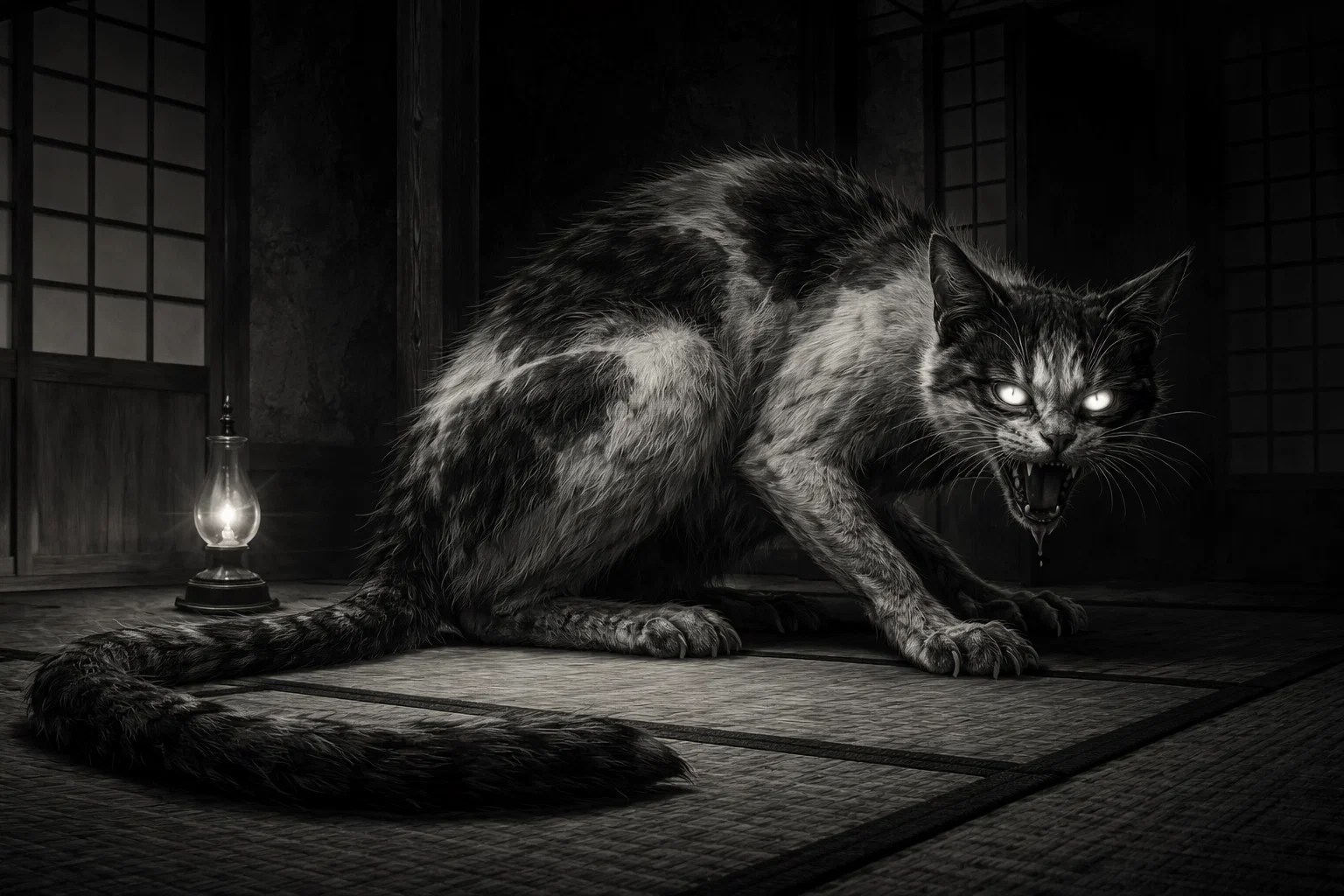

A Bakeneko is a Japanese yōkai, or supernatural cat, that gains special powers as it gets older or through certain actions. Unlike regular house cats, Bakeneko can shapeshift, speak human languages, and even control the dead. They are usually shown as sinister beings that take their owners’ places or haunt homes. Bakeneko are an important part of the bakemono, or ‘changing things,’ in Japanese folklore.
Summary
Key Takeaways
| Attribute | Details |
| Names | Bakeneko (化け猫), kaibyō (strange cat), monster cat |
| Translation | Changed cat or transformed cat |
| Title | The Monster Cat |
| Type | Obake / Bakemono |
| Origin | A domestic cat that reaches a specific age, size, or licks lamp oil |
| Gender | Can be male or female; often assumes female human forms |
| Appearance | A large cat, sometimes walking on hind legs, or a human-cat hybrid |
| Powers/Abilities | Shapeshifting, human speech, necromancy, creating fireballs |
| Weaknesses | Physical weapons, being identified in human form, death of the original cat |
| Habitat | Human homes, villages, and urban areas |
| Diet/Prey | Lamp oil (fish oil), human flesh, or their former masters |
| Symbolic Item | A tenugui (hand towel) often worn on the head while dancing |
| Symbolism | The dangers of domestic pets living too long and the supernatural potential of the mundane |
| Sources | Ehon Hyaku Monogatari, Gazu Hyakki Yagyō, Nabeshima Kaibyō Den |
Who or What is Bakeneko?
A Bakeneko starts out as a normal house cat. In Japanese folklore, especially from the Edo period, a cat becomes a yōkai when it meets certain conditions. These include being twelve or thirteen years old, weighing about 3.75 kg (one kan), or having a long, undocked tail. Cats that often lick lamp oil, which is used to be made from fish oil, are also said to turn into Bakeneko.
After transforming, a Bakeneko gets several supernatural abilities. It can grow very large, sometimes several feet long. The most noticeable change is that it can walk on its back legs and talk like a person.
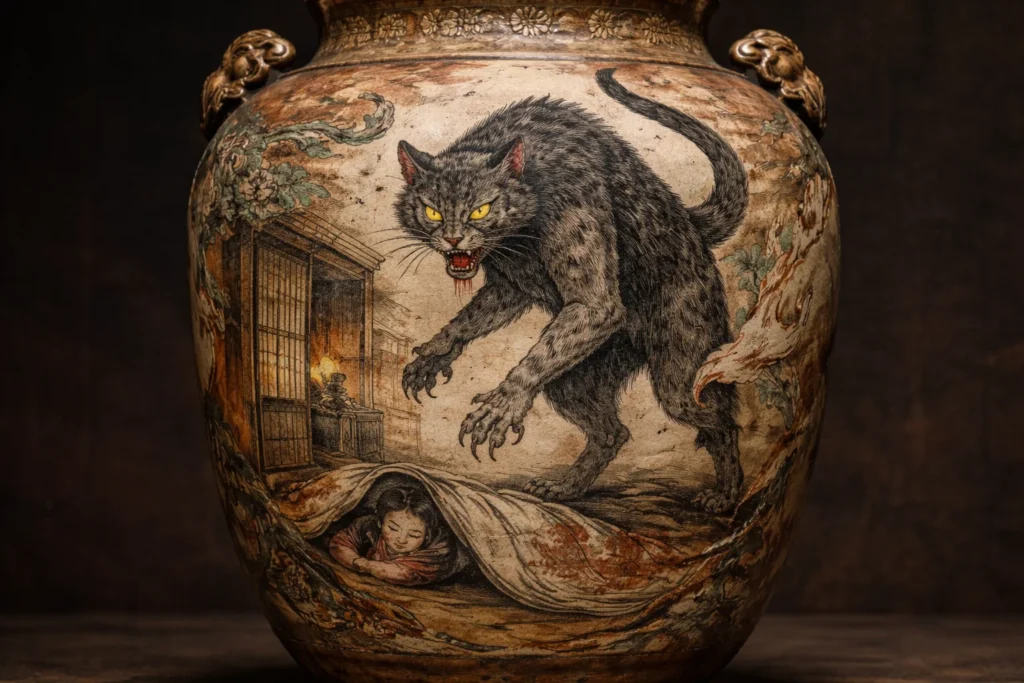
Some stories show Bakeneko as playful or just a little mischievous, but most old legends describe them as dangerous. They are often blamed for killing their owners, eating them, and then taking their place by copying their appearance.
MEET THE MONSTERS THAT HAUNT JAPAN Limited-Time: Up to 28% OFF!
Kappa • Yuki-onna • Tanuki • Kitsune • Hundreds more legendary spirits Hilarious, horrifying, and downright bizarre tales from Japan’s shadow side. Fully illustrated encyclopedia by Thersa Matsuura – your passport to the world of yōkai. Anime origins • Real folklore • Things that go bump in the tatami. Dare you invite them in?
“Bakeneko” Meaning
The word Bakeneko comes from two Japanese words. ‘Bake’ (化け) comes from ‘bakeru,’ which means ‘to transform,’ ‘to change,’ or ‘to disguise.’ This word is often used for yōkai that can shapeshift, like Tanuki or Kitsune. ‘Neko’ (猫) just means ‘cat.’ So, Bakeneko literally means ‘transformed cat’ or ‘changing cat.’
In the past, the term Bakeneko helped people distinguish these supernatural cats from ordinary ones. During the Edo period, different regions used different words. In some places, they were called kaibyō (怪猫), meaning ‘strange cat’ or ‘ghost cat.’
People sometimes use the word Nekomata to mean the same thing as Bakeneko, but experts say they are different. A Nekomata is usually older and has a split tail. In contrast, a Bakeneko often has a single long tail and is more likely to sneak into homes. The names show how these creatures are believed to cross from the natural world to the supernatural as they get older.
How to Pronounce “Bakeneko” in English
In English, Bakeneko is pronounced ‘bah-keh-neh-koh.’ ‘Bah’ rhymes with ‘car,’ ‘keh’ sounds like the ‘e’ in ‘kept,’ ‘neh’ is like ‘ne’ in ‘net,’ and ‘koh’ rhymes with ‘go.’ In Japanese, each syllable is said with equal length.
What Does Bakeneko Look Like?
A Bakeneko’s appearance changes depending on the story and how far it has transformed. At first, it looks like a very large house cat, sometimes as big as a person. One main feature is its tail. Unlike the Nekomata, which has a split tail, the Bakeneko usually has one long tail.
When a Bakeneko stands on its back legs, it can look more like a human. In many old woodblock prints, like those by Utagawa Kuniyoshi, Bakeneko are shown wearing a tenugui (a hand towel) on their heads and sometimes dancing. When they change into a human, they often look like a woman, usually an older lady or the person they have just killed.
Even when disguised as a human, a Bakeneko might still have some cat features, like a bit of fur, slitted eyes, or a cat-shaped shadow, no matter the lighting. In scarier stories, it is shown with glowing eyes, sharp claws, and a mouth big enough to swallow a person’s head.
You may also enjoy:
Who Was Hiranyaksha, the Golden-Eyed Asura?
October 7, 2025
Yuki Onna: The Terrifying Demon Bride Who Feeds on Travelers
December 9, 2025
Abura-akago: The Oil-Licking Demon Baby
October 22, 2025
Bakeneko: A Supernatural Cat Yōkai in Japanese Folklore
January 27, 2026
Who Is Abalam in Demonology? The Demon King That Serves Paimon
September 30, 2025
Who Is Abaddon, the Demon of the Abyss, in the Bible?
September 29, 2025
Habitat
Bakeneko are mostly found in homes, living close to people. Unlike yōkai like the Yama-uba, who live in the mountains, or the Kappa, who live in rivers, Bakeneko prefer to stay inside houses, especially big homes or farms. They usually live in the same places where they were once regular pets.
Stories say Bakeneko like kitchens and places where lamps are kept, since they are attracted to the oil. They are also linked to theaters and entertainment areas in cities, as they often appear in Kabuki plays. Some tales put them in empty temples or old, overgrown houses where they can hide. Because they frequently have a grudge or a long history with a family, they usually haunt or control a specific household.
Origins and History
The idea of the Bakeneko started in the early Edo period (1603–1867). At that time, cats were important in Japan because they protected silkworms and grain from mice. But people also found cats suspicious because they were active at night, moved quietly, and had eyes that changed shape in different light.
People began to believe that cats could turn into yōkai after seeing them lick lamp oil, which was made from fish and attracted them. Watching a cat stand on its hind legs to reach a lamp, with its shadow looming huge on a paper screen, helped inspire the story of the monster cat that walks on two legs.
Later, some laws were made about cat tail length, and many people cut their cats’ tails short because they thought long-tailed cats would become Bakeneko or Nekomata.
By the middle of the Edo period, Bakeneko were common in ghost stories (kaidan) and Ukiyo-e art. The real-life ‘Nabeshima Cat Disturbance’ in the 1600s made the Bakeneko even more famous, turning it from a general superstition into a well-known villain in stories and plays.
Sources
| Source | Quote |
| Ehon Hyaku Monogatari | “It is said that when a cat lives for many years, it becomes a Bakeneko. It will dance with a towel on its head and speak like a person.” |
| Gazu Hyakki Yagyō | “A cat that licks the oil of a lamp will eventually become a monster. It is known as the Bakeneko.” |
| Nabeshima Kaibyō Den | “The cat lapped the blood of the slain mistress and assumed her form, deceiving the prince for many nights.” |
Famous Bakeneko Legends and Stories
The Nabeshima Cat (Saga Domain)
The most famous legend involving a Bakeneko is the Nabeshima Kaibyō Den, set in the Saga Domain. According to the record, Prince Nabeshima Mitsushige was served by a loyal retainer, Ryūzōji Matashichirō. Due to a series of political disputes and a perceived insult, the prince ordered Ryūzōji’s execution. Ryūzōji’s mother, overwhelmed by grief, told her sorrows to the family’s pet cat and then committed suicide.
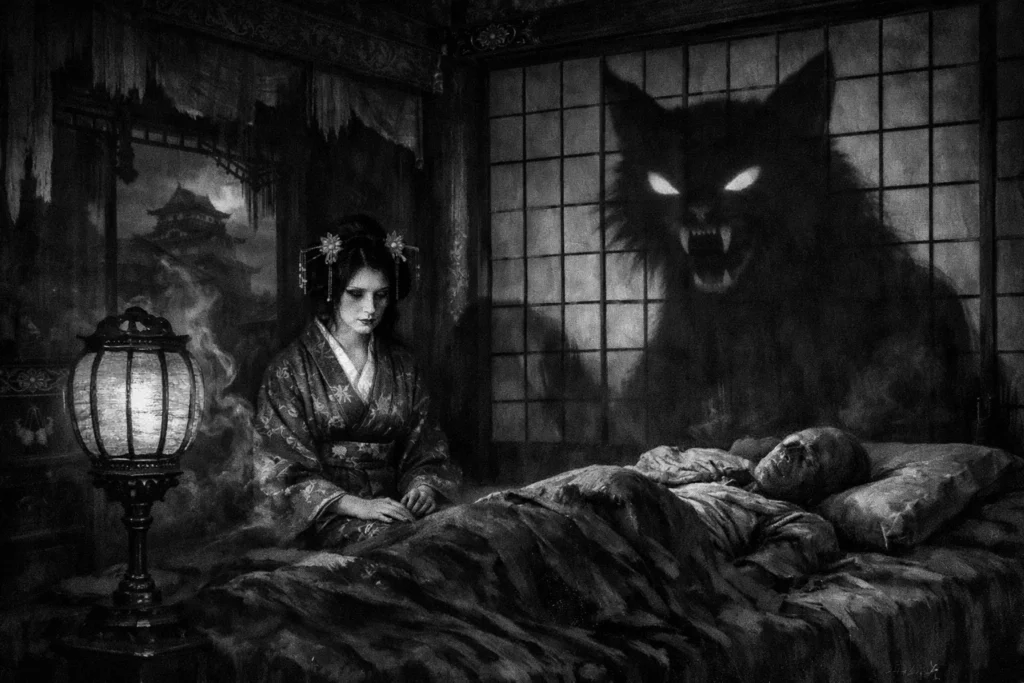
The cat licked the blood of its mistress and transformed into a massive Bakeneko. It entered the castle and killed Mitsushige’s favorite concubine, O-Tayo. The cat then took O-Tayo’s form, using its supernatural powers to drain the prince’s health night after night. Mitsushige became bedridden, suffering from terrible dreams and physical wasting. Every night, the “concubine” would stay by his side, but the guards would always fall into a deep, unnatural sleep.
Eventually, a young soldier named Komada Ichizen noticed the pattern. He stayed awake by stabbing his own thigh with a knife to prevent the cat’s magic from putting him to sleep. He witnessed the concubine’s shadow appearing as a cat on the paper screens. He attempted to kill her, but the Bakeneko escaped to the mountains. It was later hunted down and killed by a group of soldiers, ending the curse on the Nabeshima family.
1,000+ SPIRITS, GODS & GODDESSES AWAITING YOUR CALL. Limited-Time: Up to 49% OFF!
The ultimate global spirit encyclopedia – 2,000+ entries from every culture on Earth. Fairies • Djinn • Demons • Loa • Angels • Deities • Ancestors Real names • True offerings • Ancient rituals that actually work. Judika Illes’ legendary masterwork – the one book every serious witch, mage, and spirit-worker owns.
The Bakeneko of the Okazaki Track
In the Tokaido region, specifically at the Okazaki station, there is a legend often performed in Kabuki titled “The Monster Cat of the Okazaki Track.” The story involves a traveler who seeks shelter in an old, dilapidated temple or a lonely house near the station. Inside, he meets an elderly woman who treats him with kindness.
However, as the night progresses, the traveler witnesses the woman’s shadow on the wall. The shadow does not look like a human woman; instead, it has the distinct shape of a giant cat with ears and a tail, holding a tenugui and dancing.
In some versions, the cat is revealed to have killed the original priest of the temple and replaced him. The traveler often escapes just as the cat prepares to eat him, or he manages to slay the beast with a sword, revealing its true feline form after its death.
The Cat of Takasu Genbei
In another well-documented story from the Edo period, a man named Takasu Genbei noticed that his mother’s personality had changed drastically. She became reclusive, refused to eat in front of others, and developed a strange obsession with licking the oil from the household lamps.
Genbei decided to spy on her through a hole in the wall. To his horror, he saw a giant cat in his mother’s clothes, crouched over a lamp and lapping up the oil. Genbei immediately drew his sword and killed the creature. When the body was inspected, it was not his mother, but a massive cat that had lived in their house for many years.
After searching under the floorboards, Genbei found the skeletal remains of his actual mother, whom the Bakeneko had killed and consumed months prior.
You may also enjoy:
Al-Ahmar: The Tuesday King of the Seven Jinn
February 13, 2026
Who Is Arioch, the Demon of War and Vengeance?
January 21, 2026
What Is Jorōgumo? The Deadly Spider Woman of Japanese Myth
February 2, 2026
Hitotsume kozō: One-Eyed Yōkai of Japanese Folklore
February 4, 2026
Who Is Ariton, the Infernal King of the Eastern Gate?
February 17, 2026
Who Is Shiva, the Destroyer and the Lord of the Universe?
November 12, 2025
Bakeneko Powers and Abilities
Bakeneko possess many supernatural powers, making them dangerous yōkai. Their main skill is tricking people and sneaking into homes, as they can perfectly copy human appearances and actions. Unlike some yōkai that only have physical powers, Bakeneko also have spiritual and necromantic abilities.
Bakeneko are seen as very dangerous yōkai because they live inside people’s homes. While Kitsune might be better at creating illusions, Bakeneko are more physically threatening and often attack their former owners.
- Metamorphosis: The ability to take the form of a human, usually a woman or the person it has killed.
- Human Speech: The capacity to speak and understand human languages perfectly.
- Necromancy: Bakeneko can control the bodies of the dead like puppets by jumping over a corpse.
- Bipedalism: The ability to walk and dance on its hind legs for extended periods.
- Fire Manipulation: They are often seen creating hi-no-tama (fireballs) or accidentally causing house fires.
- Cursing: The ability to bring illness or misfortune to a household through a grudge.
- Massive Growth: The power to expand its body size to that of a full-grown man or larger.
How to Defend Against Bakeneko
To protect yourself from a Bakeneko, you need both physical and preventive steps. Folklore says the best way to stop a cat from turning into a Bakeneko is to cut its tail when it is a kitten. People believed the tail carried magical energy, so a short-tailed cat, like the Japanese Bobtail, could not change.
If a Bakeneko already exists, the first step is to identify it. Watch the shadow of anyone you suspect; a Bakeneko’s shadow will always look like a cat, even if it looks human. Bakeneko are also hard to feed because they like fish-based lamp oil. If you see someone licking oil, they might be a Bakeneko.
You can kill a Bakeneko with blessed swords or traditional weapons, but they move quickly. In many stories, their power comes from a grudge. Fixing the wrong that made the cat turn into a Bakeneko, like giving its owner a proper burial or punishing someone who hurt its master, can sometimes make the Bakeneko less dangerous. Shinto charms and ofuda placed around the house can also keep the yōkai out or stop its necromancy.
SPEAK THEIR TRUE NAMES… IF YOU DARE
Limited-Time: Up to 40% OFF!
Over 1,700+ demons – true names, ranks, infernal seals, powers & forbidden histories. The expanded & revised masterpiece by occult legend Michelle Belanger. Now with 200+ new entities, dozens of never-before-seen illustrations from ancient grimoires. The ultimate arsenal for demonologists, magicians, and the deliciously curious.
Bakeneko vs Other Yōkai
| Name | Category | Origin | Threat Level | Escape Difficulty |
| Nekomata | Obake | Older cat with split tail | High | Difficult; more powerful than Bakeneko |
| Kitsune | Obake | Fox gaining wisdom | Variable | Moderate; vulnerable to being outsmarted |
| Tanuki | Obake | Raccoon dog spirit | Low | Easy; usually tricksters, not killers |
| Kasha | Demon | Cat-like spirit of hell | Extreme | Very Difficult; steals corpses during funerals |
| Inugami | Spirit | Cursed dog spirit | Extreme | Near Impossible; tied to family bloodlines |
| Kappa | Suijin | Water imp/reptile | High | Moderate; can be defeated by bowing |
| Yuki-onna | Yūrei | Spirit of snow | High | Difficult; depends on keeping a promise |
| Rokurokubi | Obake | Human with cursed neck | Moderate | Moderate; easily identified by neck stretch |
| Nurarihyon | Unknown | Leader of yōkai | Low | N/A; he usually just leaves after visiting |
| Tsuchigumo | Oni | Giant spider | Extreme | Difficult; requires skilled warriors |
| Ubume | Yūrei | Mother who died in labor | Low | Moderate; asks for help holding a child |
| Jorogumo | Obake | Spider shapeshifter | High | Difficult; uses webs and seduction |
| Gashadokuro | Yūrei | Mass of soldier bones | Extreme | Very Difficult; impossible to miss |
Symbolism
| Attribute | Details |
| Element | Fire (associated with lamp oil and fireballs) |
| Animal | Domestic Cat (Felis catus) |
| Cardinal Direction | North-East (the Kimon, or Demon Gate) |
| Color | Black or Calico (traditional cat colors in art) |
| Plant | Silver Vine (Matatabi) or Catnip |
| Season | Winter (associated with indoor hearths and lamps) |
| Symbolic Item | Tenugui (Hand towel) |
The Bakeneko stands for the fear that things close to us, like pets, can become dangerous. In Japanese culture, it also shows the belief that living a long time can give something supernatural power, which is common in stories about object spirits (Tsukumogami). The cat’s mix of helpfulness and quiet, but also wildness and independence, makes it a good symbol of the line between the safe home and the world of spirits.
In art and festivals, Bakeneko often appear as symbols of dark humor or scary stories. They help shape yōkai legends by setting the idea that animals can become monsters if they live long enough or hold a grudge. The Bakeneko’s part in the Nabeshima stories also shows old fears about how servants were treated and how powerless people might get revenge through supernatural ways.
You may also enjoy:
Palis: The Foot-Licking Desert Jinn That Drinks Your Blood
December 3, 2025
What Is a Pishacha, the Flesh-Eating Demon of the Dead?
February 11, 2026
Empusa: The Blood-Drinking Wraith of Greek Mythology
November 20, 2025
Marid: The Ocean Jinn That Defies Heaven and Earth
September 30, 2025
Who Was Ravana in Hindu Mythology and Why Was He Feared?
October 3, 2025
Who Is Aka Manto, Japan’s Terrifying Red-Cloaked Yōkai?
October 24, 2025
Frequently Asked Questions
What is the difference between a Bakeneko and a Nekomata?
The primary physical difference between a Bakeneko and a Nekomata is the tail. While a Bakeneko has a single long tail, a Nekomata’s tail splits down the center into two separate appendages. In terms of power, Nekomata are typically depicted as older, larger, and more consistently malevolent toward humans. In contrast, Bakeneko can exhibit neutral or occasionally protective behaviors.
Is the Maneki-neko (Lucky Cat) related to the Bakeneko?
The Maneki-neko is considered a benevolent variation of the Bakeneko mythos. While most Bakeneko legends involve murder or deception, the Maneki-neko represents a cat spirit that brings good fortune and prosperity. Historically, some traditions hold that if a cat is treated with extreme kindness during its life, it may become a protective Maneki-neko rather than a vengeful Bakeneko.
How can you identify a Bakeneko disguised as a human?
A Bakeneko in human form can be identified by its shadow, which will retain the shape of a giant cat regardless of the creature’s physical appearance. Other signs include a persistent habit of licking lamp oil, an inability to hide feline ears under certain conditions, and cat-like mannerisms such as an obsession with grooming or an aversion to certain domestic sounds.
Are Bakeneko always evil?
Bakeneko are not always malevolent; they are often classified as neutral or mischievous. While many legends focus on the “Vampire Cat” that kills its master, other folk tales describe Bakeneko that use their powers to protect a household or assist a person who treated them well. The Okinawan variant, known as the Mayamajimun, is contrastingly described as almost exclusively evil.
What is the Mayamajimun in Okinawan folklore?
The Mayamajimun is the Okinawan equivalent of the Bakeneko. According to regional tradition, any cat that lives for thirteen years will transform into this yōkai. To prevent this, Okinawan superstition held that cats should not be buried after death, as burial was believed to trigger their transformation. Instead, deceased cats were often hanged from trees to prevent them from returning as spirits.
How did the Bakeneko influence modern “catgirls” in anime?
The modern nekomimi or “catgirl” trope in anime and manga is a secular evolution of the Bakeneko legend. Early artists like Utagawa Kuniyoshi depicted Bakeneko as human women with cat ears to signal their supernatural nature. This visual shorthand was later adopted and popularized by manga artists like Shigeru Mizuki (creator of GeGeGe no Kitarō) and Osamu Tezuka, eventually transitioning from a horror motif into a popular character archetype.
Which anime characters are based on the Bakeneko?
Several prominent anime characters are direct references to Bakeneko or Nekomata lore. Jibanyan from Yo-kai Watch is a two-tailed Nekomata spirit. At the same time, Meowth from Pokémon is classified in Japanese as the “Bakeneko Pokémon.” Other examples include the character Black Hanekawa from the Monogatari series and the Catbus from My Neighbor Totoro, both of which reflect the Bakeneko’s ability to change its size and form.
