
Balam is known as a powerful King of Hell who commands fifty-one legions of spirits. In the demonic hierarchy of the Lemegeton, especially the Ars Goetia, he is listed as the 51st spirit. He is said to give true answers about the past, present, and future. Still, his presence is often described as hoarse and intimidating.
Summary
Key Takeaways
| Attribute | Details |
| Names | Balam, Balan, Baalam |
| Title | King of Hell |
| Gender | Male |
| Role | Granting invisibility, providing forbidden knowledge of time, and inciting wit or cruelty in speech. |
| Rank | King |
| Hierarchy | Serves under the higher infernal administration; commands fifty-one legions of lesser spirits. |
| Legions | 51 Legions |
| Powers | Bestows the ability to become invisible, grants perfect knowledge of the past and future, and makes men witty or provocative. |
| Associated Figures | King Solomon (who allegedly bound him), the prophet Balaam (linguistic association). |
| Weaknesses | The seal of Solomon, the names of the Tetragrammaton, and the intervention of opposing celestial entities. |
| Opposing Angel/Saint | Haziel |
| Pantheon | Christian / Abrahamic Occultism |
| Primary Sources | Ars Goetia, Pseudomonarchia Daemonum, Dictionnaire Infernal, The Discoverie of Witchcraft. |
Who or What is Balam?
Balam is a high-ranking entity in Western demonology. As a King, he has significant authority in the infernal world. People in occult traditions often seek him out because he is believed to know about events from the distant past and the future.
Balam is seen as predatory and deceptive, linked to the darker side of human intelligence. He can give people ‘wit,’ but this often means a sharp or hurtful cleverness used against others. His ability to grant invisibility is used for hiding and spying, which makes him a symbol of secrecy and subversion in Christian occult beliefs.
COMMAND THE 72 DEMONS OF THE ARS GOETIA. Limited-Time: Up to 10% OFF!
The complete Lemegeton – restored from ancient manuscripts. Full seals & rituals • True evocation rites • Ranks & powers of every spirit Ars Goetia • Theurgia-Goetia • Ars Paulina • Almadel • Notoria • The ultimate grimoire of Solomon.
The most accurate, beautiful edition ever published (Skinner & Rankine). Every serious magician owns this. Do you?
“Balam” Meaning
The etymology of the name Balam is frequently linked to the biblical entity Balaam, a non-Israelite prophet mentioned in the Book of Numbers.
In Hebrew, the name Bileam (בִּלְעָם) is often thought to mean ‘glutton’ or ‘devourer of the people.’ Over time, medieval scholars turned figures like Balaam from human diviners into demons in the Goetia, grouping old ‘false prophets’ and foreign gods into the ranks of Hell.
The name has changed slightly in different languages. In Johann Weyer’s Pseudomonarchia Daemonum (1577), he is called Balan. The spelling Balam became standard in the 17th-century Ars Goetia. Some researchers think the name comes from the Semitic root Baal, meaning ‘Lord,’ a title used for many Levantine gods later turned into demons by Abrahamic religions.
However, Balam’s unique features, especially his three heads, show that he developed differently from other ‘Baal’ figures in the grimoire tradition. The name Baalam appears in some Spanish and French translations, but the pronunciation of the name remains the same in Western European occult texts.
How to Pronounce “Balam” in English
The name is usually pronounced as BAY-lam or BAH-lam, with the first syllable stressed. In English occult circles, the BAY-lam pronunciation is most common, following the pattern of biblical names like Balaam.
What Does Balam Look Like?
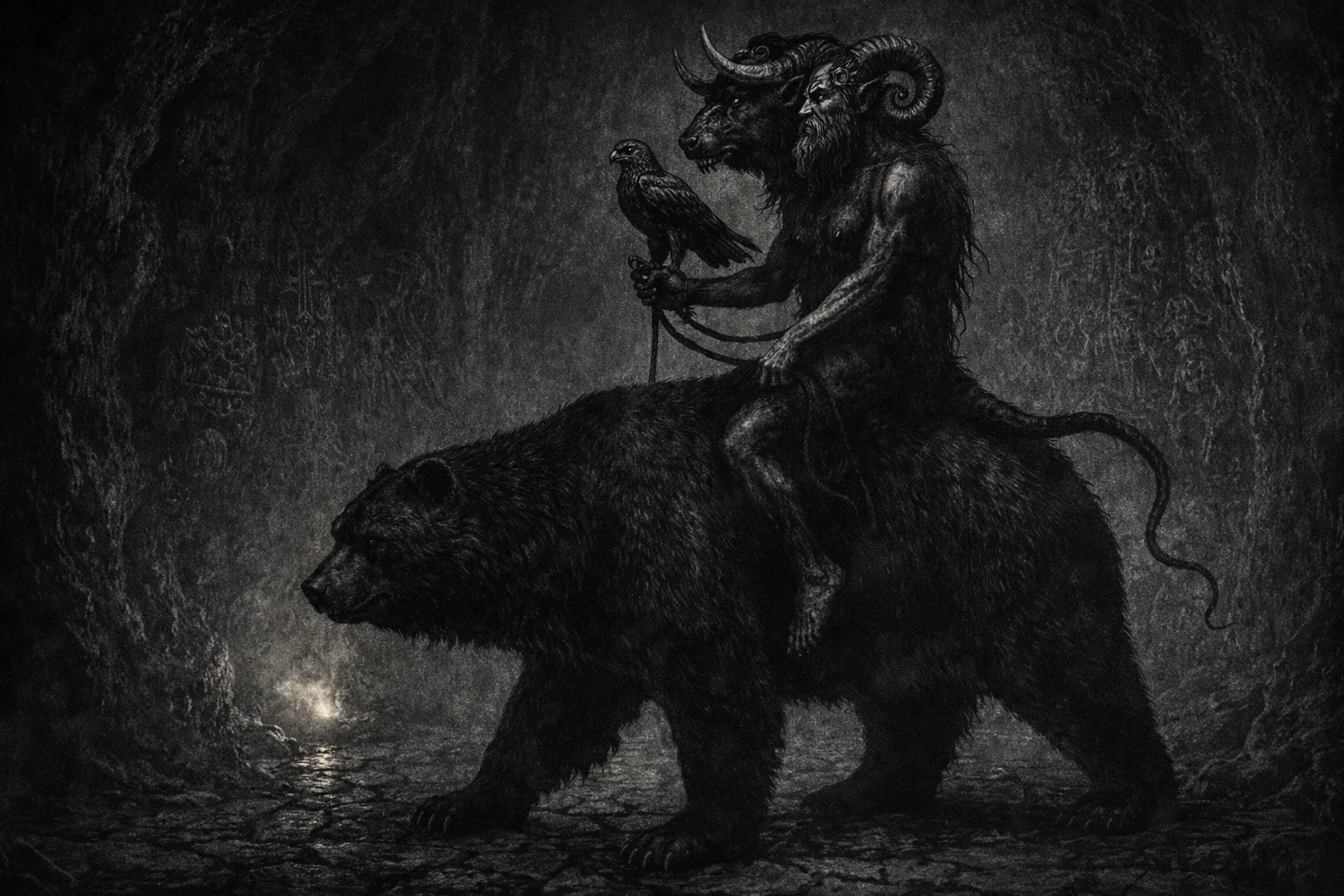
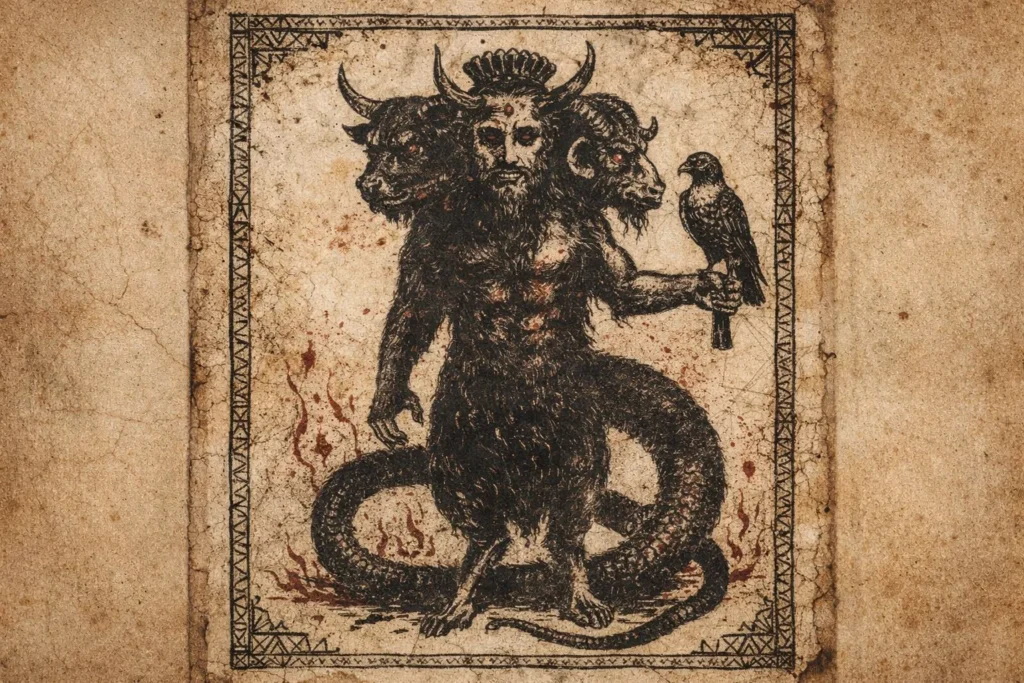
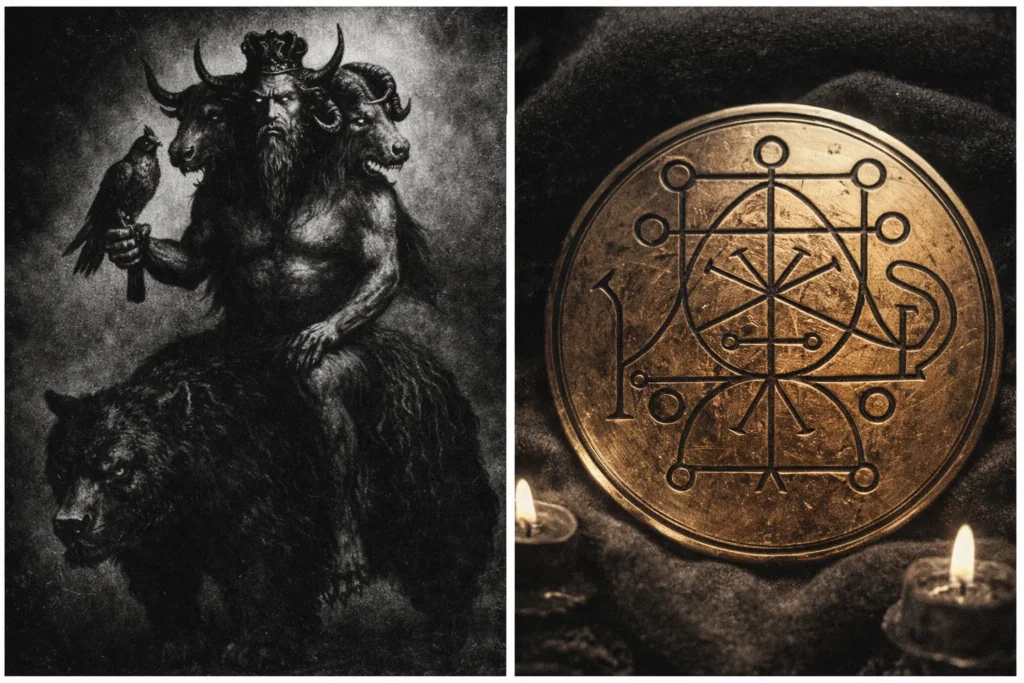
Balam is described as a monstrous demon composed of various parts. The Ars Goetia says he has three heads: one of a bull, showing strength and stubbornness; one of a man, showing intelligence and speech; and one of a ram, which stands for virility and mockery.
His body adds to his frightening image. He is said to have a serpent’s tail, linking him to the original tempter in Christian stories. His eyes are described as flaming, giving off a light that can scare or confuse those who see him.
He is often shown riding a fierce bear, which stands for strength and wild power. He has a goshawk, a bird of prey, symbolizing his speed and his role as a hunter of souls or secrets. His voice is very hoarse, which many see as a sign of his corrupted nature.
You may also enjoy:
Iblis, the Jinn King of Darkness and Deception
September 29, 2025
Who Was Hiranyakashipu, the Demon King of Hindu Mythology?
October 6, 2025
What Is the Abumi-guchi Yōkai and Why Does It Wait Forever?
October 22, 2025
Demon Amy, the 58th Goetic Spirit: Origin, Powers, and Rank
January 12, 2026
Lamashtu, the Mesopotamian Demoness of Childbirth and Infant Death
November 4, 2025
Hitotsume kozō: One-Eyed Yōkai of Japanese Folklore
February 4, 2026
Origins
Balam’s history comes from a mix of biblical stories and medieval magic traditions.
Ancient Roots and Biblical Association
The idea of Balam starts with the Old Testament figure Balaam. Although Balaam was a man, his links to divination and leading the Israelites into sin made him a target for later demonization. By the early medieval period, names of ‘enemies of God’ were often turned into names for demons or fallen angels.
Medieval Codification
Balam became officially known as a King of Hell during the late Middle Ages and the Renaissance. Johann Weyer listed him in the Pseudomonarchia Daemonum. Weyer made this list to show the dangers of black magic, but it ended up creating a lasting ‘biography’ for Balam.
The Goetic Era
In the 17th century, the Lemegeton (The Lesser Key of Solomon) clarified Balam’s rank, his fifty-one legions, and the details of his seal. At this time, he became part of the ‘Solomonic’ stories, which said King Solomon trapped these spirits in a brass vessel.
Was Balam Ever Mentioned in the Bible?
The demon Balam does not appear in the Bible. However, his name sounds like the prophet Balaam from the Book of Numbers, who is criticized in the New Testament (2 Peter 2:15, Jude 1:11, Revelation 2:14) for leading others into sin. The demon Balam was created in later grimoires as a kind of spiritual descendant of the biblical Balaam.
Balam in Grimoires and Other Texts
Balam is featured in many important occult texts. These books consistently call him a King, describe his three heads, and mention his command over many legions.
| Source | Quote |
| Ars Goetia (The Lesser Key of Solomon) | The Fifty-first Spirit is Balam or Balaam. He is a Terrible, Great, and Powerful King. He appeareth with three Heads: the first is like that of a Bull; the second is like that of a Man; the third is like that of a Ram. He hath the Taile of a Serpent, and Flaming Eyes. He rideth upon a furious Beare, and carrieth a Boshawk upon his Fist. He speaketh with a hoarse Voyce, giving True Answers of Things Past, Present, and to Come. He maketh men to goe Invisible, and also to be Wittie. |
| Pseudomonarchia Daemonum (Johann Weyer) | Balan is a great and a terrible king, he commeth foorth with three heads, the first of a bull, the second of a man, the third of a ram, he hath a serpents taile, and eies flaming; he rideth on a beare, and carrieth a hawke on his fist, he speaketh with a hoarse voice, answering perfectly of things past, present, and to come, he maketh men invisible and wise: he governeth fortie (some say 51) legions of devils. |
| Dictionnaire Infernal (Collin de Plancy) | Balan, grand et puissant roi de l’empire infernal. On le voit paraître avec trois têtes, l’une de taureau, l’autre d’homme, la troisième de bélier; il a une queue de serpent et des yeux qui jettent des flammes; il monte un ours et porte un épervier sur le poing. Sa voix est rauque; il répond sur le passé, le présent et l’avenir, rend les hommes invisibles et leur donne de l’esprit. Cinquante et une légions lui obéissent. |
THE BOOK THEY BANNED FROM THE BIBLE Limited-Time: Up to 90% OFF!
Why was Enoch removed? The fallen Watchers • The birth of the Nephilim • Origin of demons • Names of the angels who became demons • Apocalyptic visions. The original source text that inspired all demonology. Read the apocalyptic visions the church didn’t want you to see.
Powers and Abilities
Balam is said to have powers that let him manipulate how people see things and gain hidden knowledge. His main ability is called Temporal Omniscience, which means he can see all of human history and the future at once.
When he gives ‘True Answers,’ he is believed to reveal real facts from the past or future, not just make guesses. People often seek this power to gain an advantage or avoid consequences.
Balam is also known for granting invisibility. This does not always mean becoming physically invisible, but rather making someone go unnoticed by others. This power lets people move around without being seen, which can help with theft, spying, and other clandestine activities.
Balam is also said to give people’ wit’ or ‘wisdom.’ In this context, the wisdom is often negative, making someone clever in a way that can hurt others. It helps people use words to insult, break someone’s confidence, or cause arguments. This power sharpens the mind for selfish or harmful purposes.
Balam Myths, Legends, and Stories
The Binding of Balam by King Solomon
In the stories of the Ars Goetia, Balam is one of the seventy-two spirits that King Solomon trapped in a brass vessel. The legend says Solomon used his magic ring to summon Balam. Even though Balam had a hoarse, scary voice and several heads while riding a bear, Solomon made him obey.
Solomon ordered Balam to reveal secrets about the past and future to help build the Temple and rule the kingdom. Later, Balam was sealed in the brass vessel and thrown into a deep lake in Babylon.
Later, the Babylonians found the vessel and broke it open, hoping to find gold. Instead, they released Balam and his legions, but he was still controlled by the seals Solomon had made.
Balam vs Other Christian Demons
| Demon Name | Associated Sin/Temptation | Rank/Origin | Key Traits/Powers |
| Asmodeus | Lust | King (Ars Goetia) | Three heads (bull, man, ram); destroys marriages. |
| Belial | Lawlessness / Worthlessness | King (Bible/Dead Sea Scrolls) | Created next after Lucifer; grants high titles. |
| Paimon | False Science / Vain Glory | King (Ars Goetia) | Rides a dromedary; teaches all arts and sciences. |
| Beelzebub | Gluttony | Prince (Hierarchy of Hell) | Lord of the Flies; causes decay and filth. |
| Mammon | Greed / Avarice | Prince (Middle Ages) | Influences the pursuit of material wealth. |
| Astaroth | Sloth | Grand Duke (Ars Goetia) | Rides a dragon; knows all secrets of creation. |
| Behemoth | Gluttony / Bestiality | Beast (Book of Job) | Unstoppable physical strength; lord of the land. |
| Leviathan | Envy | Prince (Book of Isaiah) | Serpent of the sea; represents chaos. |
| Bael | Deception | King (Ars Goetia) | First principal spirit; makes men invisible. |
| Zagan | Mockery / Deceit | King (Ars Goetia) | Turns water into wine and fools into wise men. |
| Purson | Curiosity of Secrets | King (Ars Goetia) | Man with a lion’s face; finds hidden treasures. |
| Vine | Witchcraft / Malice | King (Ars Goetia) | Lion riding a black horse; builds towers. |
| Beleth | Arrogance | King (Ars Goetia) | Rides a pale horse; causes love/obsession. |
| Lucifer | Pride | Emperor (Christian Lore) | The morning star; the original rebel. |
You may also enjoy:
What Is the Akkorokamui, Japan’s Colossal Sea Monster?
November 14, 2025
Who Is Azazel, the Demon Blamed for Human Corruption?
February 24, 2026
Palden Lhamo: The Black Goddess of Blood and Protection
October 20, 2025
Mara: The Buddhist Demon King of Desire and Death
October 13, 2025
Marid: The Ocean Jinn That Defies Heaven and Earth
September 30, 2025
Who Was Abezethibou, the Fallen Angel Who Opposed Moses?
October 1, 2025
Rank in the Hierarchy of Hell
Balam is ranked as a King, one of the highest titles in the Goetic system. As a King, he commands fifty-one legions and has more authority than Dukes, Marquises, or Earls.
Balam is often compared to other demons with similar traits. For example, he is linked to Asmodeus because both are shown with three heads (bull, man, and ram). This may mean they work together or share influence, especially in corrupting human intellect and senses.
Even as a King, Balam serves under the Infernal Emperor. He is in charge of time-related secrets and the hidden movement of spirits. He is said to be the rival of the angel Haziel, who stands for mercy and God’s truth, the opposite of Balam’s deceptions and secret knowledge.
Mystical Correspondences
Balam is linked to the Sun and the metal gold, showing his royal status. In hermetic traditions, solar demons are the highest rank and have powerful, sometimes dangerous energy.
The Sun’s influence gives Balam his ‘flaming eyes’ and his ability to see through time, like the sun lighting up the world. But as a demon, this energy is twisted, giving him a hoarse voice and a frightening appearance instead of warmth.
Balam is also connected to the sign Sagittarius and the element of Fire, which match his speed (shown by the goshawk) and his gift of ‘wit.’ Sagittarius is linked to philosophy, travel, and higher thinking, but Balam twists these into forbidden knowledge and harsh words.
The fire element makes Balam unpredictable and gives him the power to ‘burn through’ time. Unlike earth-based demons, his evil is active, aggressive, and tied to a sharp intellect.
Balam’s Sigil
| Attribute | Details |
| Planet | Sun (Gold) |
| Zodiac Sign | Sagittarius |
| Element | Fire |
| Direction | North |
| Color | Yellow / Gold |
| Number | 51 |
| Crystal/Mineral | Topaz |
| Metal | Gold |
| Herb/Plant | Sage / Sunflower |
| Animal | Bear / Goshawk / Serpent |
Balam’s sigil is a complex geometric symbol used in Goetic magic as his unique ‘signature.’ In old occult practices, the sigil was seen as more than just a symbol—it was thought to connect directly to Balam. It was usually engraved on a gold plate, showing his royal status.
The sigil served two main purposes: protection and control. Practitioners in medieval and Renaissance times used it to make sure they were dealing with Balam and not another spirit. The sigil acted like a contract, forcing Balam to answer truthfully and stopping him from using his invisibility to escape or harm the summoner.
Summoning and Rituals
In old grimoires like the Ars Goetia, only the most skilled practitioners tried to summon Balam. Rituals focused on the right astrological timing, often when the Sun was in a good position or during certain hours linked to solar spirits. Witches and warlocks wanted his power of invisibility, which helped them avoid authorities during times of danger.
These rituals used a magic circle, burned solar incense such as frankincense, and required the wearing of the golden seal. The main goal was to obtain information that would otherwise be impossible to know, such as future events or hidden secrets from the past.
Since Balam speaks with a hoarse voice, practitioners were told to stay calm and not show fear. His appearance—riding a bear with flaming eyes—was meant to scare and weaken the summoner. These rituals were never considered safe; they were risky encounters with a being known for deception and mental power.
You may also enjoy:
Bali: The Benevolent Asura King of Hindu Mythology
October 10, 2025
The Kumbhanda: Grotesque Demons of Buddhist Hell
November 13, 2025
Who Is Al-Abyad? The White King Jinn Who Rules Love and Chaos
January 26, 2026
What Is a Rakshasa? Meaning, Origins, and Dark Powers
January 23, 2026
Who Was Mahishasura, the Buffalo Demon Slain by Goddess Durga?
October 3, 2025
Who Is Agaliarept, the General of Hell Under Lucifer?
October 8, 2025
Frequently Asked Questions
What is the demon Balam’s number in the Goetia?
In the Ars Goetia, Balam is the 51st spirit out of 72 demons bound by King Solomon. As a King of Hell, he is called on for his power to give accurate information about the past and future. He is usually summoned when the Sun is in Sagittarius.
Which day of the week is best to invoke Balam?
Since Balam is a King linked to the Sun, Sunday is the best day for his rituals. Practitioners usually performed invocations at sunrise, noon, or sunset, using gold talismans to connect with his strong, fiery energy.
What is the difference between Balam and the biblical Balaam?
The demon Balam comes from 17th-century grimoires, while Balaam was a human prophet in the Old Testament (Book of Numbers). Because the prophet was linked to divination and forbidden knowledge, medieval occultists later turned his name into that of a powerful demon.
What scent or incense is associated with Balam?
Balam is traditionally linked to frankincense and edelweiss. As a solar King, using bright resins like frankincense in rituals was meant to honor his royal status. These scents were thought to clear away lesser spirits so his hoarse voice could be heard more clearly.
Is Balam related to the Mayan deity Balam?
There is no real connection between the Goetic demon Balam and the Mayan’ Balam,’ which means Jaguar. The Goetic Balam comes from Middle Eastern and European occult traditions. At the same time, the Mayan Balam refers to jaguar gods or priests. The shared name is just a coincidence from different languages.
What does Balam’s hoarse voice signify in demonology?
In classical demonology, Balam’s hoarse voice shows his fallen state. He still has the knowledge of a high-ranking spirit, but his rough speech means he has lost his ‘angelic music’ or divine sound. This warns summoners that even though he gives ‘True Answers,’ his nature is still corrupt and dangerous.
