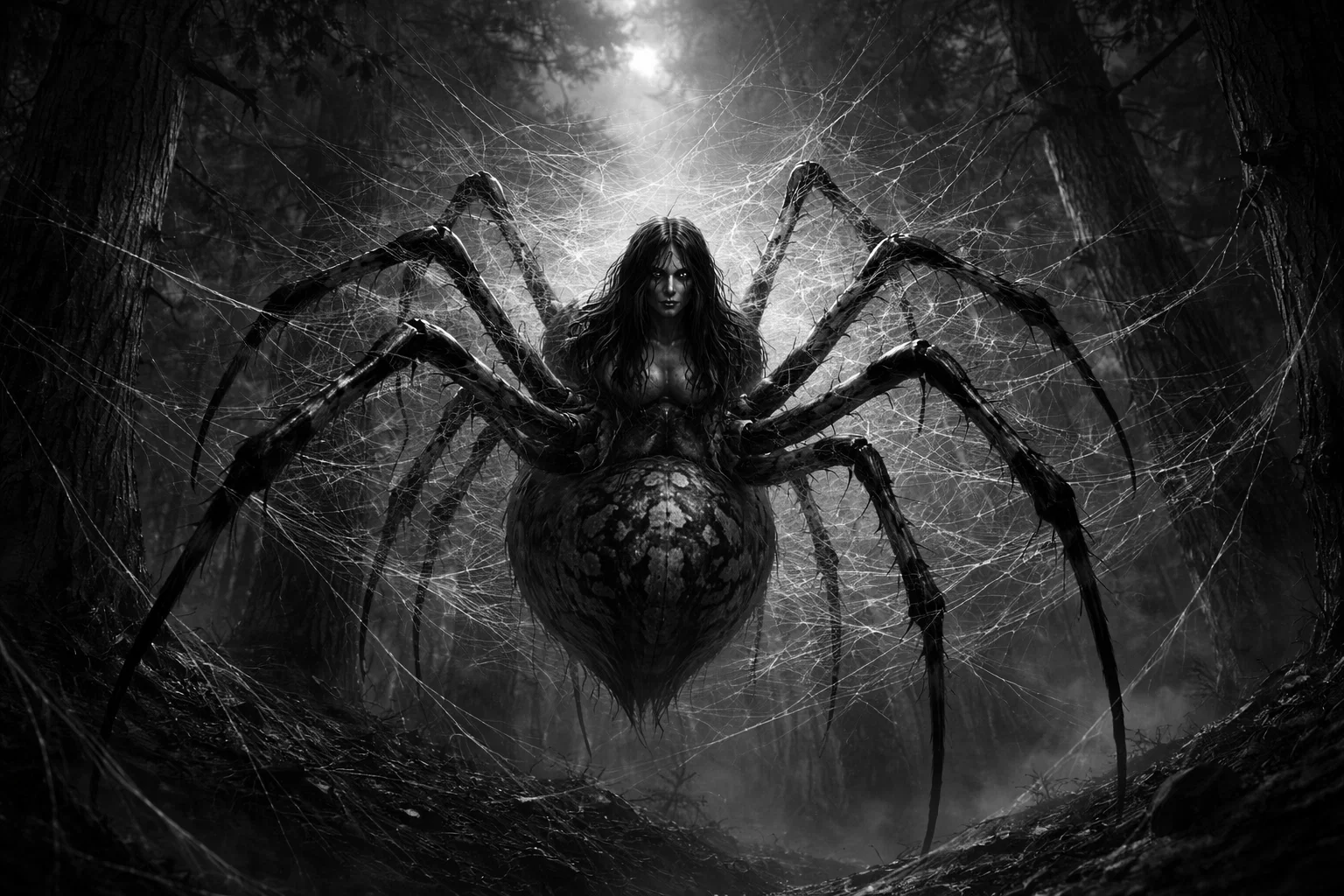

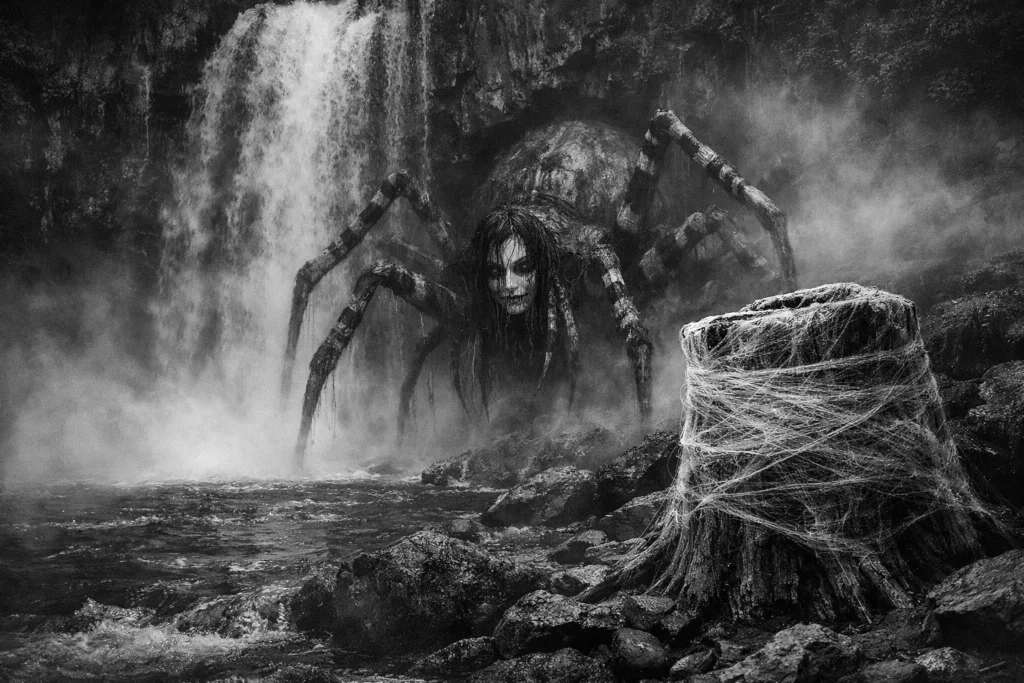
The Jorōgumo is a supernatural spider that can turn into a beautiful woman. Known for its trickery, it uses its human form to attract men, drawing them into its web to eat them.
Unlike friendlier spirits, the Jorōgumo is always shown as a deadly predator. Stories about it often take place near waterfalls or in quiet forests, where it builds its web. After living for 400 years, it has both sharp intelligence and dangerous strength.
Summary
Key Takeaways
| Attribute | Details |
| Names | Jorōgumo, Entotsu-gumo, Shinkuba |
| Translation | Entwining bride, whore spider, or binding bride |
| Title | The Spider Queen, The Binding Bride |
| Type | Magical animal (Henge-yōkai) |
| Origin | An orb-weaver spider (Nephila clavata) that reaches 400 years of age and grows to a massive size. |
| Gender | Female |
| Appearance | A massive spider with gold-and-black markings; in human form, a stunningly beautiful young woman. |
| Powers/Abilities | Shapeshifting, silk generation, controlling smaller spiders, venomous bite, and fire-breathing in some regional accounts. |
| Weaknesses | Exposed by reflections, harmed by tobacco smoke (in some accounts), and vulnerable to spiritual purification. |
| Habitat | Waterfalls, deep forests, abandoned houses, and caves. |
| Diet/Prey | Human men, particularly those wandering alone at night. |
| Symbolic Item | Silk threads, a biwa or koto (used to lure victims), and sometimes a wrapped bundle resembling a baby. |
| Symbolism | The danger of deceptive beauty, the entrapment of lust, and the predatory nature of the wild. |
| Sources | Taihei Hyakumonogatari, Tonoigusa, Konjaku Hyakki Shūi |
Who or What is Jorōgumo?
The Jorōgumo is a famous creature in Japanese folklore, known as a henge-yōkai, or shapeshifter. It comes from the golden orb-weaver spider, called Nephila clavata. Folklore says that when this spider turns 400 years old, it gains magical powers, including the ability to become a woman.
When disguised as a human, the Jorōgumo looks like a very beautiful woman. She might be seen playing music or holding what appears to be a baby to elicit sympathy from people passing by. This act is meant to bring victims close enough for her to catch them in her web.
After trapping its victim, the Jorōgumo changes back into a giant spider, often as big as a person or even larger, and feeds. It stands for a classic type of Japanese horror: the ‘femme fatale,’ where beauty hides something dangerous.
MEET THE MONSTERS THAT HAUNT JAPAN Limited-Time: Up to 28% OFF!
Kappa • Yuki-onna • Tanuki • Kitsune • Hundreds more legendary spirits Hilarious, horrifying, and downright bizarre tales from Japan’s shadow side. Fully illustrated encyclopedia by Thersa Matsuura – your passport to the world of yōkai. Anime origins • Real folklore • Things that go bump in the tatami. Dare you invite them in?
“Jorōgumo” Meaning
The name Jorōgumo is interesting because it uses different kanji characters for wordplay. The most common way to write it is 絡新婦, which means ‘entwining bride’ or ‘binding bride.’ This name refers to how the creature catches its prey with strong, sticky silk.
In spoken Japanese, the word also sounds like 女郎蜘蛛, which means ‘prostitute spider’ or ‘courtesan spider.’ The word jorō (女郎) was used for high-ranking prostitutes or courtesans in the Edo period. This connection supports the stories about the yōkai, who is said to visit red-light districts or use her looks to attract men before killing them.
The name varies slightly across regions. For example, in some areas of Shizuoka, it is connected to Joren Falls. Hence, local versions of the legend focus more on water than on city life.
How to Pronounce “Jorōgumo” in English
In English, Jorōgumo is said as ‘Joh-roh-goo-moh.’ The first two parts, ‘Joh’ and ‘roh,’ use a long ‘o’ sound, like in ‘row.’ ‘Goo’ sounds like the word for something sticky, and ‘moh’ rhymes with ‘go.’ Every syllable is pronounced clearly, with no silent letters.
What Does Jorōgumo Look Like?
The Jorōgumo appears differently depending on whether it is in its true form or pretending to be human. In its true form, it is a huge, scary spider.
Old ukiyo-e woodblock prints, like those by Toriyama Sekien, show the Jorōgumo as a giant spider, sometimes several feet long. Its legs are thin but strong, often with yellow and black stripes like the Nephila clavata. In some creepier pictures, the spider’s body might look a bit like a human face, or even have a woman’s upper body emerging from it.
When the Jorōgumo takes human form, she is described as extremely beautiful. She usually looks young, with pale skin and long black hair. She often wears colorful silk kimonos, which some stories say are made from her own webs.
To make her disguise more convincing, she might carry a biwa (lute) or a koto (zither) to look like a noblewoman or musician. In some stories, she has a small bundle and says it is her baby. To her victim, it seems like a child, but it is really an egg sac full of spiderlings wrapped in silk.
You may also enjoy:
Marid: The Ocean Jinn That Defies Heaven and Earth
September 30, 2025
Iblis, the Jinn King of Darkness and Deception
September 29, 2025
Jikininki: The Japanese Ghost That Feeds on Human Corpses
February 9, 2026
Who Is Ahriman, and Why Is He Pure Evil Incarnate?
January 8, 2026
Barbas: The Lion Demon Who Spreads Disease
March 3, 2026
What Is the Akkorokamui, Japan’s Colossal Sea Monster?
November 14, 2025
Habitat
The Jorōgumo is usually found in quiet, damp, and shady places. It often lives near waterfalls, especially Joren Falls in the Izu Peninsula of Shizuoka. These spots have the moisture and insects spiders need, and the sound of the water hides the yōkai’s movements or its victims’ cries.
Besides waterfalls, the Jorōgumo is said to live in deep forests, caves, and empty temples or houses at the edge of villages. These places let it spin huge, hidden webs between trees or in rafters.
The Jorōgumo likes places that are hidden from crowds, but still near paths people use, so it can find victims. In old city stories, it was sometimes said to hide in the attics or crawlspaces of brothels, blending in with the pleasure districts to hunt men who were alone.
Origins and History
The Jorōgumo became known in Japan during the Edo period (1603–1868), when many yōkai stories were first written down and illustrated. The legend is based on the real Nephila clavata spider, which is large and has golden silk. People thought that such a remarkable and long-lived spider must have a spirit, or mononoke.
Old records show that the Jorōgumo legend came from earlier ‘spider demon’ stories, like the Tsuchigumo, which was a more aggressive, underground monster.
As time went on, the Jorōgumo became known as a unique, sneaky predator. Its story is linked to the rise of Kaidan, or ghost stories, in which yōkai revealed the dangers of nature and uncontrolled desire. By the late 1700s, it was a common entry in books like the Konjaku Hyakki Shūi, which set its image for later generations.
1,000+ SPIRITS, GODS & GODDESSES AWAITING YOUR CALL. Limited-Time: Up to 49% OFF!
The ultimate global spirit encyclopedia – 2,000+ entries from every culture on Earth. Fairies • Djinn • Demons • Loa • Angels • Deities • Ancestors Real names • True offerings • Ancient rituals that actually work. Judika Illes’ legendary masterwork – the one book every serious witch, mage, and spirit-worker owns.
Sources
Many old Japanese books mention the Jorōgumo. These texts are the basis for the legends that still exist today.
| Source | Quote |
| Taihei Hyakumonogatari (1732) | “A woman of about twenty years appeared, holding a child in her arms. She approached the man and said, ‘Please, hold this child for a moment,’ but as he took it, he realized it was thousands of tiny spiders.” |
| Konjaku Hyakki Shūi (1781) | “The Jorōgumo is a spider that has lived for many years and gained the ability to bewitch humans. It takes the form of a woman and lures men into its nest.” |
| Tonoigusa (1660) | “A giant spider appeared in the form of a beautiful lady, playing the biwa to enchant the samurai who had entered the ruined house.” |
Famous Jorōgumo Legends and Stories
The Spider of Joren Falls
One of the best-known stories happens at Joren Falls in Shizuoka. A logger was working near the waterfall and dropped his axe into the pool. As he was about to go in after it, a beautiful woman came out of the mist and gave the axe back to him. She warned him never to tell anyone what he saw at the falls.
The logger went back to his village and kept the secret for years. But one night, after drinking a lot of sake, he gave in to curiosity and told others about the strange woman. As soon as he spoke, he fell into a deep sleep and never woke up.
In another version, the logger sees a silk thread tied to his toe while working by the falls. He quickly unties it and wraps it around a tree stump. Soon after, the stump is pulled into the water. A voice from below shouts, ‘How clever you are!’ The logger runs away, realizing he almost got dragged into the Jorōgumo’s lair.
The Tale of the Kashikobuchi
In Kashikobuchi, Sendai, there is a story about a man named Magoku. While fishing, a spider started wrapping silk around his legs. Remembering local warnings, Magoku tied the silk to a heavy stump. Soon, the stump was dragged into the river by something unseen, and a voice from the water called out, ‘Kashiko, kashiko!’ which means ‘clever, clever.’
Magoku went back to the village and told everyone that the Jorōgumo from the pool had tried to take him. The place became known as Kashikobuchi, and even now, people believe the ‘Spider Queen’ protects the area from floods if she is respected. This is one of the few times the Jorōgumo is seen as a protector, not just a monster.
The Samurai and the Lute Player
In one Edo-period story, a young samurai finds a beautiful woman in an empty house during a storm. She is playing a biwa and singing a sad song. The samurai is drawn in by her beauty and music, but then he sees that her shadow on the wall looks like a huge, many-legged creature rather than a woman.
Thinking she was a yōkai, the samurai drew his sword and attacked. The woman disappeared into the dark, leaving behind thick white silk and a few drops of blue blood. The next morning, the samurai followed the silk to the attic and found a dead spider as big as a man, killed by his sword.
You may also enjoy:
Amenadiel: Origins, Hierarchy, and Demonic Attributes
January 5, 2026
Abura-sumashi: The Potato-Headed Yōkai That Punishes Greed
October 23, 2025
Alû: The Mesopotamian Demon of Malevolence and Pestilence
November 10, 2025
Bakeneko: A Supernatural Cat Yōkai in Japanese Folklore
January 27, 2026
Palis: The Foot-Licking Desert Jinn That Drinks Your Blood
December 3, 2025
Who Was Mahishasura, the Buffalo Demon Slain by Goddess Durga?
October 3, 2025
Jorōgumo Powers and Abilities
The Jorōgumo is seen as a powerful yōkai because it is both strong and clever. Its main ability is metamorphosis, and it can look just like a real person unless someone sees its reflection or has spiritual vision.
Unlike other animal yōkai like the Kitsune, the Jorōgumo is not playful. Instead, it is focused on hunting and catching its prey.
- Transformation: The ability to transform into a beautiful woman to lure victims.
- Supernatural Silk: The Jorōgumo makes silk that is much stronger than steel. She uses it to tie up victims, build almost invisible traps, and even pull heavy things like tree stumps or people into the water.
- Spider Command: She can control normal spiders, using them to scout or attack her victims.
- Venomous Bite: In spider form, she has a deadly poison that can paralyze or kill people very quickly.
- Fire-Breathing: Some stories from Tottori Prefecture say the Jorōgumo can breathe fire to scare away attackers.
- Puppetry: In some tales, she ties silk to dead bodies and moves them like puppets to fool the living.
How to Defend Against Jorōgumo
To protect yourself from a Jorōgumo, you need to be alert and spiritually prepared. Since it uses trickery, the best defense is to spot it. Old stories say a Jorōgumo can’t hide its real form in a reflection, so carrying a bronze mirror can show the spider behind the human disguise.
Some Edo-period stories say that tobacco smoke can keep giant spiders away because its smell irritates their keen senses. If you get caught in its silk, normal blades might not work, but a sword blessed by a Shinto priest or Buddhist monk can cut through.
To get rid of a Jorōgumo for good, you have to find its main nest, usually in a high attic or deep cave, and burn it completely. The creature’s life is often linked to its web.
COMMAND THE 72 DEMONS OF THE ARS GOETIA. Limited-Time: Up to 10% OFF!
The complete Lemegeton – restored from ancient manuscripts. Full seals & rituals • True evocation rites • Ranks & powers of every spirit Ars Goetia • Theurgia-Goetia • Ars Paulina • Almadel • Notoria • The ultimate grimoire of Solomon.
The most accurate, beautiful edition ever published (Skinner & Rankine). Every serious magician owns this. Do you?
Jorōgumo vs Other Yōkai
| Name | Category | Origin | Threat Level | Escape Difficulty |
| Kitsune | Henge-yōkai | A fox that has lived 100+ years. | Moderate | Moderate; can be outsmarted with riddles. |
| Tsuchigumo | Oni/Spider | Ancient earth-dwelling spider clans. | High | Very Hard; requires military force or legendary swords. |
| Yuki-onna | Yūrei | The spirit of a woman who died in the snow. | High | Hard; she freezes victims instantly. |
| Kappa | Suijin | Water deity/spirit of the river. | Moderate | Easy; bow to it or give it a cucumber. |
| Rokurokubi | Obake | A human cursed by karma or obsession. | Low | Easy; they are often more startling than lethal. |
| Gashadokuro | Yūrei | The gathered bones of the unburied dead. | Extreme | Very Hard; it is massive and invisible until it strikes. |
| Nure-onna | Obake | A serpent-like creature with a woman’s head. | High | Hard; she uses her weight to pin victims. |
| Tanuki | Henge-yōkai | A raccoon dog with magical powers. | Low | Easy; they are mostly pranksters. |
| Oni | Oni | Manifestation of evil or a transformed human. | High | Hard; requires extreme physical or spiritual strength. |
| Ubume | Yūrei | The spirit of a woman who died in childbirth. | Moderate | Moderate; usually seeks help rather than blood. |
Symbolism
| Attribute | Details |
| Element | Water and Earth |
| Animal | Spider (Nephila clavata) |
| Cardinal Direction | North (associated with hidden things and cold predation) |
| Color | Gold and Black (colors of the orb-weaver) |
| Plant | Spider Lily (Higanbana), often associated with death |
| Season | Autumn (when orb-weaver spiders are most visible) |
| Symbolic Item | The Silk Thread |
The Jorōgumo stands for the danger of hidden motives. In Japanese culture, she is a warning about the risks of desire and how beauty can hide something harmful. She is the classic ‘trap’—showing that tempting things can lead to trouble.
In the past, the Jorōgumo also showed worries about the ukiyo, or Floating World, and the pleasure districts. Her name, meaning both ‘entwining bride’ and ‘courtesan,’ hints at a criticism of the sex trade, where men were ‘consumed’ by their desires and lost money or even their lives.
In art, the Jorōgumo is a popular subject for ukiyo-e artists. She stands for the struggle between the civilized world and the wild, unpredictable side of nature.
You may also enjoy:
Al-Ahmar: The Tuesday King of the Seven Jinn
February 13, 2026
The Ghul: The Flesh-Eating Demon of Arabian Folklore
October 1, 2025
Amenadiel: Origins, Hierarchy, and Demonic Attributes
January 5, 2026
Barbatos: The Strange Demon Who Can Understand Every Animal
March 13, 2026
Hitotsume kozō: One-Eyed Yōkai of Japanese Folklore
February 4, 2026
Who Was Hiranyaksha, the Golden-Eyed Asura?
October 7, 2025
Frequently Asked Questions
Are Jorōgumo and Tsuchigumo the same creature?
No, Jorōgumo and Tsuchigumo are distinct yōkai. While both are spider-like, the Jorōgumo is a metamorph orb-weaver (Nephila clavata) that focuses on deceptive luring and individual predation. In contrast, the Tsuchigumo is an “earth spider,” often depicted as a giant, multi-limbed demon or a literal clan of renegade humans who defied the Imperial Court in ancient Japanese history.
What is the difference between a Jorōgumo and a Drider?
A Jorōgumo is a creature from Japanese folklore that is naturally a spider and takes on a human disguise to hunt. A Drider, however, is a creature from Western fantasy (specifically Dungeons & Dragons) that is a “centaur-like” hybrid with a drow’s upper body and a spider’s lower body, created as a punishment by the goddess Lolth. Jorōgumo are usually full-spider or full-human, rarely permanent hybrids.
Can a Jorōgumo be male?
In traditional Japanese mythology, Jorōgumo are exclusively depicted as female. The name itself—specifically the characters for “bride” (婦) or “courtesan” (女郎)—identifies the creature as feminine. While there are other spider yōkai in folklore that can be male, the specific legend of the Jorōgumo is inextricably tied to the “femme fatale” archetype.
Is the Jorōgumo based on a real spider?
Yes, the Jorōgumo is based on the Nephila clavata, commonly known as the Joro spider. This species is native to East Asia, including Japan. They are known for their large size, remarkable yellow and blue-black stripes, and the ability to spin massive, golden-tinted webs that can cover several feet, which likely inspired the legends of supernatural silk.
Are there any Jorōgumo in modern anime or video games?
The Jorōgumo appears frequently in modern media. Important examples include the character Quelaag in Dark Souls, various monster designs in the Shin Megami Tensei and Persona series, and the “Spider Demon” (Mother) in Demon Slayer: Kimetsu no Yaiba. She also appears as a high-level boss in the action-RPG Nioh.
