
Pishachas are evil, flesh-eating spirits mentioned in both Buddhist and Hindu texts. In Buddhist beliefs, they are usually seen as a type of hungry ghost or as helpers to the Lords of the Quarters. They are best known for haunting cremation grounds and feeding on human flesh or life force.
Pishachas are also important demons in Hinduism, appearing in the Vedas and Puranas. For more on their Vedic roots and their connection to Krodha (Kashyapa), see the Hindu Demons category.
Summary
Key Takeaways
| Attribute | Details |
| Names | Pishacha, Pisaca, Piśāca, Pishaci (female), Pishacha-gana |
| Title | Flesh-Eater, Consumer of Vitality |
| Region | India, Tibet, Southeast Asia, Central Asia |
| Type | Buddhist demon, Malevolent spirit, Flesh-eating ghost |
| Gender | Male and Female (Pishaci) |
| Realm | Preta-loka (Hungry Ghost Realm), Human Realm (haunting wilderness/graveyards) |
| Obstacle/Threat | Consumption of human flesh, spreading of disease, draining of Ojas (vitality) |
| Associated Figures | Dhritarashtra, Virudhaka, Shiva, Kubera, Vajrapani |
| Weapon/Item | None (often use claws or teeth) |
| Weaknesses | Mantras, Dharanis, protective amulets, herbal offerings, iron |
| Associated Deity/Figure | Vajrapani, Medicine Buddha (for curing Pishacha-induced illness) |
| Pantheon | Buddhist (Abhidharma), Hindu (Vedic and Puranic) |
| Primary Sources | Mahavayu Sutra, Lalitavistara Sutra, Lotus Sutra, Atharvaveda |
Who or What is Pishacha?
In Buddhist and Indian traditions, a Pishacha is a minor demon known for its frightening looks and vampire-like behavior. They are ranked low among spirits, often mentioned with Yakshas and Rakshasas. Still, they are seen as more disgusting and weaker than Rakshasas. Pishachas are always hungry, but regular food does not satisfy them—they crave dead bodies, life energy, and filth.
In Buddhism, Pishachas are often described as part of the Four Heavenly Kings’ groups, especially in the South under King Virudhaka. Although they are usually hostile to people, Buddhist teachings say they can be changed by the Dharma or controlled by rituals to become protectors or stop causing harm.
1,000+ SPIRITS, GODS & GODDESSES AWAITING YOUR CALL. Limited-Time: Up to 49% OFF!
The ultimate global spirit encyclopedia – 2,000+ entries from every culture on Earth. Fairies • Djinn • Demons • Loa • Angels • Deities • Ancestors Real names • True offerings • Ancient rituals that actually work. Judika Illes’ legendary masterwork – the one book every serious witch, mage, and spirit-worker owns.
“Pishacha” Meaning
The word Pishacha comes from the Sanskrit root piś, meaning to carve or cut,” usually referring to meat or flesh. The name literally means “one who eats the flesh” or “flesh-grinder.”
In the past, this term described not only spirits but also tribal groups or outcasts living outside Vedic society, which is why some Northwestern Indo-Aryan languages are called Pishacha languages.
As Buddhism spread across Asia, the word was adapted to local languages. In Chinese, Pishacha is called Bìshèshé (毘舍闍), which sounds like the Sanskrit name. In Tibetan, they are called sha za, which directly means “flesh-eater.”
In all these regions, the name Pishacha is still linked to eating raw flesh and the decay of the body. Unlike Rakshasas, who sometimes have noble or warrior traits in stories, Pishachas are always connected to the ugly and decaying.
How to Pronounce “Pishacha” in English
Pishacha is a three-syllable Sanskrit word. In English, it is pronounced as pi-SHAA-chuh:
- First syllable (pi): This is a short, soft vowel, like in “pin” or “pit.” It is not stressed.
- Second syllable (SHAA): This is the stressed part. The “sh” is like the “sh” in English, followed by a long “aa” sound, as in “father,” or the “ah” sound at the doctor’s office.
- Third syllable (chuh): This ends with a soft “ch” as in “church,” then a neutral “uh” sound, like the “a” in “sofa.”
For the feminine form, Pishachi, the last syllable is a long “ee” sound, so it is pronounced pi-SHAA-chee. The spelling Piśāca is pronounced the same way, since “ś” stands for “sh” and “c” stands for “ch” in the International Alphabet of Sanskrit Transliteration (IAST).
What Does Pishachi Look Like?
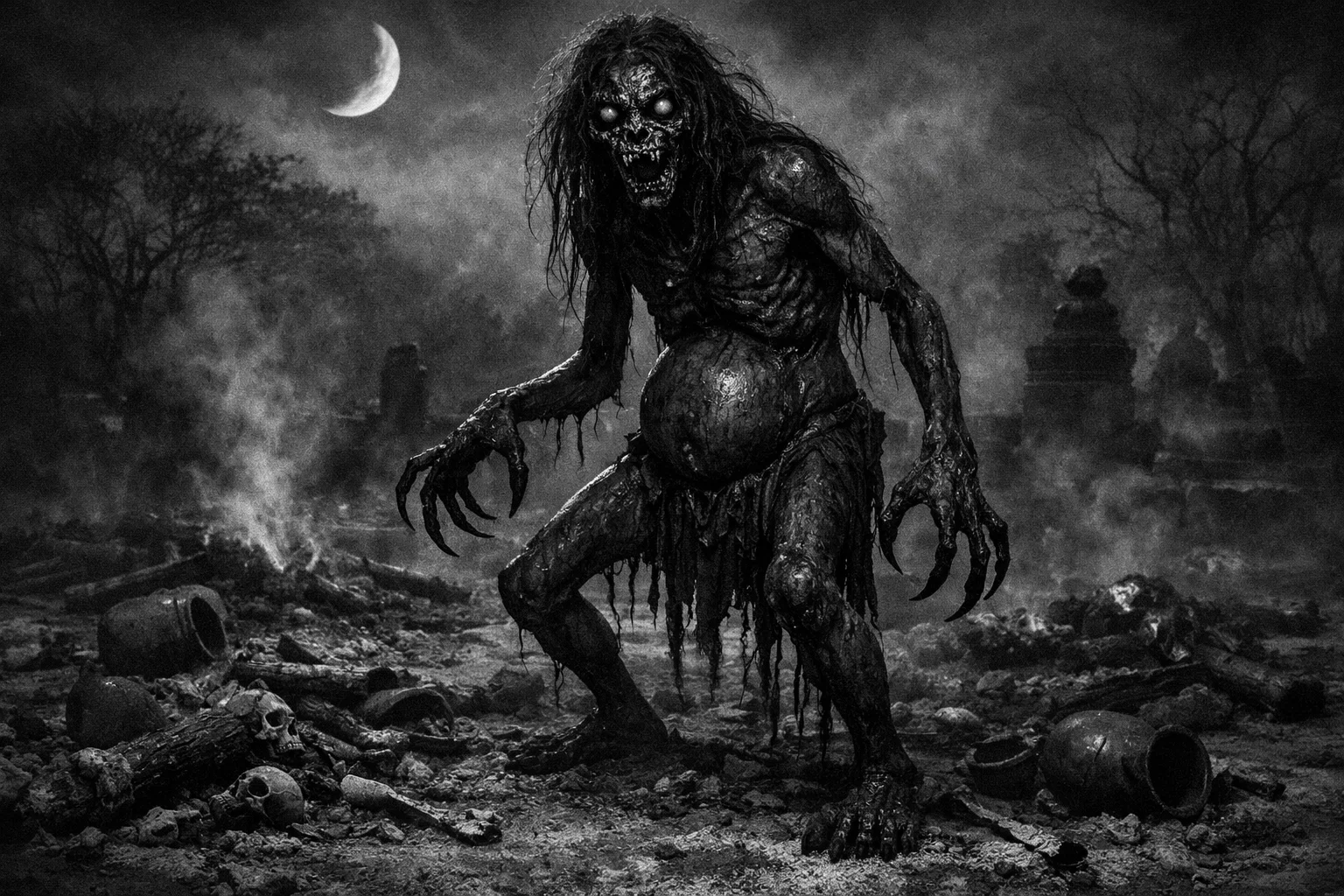
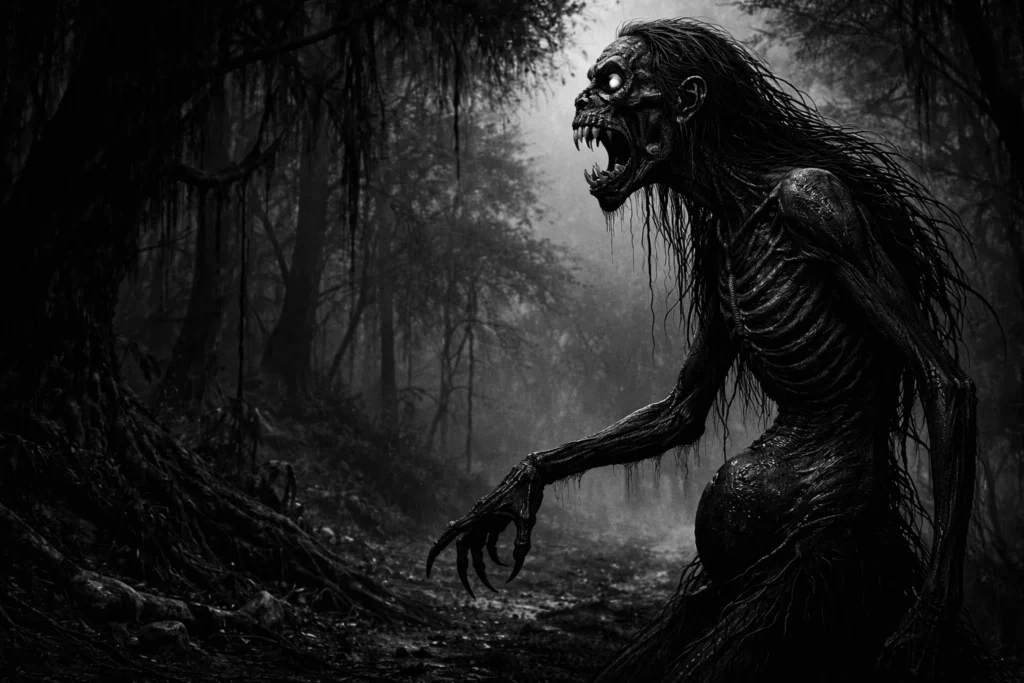
Pishachas are always described as ugly and very thin. They usually have dark skin, like soot or burnt wood. Their veins show through their tight skin, making them look skeletal. One of their main features is their bulging, red eyes, which show their constant hunger and restlessness.
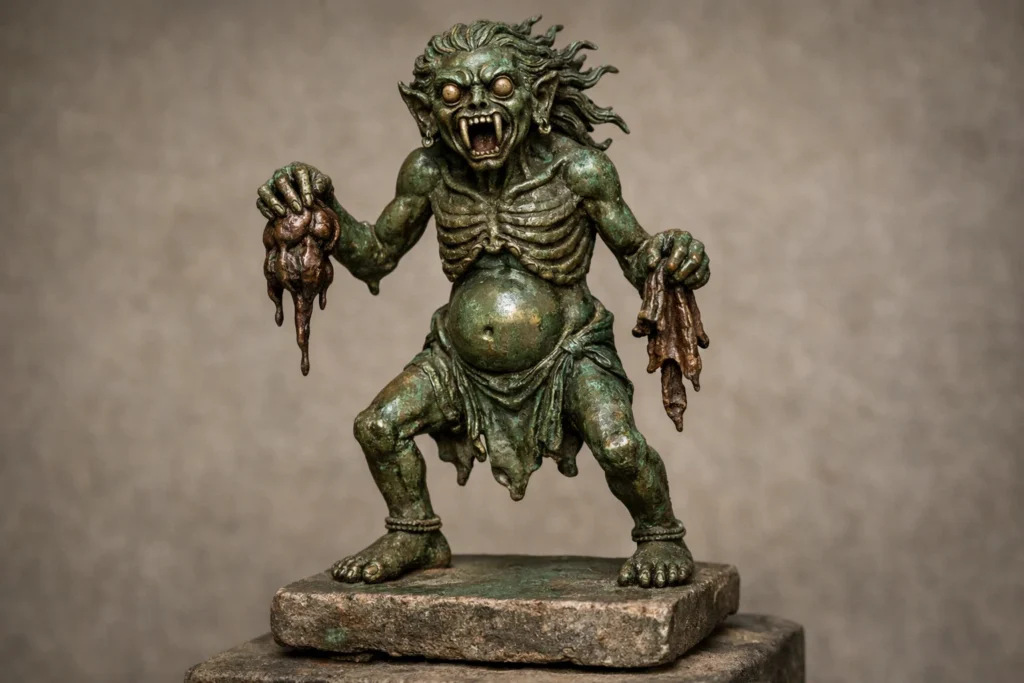
They are said to have sharp fangs and claws for tearing flesh. Many images show them with messy, tangled hair sticking out in all directions. They often have swollen bellies, like Pretas, showing that even though they eat flesh, they are always hungry.
Pishachas can change shape to trick people, but their true form is so ugly that it can scare or sicken anyone who sees them. In Tibetan art, they sometimes appear as small figures alongside wrathful gods, holding human organs or pieces of skin.
You may also enjoy:
Palden Lhamo: The Black Goddess of Blood and Protection
October 20, 2025
Who Was Abezethibou, the Fallen Angel Who Opposed Moses?
October 1, 2025
Who Is Barqan, The Powerful Jinn King?
March 12, 2026
Bali: The Benevolent Asura King of Hindu Mythology
October 10, 2025
Agubanba: The Ash-Born Demon of Japanese Folklore
October 23, 2025
Origins
Pishachas first appeared in ancient India during the Vedic period, as dark spirits mentioned in the Atharvaveda that haunt the night. At first, they were seen as the lowest kind of supernatural being, either born from Brahma’s anger or descended from the sage Kashyapa and his wife Krodhasha.
As Buddhism spread, Pishachas became part of Buddhist beliefs (Abhidharma) and were seen as inhabiting the Desire Realm (Kamadhatu).
Early Buddhist texts changed Pishachas from simple forest demons to organized followers of the Four Heavenly Kings (Caturmaharaja). This change explained their place in the world—they were not just random monsters, but part of a cosmic order that could be controlled by the Buddha’s power.
Over time, Pishachas began to appear in Sutras as attendants at the Buddha’s talks. This showed that even the lowest and most harmful spirits were still under the Universal Law.
MEET THE MONSTERS THAT HAUNT JAPAN Limited-Time: Up to 28% OFF!
Kappa • Yuki-onna • Tanuki • Kitsune • Hundreds more legendary spirits Hilarious, horrifying, and downright bizarre tales from Japan’s shadow side. Fully illustrated encyclopedia by Thersa Matsuura – your passport to the world of yōkai. Anime origins • Real folklore • Things that go bump in the tatami. Dare you invite them in?
Regional Variations
Although Pishachas are always known as flesh-eaters, their roles and looks can change a bit depending on the local Buddhist tradition and the folklore they mix with.
| Region/Tradition | Appearance | Role |
| Theravada (Sri Lanka/SE Asia) | Shadowy, humanoid, dark-skinned | Spirits causing “Pishacha-dosa” (sickness/possession) |
| Mahayana (China/Japan) | Vampiric, skeletal, often green or black | Attendants to protective deities in the underworld |
| Vajrayana (Tibet/Himalayas) | Wrathful, holding skulls, fierce fangs | Class of “sha za” (flesh-eaters) bound as oath-protectors |
Buddhist Cosmology
In Buddhist beliefs, Pishachas live in the Realm of the Hungry Ghosts (Preta-loka) or on the edges of the Human Realm. They are ruled by Virudhaka, the Guardian of the South, who also leads the Kumbhandas.
Unlike the higher gods, Pishachas are controlled by base desires. They are often found in dirty places, such as battlefields and cemeteries.
You may also enjoy:
Hitotsume kozō: One-Eyed Yōkai of Japanese Folklore
February 4, 2026
Palden Lhamo: The Black Goddess of Blood and Protection
October 20, 2025
Arati: The Beautiful Demon of Aversion in Buddhist Mythology
October 15, 2025
Who Is Al-Abyad? The White King Jinn Who Rules Love and Chaos
January 26, 2026
What Is Jorōgumo? The Deadly Spider Woman of Japanese Myth
February 2, 2026
Kuchisake-onna: Folklore, Origins, and Urban Legend History
February 10, 2026
Pishacha in the Pali Canon
In the Pali Canon, Pishachas are spirits that can cause problems, but they are weaker than the power of the Dhamma.
| Source | Quote |
| Atanatiya Sutta (DN 32) | Santi hi kho, marisa, amanusā caṇḍā ruddā rabhassā… piśācā. (There are, sir, non-human beings who are fierce, cruel, and violent… the Pishachas.) |
| Vinaya Pitaka | Aññataropi pisāco gāmaṃ piṇḍāya carati. (A certain Pishacha also wandered into the village for alms.) |
Pishacha in Mahayana Sutras
In Mahayana texts, Pishachas are often shown among the beings listening to the Buddha, which means they also have the chance for enlightenment.
| Source | Quote |
| Lotus Sutra (Chapter 26) | If there are rakshasas, or pishachas, or krityas… seeking to take advantage of these preachers of the Dharma, they shall not be able to do so. |
| Lalitavistara Sutra | The pishachas, along with the kumbhandas and the yakshas, stood there with their hands joined in respect. |
Pishacha in Chinese or Korean Folklore
Pishachas appear in the Jataka Tales and early Chinese Buddhist stories. Still, they are less well-known than the more popular Preta or Rakshasa.
| Source | Quote |
| Mahavibhasa Shastra | The Pishacha is a spirit that eats meat; it lives in the mountains and forests. |
Powers and Abilities
Pishachas are usually seen as low to mid-level demons in Buddhism. They are stronger than regular Pretas but lack the great magic or organization of Rakshasas or Asuras.
- Shapeshifter: They can assume the form of a victim’s loved ones to gain proximity to the victim.
- Invisibility: They move through the human world unseen, particularly at twilight and night.
- Vitality Draining: They can suck the Ojas (life essence) from humans, leading to wasting diseases.
- Possession: They are capable of entering a human body to cause madness or erratic behavior.
- Illusion (Maya): They can create minor auditory or visual hallucinations to lead travelers astray in the wilderness.
Pishacha Myths, Legends, and Stories
The Subjugation by Vajrapani
In various Vajrayana commentaries, the Pishachas are described as wild, uncontrollable spirits that terrorized the practitioners of the early wilderness. When the Bodhisattva Vajrapani manifested in his wrathful form, he summoned the leaders of the Pishacha clans.
Using his Vajra, he displayed a power so immense that the Pishachas were forced to submit. Rather than destroying them, Vajrapani bound them by oath (Samaya) to protect the periphery of sacred sites.
In exchange, they were promised a portion of the ritual offerings (usually the “unclean” or leftover parts of a feast). This narrative explains why Pishachas are often depicted on the outer walls of mandalas.
The Pishacha and the Sick Monk
A story in the Vinaya commentaries tells of a monk meditating in a remote forest. A Pishacha, attracted by the monk’s physical weakness, began to haunt him, causing his illness to worsen by feeding on his waning energy.
The monk, remaining mindful, realized the nature of the entity. Instead of showing fear, he chanted the Atanatiya Raksha—a protective chant given by the Four Heavenly Kings to the Buddha.
After hearing the names of the Great Kings and the affirmations of the Buddha’s authority, the Pishacha was paralyzed and eventually fled, unable to withstand the “brightness” of the monk’s focused mind and the power of the protective words.
DEMONS ARE REAL — AND THE BIBLE PROVES IT Limited-Time: Up to 20% OFF!
No myths. No exaggeration. Just Scripture. Clinton Arnold’s landmark biblical theology of the powers of darkness. What the Old & New Testaments actually teach about Satan, demons, and spiritual warfare. Essential reading for every pastor, counselor, and believer facing the unseen battle. The book seminaries and deliverance ministries swear by.
Demons are real • Scripture is clear • Victory is yours • Clinton Arnold’s definitive biblical study.
The Conversion at Gridhrakuta
During one of the Buddha’s assemblies at Vulture Peak, according to lore, a vast multitude of non-human beings attended, including Pishachas. While most demons attended out of curiosity or to cause trouble, a specific group of Pishachas was moved by the Buddha’s discourse on the suffering of all sentient beings.
They realized that their own state—driven by the constant, agonizing hunger for flesh—was a result of their own past negative karma. They took the Five Precepts and vowed to stop killing humans for food, instead subsisting on the “spiritual food” of the Dharma and the merit shared by practitioners.
Pishacha vs Other Buddhist Demons
| Demon Name | Associated Obstacle/Role | Origin/Source | Key Traits/Powers |
| Mara | Temptation and Delusion | Pali Canon | Lord of the Desire Realm, illusion |
| Yaksha | Protection or Nature Harassment | Vedic/Buddhist | Superhuman strength, wealth guarding |
| Rakshasa | Aggression and Meat-eating | Ramayana/Sutras | Size-shifting, fierce combat |
| Kumbhanda | Draining vital energy (sleep) | Lotus Sutra | Phallic shape, energy vampires |
| Preta | Insatiable Hunger | Abhidharma | Narrow necks, bloated bellies |
| Asura | Pride and Warfare | Cosmology | Divine combatants, jealousy |
| Garuda | Predation (on Nagas) | Jataka Tales | Flight, massive size |
| Naga | Weather and Water | Pali Canon | Serpentine form, venom |
| Dakini | Spiritual Energy/Testing | Tantric Texts | Flight, wisdom-gatekeeping |
| Vetala | Corpse Possession | Indian Folklore | Reanimation, riddles |
Mystical Correspondences
| Attribute | Details |
| Planet | Saturn (associated with decay and obstacles) |
| Zodiac Sign | Scorpio (death, rebirth, and the hidden) |
| Element | Earth (specifically decomposing or stagnant earth) |
| Direction | South (under Virudhaka) |
| Color | Black or Dark Brown |
| Number | 8 (often grouped in sets or as attendants) |
| Crystal/Mineral | Black Tourmaline (for protection against them) |
| Metal | Lead or Iron |
| Herb/Plant | Neem or Garlic (used to ward them off) |
| Animal | Hyena or Vulture |
| Trait/Role | Flesh-eating, Disease-bearing |
Pishachas are linked to the darker sides of the physical world. In rituals, they are connected to Saturn, which stands for the decay of the body and problems caused by uncontrolled urges. Their direction is south, which many traditions see as the realm of ancestors and the dead.
Since Pishachas are connected to disease, people often link them to the waning moon, when their power to drain energy is thought to be strongest. To protect against them, rituals often use iron and strong-smelling herbs, which are believed to bother Pishachas and keep them away from homes.
Pishacha’s Items & Symbolism
Pishachas are rarely shown with fancy weapons. Their main symbols are their claws and teeth, which stand for their wild hunger.
In Vajrayana art, Pishachas sometimes hold a Kapala (skull cup) or a chopper. These items show their role in cutting away physical attachments, though in a violent way. Their images in Buddhist art remind people of the body’s impurity and the results of living only for pleasure.
You may also enjoy:
Gandharva: God, Spirit, or Demon?
November 13, 2025
Mara: The Buddhist Demon King of Desire and Death
October 13, 2025
Who Is the Demon Andras, The Great Marquis of Discord?
January 15, 2026
Who Is the Infernal King Balam? Origins, Powers, and Occult History
February 26, 2026
Banasura: The Thousand-Armed Demon King
October 10, 2025
Vaisravana: The Golden Guardian King Who Rules the North
October 16, 2025
Frequently Asked Questions (FAQ)
What is the difference between a Pishacha and a Rakshasa?
Both Pishachas and Rakshasas eat meat, but Rakshasas are strong, warrior-like demons with powerful magic and the ability to build kingdoms. Pishachas are lower-ranked, ghoul-like scavengers who mostly eat decaying flesh and human energy (Ojas). Rakshasas are usually shown as better hunters and shapeshifters, with a higher place among demons.
How can you protect yourself from a Pishacha according to folklore?
To protect themselves from Pishachas, people often use iron objects, burn incense, and recite special Buddhist chants or the Atanatiya Sutta. Many cultures also say to avoid cremation grounds at twilight and carry herbs like mustard seeds or garlic, since strong smells and holy symbols are thought to drive Pishachas away.
What causes a human to be reborn as a Pishacha?
In Buddhist karma theory, a person can be reborn as a Pishacha if they lived a cruel, greedy, or dishonest life. Violent people, who enjoyed others’ suffering, or disrespected sacred offerings, are said to become Pishachas to feel the same hunger they caused others.
Are there female Pishachas in Buddhist mythology?
Yes, female Pishachas are called Pishachi. They are often seen as more dangerous than males because they use illusions to attract travelers into the wild. Once alone, the Pishachi returns to her true, thin form to drain the victim’s life or eat their flesh.
Do Pishachas have a specific language?
Historically, Pishacha also refers to the Paishachi language, an old Prakrit from ancient India. While the mythical Pishachas are said to speak in harsh, strange sounds, this language name shows that “Pishacha” was also used for tribes whose speech was not understood by the Vedic people.
