
Empusa is a chthonic demonic entity from ancient Greek mythology often associated with the goddess Hecate. Primarily known as a vampiric, form-changing wraith, this demon was feared for its habit of terrifying travelers and, crucially, seducing young men to consume their blood and flesh.
The accounts place this entity among other nocturnal female spirits (like the lamiai and mormolykeia). The narratives concerning the Empusa typically depict it as a fearsome apparition, emphasizing its deceptive beauty and its monstrous physical form, most notably its distinctive mixed animal and human limbs.
Summary
Key Takeaways
| Attribute | Details |
| Names | Empusa, Empousa (Ancient Greek: Ἔμπουσα), Empousa (Latin), Echetra (a less common name sometimes associated with it) |
| Title | Nocturnal Phantom, Spectral Creature, Phantom of Hecate, Shape-Shifting Demoness |
| Origin | Ancient Greek |
| Gender | Female |
| Genealogy | Often described as a subordinate or attendant of the goddess Hecate; no clear lineage otherwise |
| Role | Seducing and preying upon humans, causing fear and terror, serving Hecate |
| Associated Deity/Figure | Hecate (goddess of witchcraft, night, moon, ghosts) |
| Brings | Sudden fear, deception, death (by consumption of blood/flesh), nightmares |
| Weaknesses | Insult/derision, bright light (implied by nocturnal nature), being identified |
| Realm/Domain | Roadsides, wilderness, doorways, the Underworld |
| Weapon/Item | Shape-shifting ability, hypnotic beauty |
| Symbolism | Deceptive beauty, dangerous seduction, nocturnal terrors |
| Sources | Aristophanes’ The Frogs and Ecclesiazusae, Philostratus’ Life of Apollonius of Tyana |
Who or What is the Empusa?
The Empusa (Ancient Greek: Ἔμπουσα) is a figure in Greek mythology and folklore, categorized as a ghost or wraith. It is consistently associated with the goddess of witchcraft and the night, Hecate, functioning as one of her monstrous attendants or servants.
The fundamental identity of the Empusa is that of a form-changing, succubi-like entity that targets men. It had the power to transform its appearance, usually adopting the guise of a beautiful woman to lure unsuspecting young men before revealing its true, terrifying, and often mismatched form.
Its primary purpose was to prey on its victims, consuming their life force, blood, and sometimes their flesh. The entity’s name became a generic term in antiquity for a frightening, night-roaming wraith.
You may also enjoy:
Alû: The Mesopotamian Demon of Malevolence and Pestilence
November 10, 2025
Who Is Abaddon, the Demon of the Abyss, in the Bible?
September 29, 2025
Who Is Azazel, the Demon Blamed for Human Corruption?
February 24, 2026
Demon Alastor: The Grand Executioner of Hell
November 17, 2025
Who Is Agaliarept, the General of Hell Under Lucifer?
October 8, 2025
What Is a Pishacha, the Flesh-Eating Demon of the Dead?
February 11, 2026
“Empusa” Meaning
The name Empusa (Ἔμπουσα) is derived from the Ancient Greek verb emphainein (ἐμφαίνειν), meaning to show, to manifest, to appear. This etymological root directly relates to the entity’s primary characteristic: its ability to appear or manifest in a visible form, often suddenly and deceptively, as a phantom or specter.
Another possible derivation is from the Greek adjective empous (ἔμπους), meaning one-footed or one-legged, which aligns with a key feature of its monstrous description.
The name, therefore, is directly tied to its terrifying function as an apparition or a creature with a distinctive, unusual limb—a manifestation of nocturnal dread.
In the later Hellenistic and Roman periods, the term Empusa came to be used as a general epithet or common noun for a goblin, phantom, or female demon, emphasizing how widespread the fear of this creature became in popular imagination.
How to Pronounce “Empusa” in English
The most common pronunciation of Empusa in English is em-POO-sa. The stress falls on the second syllable, which is pronounced like the word “poo” in “pool,” followed by the sa sound as in the English word “say” or “saw.” This pronunciation reflects the stress pattern of the original Greek Empousa (Ἔμπουσα).
Origins
The origins of this demonic spirit are firmly rooted in ancient Greek mythology and associated folklore. Unlike certain primordial monsters with complex creation myths, the Empusa lacks an elaborate origin story. Its entire existence is intrinsically linked to the nocturnal and infernal sphere of the goddess Hecate.
The most common depiction is that of a servant or attendant of Hecate, an entity she sends forth to terrify and harm mortals. This link suggests that Empusa was not a powerful, independent deity or Titan. It was rather a member of the goddess’s spectral hound and demonic assistant retinue, who carried out her will in the mortal world.
The earliest known literary mention is in the comedies of Aristophanes, dating to the 5th and 4th centuries BCE, where it is already presented as a recognized figure of terror, demonstrating its establishment within popular beliefs of the time.
The entity is often grouped with other female phantoms, such as the Lamia and the Mormo, which also prey on humans, particularly children or young men, during the night.
Genealogy
The Empusa’s genealogy is notably sparse, as it is primarily depicted as a subordinate entity rather than a figure with a lineage of its own. Its primary defining relationship is its association with the goddess of witchcraft.
Sources
The primary sources mentioning this demonic entity are found in Classical Greek literature, primarily in comedic plays and later philosophical and biographical works, which attest to its presence in popular belief and folklore.
| Source | Quote |
| Aristophanes, The Frogs | But Empusa’s here! … She’s dreadful, Dionysus: she keeps changing shape. Now she’s a beautiful woman, then she’s a cow, now she’s a mule, then she’s an exceedingly lovely woman again. Now one of her legs is bronze, and the other is a cow-dung slipper. |
| Aristophanes, Ecclesiazusae | When I was a boy, one evening after dinner, I rushed to go to bed, not knowing that my grandfather had just died; and my grandmother, in the bedroom next to mine, was yelling at the top of her lungs, ‘Oh, the Empusa! The Empusa!’ |
| Philostratus, Life of Apollonius of Tyana | Now, the Empusa used to appear to them, in the shape of a most beautiful and elegant woman, and she was a great favorite among them. … ‘You are embracing a serpent, and the serpent has assumed the semblance of a woman.’ … ‘This specter is of the Empusa kind, and she will try to put a stop to your marriage, but you must keep up a good heart, for she will be routed by an insult.’ |
What Does Empusa Look Like?
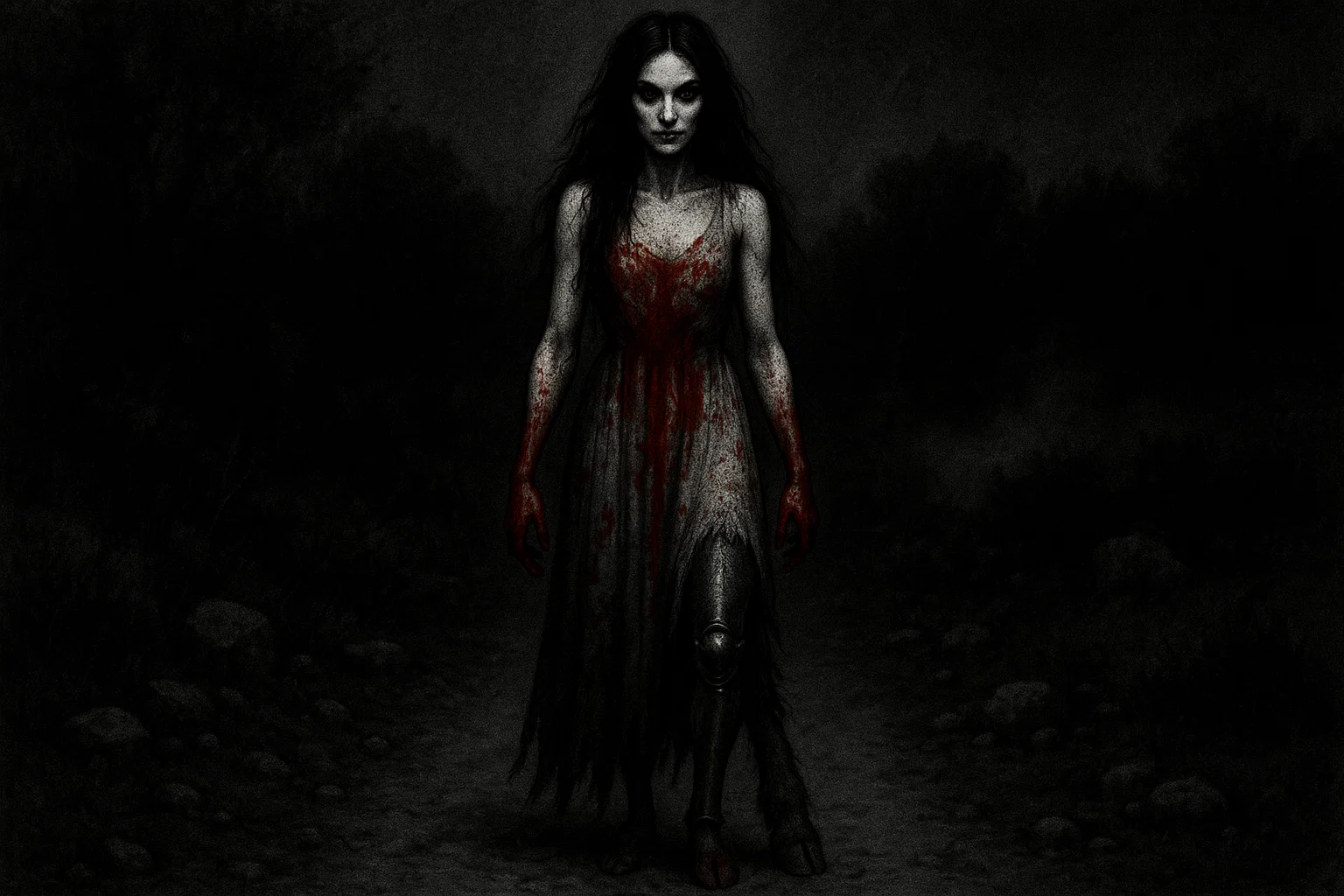
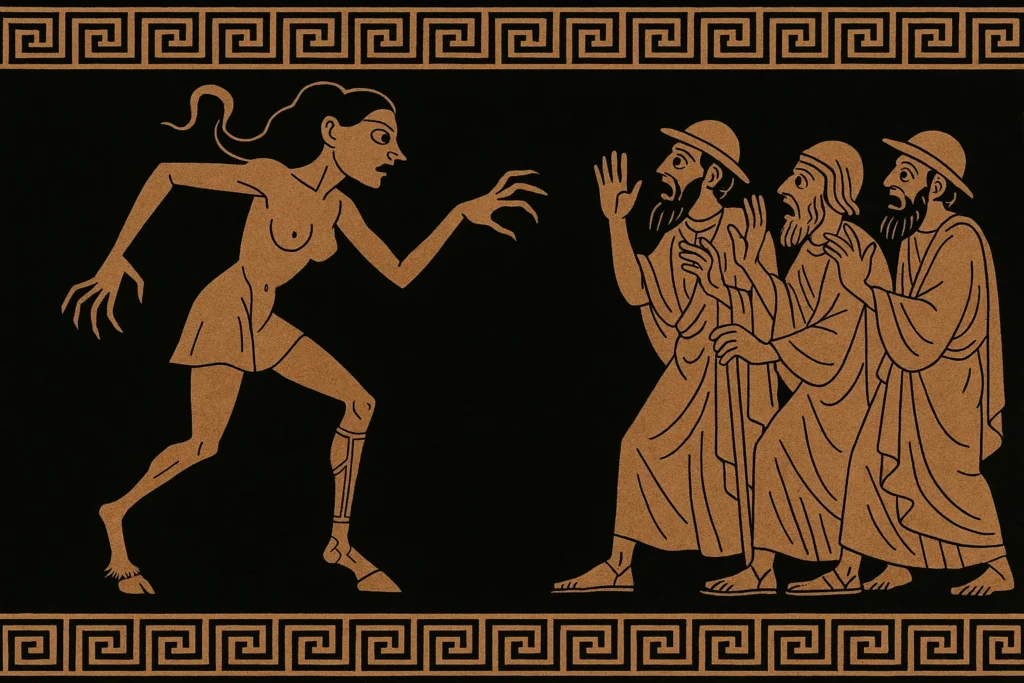
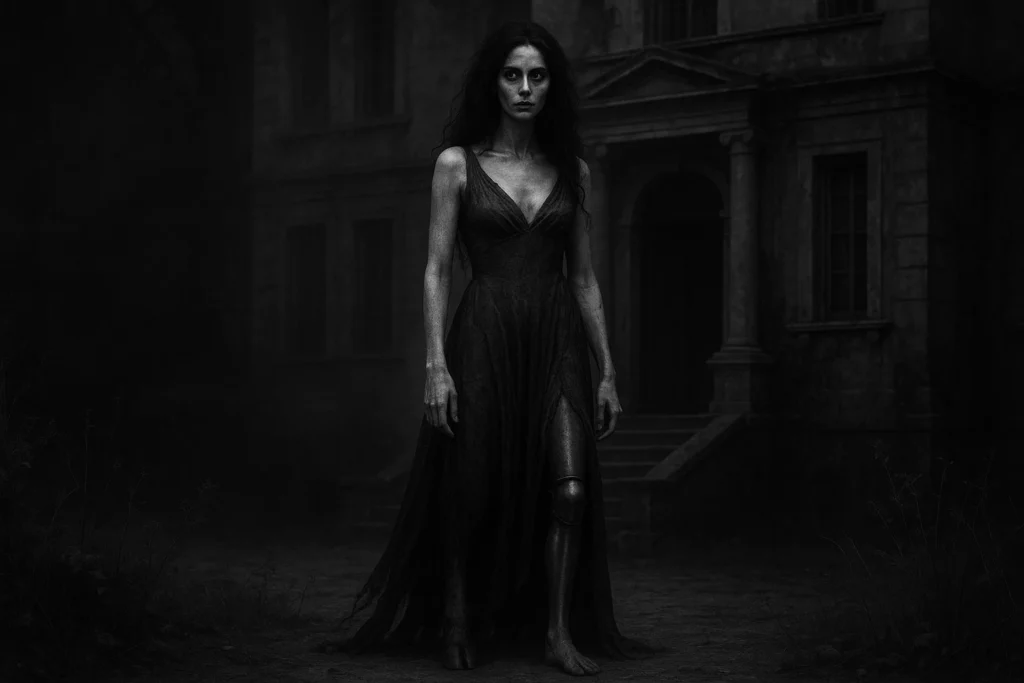
The most distinctive physical characteristic of the Empusa is its ability to shape-shift and its mismatched limbs. When luring victims, the Empusa appears as an exceedingly beautiful woman. This form is a deceptive glamour used for seduction. However, its true or partially revealed form is monstrous and composite.
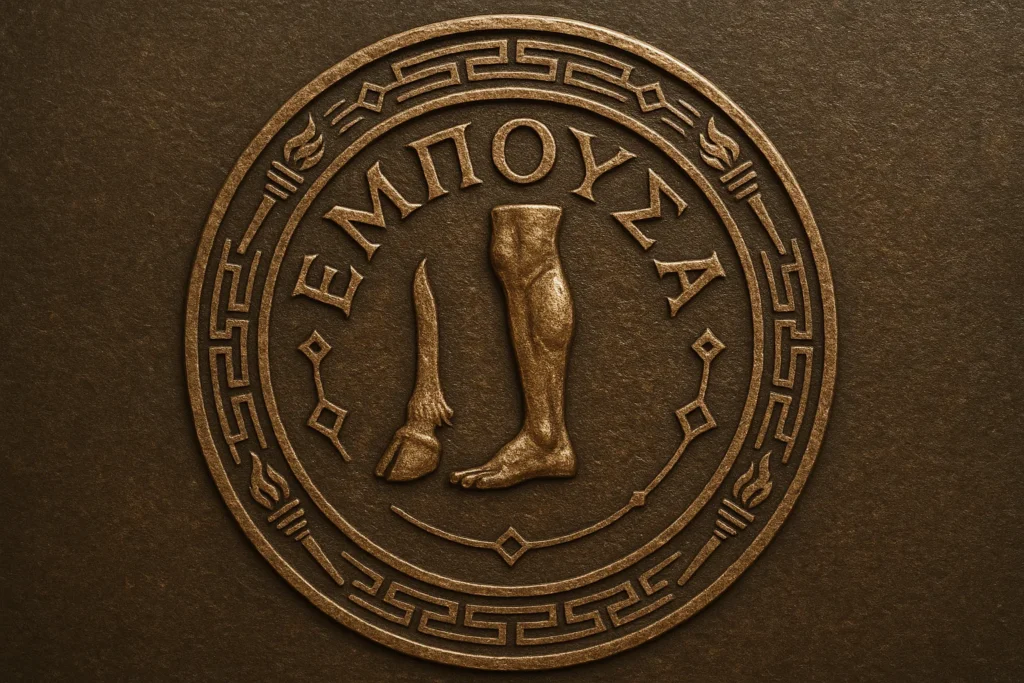
The key descriptive element in Aristophanes’ comedy The Frogs specifies its legs: one leg is made of bronze or brass (chalkine), and the other is a donkey’s leg or a leg covered in cow dung or manure (onokole). This combination of metallic and animalistic features highlights its unnatural, demonic nature.
It is also mentioned that it can take the form of a cow or a mule, suggesting a fluidity of form that defies singular definition, making it a truly terrifying figure that can be beautiful one moment and monstrous the next.
Enemies, Rivals, and Allies
The primary alliance is with the goddess Hecate. The Empusa is understood to be one of her faithful attendants and servants, carrying out the goddess’s nocturnal, underworld-related functions.
As a solitary predator, the she typically has no defined personal allies or rivals among other powerful entities. However, its type—a nocturnal, seductive, vampiric female entity—places it in the company of other similar mythological figures of dread (such as the Lamia and the Mormo), both of which were also used to frighten children or associated with preying on humans.
Her greatest adversary is the human ability to recognize its true nature and the power of derision or insult, as seen in the account of Apollonius of Tyana, where it is routed by being identified and ridiculed.
Connections to Other Ancient Demons
| Name | Genealogy | Type | Appearance |
| Lamia | Greek | Child-eating monster, nocturnal demoness | Beautiful woman from the waist up, but monstrous from the waist down (or in other accounts, a serpent) |
| Mormo | Greek | Child-snatching spirit | Shapeless, hideous female monster (often used to frighten misbehaving children) |
| Gello | Greek | Postnatal demon, ghost of a dead maiden | A female specter, sometimes described with a hideous face and large claws |
| Lilith | Mesopotamian/Jewish | Nocturnal demoness, night hag, child killer | Beautiful woman, sometimes winged and depicted with the feet of an owl |
| Humbaba | Mesopotamian (Sumerian/Akkadian) | Guardian monster | Giant with a face made of coiled entrails, or a lion-faced monster with a terrifying roar |
| Pazuzu | Mesopotamian (Akkadian) | Wind demon, King of the demons of the air | Composite form: human-like body, lion/dog head, eagle talons, two pairs of wings, scorpion tail |
| Lamashtu | Mesopotamian (Sumerian/Akkadian) | Disease demoness, preys on children and mothers | Hairy body, lion’s head with donkey’s teeth and ears, talons, and standing on a donkey |
| Asmodeus | Jewish/Persian | Demon of lust, gambling, and wrath | Man with three heads (man, ram, ox), riding a dragon/serpent |
| Ba’al | Phoenician/Canaanite/Jewish | Infernal dignitary | Sometimes a man with the head of a cat or an ox |
| Balor | Irish (Fomorian) | Giant, King of the Fomorians | A giant with one enormous, evil eye that could kill with its glare |
| Grendel | Anglo-Saxon | Giant monster/demon | Giant, man-like shape, extremely strong, dark and hideous appearance |
You may also enjoy:
Who Is Andromalius and Why Is He the Last Demon of the Goetia?
January 20, 2026
What Is the Akkorokamui, Japan’s Colossal Sea Monster?
November 14, 2025
Who Is the Demon Baphomet and What Does It Represent?
March 2, 2026
Apophis: The Great Serpent of Egyptian Chaos
November 11, 2025
Alû: The Mesopotamian Demon of Malevolence and Pestilence
November 10, 2025
Who Is Ariton, the Infernal King of the Eastern Gate?
February 17, 2026
Empusa Myths, Legends, and Stories
The Empusa in Aristophanes’ The Frogs
One of the earliest and most memorable appearances of the Empusa can be found in the play The Frogs, written by the Athenian playwright Aristophanes around 405 BCE.
In this story, the god Dionysus and his slave Xanthias are on a journey to the underworld. During their travels, Xanthias suddenly sees something frightening and shouts out. He recognizes it as an Empusa, a shapeshifter.
Xanthias describes how the Empusa keeps changing its appearance. At one moment, it looks like a beautiful woman. It transforms into a cow, and then a mule, only to change back into an incredibly attractive woman again. One of the most striking details is about its legs: one looks like it’s made of bronze, while the other resembles a slipper made from cow dung.
Dionysus is so scared by this sight that he thinks he has embarrassed himself and pleads with a priest for help. However, when Dionysus asks where the creature has gone, Xanthias tells him that it has disappeared.
The Apparition Defeated by Apollonius of Tyana
A fascinating story about a creature called the Empusa comes from the book “Life of Apollonius of Tyana,” written by Philostratus around the 3rd century CE. The tale revolves around a philosopher, Apollonius, and a young man, Menippus, from Lycia.
Menippus falls in love with a stunning woman who claims to be very wealthy and lives in a grand house near Corinth. She convinces him to get married. However, Apollonius gets a feeling that something isn’t right about her. He decides to observe them at a dinner party and soon tells Menippus that the woman isn’t real—he compares her to a snake in disguise.
Finding the courage to confront this mysterious figure, Apollonius explains to Menippus that she’s actually an Empusa—a phantom sent to trick him and prevent the marriage. He encourages Menippus not to be afraid, saying that merely insulting the creature will make it go away.
When Apollonius calls her out, the Empusa begins to cry and pleads with him not to reveal her true nature. Eventually, she admits that she is indeed an Empusa, and her plan was to marry Menippus just to consume him for his blood and body, which is how she nourishes herself.
Once her secret is revealed and she is insulted, the Empusa, along with everything in her illusory mansion—like gold, silver, and her servants—vanishes into thin air, proving Apollonius was right all along.
Empusa Powers and Abilities
The Empusa’s powers are primarily based on deception and spectral manifestations, making it a terrifying threat within its mythological context. Her greatest strength lies in her ability to lure and incapacitate victims, mainly young men, through psychological manipulation and physical transformation before enacting her vampiric predation.
In terms of strength, the demoness is not depicted as a powerful, world-ending entity but rather a potent, local, nocturnal menace, formidable enough to cause immense fear and death to individual mortals but susceptible to the power of wisdom and derision.
- Metamorphosis: She can change her physical appearance, most notably adopting the guise of a beautiful woman to seduce and entrap victims, and transforming into animal forms such as a cow or a mule.
- Vampirism: The entity’s central power is its ability to consume the blood and flesh of its human victims, which it requires for sustenance.
- Illusion/Phantom Creation: As a specter, she can create phantom environments and illusory wealth (as demonstrated by the mansion and gold in the story of Menippus) to maintain her deception.
- Instantaneous Vanishing: She can disappear instantly when identified or confronted by a powerful intellect, such as Apollonius of Tyana, suggesting a non-corporeal or spectral nature.
- Terror Inducement: The mere sight of the demoness’ true, monstrous form is sufficient to induce extreme fear in mortals (as seen with Dionysus), fulfilling her role as a bringer of dread.
Rituals, Amulets, and Protective Practices
Given her nature as a terrifying yet somewhat localized specter, ancient protective practices were generally focused on identification and expulsion through vocal means.
The lack of extensive ritual texts or complex, dedicated cults suggests that the fear of the Empusa was handled primarily through folk tradition, general protective measures against Hecate’s powers, or by seeking the help of wise men or philosophers.
Incantations and Ceremonies
No specific, dedicated, or formal incantations have been documented in the surviving ancient texts that were used solely for the ceremonial expulsion or invocation of the demon. The available evidence points towards a simpler, more immediate method of routing the creature: verbal insult and identification.
In the account of Apollonius of Tyana, the philosopher does not use a formalized incantation but rather uses his knowledge and direct address to confront the specter. He essentially performs an act of verbal exorcism by accurately identifying the creature’s true nature and function:
“This specter is of the Empusa kind, and she will try to put a stop to your marriage, but you must keep up a good heart, for she will be routed by an insult.”
By correctly identifying the beautiful woman as an Empusa and exposing her true predatory intent, the philosopher renders the illusion powerless. The creature’s subsequent wailing and vanishing after being identified and insulted suggests that verbal derision and the removal of its disguise constituted the primary means of ceremonial or protective defense against it.
Amulets and Talismans
There is no direct evidence in surviving mythological or archaeological records of specific amulets or talismans designed and consecrated solely against the Empusa.
Protection against this demonic entity would likely have fallen under the general category of apotropaic (evil-averting) amulets or charms used against all nocturnal spirits, phantoms, and the forces of Hecate.
These general protections in the ancient Greek world often included objects such as the fascinum (phallic symbols for luck and protection), the Gorgoneion (Medusa’s head), or small figurines of protective deities like Hermes or, paradoxically, Hecate herself (used in a placatory manner).
However, the narrative of Apollonius suggests that wisdom and recognition were more potent defenses than any physical charm.
You may also enjoy:
Who Is Jann in Islamic Mythology and Why Is He Feared?
October 2, 2025
Demon Alastor: The Grand Executioner of Hell
November 17, 2025
Aim (Aym): The Great Duke of Hell in the Ars Goetia
November 11, 2025
Mahakala: The Dark Guardian Who Consumes Evil
October 16, 2025
Vritra: The Dragon Who Swallowed the Sky in Hindu Mythology
October 7, 2025
Pazuzu: The Demon Who Fought Evil with Evil
November 4, 2025
Frequently Asked Questions
What is an Empusa?
The Empusa is a form-changing female spectral creature in Ancient Greek mythology, often associated with the goddess Hecate. Primarily, it functions as a nocturnal wraith that uses the guise of a beautiful woman to lure and prey upon young men, ultimately consuming their blood and flesh.
Is Empusa evil?
Yes, the Empusa is definitely characterized as a malign and predatory entity within Greek mythology. Its sole known role is to deceive, terrify, and consume the life force (blood and flesh) of human victims, which aligns it with other ancient, malevolent demons and specters like the Lamia.
Are Empusa vampires?
Based on its documented activities in ancient sources, the Empusa functions as a vampiric entity. In the account from the Life of Apollonius of Tyana, the specter confesses that its intent was to marry its victim to devour his body and drink his blood, which is the characteristic behavior of a vampire figure in mythology.
What is the Empusa’s primary weakness?
The Empusa’s primary weakness is identification and verbal derision or insult. In the legend of Apollonius of Tyana, the creature immediately vanishes and is routed once the philosopher identifies it as a phantom and verbally exposes its true, terrifying nature and predatory intent.
