
Apophis (Apep) is the ancient Egyptian demonic manifestation of primal chaos (Isfet) and darkness. This ancient demon exists in perpetual opposition to the cosmic order (Ma’at).
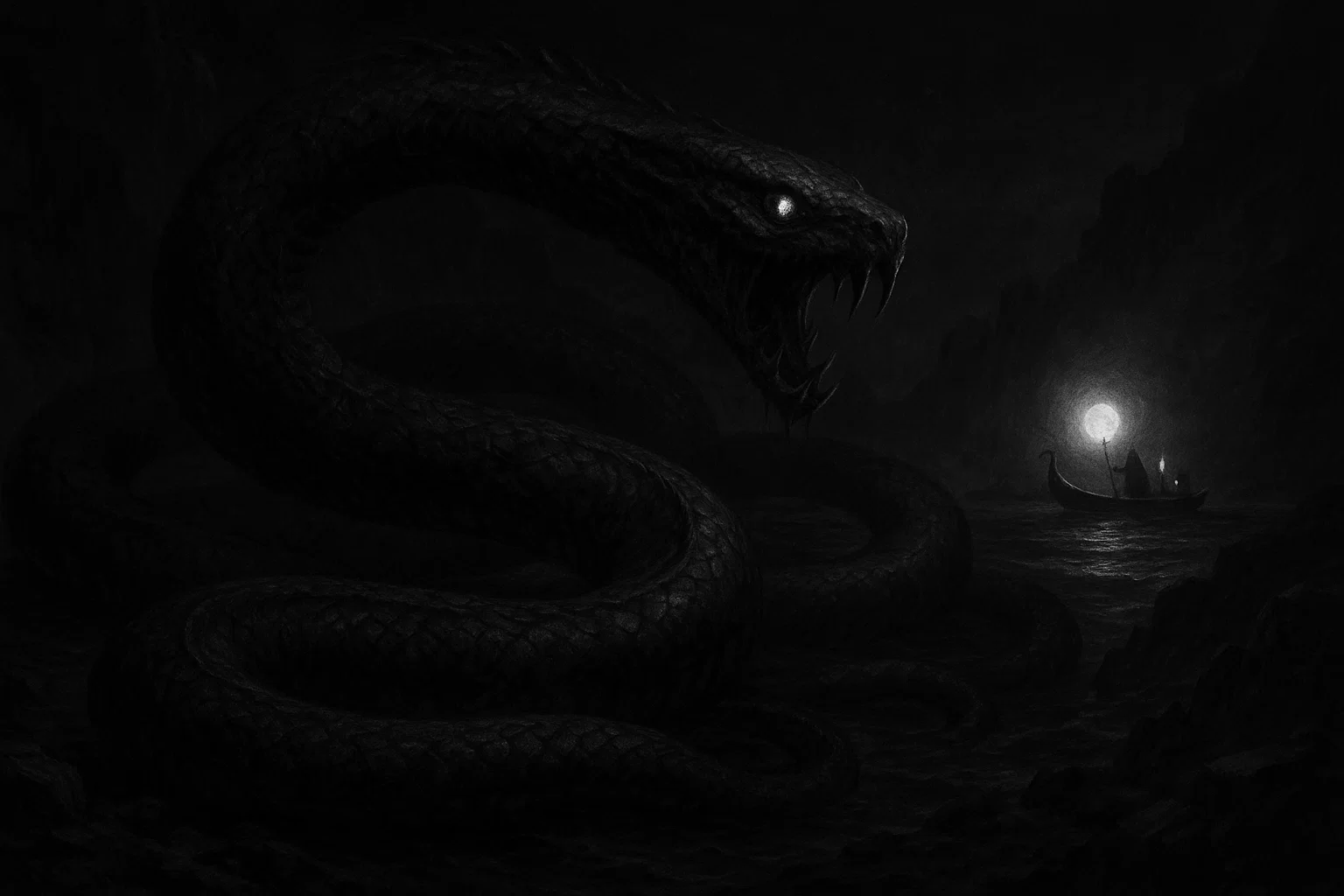
He is typically depicted as a colossal serpent and is the sun god Ra’s greatest foe. His primary mythological function is to perpetually attack Ra’s solar barque (boat) as it travels through the Duat (the underworld/night sky) each night. The battle between Ra and Apophis threatens to plunge the entire cosmos into darkness and non-existence.
Despite the constant attempts by Apophis to swallow Ra and halt the sun’s journey, he is defeated every night by the combined efforts of Ra and the protective deities traveling with him, ensuring the cyclical renewal of the sun at dawn.
Summary
Key Takeaways
| Attribute | Details |
| Names | Apophis, Apep |
| Title | Chaos Serpent, The Great Serpent, Enemy of Ra, Dweller in the Deep |
| Origin | Ancient Egyptian Mythology |
| Gender | Male |
| Genealogy | Believed to have emerged from the primordial waters of Nun; No clear lineage |
| Role | Primary agent of Isfet (Chaos); Cosmic adversary; Threat to Ma’at (Order) |
| Associated Deity/Figure | Ra (opponent), Set (defender of Ra), Mehen, Isis, Aker |
| Brings | Darkness, earthquakes, storms, non-existence, cessation of life/creation |
| Weaknesses | Divine power (especially Ra’s), protective magic, the sharp knives of the gods (e.g., those held by Set) |
| Realm/Domain | The Duat (Underworld), the waters of the primordial abyss (Nun) |
| Weapon/Item | Massive serpent form, ability to hypnotize, control over water |
| Symbolism | Cosmic chaos, non-being, the inevitable threat to order, darkness, destruction |
| Sources | The Coffin Texts, The Book of the Dead, The Book of Gates, The Amduat |
Who or What is Apophis?
Apophis is the supreme embodiment of chaotic evil and unmaking in ancient Egyptian cosmology. He is the ultimate adversary of the divine order established by the creator gods, fundamentally threatening the very existence of the universe. Not only a god of evil, Apophis represents the primordial state of non-existence (Isfet) that perpetually seeks to reassert itself over the created cosmos (Ma’at).
But most importantly, his existence is inextricably linked to the nightly journey of the sun god Ra.
Every sunset, Ra’s barque enters the Duat. In this underworld, it must traverse twelve perilous hours before rising again at dawn. Throughout this journey, Apophis lies in wait, primarily in the tenth hour of the night, attempting to swallow the solar barque and halt the sun’s rebirth.
The constant battle against Apophis is a metaphor for the necessary, ongoing struggle to maintain order against the ever-present threat of chaos and darkness.
“Apophis” Meaning
The name Apophis is the Greek rendering of the ancient Egyptian name Apep (or ỉpp).
The original meaning of the Egyptian name Apep is not precisely known, as it is a name associated with an entity that existed outside of the created world and was generally not worshipped or praised. However, the name itself is onomatopoeic, possibly connected to the word’ p’p (which is associated with slipping away or swallowing).
His title, “Enemy of Ra,” clearly signifies his primary role. The name Apophis or Apep is consistently associated with the forces of darkness and destruction.
Apophis has no known cult or temples dedicated to him, as he was an entity to be repelled and defeated rather than appeased. His name was frequently deliberately broken or mutilated in written form—often pierced with a knife or shown to be cut—in ritual documents to symbolize his continual defeat and to prevent his power from being invoked or realized.
How to Pronounce “Apophis” in English
The name Apophis is generally pronounced in English as A-POE-fiss. The emphasis is typically placed on the second syllable: /əˈpoʊ.fɪs/. The initial letter ‘A’ is pronounced like the ‘a’ in ‘about’, and the ‘ph’ is pronounced like an ‘f’.
The Egyptian name Apep is pronounced AH-pep, with the stress on the first syllable.

Origins
Apophis’s origins are not detailed in the Egyptian pantheon. Rather, he is a manifestation of what the ordered cosmos was created from.
Apophis is considered to have appeared from the primeval, unformed waters of Nun, the abyss that existed before the world. This makes him an eternal, uncreated entity, embodying the non-being that threatens to engulf all creation.
He is not a physical being in the sense of a mortal or a created god. He is the personification of Isfet (the principle of disorder, violence, and injustice), which is the antithesis of Ma’at (truth, order, balance).
In some accounts, it is suggested that Apophis existed from the very beginning of creation, lying deep within the unorganized waters of Nun. He is sometimes viewed as the breath-snatcher that arises after the creation.
His presence symbolizes the eternal, inherent threat of reversion to chaos that all life, the sun, and the cosmos must continually resist. Unlike deities who were born or created, Apophis is often described simply as existing in the depths, waiting to destroy the world of the living.
You may also enjoy:
Who Is Taṇhā, the Seductive Demon of Craving in Buddhist Mythology?
October 15, 2025
What Is a Bhuta? The Backward-Footed Ghosts of Hindu Horror
February 5, 2026
Who Is Andromalius and Why Is He the Last Demon of the Goetia?
January 20, 2026
What Is Qarin and Why Does It Follow Every Human Being?
October 8, 2025
Abura-sumashi: The Potato-Headed Yōkai That Punishes Greed
October 23, 2025
Amdusias in the Ars Goetia: The Demon of Dark Music
December 2, 2025
Genealogy
Apophis is a being of the primordial abyss. Therefore, he does not possess a traditional mythological family structure. He is not the child of any god or goddess, nor does he consort with them. His existence is purely defined by his opposition to Ra and the ordered cosmos.
Sources
The earliest mentions of Apophis date back to the Middle Kingdom in texts such as the Coffin Texts. He becomes a more central and prominent adversary in the New Kingdom, particularly in the elaborate texts that detail the Sun God Ra’s journey through the Underworld (Duat).
| Source | Quote |
| Coffin Texts, Spell 362 | “I am the Lord of the Winding Waterway… Apophis is smitten, the back-bone is cut, the vertebrae are severed.” |
| The Book of the Dead (Papyrus of Ani), Chapter 7 | “O thou who goest with the boat of the lord of things, thou who art commanded, make the boat travel happily! May I overthrow Apophis for thee, and I will strike him down for thee with the harpoon.” |
| The Amduat (Book of that which is in the Underworld), Sixth Hour | “Ra addresses his company: ‘I have gone forth into the deep. I have found Apophis lying there… I have commanded the serpent god Mehen to protect me against him.’” |
| The Book of Gates, Tenth Hour | “The serpent named Apophis, his coils are tied and bound by the company of the gods, his skin is pierced by knives and his venom is spilled.” |
What Does Apophis Look Like?
Apophis is consistently depicted as an enormous, multi-coiled serpent or snake. His size is frequently emphasized as colossal, spanning vast distances across illustrations of the Duat. He is sometimes depicted with features that intensify his monstrous nature, such as having a head that is either unusually large or a less-defined head (likely symbolizing his chaotic state).
In various funerary texts (such as the Book of Gates), he is shown bound and mutilated by the gods who accompany Ra. He is frequently pierced by knives or speared by figures like Set.
In some depictions, his body is segmented into many parts. Each part is attacked by different protective deities, such as Isis and Neith.
Apophis is usually depicted in dark or black colors, appropriate for the embodiment of darkness and night. He may also be shown looped around the body of the earth god Aker, or within the waters of the underworld, signifying his domain in the deepest, most chaotic parts of the Duat.
Enemies, Rivals, and Allies
Apophis’s relationships are defined by his solitary, eternal adversarial status.
His primary and absolute enemy is the sun god Ra. Every other deity and protective entity who travels with Ra in the solar barque is an enemy of Apophis, as they are all dedicated to preserving Ma’at and ensuring the sun’s rebirth.
His other notable direct rival and combatant is the god Set. Although Set is an ambiguous and sometimes chaotic god himself, he takes on the role of a fierce warrior on the prow of the solar barque, using his harpoon and great strength to repel Apophis. Set’s chaotic power is uniquely suited to fight the pure chaos of Apophis.
Other deities involved in the protective cycle against Apophis include the snake-headed god Mehen (who coils around Ra to protect him) and the goddesses Isis and Neith (who use their magical power to bind or immobilize him).
Apophis has no allies. He is the principle of cosmic negation that is opposed by the entire ordered creation.
Connections to Other Entities
| Name | Genealogy | Type | Appearance |
| Tiamat | Babylonian | Primordial Ocean Goddess/Chaos Monster | Gigantic, winged dragon or serpent |
| Jörmungandr | Norse | Midgard Serpent/Cosmic Adversary | Massive serpent encircling the world |
| Leviathan | Ancient Canaanite/Hebrew | Primordial Sea Monster | Giant, multi-headed sea serpent |
| Vritra | Vedic/Hindu | Asura/Drought Demon | Serpent or dragon holding back the waters |
| Illuyanka | Hittite | Dragon/Serpent Monster | Serpentine dragon defeated by the Storm God |
| Dahaka | Zoroastrian/Persian | Three-headed Dragon/Demon | Three-headed monstrous serpent |
| Pytho (Python) | Greek | Chthonic Serpent/Earth Dragon | Vast serpent dwelling in the earth |
| Yamm | Ugaritic/Canaanite | God of the Sea/Chaos | Tyrannical god of the sea and floods |
| Cetus | Greek | Sea Monster/Beast | Large, serpentine sea monster |
| Typhon | Greek | Monstrous Giant/Adversary of the Gods | Giant with a hundred snake heads |
You may also enjoy:
Andhaka: The Blind Demon Born From Cosmic Darkness
February 6, 2026
Demon Alastor: The Grand Executioner of Hell
November 17, 2025
Al-Ahmar: The Tuesday King of the Seven Jinn
February 13, 2026
Who Was Hiranyakashipu, the Demon King of Hindu Mythology?
October 6, 2025
Who Is Taṇhā, the Seductive Demon of Craving in Buddhist Mythology?
October 15, 2025
Lamashtu, the Mesopotamian Demoness of Childbirth and Infant Death
November 4, 2025
Apophis Myths, Legends, and Stories
The Eternal Struggle in the Duat
The principal and most important myth concerning Apophis is the account of the nightly journey of the sun god, Ra, through the underworld, the Duat.
Upon sunset, Ra’s form merges with Osiris, and the solar barque begins its passage through the twelve hours of the night. Apophis’s role is to disrupt this journey and prevent the dawn.
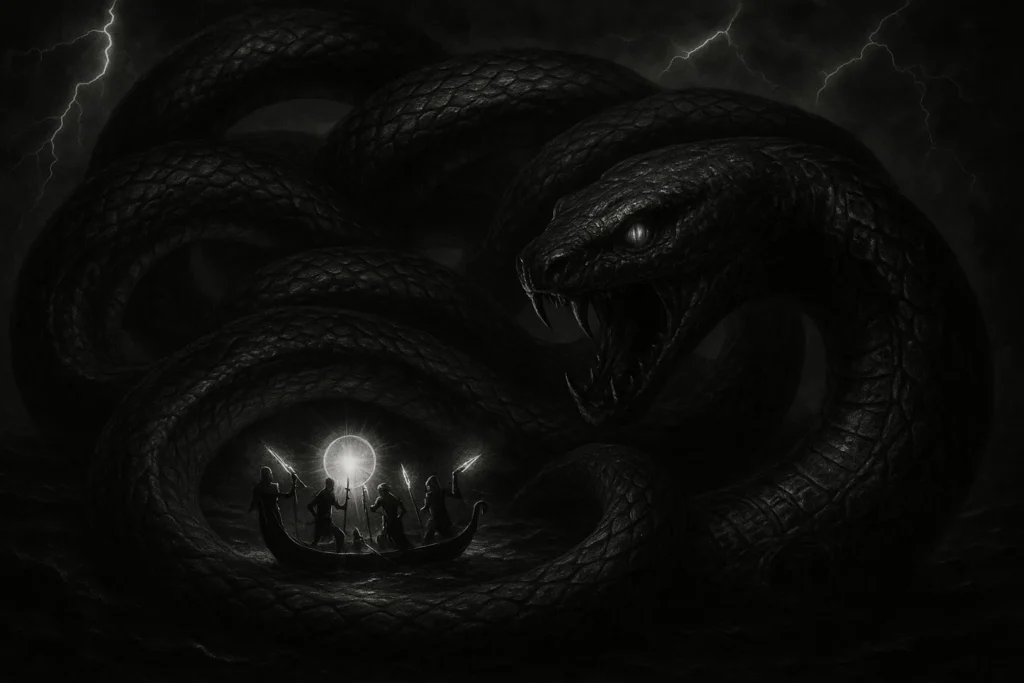
In the tenth hour of the night, specifically, Apophis waits in the deepest part of the watery abyss. He attempts to swallow the solar barque, thereby causing the sun to cease its journey and plunging the world into eternal darkness and chaos (Isfet).
The texts describe Apophis as being an enormous, heavy serpent that can hypnotize with his gaze and use his vast coils to obstruct the water and block the boat’s passage.
To defeat him, Ra is assisted by a group of protective deities. The god Set, despite his own chaotic nature, stands on the prow of the boat and uses a great harpoon to stab and repel Apophis. Other gods and goddesses use magical incantations and knives to slash, stab, and bind the great serpent.
In some versions, the serpent is only temporarily stunned, forced to vomit Ra and the barque back out, or is simply subdued until the next night. This struggle is cyclical and unending, ensuring that Apophis never achieves permanent victory but remains a perpetual threat.
His defeat secures the dawn and the continuation of Ma’at for another day.
Apophis and the Second Chaos
A text known as The Book of Overthrowing Apophis suggests that Apophis is not only a nightly threat but is also associated with a final, eschatological event.
According to this narrative, after the world has been successfully ordered and the gods have completed their work, a second state of chaos will follow. In this ultimate event, the created universe will dissolve back into the primordial waters of Nun, and only the creator god (often Atum or Ra) and Osiris will remain.
In this context, Apophis’s existence is tied to this final dissolution. He is the ultimate power of destruction, and his final success would mean the complete unmaking of the cosmos.
This idea reinforces Apophis as the personification of non-being, the void that lies both before creation and after its eventual end. The continual defeat of Apophis in the nightly journey thus acts as a magical guarantee against this final destruction.
Apophis Powers and Abilities
Apophis is the physical manifestation of Isfet, or cosmic chaos, making him immensely powerful. His strength is not merely physical but is based on his fundamental role as the antithesis of existence and order.
His primary power lies in his ability to disrupt and negate. He is strong enough to pose a continuous, serious threat to Ra, the king of the gods, and the entire divine company.
His abilities center on obstruction, hypnosis, and elemental control. He can cause the waters of the Duat to recede or become turbulent, grounding Ra’s barque. His great coils can completely envelop the solar vessel. Furthermore, his presence is sufficient to instill fear and lethargy, representing the power of chaos to halt motion and life.
Despite being defeated nightly, his ability to resurrect himself immediately is his most important power. This ability also ensures his eternal adversarial role and the perpetual struggle between order and chaos.
Apophis’s powers and abilities:
- Cosmic Negation: Apophis is the embodiment of Isfet (Chaos), allowing him to perpetually threaten the existence of Ma’at (Order).
- Hypnosis/Gaze: He possesses a powerful gaze that can mesmerize the crew of Ra’s barque, potentially stopping the vessel in its tracks.
- Water Control: Apophis can control the waters of the Duat, either by causing turbulence (whirlpools) or by drawing them away to strand the solar barque.
- Massive Physicality: His form as a colossal serpent allows him to physically block the path of the sun god’s boat and attempt to swallow it whole.
- Instant Regeneration: Despite being speared, stabbed, and cut into pieces by the gods each night, Apophis reconstitutes himself immediately, ensuring his return the following night.
Rituals, Amulets, and Protective Practices
The practices associated with Apophis were not for appeasement but exclusively for repulsion and destruction. Apophis was considered the Enemy whose existence threatened all life, so the goal of all related ceremonies and magical acts was to perpetually ensure his defeat and render him inert.
Texts detailing these procedures are found in specialized funerary works and also in temple archives (such as the Papyrus Bremner-Rhodes).
Incantations and Ceremonies
The most formalized practices are detailed in “The Book of Overthrowing Apophis” (also known as The Ritual of the Repelling of Apep). This was a daily temple ritual, particularly at Heliopolis, designed to magically assist Ra in his nightly battle and protect the country from the chaos Apophis represented. The ceremony involved the ritualistic destruction of his image.
Key elements of the ritual included:
- The creation of an image: A small figure or drawing of Apophis was created, usually in wax or drawn on papyrus. The image was sometimes inscribed with negative spells or the names of his associates.
- Ritualistic Corruption: The image of Apophis was spat upon, trodden underfoot, and defiled.
- Destruction by Fire and Piercing: The figure was ritually stabbed or mutilated with knives. The final and most critical step was to burn the effigy completely, ideally over a fire fueled by specific plants considered anathema to Apophis, such as wormwood. The ashes were then mixed with waste and ritually disposed of, often by burial or by throwing them in water.
- Recitation of Spells: Incantations were recited throughout the process, invoking the gods to defeat Apophis and secure Ma’at.
An example of a spell used to destroy or limit Apophis’s power:
Original Egyptian (Transliteration):
nn ỉw.n=k nn wn.n=k
ḫpr ỉw.n=k ḥnˁ=f
nn ḫpr.n=k m ỉnỉt wˁ
ỉw wnn.n=k m ỉnỉt wˁ ỉw
nn wn.n=k ḫpr
English Translation:
“You shall not exist, you shall not persist.
You exist with him [Ra]
But you shall not exist as one,
You shall not persist to exist.”
Another key phrase to be spoken over the destroyed image: “Apophis is cut, Apophis is bound, Apophis is speared, Apophis is defeated!”
Amulets and Talismans
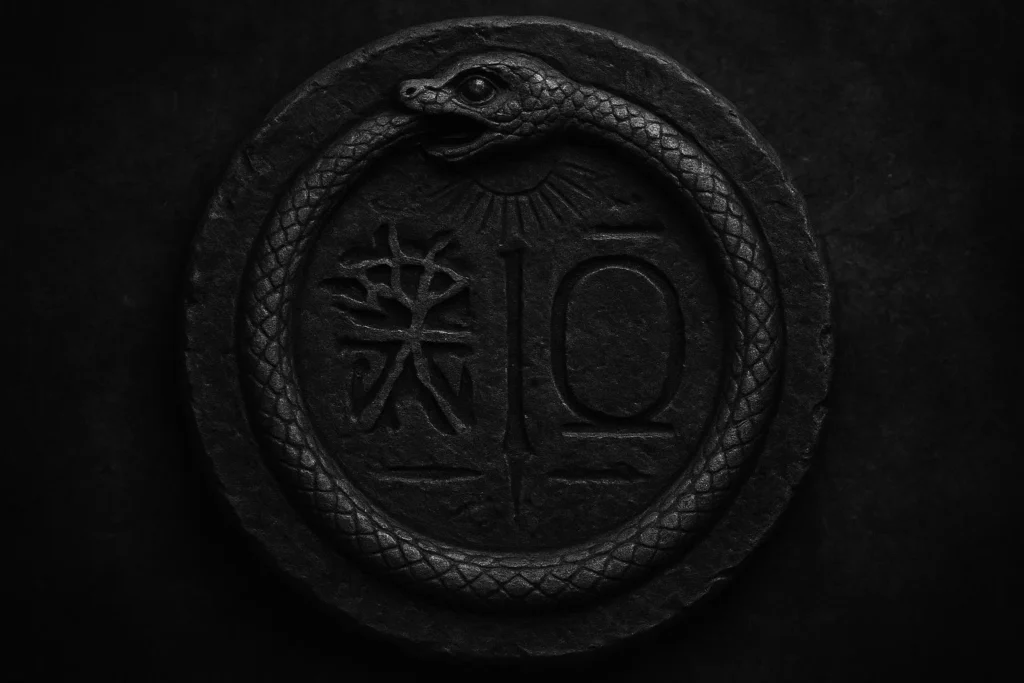
Protective amulets related to the Apophis struggle were designed to invoke the power of the gods who defeated him.
Most notably, amulets and talismans featuring the god Set in his role as the protector on the solar barque were used. These could include images of Set harpooning the serpent.
Other popular amulets were those representing Mehen, the coiling serpent god who protected Ra in the Duat, and the Eye of Horus (Wedjat), a common symbol of magical protection and healing against evil and chaos.
The imagery of the djed pillar, symbolizing stability and the backbone of Osiris, was also used to magically counter Apophis’s chaos and guarantee the endurance of order.
You may also enjoy:
What Is the Akashita, the Red-Tongued Demon of Japanese Folklore?
November 5, 2025
Agubanba: The Ash-Born Demon of Japanese Folklore
October 23, 2025
Who Is Agaliarept, the General of Hell Under Lucifer?
October 8, 2025
Who Is Baal in Christian Demonology?
February 25, 2026
What Is a Yūrei? The True Meaning of Japanese Ghosts
January 30, 2026
Who Was Mahishasura, the Buffalo Demon Slain by Goddess Durga?
October 3, 2025
Frequently Asked Questions
Is Apophis mentioned in the Pyramid Texts or Book of the Dead?
Apophis is mentioned in major Egyptian funerary texts, appearing in the Coffin Texts (Middle Kingdom), the Book of the Dead (New Kingdom), and the Amduat (Book of that which is in the Underworld). His inclusion in these spells shows that the deceased required protection against him to ensure a successful journey through the Duat to the afterlife, where Apophis was a primary threat to the soul.
Does Apophis have any mythological connections to solar eclipses?
Yes, Apophis is linked to solar and lunar eclipses in Egyptian belief. Ancient Egyptians believed that a solar eclipse occurred when Apophis successfully swallowed Ra’s barque during its daytime journey across the sky. Similarly, a lunar eclipse was sometimes attributed to the serpent attacking the Moon or one of the lunar deities. These temporary victories were quickly reversed by the combined efforts of the gods, allowing the sun or the Moon to reappear.
Why is the asteroid 99942 named Apophis?
The near-Earth asteroid 99942 was named Apophis because, upon its discovery in 2004, initial calculations suggested a non-zero, though very small, chance of a collision with Earth in 2029 or 2036. Astronomers chose the name of the Egyptian god of chaos and destruction to reflect this potentially catastrophic threat to the planet. Further observations have since ruled out any impact risk for at least 100 years.
What is the distinction between Apophis (Isfet) and Ra (Ma’at)?
Apophis represents Isfet, the ancient Egyptian term for chaos, disorder, injustice, and non-existence. In contrast, Ra represents Ma’at, the opposing concept of cosmic order, truth, balance, and harmony. Apophis is not merely Ra’s enemy but the embodiment of the essential, primordial condition of non-being that Ma’at—and thus the entire created world—must constantly struggle to suppress.
How is Apophis portrayed in modern popular culture?
Apophis frequently appears in modern popular culture as a symbol of ultimate evil, destruction, and chaos. A notable example is the main antagonist, Apophis, in the popular science fiction television series Stargate SG-1, who is a powerful, tyrannical alien who claims divinity, directly referencing the god’s mythological association with cosmic disorder.
What is Apophis the god of?
Apophis is not a god, but the personification of primordial chaos, destruction, and non-existence (Isfet). Unlike deities who were worshiped, Apophis was the ultimate adversarial force that the gods, particularly the sun god Ra, fought against every night. He represents the ever-present threat of the ordered world reverting to unformed darkness.
How was Apophis killed in Egypt?
Apophis was never permanently killed in Egyptian mythology. He was defeated nightly by Ra and his crew (especially Set), who would harpoon, stab, and bind him, sometimes cutting him into pieces or burning his effigy in ritual. However, Apophis would always regenerate and revive himself to attack the solar barque again the following night. His inability to be permanently vanquished ensured the endless, cyclical nature of the conflict between order (Ma’at) and chaos (Isfet).
Who is stronger, Ra or Apophis?
Ra is ultimately stronger than Apophis, as evidenced by his nightly victory and the continued existence of the cosmos. While Apophis is a powerful force of destruction, Ra is the creator god and the embodiment of Ma’at (Order). Apophis’s power allows him to perpetually challenge Ra and momentarily disrupt his journey (causing phenomena such as eclipses). Still, Ra’s divine authority and the support of his protective deities ensure Apophis is always repelled, and the sun rises again.
Is Apophis a snake?
Yes, Apophis is almost always depicted as a massive serpent. This snake-like form symbolizes his connection to the primordial waters of Nun, the darkness of the underworld, and his role as a low, creeping creature of chaos and destruction that threatens the orderly path of the sun.
Is Apophis male or female?
Apophis is consistently treated as a male entity in ancient Egyptian texts and depictions. He is referred to using male pronouns and epithets, aligning with his role as a singular, destructive force of chaos that appears from the primordial waters of Nun.
