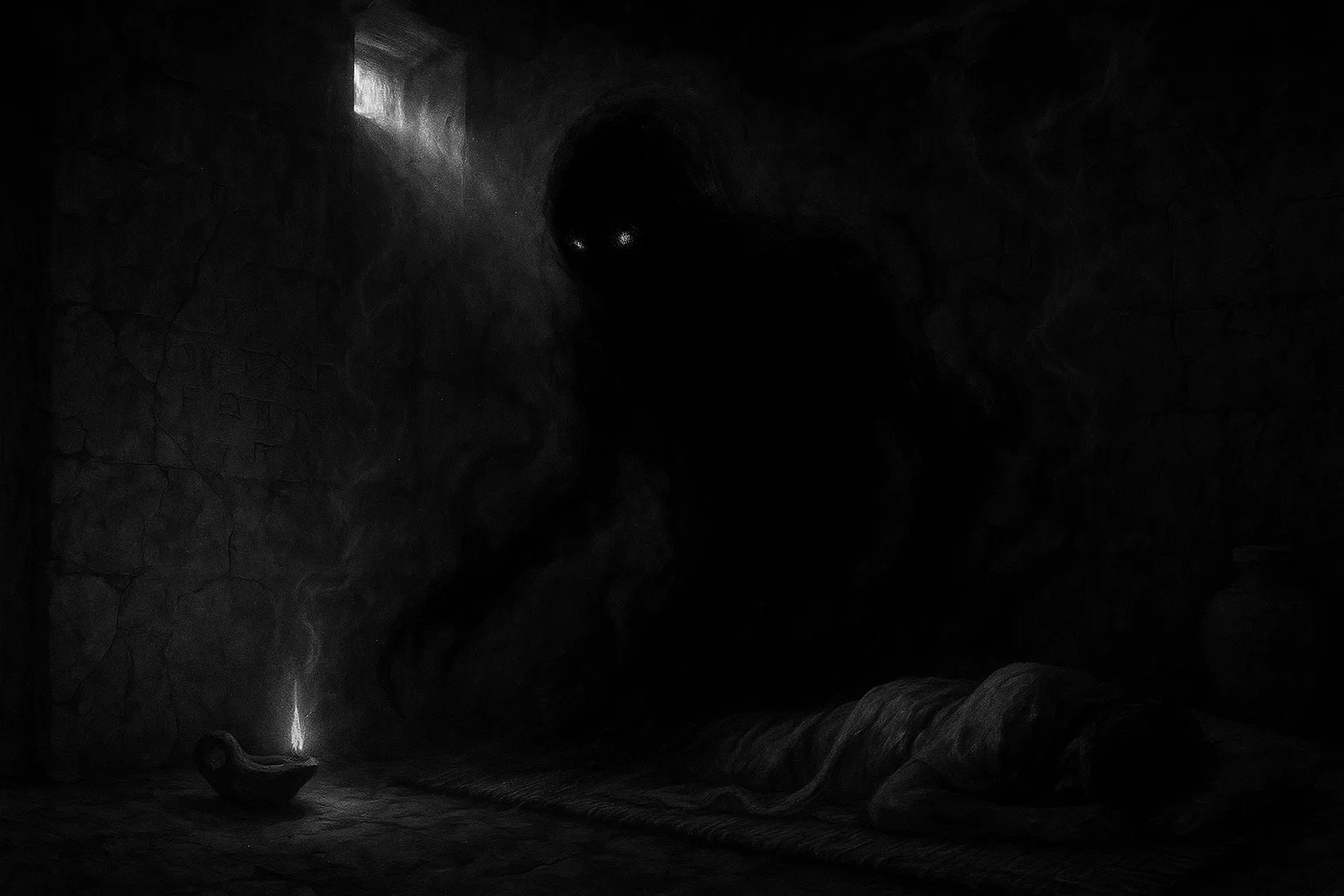

Alû is a malevolent, often plague-bearing spirit (or, in some interpretations, class of demons) from ancient Mesopotamian mythology and demonology. Primarily featured in Akkadian, Sumerian, and Babylonian texts, this ancient demon is typically portrayed as able to seize people (particularly in their sleep), causing illness, headaches, and general malaise.
Unlike some other Mesopotamian demons with clear physical descriptions, Alû is often described as a wraith-like, ethereal entity, capable of stealthy entry into homes and the human body.
Its very existence is deeply intertwined with the ancient Mesopotamian understanding of disease and the unseen forces that disrupt human well-being, making it a frequent subject of apotropaic rituals and incantations designed to expel sickness.
Summary
Key Takeaways
| Attribute | Details |
| Names | Alû, Alû-demon |
| Title | Seizing Spirit, Wraith, Invisible Demon |
| Origin | Sumerian, Akkadian, Babylonian (Mesopotamian) |
| Gender | Male (often referred to as ‘it’ or masculine, though a specific gender is less crucial than its nature) |
| Genealogy | No clear lineage |
| Role | Primary function is to seize, sicken, and cause headaches or general illness; considered a malevolent spirit of the night |
| Associated Deity/Figure | Pazuzu (Invoked to repel malevolent entities, including Alû), Utukku (Often grouped with this class of demons) |
| Brings | Illness, disease, headaches, fevers, general malaise, seizing of the person (often in sleep) |
| Weaknesses | Repelled by apotropaic rituals, specific incantations, figurines of Pazuzu, and protective amulets |
| Realm/Domain | The earthly realm, particularly houses and streets where it preys on people, and potentially the netherworld from which spirits often originate |
| Weapon/Item | None |
| Symbolism | Represents unseen illness, the dangers of the night, and malevolent supernatural affliction. |
| Sources | Sumerian/Akkadian Cuneiform Tablets, Ancient Mesopotamian incantations (e.g., Maqlû series), Exorcistic rituals |
Who or What is Alû?
Alû is a classification of malevolent spirit or demon within ancient Mesopotamian religion, particularly prominent in Akkadian, Babylonian, and Sumerian texts.
It belongs to a broader category of harmful, unseen entities that includes spirits like Utukku and gallû. The central characteristic of Alû is its nature as a wraith-like, insubstantial entity that typically operates during the night.
This demon is associated with seizures and affliction, primarily manifesting as severe headaches, fevers, and general, debilitating illness.
Alû is considered exceptionally dangerous because it can silently enter and occupy a person or a home, often remaining invisible and formless. Its terror comes from its ability to afflict without warning or clear cause, making it a frequent target of elaborate Mesopotamian exorcism rituals designed to force the spirit to depart from the victim.
“Alû” Meaning
The term “Alû” is derived from Akkadian, though its roots are also evident in earlier Sumerian thought. The etymology is complex but typically associated with concepts of seizure, absence of form, or breath/wind.
In Akkadian, alû specifically refers to a demon that is often described as lacking a proper physical form, sometimes portrayed as a shade, ghost, or a stealthy, disembodied presence.
This lack of a clear definition distinguishes it from demons like Lamashtu or Pazuzu, which have distinct zoomorphic characteristics. Some researchers connect the term to words signifying ‘to seize’ or ‘to hold fast,’ reflecting the demon’s primary role of afflicting and seizing people, often with sickness.
The nature of the name itself emphasizes the action of the spirit—its malevolent seizing of the body—rather than a specific, identifiable physical description.
How to Pronounce “Alû” in English
The correct pronunciation of Alû in English is Ah-LOO. The emphasis is typically placed on the second syllable (LOO). The “A” is pronounced with a short, open sound, similar to the “a” in father or car, and the “û” often represents a long ‘oo’ sound, as in too or blue.
You may also enjoy:
Iblis, the Jinn King of Darkness and Deception
September 29, 2025
Aeshma: The Zoroastrian Demon of Wrath and Fury
January 13, 2026
Banasura: The Thousand-Armed Demon King
October 10, 2025
Tarakasura: The Dark Demon Who Ruled Hell on Earth
December 4, 2025
Marid: The Ocean Jinn That Defies Heaven and Earth
September 30, 2025
Aim (Aym): The Great Duke of Hell in the Ars Goetia
November 11, 2025
Origins
The origins of the demon Alû are embedded in the earliest attested demonology of Mesopotamia, stretching back to the Sumerian period, and continuing through the Akkadian and Babylonian empires. However, the concept likely arose from attempts to rationalize and explain unexplained sicknesses, mental afflictions, and the mysterious dangers of the night.
In the Mesopotamian worldview, the line between demons and ghosts was often blurred, and Alû falls into this category of malevolent spirits believed to originate in the netherworld or to be the disembodied spirits of the dead.
It is frequently categorized with other demons of affliction, such as the utukku (a general class of demon, good or evil) or the gallû (underworld demons). The Alû’s characteristic method of affliction—the seizing of a person, often at night and stealthily—made it a constant threat within the home and on the streets.
Genealogy
The demon Alû lacks a clearly defined, detailed genealogy like that of other major Mesopotamian figures—such as Tiamat or Pazuzu. It is generally considered to be an independent spirit of affliction, or a member of a class of demonic entities, rather than the offspring of specific gods or primordial beings.
| Relationship | Details |
| Parents | No clear parent figures are assigned to Alû |
| Siblings | Often grouped with other Utukku and gallû demons, but no direct siblings |
| Spouse | None |
| Children | None |
Sources
Alû is primarily attested in Akkadian, Babylonian, and Sumerian cuneiform texts, specifically within apotropaic incantations and exorcistic rituals.
These sources do not typically tell narrative myths about the demon but rather focus on its nature, the harm it causes, and the formulaic language necessary to repel it.
| Source | Quote |
| Maqlû VII 131-133 (The Burning Series, a comprehensive incantation series against witchcraft) | The evil utukku, the evil alû, the evil gallû – may you swear an oath against them! |
| Udug-hul Tablet 10 (or 13) 4-5 (Exorcistic Incantations against Evil Demons) | The evil Alû who in the man’s body has dwelt, who in the woman’s body has dwelt, a net he cast, he afflicted. |
| Bīt Mēseri (Incantation) (A ritual series for protective rites) | From the house, may the evil Alû and gallû be driven away, and may they not come near the man. |
| Maqlû I 3-5 | Witch and sorcerer, Alû and gallû! You who have been bound by the words of the mouth… |
| Lamaštu Incantation (A text used against the demon Lamashtu) | She is cast out from the house of the man, the evil Alû is cast out, the evil gallû is cast out, the evil god is cast out, the evil spirit is cast out, the evil fever is cast out. |
What Does Alû Look Like?
The physical description of Alû in ancient Mesopotamian texts is consistently vague or, more accurately, defined by the absence of a clear form.
Unlike the lion-headed Lamashtu or the composite figures of Pazuzu, Alû is most often depicted as a wraith, a shade, or a phantom—an intangible, formless entity.
The primary characteristic of this ancient demon is its stealth and invisibility. It is the spirit that seizes without being seen. Some texts describe it as a husk or an empty shape, perhaps hinting at a connection to the restless dead or a spirit that has not taken on a definite form.
When forced to manifest in exorcistic literature, its description often remains abstract, focusing on its ability to pass through barriers—such as walls and doors—and on its pervasive, oppressive presence rather than on a concrete physical appearance.
This lack of definite form makes its banishment a critical part of the rituals: to force the intangible to become tangible and thus susceptible to magical coercion.
Enemies, Rivals, and Allies
Alû is not known for having explicit, personalized enemies or rivals in the narrative sense, as it lacks a detailed mythology of its own. Instead, it is an adversary to all humanity and a target for exorcists and protective deities.
Its primary “enemies” are the figures and objects used to banish it:
- Pazuzu: The demon Pazuzu, though fearsome himself, was frequently invoked in ancient Mesopotamia to protect against other, lesser malevolent spirits, particularly the female demon Lamashtu. Pazuzu’s statues and amulets served as powerful apotropaic (evil-averting) devices capable of repelling malevolent entities like Alû.
- Amulets and Incantations: The specialized knowledge and rituals performed by the Ašipu (exorcist priest) are the main opposing force to Alû. The entire corpus of exorcistic literature, like the Maqlû and Udug-hul series, is explicitly designed to identify, bind, and expel the Alû-demon.
Alû’s main “allies” are other demons of a similar malignant nature. It is typically mentioned in litany-like lists with other harmful entities, suggesting it is part of a collective force of malevolence:
- Utukku: A general term for spirits, some good but many malevolent, that are restless and often bring affliction.
- Gallû: A class of terrifying, oppressive, and often lion-headed demons, primarily associated with dragging victims down to the netherworld.
- Rabisu: The ‘Lurker’ demon, which waits to ambush or seize a person.
You may also enjoy:
Aeshma: The Zoroastrian Demon of Wrath and Fury
January 13, 2026
Gandharva: God, Spirit, or Demon?
November 13, 2025
Azhi Dahaka: The Three-Headed Dragon of Zoroastrian Mythology
January 14, 2026
Who Is the Demon Andras, The Great Marquis of Discord?
January 15, 2026
Mara: The Buddhist Demon King of Desire and Death
October 13, 2025
Who Is Agaliarept, the General of Hell Under Lucifer?
October 8, 2025
Connections to Other Entities
| Name | Genealogy | Type | Appearance |
| Lamashtu | Babylonian/Assyrian | Disease Demon/Child-Killer | Lion-headed female, hairy body, exposed breasts, bird’s talons, standing on a donkey. |
| Pazuzu | Assyrian/Babylonian | Wind/Plague Demon | Winged creature, lion- or dog-like head, serpent penis, scaly body, sharp claws. |
| Gallû | Sumerian/Akkadian | Underworld Demon/Constable | Usually depicted as humanoid, heavily muscled demons, sometimes with lion heads or horns, dragging victims. |
| Utukku | Sumerian/Akkadian | Spirit/Demon (Good or Evil) | Varies; often described as a shadow or restless dead, sometimes with composite features like horns or lion paws. |
| Rabisu | Akkadian/Babylonian | Lying-in-Wait Demon | A lurker or ambusher, often described as a shadowy figure or spectral presence waiting in ambush. |
| Lilû/Līlītu (Lilith) | Sumerian/Akkadian | Night Demon/Succubus | Female winged spirit with flowing hair, associated with harming men and newborn babies. |
| Asakku | Sumerian/Akkadian | Disease Demon | Specifically brings fever and consumption; sometimes depicted as a monstrous figure but often associated with the disease itself. |
| Shedu/Lamassu | Assyrian/Babylonian | Protective Spirit | Bull or lion body with human head and eagle wings; primarily benevolent, used to repel malevolence. |
| Humbaba | Sumerian/Babylonian | Guardian Demon | Giant with a terrifying face composed of intertwined guts or coils, guardian of the Cedar Forest. |
| Ti’u | Babylonian | Headache/Sickness Demon | Specifically associated with affliction and pain, often listed with Alû. |
| Mūtu | Akkadian/Babylonian | Death/Plague Spirit | Personification of death or pestilence, often associated with the netherworld. |
Alû Myths, Legends and Stories
The entity Alû is not a central figure in extended narrative myths or heroic legends. Unlike Mesopotamian deities or major cosmological figures (like Marduk or Tiamat), this ancient demon is primarily documented in apotropaic and exorcistic texts.
However, these sources do not recount a biography, a creation story, or a specific battle involving the demon. Instead, they focus on the demon’s mode of operation and the consequences of its affliction.
The “stories” of Alû are therefore contained within the formulaic language of incantations, which describe the actions of the demon to ritualistically reverse them.
The Alû as the Seizer of the Unsuspecting
The most common “story” of the Alû is the act of seizing a person and inflicting illness. Texts repeatedly mention Alû’s characteristic stealth and its preference for afflicting victims during times of vulnerability, such as sleep or in the privacy of the home. The incantations function as a detailed description of the demonic crime and a legal decree for its expulsion.
The typical narrative described in the exorcistic liturgy is:
The Alû has entered the house undetected, perhaps passing over the wall or the roof like the wind. It has found the sleeping man or woman and seized them (Lian-ni). This seizing manifests as a headache that splits the skull, a fever that burns the body, or a general malaise that drains strength. The incantation calls upon a protective deity (often a god like Ea or a heroic figure like Asalluḫi/Marduk) to locate this invisible, oppressive spirit, force it into a susceptible form (like a figurine), and then bind and expel it from the victim’s body and house.
This cycle of Invasion, Affliction, and Expulsion forms the entirety of the demon’s “legend.”
The Alû as a Member of the Evil Horde
Another prevalent textual context is the Alû being listed as one member of a collective horde of evil spirits. Texts often invoke and banish multiple demons simultaneously, suggesting that they work in concert to afflict humanity.
The ritual series Maqlû (“Burning”) is dedicated to eliminating witchcraft and the demons associated with it. In these spells, the Alû is grouped with the utukku, gallû, and various forms of malevolent magic.
For example, a passage might state: May the evil Alû, the evil utukku, the evil gallû, the evil rabisu, the evil Ti’u, and the witch/sorcerer—may all of them be bound and burned!
This placement within the litany confirms its status as a foundational demon of affliction, but also shows it operating as part of a vast, generalized hostile force against human prosperity and health, rather than as an individual character with a distinct narrative.
Alû Powers and Abilities
Alû’s powers and abilities are primarily centered on affliction, stealth, and invisibility, consistent with its role as a spectral spirit of disease.
It is considered a powerful malevolent entity whose strength lies in its intangibility and its ability to cause deep, pervasive illness without any physical contact or struggle. Its power is sufficient to require the intervention of high-ranking deities or specialized Ašipu (exorcists) to remove it.
The primary measure of Alû’s strength is its persistence and its capacity to break through the basic protections of a home and body. Its defining power is its ability to seize (Lianu) the victim, leading to symptoms that could range from mental distress to fatal fevers, reflecting a significant threat within the Mesopotamian medical and spiritual framework.
- Invisibility/Intangibility: Alû’s defining power. It can pass through walls and doors silently and remain unseen by human eyes, making preventative measures extremely difficult.
- Seizure (Lianu): The primary mode of attack. It can “seize” a person in their sleep or while awake, leading to immediate sickness, a sudden high fever, or debilitating physical and mental pain.
- Disease/Illness Infliction: Its main effect. It is responsible for various forms of illness and general malaise, especially persistent headaches and fevers, without an apparent natural cause.
- Oppression: The ability to cause a heavy, oppressive presence or psychological distress in the victim or a household.
Rituals, Amulets, and Protective Practices
The ancient practices and rituals associated with the Alû are fundamentally apotropaic—designed to avert, repel, and banish the spirit.
Since the Alû was an invisible, disease-bringing entity, the rituals were comprehensive, involving not only spoken incantations but also the ritual destruction of surrogate figures and the use of physical amulets to establish a protective boundary.
Incantations and Ceremonies
The ceremonies related to this ancient demon were complex exorcistic rites performed by the Ašipu (exorcist priest).
The most famous examples come from the Maqlû (The Burning) and Udug-hul (Evil Demon) series of tablets. These rituals aimed to identify the unseen spirit, bind it, and then destroy or expel it.
The ritual typically involved:
- Preparation: Setting up a ritual area, often with pure water, a censer of aromatics, and specific offerings.
- Identification and Invocation: The Ašipu would recite an incantation, listing the Alû and other demons by name and detailing the harm they inflicted, thereby making the intangible target tangible through language.
- Binding and Expulsion: The core of the ritual involved binding the demon. This was sometimes achieved by symbolically forcing the Alû into a figurine made of clay or paste—a surrogate of the demon or the afflicted part of the body. Once transferred, the figurine was ritually destroyed (often by burning it in a flame or crushing it), symbolically breaking the demon’s hold on the victim.
A typical binding and expulsion formula against a host of evil spirits, including the Alû, would be recited. Though the complete, unaltered Sumerian and Akkadian texts are extensive, the translations show the direct, commanding language used to address the entity:
Akkadian:
lú.u.lu hé.me.en dím.me.ir.ri hé.me.en
zi.ga.bi alû nam.lú.u.lu.bi ki.ág
u4.sá.an ba.an.šub.bé.en u4.sá.an ba.an.šub.bé.en
English Translation:
Whether you are a man or a god,
The spirit of this Alû, which loves this person,
Is cast out from the side! It is cast out from the side!
The incantations repeatedly command the demon to “go forth,” “be bound,” and “depart from the house of the man,” often invoking the authority of a great god (such as Ea or Marduk) or a specific benevolent spirit (such as Lama or Šedu).
Amulets and Talismans
Physical objects were also used to protect against the Alû, acting as permanent deterrents or boundaries.
- Pazuzu Figurines/Amulets: The most famous apotropaic device was the Pazuzu amulet or statuette. Although a demon himself, Pazuzu was considered the natural enemy of other malevolent spirits.4 Placing a Pazuzu head on a wall or wearing a small Pazuzu amulet was believed to repel the Alû and other demons of the night and disease.
- Protective Wall Markings: Ritual markings, such as bit mēseri (house siege) rituals, involved placing specific magical bricks or clay figurines (often of benevolent or powerful demons, such as Lamassu or Ušumgallu) into the walls or under the floor of a house. These served as a magical military garrison to prevent the stealthy entry of spirits like the Alû.
- Neck Amulets: Small cylinder seals or plaques inscribed with specific protective incantations mentioning the Alû and its banishment were worn by vulnerable individuals, serving as a personal, portable boundary against the demon’s seizing power.
You may also enjoy:
Who Were the Hinn, the First Spirits of Creation?
November 12, 2025
Pazuzu: The Demon Who Fought Evil with Evil
November 4, 2025
Nasnas: The Monstrous Demon Hybrid That Haunted Pre-Human Earth
November 12, 2025
Who Was Abezethibou, the Fallen Angel Who Opposed Moses?
October 1, 2025
Who Was Ravana in Hindu Mythology and Why Was He Feared?
October 3, 2025
Agubanba: The Ash-Born Demon of Japanese Folklore
October 23, 2025
Frequently Asked Questions
In Akkadian cosmology, what is the fate of the demon Alû?
The Alû is often classified as a vengeful spirit of the Utukku (ghosts of the dead) that goes down to Kur, the Sumerian name for the underworld or netherworld. However, like other evil spirits, it is known to roam the earthly realm at night, primarily to terrify and torment people while they sleep.
How is the Alû-demon specifically related to the modern phenomenon of sleep paralysis?
The ancient descriptions of Alû’s actions—specifically its ability to seize a person in bed and overwhelm them like a garment—closely parallel the clinical symptoms of sleep paralysis. It was believed that possession by the Alû caused the victim to be conscious but unable to move or cry out, functioning as an ancient explanation for this terrifying nocturnal experience.
Are there any texts suggesting that Alû has an androgynous or dual-gender nature?
Yes, scholarly interpretations of certain cuneiform texts indicate that Alû may have been viewed as androgynous or of dual gender, or that its affliction was non-gender-specific. One cited translation mentions the wicked Alû covered the victim in bed and specifically attacks a man’s breast, suggesting a potential incubus/succubus function in addition to its disease-bringing role.
What other negative psychological effects is the Alû demon associated with besides physical illness?
The Alû is sometimes understood as a metaphor for mental disturbances, specifically a dark cloud (metaphor for depression) or an entity causing psychological torment. Its ability to seize the mind and body led ancient Mesopotamians to associate it with conditions causing unconsciousness or a coma, highlighting a blend of physical and mental affliction.
