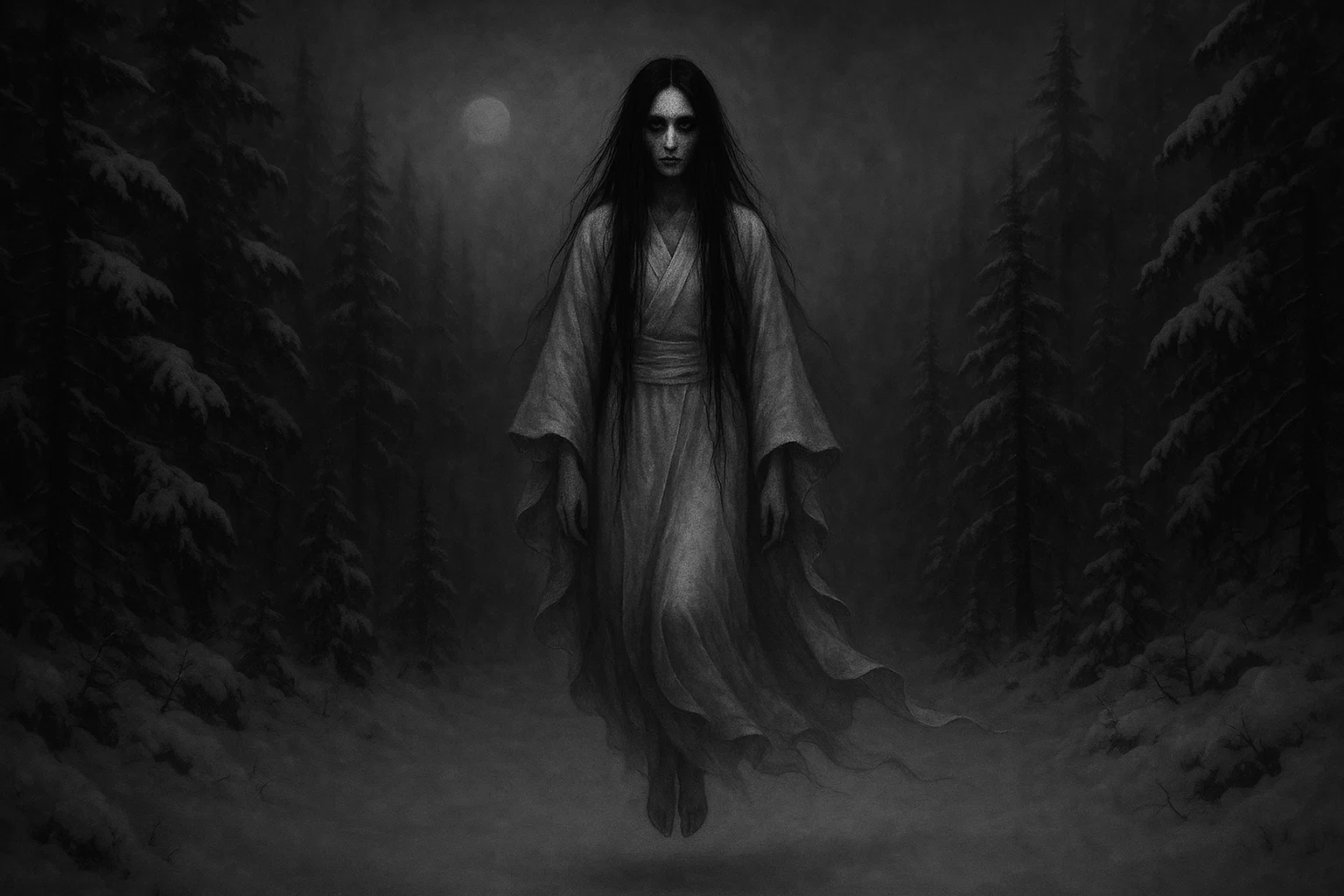

The Yuki Onna (or Yuki-musume) is a well-known Japanese yōkai characterized as a spirit (or obake) associated with snow, cold weather, and winter storms. She is typically depicted as a beautiful woman who appears in snow-covered landscapes, primarily in mountainous regions or during heavy snowfall.
This entity is known for its lethal nature. According to stories, she often causes travelers to freeze to death or lures them to their demise using supernatural powers related to ice and cold. She is a manifestation of the severe and often deadly aspects of the winter environment in Japan.
Summary
Key Takeaways
| Attribute | Details |
| Names | Yuki Onna, Yuki-musume (Snow Daughter), Yuki-jorō (Snow Woman/Girl), Yukijorō, Yuki-ba (Snow Hag), Tsurara Onna (Icicle Woman), Koshijin, Yuki Furu Onna |
| Translation | Snow Woman |
| Title | Ghost of the Snow, Spirit of Winter |
| Type | Yōkai (Supernatural creature), Obake (Shape-shifting spirit), sometimes categorized as Yūrei (Ghost) |
| Origin | Spirit of a woman who died in the snow, an elemental manifestation of winter, or a mountain spirit (yama-hime) adapted to cold environments. |
| Gender | Female |
| Appearance | Extremely pale or translucent white skin. Long black hair. Exceptionally beautiful, wearing a white kimono or appearing nude. Often described as having no feet and floating above the snow. |
| Powers/Abilities | Generating ice and blizzards; draining life force (ki) through breath or touch; hypnotic beauty; shape-shifting. |
| Weaknesses | Fire, heat, warmth, Shinto charms, or violation of a sacred vow/promise. |
| Habitat | Snowy mountains, high mountain passes, and dense forests during heavy snow. |
| Diet/Prey | Human travelers, especially young men, whose life force or heat she absorbs. |
| Symbolic Item | None |
| Symbolism | The lethal beauty of winter, nature’s indifference, purity, death, and the temporary nature of human life. |
| Sources | Sōzan Chomon Kishū (1778), Tōno Monogatari (1910) by Kunio Yanagita, various regional folktales and oral traditions. |
Who or What is Yuki Onna?
The Yuki Onna is a powerful and widespread creature in Japanese folklore, predominantly associated with the deep snow and harsh winters of the country’s northern and mountainous regions.
As a yōkai, she is a supernatural entity, often portrayed as an obake due to her ability to appear suddenly and her transformation capabilities, or sometimes as a yūrei given her spectral, non-corporeal nature. The Yuki Onna is deeply connected to ice and snow, serving as a localized personification of the severe and deadly aspects of a winter storm.
She is generally depicted as an ethereal woman with pale, almost transparent skin, allowing her to blend seamlessly into a frozen environment. The Yuki Onna is considered the embodiment of winter’s lethal power, capable of freezing a person instantly with a single breath.
Her victims are typically travelers caught in a blizzard, lured to their death by her unnatural beauty or overwhelmed by the chilling powers she commands.
MEET THE MONSTERS THAT HAUNT JAPAN Limited-Time: Up to 28% OFF!
Kappa • Yuki-onna • Tanuki • Kitsune • Hundreds more legendary spirits Hilarious, horrifying, and downright bizarre tales from Japan’s shadow side. Fully illustrated encyclopedia by Thersa Matsuura – your passport to the world of yōkai. Anime origins • Real folklore • Things that go bump in the tatami. Dare you invite them in?
“Yuki Onna” Meaning
The name “Yuki Onna” is direct in its linguistic roots, translating from Japanese as “Snow Woman.” The name is composed of the two primary elements: Yuki (雪), meaning “snow,” and Onna (女), meaning “woman” or “female.” This straightforward translation clearly reflects her fundamental identity as a spirit inextricably linked to the weather phenomenon of snow.
Historically, the name has had several regional interpretations, each offering minor descriptive differences. The term Yuki-musume (雪娘), meaning “Snow Daughter” or “Snow Girl,” is often used in regional folktales to describe a younger or sometimes slightly less malicious version of the entity.
Yukijorō (雪女郎), translating approximately as “Snow Courtesan” or “Snow Woman/Girl,” appears in some Edo-period texts, emphasizing her stunning beauty and seductive mannerisms used to lure victims.
A highly descriptive variant, Tsurara Onna (つらら女), the “Icicle Woman,” is used in some legends to highlight her affinity with sharp, freezing forms of water.
Plus, regional dialect names exist, such as Koshijin in Niigata Prefecture, and Yuki Furu Onna (Snow Falling Woman) in Gifu. Despite these variations, the core identity is consistently that of a female entity originating from or composed of snow.
How to Pronounce “Yuki Onna” in English
The name Yuki Onna is pronounced as Yoo-kee Oh-n-nah. The first part, Yuki, is pronounced like “yoo-key,” with the long ‘oo’ sound similar to the ‘oo’ in moon and the ‘i’ sound like the ‘ee’ in keep.
The second part, Onna, is pronounced as “oh-n-nah,” with the ‘o’ sounding like the ‘o’ in go and the double ‘n’ creating a slight pause or emphasis before the final ‘a’ sound, which is pronounced like the ‘a’ in father.
What Does Yuki Onna Look Like?
The Yuki Onna’s appearance is consistently described across Japanese folklore as one of supernatural, chilling beauty, which is a dangerous contrast to her lethal nature.
She is almost universally depicted as possessing exceptionally fair skin, often so pale that it appears translucent, resembling the fresh, unbroken surface of snow or ice.
This complexion is her main attribute, allowing her to blend visually into her frozen world. The air around her is unnaturally cold; sometimes she is even described as radiating a cold vapor or reiki that others can feel.
Her hair is typically depicted as long, flowing, and black, providing a sharp contrast to her pale skin and white surroundings. This distinctive black-and-white duality is a highly effective visual element in her representation.
She is most often seen wearing a white kimono (shiro kimono), which enhances her spectral look and reinforces her connection to the snow. In some legends, she appears nude, with her perfectly white skin serving as her only covering, emphasizing her non-human, elemental nature.
A frequent and significant detail in many accounts is that she doesn’t have feet and leaves no footprints (ashiato). She is said to float or glide silently over the snow, which reinforces her status as a non-corporeal spirit rather than a physical being.
Her form is typically youthful and flawless, to keeping with the Onna (woman/girl) part of her name. In some regional tales, she might appear as an old woman (Yuki-ba). However, the beautiful young spirit is the standard depiction.
You may also enjoy:
Jikininki: The Japanese Ghost That Feeds on Human Corpses
February 9, 2026
Who Is the Demon Andras, The Great Marquis of Discord?
January 15, 2026
Who Was Ravana in Hindu Mythology and Why Was He Feared?
October 3, 2025
Vritra: The Dragon Who Swallowed the Sky in Hindu Mythology
October 7, 2025
Who Was Abezethibou, the Fallen Angel Who Opposed Moses?
October 1, 2025
Who Were the Hinn, the First Spirits of Creation?
November 12, 2025
Habitat
Yuki Onna’s habitat is rigorously defined by extreme cold and heavy snow. She is primarily found in the mountainous, northern, and deeply rural regions of Japan during the winter months, specifically areas prone to blizzards. These include places like the Tōhoku, Nagano, and Niigata prefectures.
She favors isolated and hazardous environments such as remote mountain passes, blizzard-struck roads, and deep, silent forests covered in snow. The cold, wind, and blinding snow of a blizzard are her active domain, providing both concealment and the optimal conditions for her powers. In these isolated areas, she can trap and consume travelers struggling against the elements.
In some stories, she also appears near isolated farmhouses or in villages that are completely cut off by winter storms. This reflects a fear of being trapped and vulnerable even within one’s own home.
Her preference for these lethal habitats is integral to her identity: she is not merely residing in the snow. Still, she is the embodiment of the snowstorm’s danger. The deeper the snow and the fiercer the blizzard, the more active and powerful the Yuki Onna is said to become.
1,000+ SPIRITS, GODS & GODDESSES AWAITING YOUR CALL. Limited-Time: Up to 49% OFF!
The ultimate global spirit encyclopedia – 2,000+ entries from every culture on Earth. Fairies • Djinn • Demons • Loa • Angels • Deities • Ancestors Real names • True offerings • Ancient rituals that actually work. Judika Illes’ legendary masterwork – the one book every serious witch, mage, and spirit-worker owns.
Origins and History
The historical origins of the Yuki Onna are from oral folklore across Japan’s snowy regions, making a single definitive origin text unlikely.
However, the earliest known textual reference that closely matches the Yuki Onna archetype is found in the Sōzan Chomon Kishū (Listening to Tales from Mount Sōzan), an Edo period (1603-1868) collection of kidan (strange tales) compiled by Yamaguchi Sōzan around 1778.
In various regional traditions, the Yuki Onna is conceived through several origins:
- Spirit of the Dead (Yūrei): She is often viewed as the yūrei (vengeful ghost) of a woman who perished from exposure in the snow. Her spirit is bound to the cold element, manifesting her fate as a deadly force against the living.
- Elemental Manifestation: An older concept casts her as a nature spirit or mountain spirit (yama-hime), which later evolved to a specific entity of intense cold and blizzards. This ties her into the broader system of kami (divine beings) and nature yōkai that embody specific environmental phenomena.
The folklorist Kunio Yanagita standardized her narrative in the Meiji Era (1868-1912). His 1910 work, the Tōno Monogatari (The Legends of Tōno), compiled local tales from Iwate Prefecture, establishing the recognizable template for the Yuki Onna legends widely known today.
Sources
The Yuki Onna is not typically mentioned in Japan’s most ancient texts, like the Kojiki or Nihon Shoki. Her primary documentation comes from Edo-period compilations of strange tales and Meiji-period folklore collections.
| Source | Quote |
| Sōzan Chomon Kishū (1778) | …a woman, as beautiful as a flower, whose skin was white like snow, stood before him. She breathed a white vapor over him, and he instantly felt the chill of death. |
| Tōno Monogatari (1910) by Kunio Yanagita | ある所には雪女とて、雪のふる夜に、窓の戸をたたくものあり。その家の者いねとて、まかりいでて、戸をあけてみれば、雪女にて、その家の人を凍えさするなり。 / [Translation: In a certain place, there is the Yuki Onna, who on a snowy night, taps on the window shutter. A person in that house goes out, opens the door, and seeing the Yuki Onna, is frozen by her.] |
Famous Yuki Onna Legends and Stories
The Yuki Onna is featured in numerous regional tales, often focused on encounters between a solitary traveler and the beautiful, lethal spirit. These narratives propose themes of promises, nature’s unforgiving power, and the duality of beauty and death.
The Story of Minokichi and Mosaku
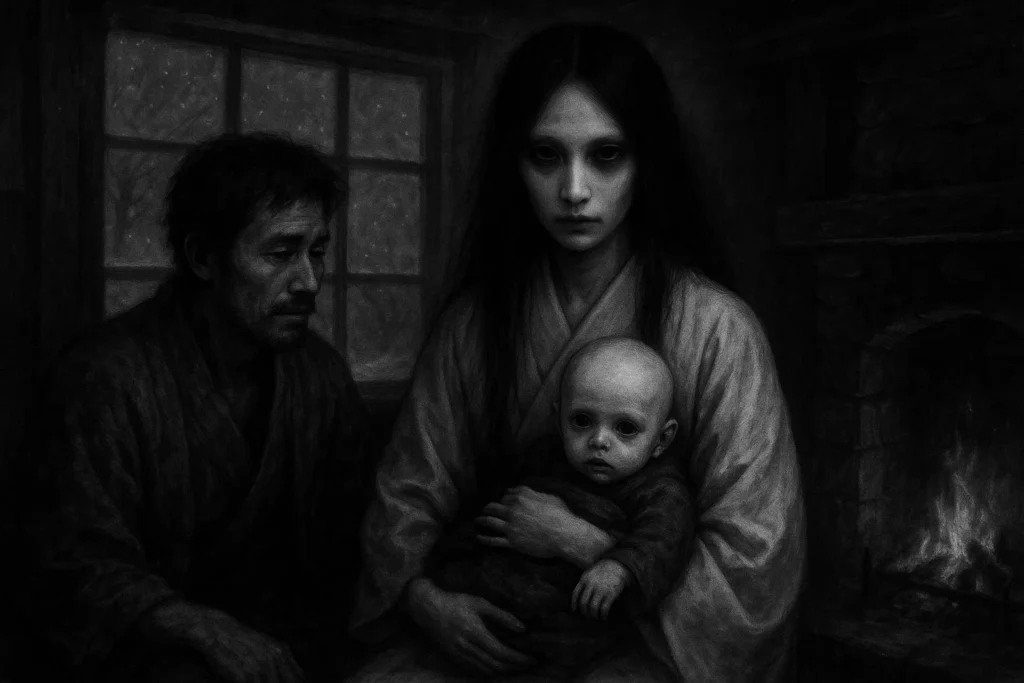
This is the most famous version, popularized by Lafcadio Hearn. The story begins in Musashi Province with two woodcutters, the elderly Mosaku and his young apprentice, Minokichi.
One frigid winter day, they were caught in a sudden, violent snowstorm while crossing a river, forcing them to take shelter in an abandoned charcoal burner’s hut. The fierce wind and snow trapped them, and as night fell, they drifted into a troubled sleep.
In the dead of night, Minokichi was roused by a cold draft. He saw a woman standing over Mosaku. Her skin was dreadful white, and her pale kimono seemed to blend with the snow, light filtering through the door. She leaned over Mosaku and breathed a puff of white mist directly onto the old man’s face. Mosaku immediately gave a final shiver and was instantly frozen solid.
The Snow Woman then turned toward Minokichi. She moved silently, bending down to stare into his face, which was still young and handsome.
Instead of killing him, she paused and stated, “I intended to kill you as well, but because of your youth, I shall spare you, on one condition: you must never, ever speak a word about what you saw tonight. If you ever tell anyone, even your wife or children, I will know it, and I will kill you without mercy.”
Having extracted this dreadful vow, the Snow Woman vanished into the swirling blizzard, leaving Minokichi paralyzed by fear.
Minokichi kept his terrifying promise for years. The following winter, he met a beautiful girl named O-Yuki (Snow), whose skin was unusually white and cold to the touch. They married and had a happy life, eventually raising ten children. O-Yuki remained youthful, never seeming to age, and her appearance retained an unnerving, snow-like perfection.
Years later, Minokichi, overcome by the memory, confessed to his wife. He recounted the entire story of the hut and the Snow Woman, concluding by saying, “When I look at you, my O-Yuki, you remind me so much of that terrible woman.”
O-Yuki’s face instantly changed. She arose, her beauty transforming into a look of vile pallor and terrifying rage. “It was I! I was the woman you saw that night! I warned you never to speak of it! You have broken your vow. However, because of these children, whom I must care for, I will not kill you now. But heed my warning: if you ever make them unhappy, or if they ever have cause to complain, I shall return and destroy you!”
With a howl of wind, O-Yuki’s form dissolved into a white mist and ascended through the smoke hole, never to be seen again. Minokichi was left alone, forever bound to his children and his broken promise.
DEMONS ARE REAL — AND THE BIBLE PROVES IT Limited-Time: Up to 20% OFF!
No myths. No exaggeration. Just Scripture. Clinton Arnold’s landmark biblical theology of the powers of darkness. What the Old & New Testaments actually teach about Satan, demons, and spiritual warfare. Essential reading for every pastor, counselor, and believer facing the unseen battle. The book seminaries and deliverance ministries swear by.
Demons are real • Scripture is clear • Victory is yours • Clinton Arnold’s definitive biblical study.
The Hunter and the Icicle Woman (Tsurara Onna)
In some tales, the Yuki Onna is known by the name Tsurara Onna (Icicle Woman), emphasizing her sharp, fatal nature. One version tells of a hunter who lived alone in the deep mountains of Hida Province.
One winter day, he returned to find a beautiful woman waiting near his cabin. She claimed to be a lost traveler seeking shelter. He allowed her to stay, and they soon developed a powerful affection.
The woman was named Yuki, and she insisted that the hunter never light a large fire, claiming the heat gave her headaches. The hunter agreed, keeping his house cold with only a small brazier.
As the winter progressed, his suspicion grew due to the extreme cold that radiated from her body and her refusal to approach any flame. He noticed that she would often leave the cabin during the fiercest blizzards, returning only when the snow had stopped.
One day, driven by the intense cold and his rising fear, the hunter built a massive fire in his hearth while Yuki was sleeping. The heat filled the small cabin, becoming almost unbearable. A terrible scream awoke the hunter.
He rushed to the hearth and found that Yuki had dissolved into a puddle of water, mixed with pieces of shattered ice and thin, broken icicles. He realized that he had fallen in love with a creature made of the very winter she brought, and his human warmth had destroyed her.
You may also enjoy:
Who Is the Demon Andras, The Great Marquis of Discord?
January 15, 2026
Who Was Abezethibou, the Fallen Angel Who Opposed Moses?
October 1, 2025
Hariti: The Demon Mother Who Fed on Children at Night
December 8, 2025
What Is Baku? The Japanese Yōkai That Eats Nightmares
January 28, 2026
Who Was Hiranyaksha, the Golden-Eyed Asura?
October 7, 2025
The Fatal Door Knock (from Tōno Monogatari)
A brief but terrifying regional legend from the Tōno region speaks of the Yuki Onna’s simple, deadly method of attack on homes during a storm. The tale states that on nights of heavy snowfall, the Yuki Onna will tap gently on the door or window of an isolated home.
If the resident is foolish enough to answer and open the door, the Yuki Onna will be standing there, her beauty enhanced by the ghostly, cold light of the snow. She will look at the resident and, with a single, quick breath of freezing air, lock the door shut and instantly freeze the person where they stand.
The victim, frozen solid in the act of opening the door, becomes a mere icy sculpture, their heat absorbed by the elemental spirit of the cold. The danger here lies not in a complex deception, but in the simple act of extending human hospitality to the deadly force of nature outside.
Yuki Onna Powers and Abilities
The Yuki Onna is a powerful elemental yōkai whose abilities are entirely focused on the manipulation and control of cold, ice, and snow. Her strength is considerable within her specific environment, though it is highly localized and seasonal.
She is supremely powerful in a blizzard but powerless in the presence of intense heat or fire, making her a specialized force among yōkai rather than universally strong like an Oni.
A key mechanism of her power is the absorption of ki (life force or internal heat) from human beings. She does not physically consume flesh but drains the warmth necessary for life, transforming her victims into preserved icy corpses.
Powers and abilities breakdown:
- Cryokinesis (Ice/Snow Control): The primary ability to generate, manipulate, and control ice, frost, and snow. She can conjure sudden blizzards, create ice spikes or icicles, and freeze doors shut to trap victims.
- Life-Force Absorption (Ki Drain): She can absorb the heat or ki directly from a victim’s body, often by breathing or kissing them. This instantly freezes the victim to death, leaving an intact, frozen corpse.
- Hypnotic Beauty: She has an ethereal and irresistible beauty that acts as a lure, often causing travelers to approach her willingly despite the danger.
- Metamorphosis and Illusions: The Yuki Onna can seamlessly shift her appearance, most commonly into a human woman. She can also dissolve her body into a white mist or a column of snow for instantaneous travel or disappearance.
- Intangibility/Afoot: She is typically described as having no physical feet, allowing her to float silently across the snow without leaving any footprints, which makes her impossible to track.
- Cold Aura/Immunity: She emits an unnatural coldness that affects the surrounding air and is completely immune to all effects of extreme cold, as she is composed of the element itself.
How to Defend Against Yuki Onna
According to folklore, defense against the Yuki Onna relies on avoiding her domain or using the elemental opposite of her existence: heat. Her weaknesses are directly linked to the environment she personifies.
- Heat and Fire: The most effective defense is intense heat or fire. Building a large, roaring fire in a shelter (such as a hearth or irori) is an essential defensive measure, as heat causes her elemental form to dissolve, turning her back into snow or water.
- Shinto Charms (Ofuda): As a yōkai, she is susceptible to traditional Japanese spiritual defenses. Shinto talismans (ofuda) inscribed with protective kami or Buddhist invocations, placed on entry points, are said to repel her from entering a home.
- Upholding Vows: In narrative traditions like the Minokichi tale, the key defense is to never break a vow or promise made to her. The sanctity of the pledge has her power in check. On the other hand, breaking the promise forces her hand, potentially leading to fatal consequences. However, a stronger emotion (such as maternal affection) may override the punishment.
- Avoidance: The simplest method is strict avoidance. Do not travel alone in blizzards, do not wander in deep snow, and never approach or respond to a woman encountered alone in a desolate frozen environment. If trapped, never open a door or window during a severe storm.
Yuki Onna vs Other Yōkai
| Name | Category of Yōkai | Origin | Threat Level | Escape Difficulty |
| Kitsune | Kemono (Beast) / Obake | Fox that gains supernatural powers with age and wisdom. | Moderate to High | Difficult, due to superior intelligence, shape-shifting, and illusion casting. |
| Kappa | Mizuchi (Water Spirit) | Elemental water creature, often regional and found near rivers. | Moderate | Easy, if its sara (head dish) is drained of water, or by a strategic bow. |
| Oni | Oni (Ogre/Demon) | Malevolent spirit of the dead, sometimes born from human hatred. | Very High | Extremely difficult; requires superior physical force or powerful spiritual/Shinto magic. |
| Tengu | Kami (Deity) / Yōkai | Half-human, half-bird mountain spirit, a protective but prideful spirit. | High | Difficult; can fly, use magic, and is often unpredictable. Protection requires Buddhist virtue. |
| Nuppepō | Obake (Mutant/Grotesque) | Animated lump of human flesh, emitting a foul odor. | Low | Easy to moderate; slow-moving but difficult to damage due to its consistency. |
| Nopperabō | Obake (Shape-shifter) | Spirit that appears human but lacks facial features. | Low | Easy to moderate; purely a psychological threat, often retreating if directly confronted. |
| Gashadokuro | Yūrei (Ghost/Specter) | Giant skeleton formed from the accumulated bones of famine victims. | Very High | Difficult; nearly invisible and invulnerable to conventional attack, but slow. |
| Yama-uba | Yōkai (Mountain Hag/Witch) | Mountain-dwelling witch, often an exiled older woman. | High | Difficult; strong physical power, human disguise, and potent wilderness magic. |
| Aka Manto | Yūrei (Urban Legend) | Ghost in a public bathroom stall offering lethal choices of colored paper. | High | Difficult; attacks when vulnerable and cannot be reasoned with. Only escape is refusing the offer. |
| Nurikabe | Obake (Impassable Wall) | Invisible, animated wall that blocks paths at night. | Low | Easy; defeated by tapping the wall near its base or waiting for dawn. |
Symbolism
| Attribute | Details |
| Element | Water/Ice |
| Animal | None (Purely elemental/humanoid) |
| Cardinal Direction | North (Associated with cold, winter, and the Genbu or Black Tortoise in Onmyōdō) |
| Color | White (Symbolizing both purity/sacredness and death/mourning in Japanese culture) |
| Plant | Pine (Symbolic of resilience in winter, juxtaposed with her fleeting beauty) |
| Season | Winter |
| Symbolic Item | None |
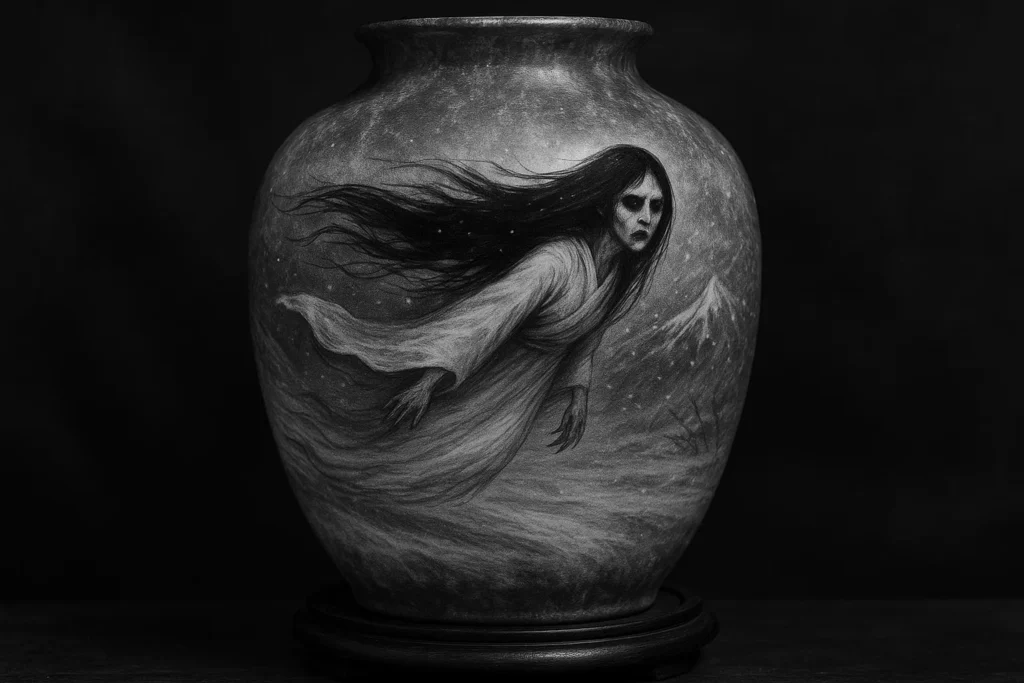
The Yuki Onna has a significant symbolic place in Japanese culture, acting as the ultimate personification of the dangerous and fatal beauty of nature. She embodies the lethal indifference of winter, demonstrating that while the snow-covered environment can be breathtakingly pure and beautiful, it is also a relentless killer that shows no compassion for human life.
Her appearance also represents a profound duality through the color White (shiro). This color is culturally associated with both sacred purity (often seen in Shinto contexts) and death/mourning (as white robes are traditionally worn at funerals).
The Yuki Onna perfectly blends these concepts: a creature of ethereal, pure beauty that brings swift, cold death. This duality is central to the horror she inspires.
Finally, her legends, especially the Minokichi narrative, explore the consequences of broken vows and the dangers of miscegenation between the human and supernatural worlds. She is a cultural artifact that stresses the importance of keeping one’s word and respecting the clear, albeit thin, boundaries between the natural, human, and spiritual domains.
You may also enjoy:
Lamashtu, the Mesopotamian Demoness of Childbirth and Infant Death
November 4, 2025
Who Is Al-Abyad? The White King Jinn Who Rules Love and Chaos
January 26, 2026
Andrealphus: The Peacock Demon Who Twists Minds and Bodies
January 19, 2026
Ammit: Devourer of the Dead in Ancient Egyptian Mythology
November 10, 2025
Palden Lhamo: The Black Goddess of Blood and Protection
October 20, 2025
Frequently Asked Questions
What does the Yuki Onna do?
The Yuki Onna is a dangerous yōkai that preys on human travelers caught in snowstorms. She typically lures them with her beauty or appears in isolated homes, then drains their life force (ki) using her icy breath or touch, freezing them instantly and leaving a perfect, frozen corpse.
Is Yuki Onna good or bad?
The Yuki Onna is overwhelmingly classified as a malignant or lethal yōkai. While she occasionally shows mercy (often conditional on a sacred vow, as seen in the Minokichi legend), her fundamental nature is that of an elemental spirit who brings death and destruction through cold.
Can Yuki-onna fall in love?
Yes, in several prominent legends (such as the story of Minokichi), the Yuki Onna takes a human husband and raises a family. This often occurs after she makes a solemn promise not to harm the man, suggesting that she is capable of forming deep, albeit conditional, maternal and romantic attachments.
Is Yuki Onna a human?
No, the Yuki Onna is not human. She is classified as a supernatural yōkai (specifically an obake or elemental spirit) who often takes the form of a human woman to deceive or interact with people. Her true form is composed of ice and snow, and she has no feet, gliding silently over the ground.
Can Yuki Onna get pregnant?
Yes, according to the widespread legend of Minokichi and O-Yuki, the Yuki Onna is shown to be capable of bearing children with a human man. She raised ten children in that specific tale, suggesting the yōkai can sustain a human family structure while disguised.
What are Yuki Onna’s powers?
The Yuki Onna has cryokinesis, allowing her to manipulate ice, snow, and blizzards. Her primary lethal power is the ability to drain a person’s life force (ki) via her breath or touch, instantly freezing the victim. She also uses hypnotic beauty and transformation to lure prey.
What is Yuki Onna’s weakness?
The Yuki Onna’s primary weakness is heat and fire. Because her body is composed of snow and ice, intense heat causes her form to dissolve. She is also vulnerable to Shinto protective charms (ofuda) and is constrained by any sacred vow she makes.
Is Yuki Onna a vampire?
No, the Yuki Onna is not a vampire. She does not consume blood or flesh like a classical vampire. She is an elemental yōkai whose method of attack is to absorb the heat or life force (ki) of her victims, instantly freezing them to death.
Where does the Yuki Onna live?
The Yuki Onna primarily inhabits snowy mountains and desolate, rural regions of Japan during the winter, such as the Tōhoku and Niigata prefectures. She thrives in blizzards and near remote mountain passes, where she can isolate human travelers.
What does a Yuki Onna look like?
She appears as a woman of supernatural, ethereal beauty with skin as pale and translucent as snow. She has long, black hair and usually wears a white kimono. Crucially, she has no feet and floats silently over the snow.
