
Ahriman, also called Angra Mainyu, is the main creature of evil in Zoroastrianism. He stands in direct opposition to Ahura Mazda, the God of light and wisdom. In ancient Persian beliefs, Ahriman causes all destruction, death, and moral corruption in both the physical and spiritual worlds.
Ahriman tries to disrupt the world’s order by spreading chaos, disease, and lies (druj). He lives in total darkness and is helped by many demons called daevas. His role is key to the ongoing battle between good and evil in Zoroastrian belief.
Summary
Key Takeaways
| Attribute | Details |
| Names | Ahriman, Angra Mainyu, Anra Mainyu, Ahreman |
| Title | The Destructive Spirit, Lord of Darkness, Prince of Evil |
| Origin | Ancient Persian / Zoroastrian |
| Gender | Male (often depicted as a malevolent masculine force) |
| Genealogy | Co-eternal rival of Ahura Mazda; in Zurvanism, the twin son of Zurvan |
| Role | Cosmic adversary, source of all evil, bringer of death and decay |
| Associated Deity/Figure | Ahura Mazda (Opponent), Mithra, Spenta Mainyu |
| Brings | Death, disease, winter, noxious creatures (khrafstra), sin, and falsehood |
| Weaknesses | The recitation of the Ahuna Vairya prayer, the eventual triumph of light |
| Realm/Domain | Duzakh (Hell), the Abode of Darkness, the North |
| Weapon/Item | The lie (druj), serpents, darkness |
| Symbolism | Absolute evil, chaos, entropy, and the negation of life |
| Sources | The Avesta, Gathas, Bundahishn, Denkard |
Who or What is Ahriman?
Ahriman is the absolute personification of evil in the ancient Iranian tradition. Unlike some mythological figures that possess a mix of traits, Ahriman is characterized by total malevolence. He is not a fallen deity but a primordial force of destruction that chose to do evil. His primary goal is to destroy the Asha (truth/order) of the universe and replace it with Druj (falsehood/chaos).
In the earliest writings, Ahriman was seen as the spiritual opponent of Spenta Mainyu (the Holy Spirit). Later, he became Ahura Mazda’s main enemy. Ahriman is blamed for creating all harmful things, like poisonous snakes, scorpions, winter, and old age. He cannot create life, only things that harm it. In the end, he is fated to be defeated during Frashokereti, the Zoroastrian idea of the world’s final purification.
NAME THEM. BIND THEM. CAST THEM OUT! Limited-Time: Up to 40% OFF!
The ultimate deliverance thesaurus by Apostle John Eckhardt. Hundreds of demonic names & attributes exposed alphabetically – from Jezebel to Python, infirmity to poverty. Hundreds of demons named & defeated Identify → Bind → Cast Out!
The essential weapon for every prayer warrior, intercessor, and deliverance minister. Victory starts with identification.

Ahriman Meaning
The name Ahriman is the Middle Persian development of the Avestan Angra Mainyu. The term Angra is linguistically related to words meaning “destructive,” “evil,” or “hostile.” The word Mainyu translates to “spirit,” “mentality,” or “mind.”
Because of that, the literal meaning is “Destructive Spirit” or “Hostile Mind.” This name reflects his nature as a spirit whose fundamental essence is to oppose and destroy.
The name is the opposite of Spenta Mainyu (the Bounteous or Holy Spirit). In the Sassanid era, the name was shortened to Ahreman in Pahlavi. Zoroastrian scriptures sometimes write his name upside down to show contempt and weaken his power. The meaning of his name highlights that he exists only to oppose the good creation of the supreme God.
How to Pronounce “Ahriman” in English
The name is usually pronounced as AH-ri-man (IPA: /ˈɑːrɪmən/). The first part, ‘Ah,’ sounds like the ‘a’ in ‘father.’ The ‘ri’ is short, like in ‘bit,’ and ‘man’ is pronounced as in the English word ‘man.’ The Avestan form, Angra Mainyu, is pronounced ANG-ra MINE-yoo.
Origins
The idea of Ahriman began in the Proto-Indo-Iranian period, but his role as the main spirit of evil was set by the prophet Zoroaster (Zarathustra) around 1500–1000 BCE. In the Gathas, the oldest part of the Avesta, Zoroaster talks about two ‘Twin Spirits’ who chose between good and evil at the start of time.
During the Sassanid period, the Zurvanite sect, a minority group within Zoroastrianism, introduced a different origin story. Their beliefs about the universe differed a lot from mainstream Zoroastrian ideas.
In this story, Zurvan (Infinite Time) made a sacrifice to have a son. Because of a moment of doubt, two twins were born: Ahura Mazda, who stands for the sacrifice, and Ahriman, who stands for the doubt. Ahriman came out first to try to rule the world for 9,000 years. In mainstream Zoroastrianism, though, Ahriman is just a spirit who chose the path of the ‘Worst Mind.’
Genealogy
Ahriman’s family relationships differ depending on the branch of Zoroastrianism.
| Relationship | Details |
| Parents | None in orthodox tradition; Zurvan (Infinite Time) in Zurvanism |
| Siblings | Ahura Mazda (Twin brother in Zurvanism) |
| Spouse | Jahi (The Whore / Demoness of Lasciviousness) |
| Children | The Daevas (Demons), including Aka Manah, Indra, and Saurva |
Sources
The main sources on Ahriman’s history and nature are Zoroastrian sacred texts, mostly written in Avestan and Middle Persian (Pahlavi).
| Source | Quote |
| Yasna 30.3 (Gathas) | Atã vā mainyū paouruyē yā yēmā xᵛafnā asrvātem manahicā vacahicā šyaothanōicā hayā vahyō akemcā… (Truly there are two primal Spirits, twins renowned to be in conflict. In thought and word and act they are two: the better and the bad.) |
| Yasna 45.2 (Gathas) | I will speak of the two spirits of whom, at the beginning of existence, the Holier spoke thus to the Evil One: “Neither our thoughts, nor our teachings, nor our wills, nor our choices, nor our words, nor our deeds, nor our consciences, nor our souls agree.” |
| Bundahishn 1.24 | Ahreman, on account of his backward knowledge, was not aware of the existence of Ohrmazd; then he rose from the abyss, and came to the place of the lights. |
What Does Ahriman Look Like?
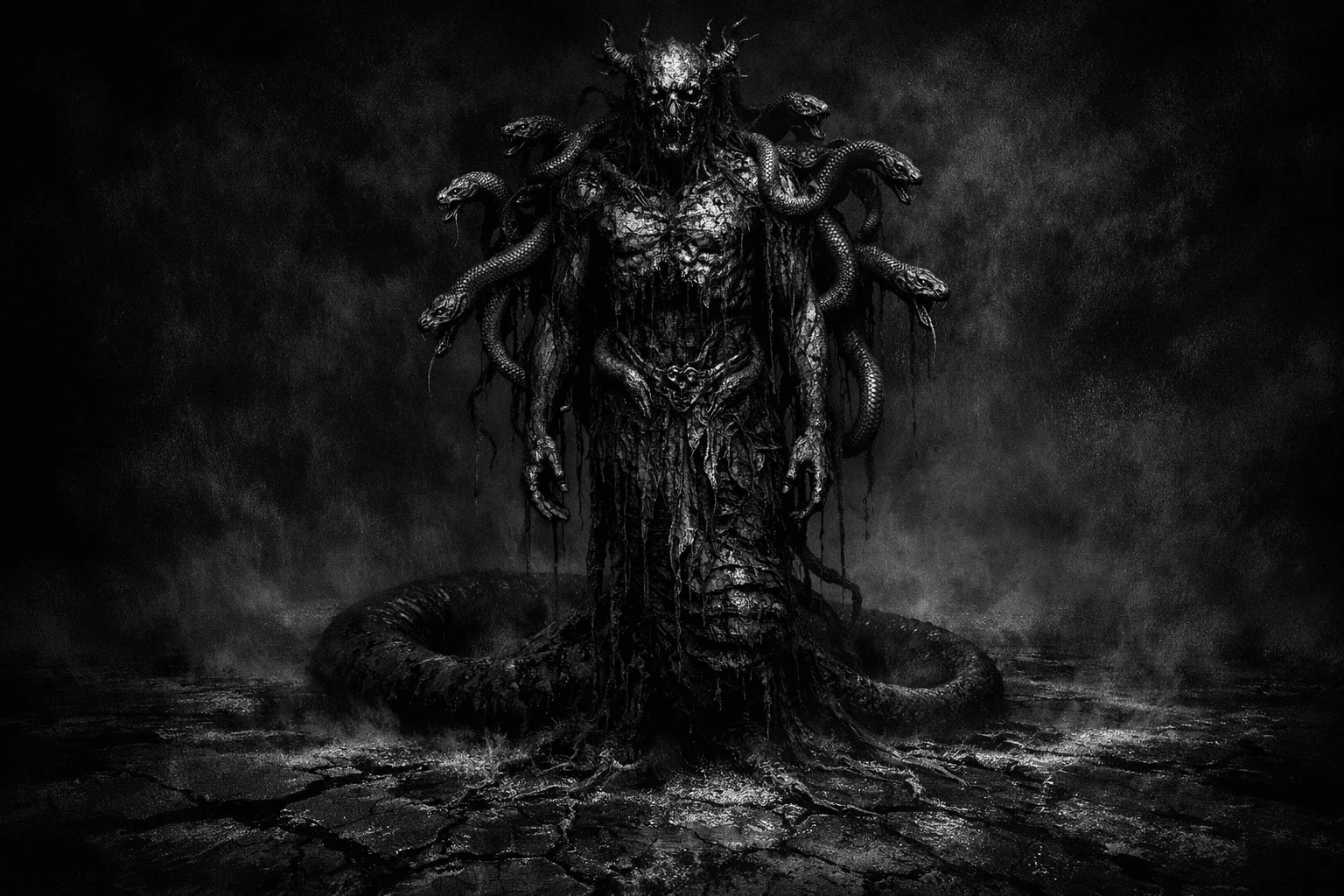
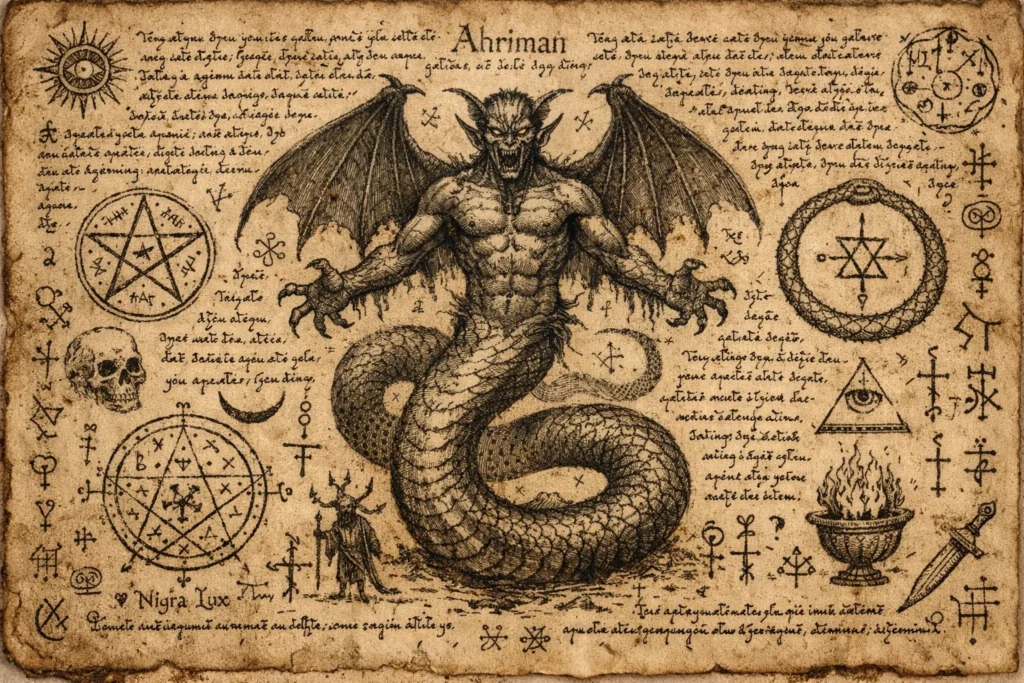
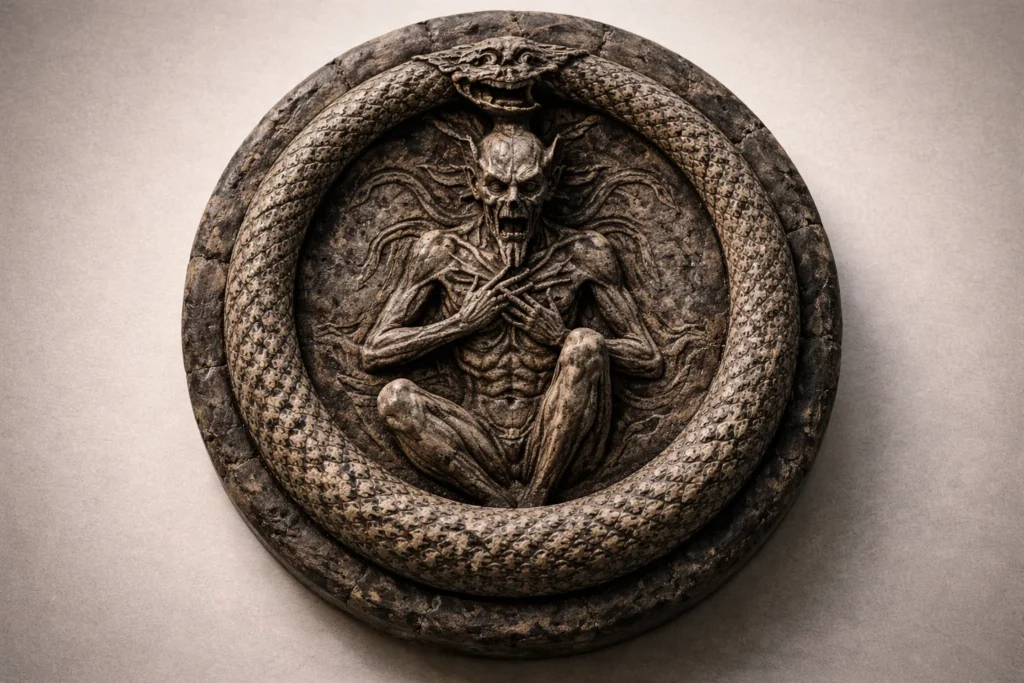
In the oldest texts, Ahriman is described as a spirit without a physical body. Later stories and images, though, give him a form. He is often linked to the shape of a serpent or dragon. The Bundahishn says he jumped into the sky as a snake.
In Sassanid rock carvings like those at Naqsh-e Rostam, Ahriman appears as a human-like entity lying under Ahura Mazda’s horse. In these images, snakes often appear from his shoulders or hair, similar to the later Persian story of Zahhak.
Zahhak is a legendary king in Persian mythology who was tricked by Ahriman. After Ahriman kissed his shoulders, two snakes grew from them. These snakes needed to eat human brains, which became a symbol of tyranny and evil.
Ahriman’s appearance is meant to show filth, decay, and monstrosity. He is said to live in the darkness of the north, and his presence is believed to bring a real smell of corruption and death.
BREAK THE TOUGHEST DEMONIC BONDAGE! Limited-Time: Up to 41% OFF!
Real-life deliverance secrets from Apostle Alexander Chisango – straight from the front lines in Africa. Generational curses • Witchcraft • Sexual bondages • Addiction strongholds. Step-by-step keys that actually work when everything else has failed. Hundreds set free – your breakthrough starts here!

Enemies, Rivals, and Allies
Ahriman’s main enemy is Ahura Mazda, the God of Light. He also faces opposition from the Amesha Spentas (Holy Immortals) and other divine beings known as yazatas, such as Mithra and Sraosha.
Ahriman’s allies are the Daevas, evil spirits he created to fight against the divine beings of light. His main helper is Aka Manah (Evil Mind), who is the opposite of Vohu Manah (Good Mind). He is also connected to Jahi, the demoness who woke him from a long sleep to attack the world of light.
You may also enjoy:
Barbas: The Lion Demon Who Spreads Disease
March 3, 2026
Si’la: The Seductive Jinn Who Lures Travelers to Their Doom
October 9, 2025
Abura-akago: The Oil-Licking Demon Baby
October 22, 2025
Ammit: Devourer of the Dead in Ancient Egyptian Mythology
November 10, 2025
Who Is Baal in Christian Demonology?
February 25, 2026
Aeshma: The Zoroastrian Demon of Wrath and Fury
January 13, 2026
Connections to Other Ancient Demons
| Name | Genealogy | Type | Appearance |
| Apep | Egyptian | Chaos Serpent | Giant snake/serpent |
| Tiamat | Babylonian | Primordial Chaos | Dragon or sea monster |
| Lamashtu | Mesopotamian | Disease Demon | Lion head, donkey teeth, hairy body |
| Surtr | Norse | Fire Giant | Giant with a flaming sword |
| Typhon | Greek | Monster/Giant | Serpent-headed giant |
| Mot | Canaanite | Death Deity | Entity with a gaping throat |
| Pazuzu | Assyrian | Wind Demon | Humanoid with wings and lion face |
| Asmodeus | Persian/Jewish | Demon of Wrath | Three-headed humanoid |
| Mara | Buddhist | Tempter/Demon | Often humanoid or monstrous |
| Chernobog | Slavic | Black God/Evil | Dark, shadowy figure |
Ahriman Myths, Legends, and Stories
The Primal Choice
At the start, there were two spirits: Spenta Mainyu and Angra Mainyu. They were twins and always opposed each other. When they first met, they created both life and non-life.
Spenta Mainyu chose the way of Asha (truth and righteousness), while Angra Mainyu chose the path of the worst thoughts and deeds. This decision set up the universe’s moral foundation, where every being must choose between Mazda’s light and Ahriman’s darkness.
The Attack on Creation
The Bundahishn says Ahura Mazda created the spiritual world first, then the material world, to trap evil. Ahriman saw the light from the abyss and attacked. At first, the Ahuna Vairya prayer stopped him, and he fell back into darkness, where he slept for 3,000 years.
Later, the demoness Jahi woke Ahriman and promised to harm Mazda’s creation. Ahriman jumped into the sky as a snake, bringing darkness. He corrupted the Earth by making harmful creatures like snakes and scorpions. He caused the deaths of the Primeval Ox and the First Man, Gayomard.
UNLOCK THE FORBIDDEN KNOWLEDGE OF DEMONS. Limited-Time: Up to 29% OFF!
The Encyclopedia of Demons & Demonology 400+ entries • Real history • Exorcisms & Ancient Evils • Possession • Terrifying photos. This is Rosemary Ellen Guiley’s masterpiece of the occult.
The Reign of Zahhak
In the Persian epic Shahnameh, Ahriman is a trickster. He visits Prince Zahhak in different disguises. First, he persuades Zahhak to kill his father and take the throne. Later, as a skilled cook, Ahriman gives Zahhak meat (which is a sin) and asks to kiss the king’s shoulders in return.
After the kiss, two black snakes grow from Zahhak’s shoulders. These snakes needed to eat human brains every day, letting Ahriman spread death and fear in the kingdom for a thousand years.
Ahriman Powers and Abilities
Ahriman has great cosmic power, but it is only destructive. He cannot create real life; he can only twist or ruin what already exists. He can make evil versions of Ahura Mazda’s good creations. His influence works through people’s minds, as he is a spirit who tempts and deceives.
- Counter-Creation: The ability to create “bad” versions of Mazda’s creations (e.g., creating winter to counter summer).
- Corruption: The power to instill greed, wrath, and doubt in the hearts of humans.
- Metamorphosis: He can appear as a young man, an old man, a cook, or a serpent.
- Bringer of Death: He introduced mortality and decay into the physical world.
- Darkness Manipulation: He commands absolute darkness and lives in a void devoid of light.
Rituals, Amulets, and Protective Practices
Ancient Persians did not worship Ahriman. Instead, they held rituals to keep him away or lessen his power. Because Ahriman is drawn to filth, dead things, and lies, Zoroastrian practices focus on maintaining physical and spiritual purity.
People practiced ritual washing, called Padyab, to clean themselves before prayers or ceremonies. They also tended fires, since fire symbolized purity and Ahura Mazda’s presence. Keeping their surroundings clean and telling the truth were important for spiritual purity. The main way to protect against Ahriman was to have Good Thoughts, Good Words, and Good Deeds.
Incantations and Ceremonies
The strongest defense against Ahriman is saying the Ahuna Vairya (Yatha Ahu Vairyo) prayer. This prayer was believed to be the weapon Ahura Mazda used to defeat Ahriman at the start of time. Other rituals use sacred fire and haoma (a holy drink) to purify the area and keep away the daevas.
The Ahuna Vairya Prayer:
“yathā ahū vairyō athā ratuš ašāt̰-cīt̰ hacā
vaŋhēuš dazdā manaŋhō šyaothananąm aŋhēuš mazdāi
xšathremcā ahurāi ā yim drigubyō dadat̰ vāstārem”
Translation:
“Just as the Lord is all-powerful, so is the Teacher by reason of his store of Truth and Righteousness.
The gifts of the Good Mind are for those who work for the Lord of Life.
The Strength of Ahura is given to him who helps the poor and the needy.”
Amulets and Talismans
Amulets to protect against Ahriman often depicted the Faravahar (a winged disc symbolizing the soul or divine glory) or images of Mithra slaying a bull. Fire symbols were also common, as fire symbolizes Asha (Truth) and is believed to drive away the darkness of the ‘Destructive Spirit.’
Metal was seen as protective because it was linked to Khshathra Vairya (Desirable Dominion), one of the Holy Immortals.
You may also enjoy:
Empusa: The Blood-Drinking Wraith of Greek Mythology
November 20, 2025
Who Is Taṇhā, the Seductive Demon of Craving in Buddhist Mythology?
October 15, 2025
Who Was Abezethibou, the Fallen Angel Who Opposed Moses?
October 1, 2025
Amenadiel: Origins, Hierarchy, and Demonic Attributes
January 5, 2026
Bali: The Benevolent Asura King of Hindu Mythology
October 10, 2025
Who Was Hiranyaksha, the Golden-Eyed Asura?
October 7, 2025
Frequently Asked Questions (FAQ)
Who is Ahriman in the Bible?
Ahriman is not mentioned by name in the Bible. Still, many researchers say the idea of Ahriman in Zoroastrianism influenced how Satan was later seen in Judeo-Christian traditions. Ahriman is an independent force of evil, while the Biblical Satan is usually a fallen being under God’s control.
Is Ahriman human?
No, Ahriman is not human. He is a spirit (Mainyu) and a cosmic being who existed before the world was made. He can appear as a cook or a young man to trick people. Still, his true nature is spiritual and evil, representing destruction and chaos.
What is the other name for Ahriman?
Ahriman’s other main name is Angra Mainyu. In different periods and texts, he is also called Ahreman, Anra Mainyu, or just the Spirit of Falsehood (Druj).
What are the 16 counter-creations of Ahriman?
The Vendidad says Ahriman made a special plague or evil for each of the sixteen lands created by Ahura Mazda. For example, he sent serpents to Airyana Vaejah, poisonous flies to Sugda, sinful desires to Mouru, and evil magic to Haetumant. Each was meant to make the lands hard to live in or morally bad.
How long is the cosmic battle between Ahura Mazda and Ahriman?
The battle between Ahura Mazda and Ahriman is said to last 12,000 years. The first 3,000 years were for spiritual creation; the next 3,000 were when Ahriman slept; the third 3,000 were a mix of good and evil; and the last 3,000 years will end with Ahriman’s defeat and the world’s purification.
What is the relationship between Ahriman and the planet Mars?
In later Zoroastrian astrology and Pahlavi literature, Ahriman and his daevas were associated with the planets, which were seen as “wandering” and disruptive forces. Ahriman is specifically linked to the planet Mars, representing aggression, war, and bloodshed, standing in opposition to the fixed stars that represent the orderly creation of light.
Who is the demon of death under Ahriman’s command?
Ahriman is the source of all death, but the demon Asto Vidatu (the ‘divider of bodies’) carries out the act of dying. The Avesta says Asto Vidatu puts a noose around the necks of the dying and tries to pull their souls into Ahriman’s darkness.
Does Ahriman have a physical place on Earth?
In Zoroastrian stories, the Alburz Mountains, especially the peak of Arezura, are seen as the ‘Gate of Hell’ where Ahriman and his demons gather. People believed the entrance to the underworld was in the north, so Zoroastrians often avoided facing north during some prayers.
