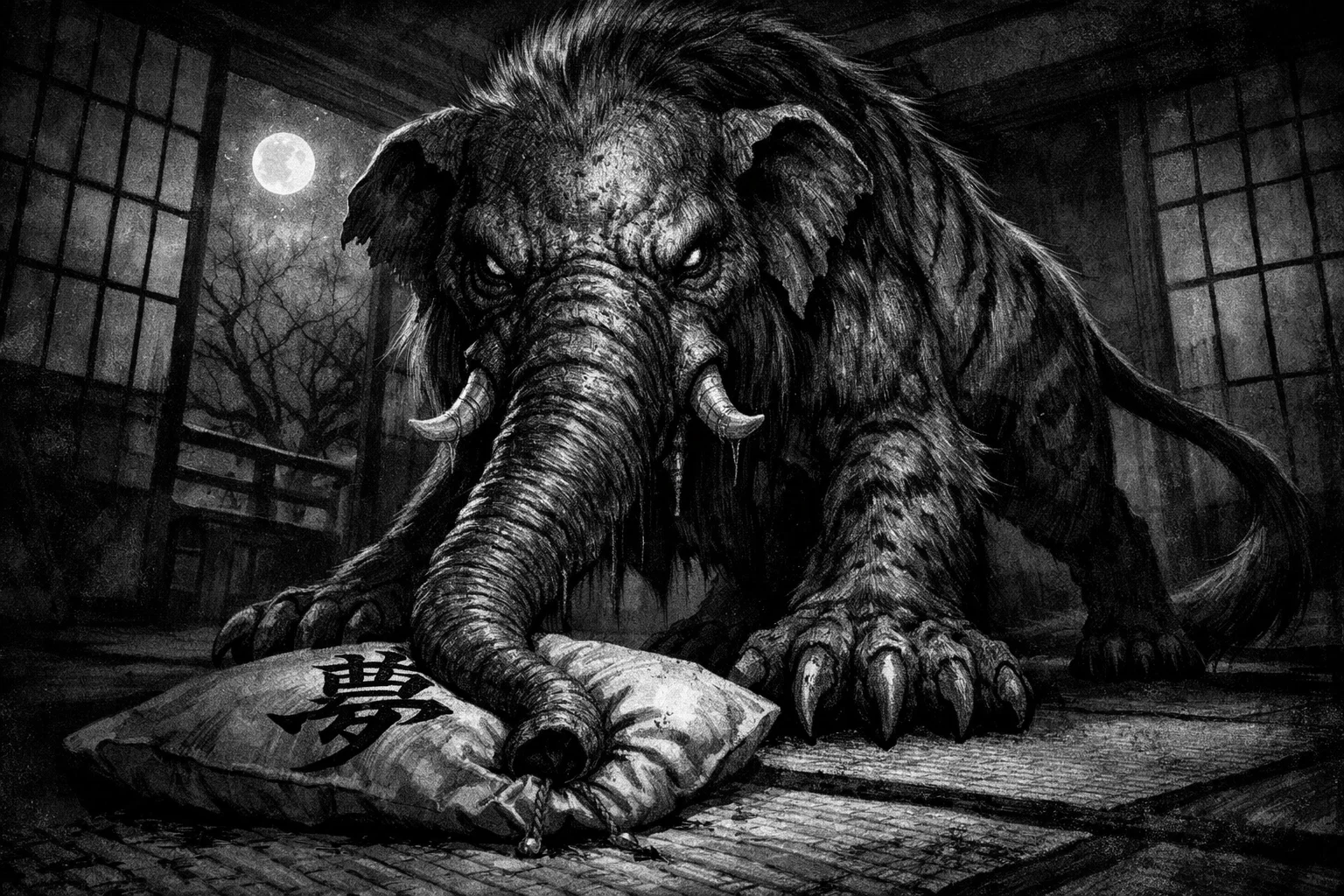

The Baku is a kind of Japanese yōkai known for eating nightmares. It is a mix of different animals, usually shown with an elephant’s trunk, a rhinoceros’s eyes, an ox’s tail, and a tiger’s paws.
In the past, people saw the Baku as a protective spirit. If someone woke up from a scary dream, they could ask the Baku to eat the nightmare so it would not turn into bad luck. The Baku started in Chinese stories but became a big part of Japanese folklore during the Edo period.
Summary
Key Takeaways
| Attribute | Details |
| Names | Baku, Hakutaku (sometimes conflated), Dream Eater |
| Translation | The name translates directly to the animal known as the tapir in modern Japanese. |
| Title | Eater of Dreams, Devourer of Nightmares |
| Type | Chimerical Holy Beast (Seijū) |
| Origin | Chinese mythology; imported to Japan as a protective spirit. |
| Gender | Ambiguous/Unspecified |
| Appearance | Elephant’s trunk, rhinoceros’s eyes, tiger’s paws, and an ox’s tail. |
| Powers/Abilities | Consumption of nightmares and the conversion of bad luck into good fortune. |
| Weaknesses | Over-hunger (may consume hopes and dreams if called too often). |
| Habitat | The spiritual realm; often summoned into domestic bedrooms. |
| Diet/Prey | Human nightmares and bad dreams. |
| Symbolic Item | The kanji for “Baku” or illustrations on pillows. |
| Symbolism | Protection, psychological relief, and the transformation of misfortune. |
| Sources | Sancai Tuhui, Konjaku Hyakki Shūi, Wakan Sansai Zue. |
Who or What is Baku?
The Baku is a supernatural creature seen as a holy beast or chimera, and acts as a spiritual guardian. Unlike yōkai that scare or hurt people, the Baku is wanted because it only eats human nightmares. People believe it lives in the spirit world but comes to help when someone calls for it after a bad dream.
In Japan, the Baku is more than just a monster—it stands for divine protection. During the Edo period, people often depicted the era on talismans and pillows to ward off evil spirits. The Baku is considered lucky and is grouped with other famous creatures, such as the Kirin and the Phoenix. Its main job is to help people avoid lasting harm from bad dreams.
MEET THE MONSTERS THAT HAUNT JAPAN Limited-Time: Up to 28% OFF!
Kappa • Yuki-onna • Tanuki • Kitsune • Hundreds more legendary spirits Hilarious, horrifying, and downright bizarre tales from Japan’s shadow side. Fully illustrated encyclopedia by Thersa Matsuura – your passport to the world of yōkai. Anime origins • Real folklore • Things that go bump in the tatami. Dare you invite them in?
“Baku” Meaning
The word Baku (獏) in Japanese means both the legendary yōkai and the real animal, the tapir. The name comes from Chinese mythology, where the creature first appeared in the Shanhaijing (Classic of Mountains and Seas). The word originally meant something like ‘strike’ or ‘tap,’ but in Japanese stories, it is linked to eating or consuming.
When the Baku legend moved from China to Japan, the name stayed the same, but its traits changed. In China, people valued the Baku for its pelt, which they thought could prevent illness. In Japan, the story became more about dreams and spiritual protection.
The name Baku is used the same way all over Japan. Sometimes it is linked to the Hakutaku, another mythical beast with many eyes, so the two creatures appear together in old art.
How to Pronounce “Baku” in English
In English, Baku is pronounced BAH-koo. The first part, ‘Ba,’ sounds like ‘father’ or ‘basket.’ The second part, ‘ku,’ sounds like ‘koo’ in ‘cool’ or ‘food.’ Both syllables are stressed evenly, just like in Japanese.
What Does the Baku Look Like?
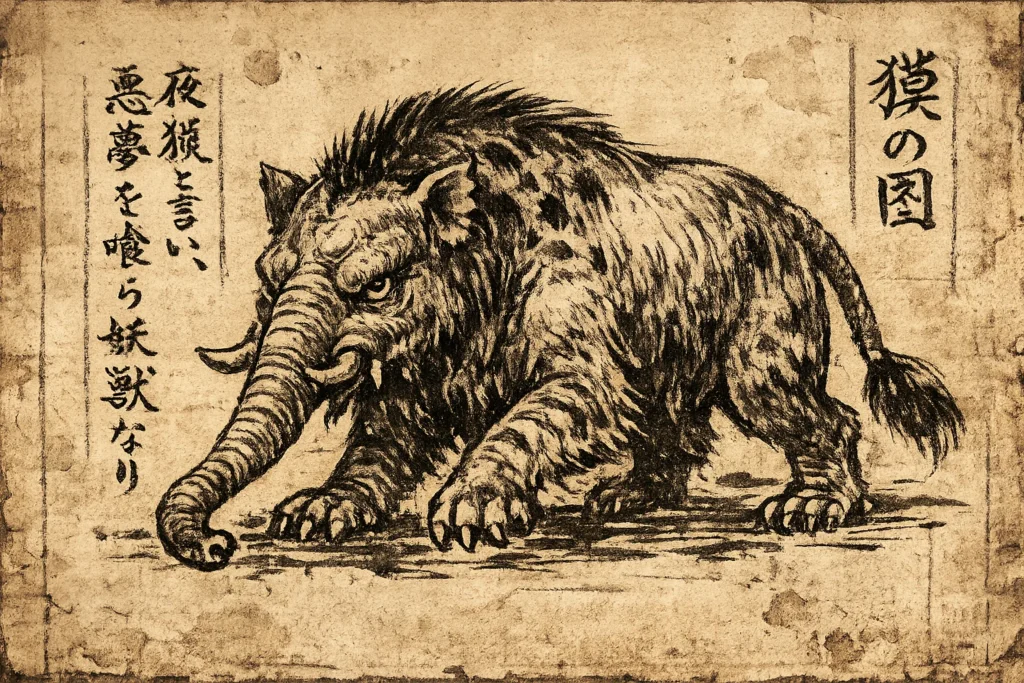
The Baku’s look is very unique, as if it were made from the leftover parts after the gods created other animals. The Wakan Sansai Zue, an encyclopedia from the Edo period, says the Baku has an elephant’s trunk to sniff out and inhale dreams. Its eyes are like a rhinoceros’s, often shown as sharp or watchful.
The Baku is often said to have tiger’s paws, showing its strength and its quiet steps in the dream world. Its tail is like an ox’s, and its fur is usually shown as spotted or rough. In many ukiyo-e prints, including those by Hokusai, the Baku has a thick mane and sharp tusks.
Even though the Baku looks strong and a bit odd, it is not shown as scary. Instead, it is seen as a solid, protective creature. Some stories say its skin is so tough that weapons cannot pierce it, and its urine can dissolve iron or stone.
Habitat
The Baku does not live in a real place, such as a forest or a mountain. Instead, it lives in the dream world or in the space between sleep and waking. Stories say it moves through this spirit world, attracted by the energy from people’s troubled dreams.
At home, people would invite the Baku in. In the past, its home was thought to be the bedroom. People used to keep ‘Baku pillows’ or put pictures of the Baku under their beds.
This made the bedroom a protected space where the Baku could appear. Since it eats dreams, the Baku is never found in the wild or empty places. It is always connected to people and their minds.
Origins and History
The Baku first appeared in Chinese stories during the Tang Dynasty. At first, people thought it protected them from disease. They believed that using a blanket made from Baku fur would keep them safe from sickness and evil spirits. When the story came to Japan, the Baku’s protection became more about the night, a time seen as spiritually risky.
In the Muromachi period (1336–1573), people started putting images of the Baku on deathbeds to help souls pass peacefully, safe from evil spirits. By the Edo period, this belief was very popular. People would write the Baku’s kanji on their pillows or use pillows shaped like the creature. Over time, the Baku changed from a general protector against illness to a special ‘dream eater.’
As time went on, people started to mix up the legendary Baku with the real tapir. Early Japanese travelers saw the Malayan tapir, noticed its trunk-like nose and odd look, and thought it matched the old stories about the Baku.
Sources
Many old Japanese books and encyclopedias from the Edo period mention the Baku.
| Source | Quote |
| Wakan Sansai Zue | The Baku has the trunk of an elephant, the eyes of a rhinoceros, the tail of an ox, and the feet of a tiger. It eats copper and iron, but also devours human dreams. |
| Konjaku Hyakki Shūi | When one has a bad dream, if they call ‘Baku-kura, Baku-kura’ (Baku, come eat), the dream will be consumed and no harm will come. |
You may also enjoy:
Who Is Andromalius and Why Is He the Last Demon of the Goetia?
January 20, 2026
What Is a Bhuta? The Backward-Footed Ghosts of Hindu Horror
February 5, 2026
Empusa: The Blood-Drinking Wraith of Greek Mythology
November 20, 2025
Amdusias in the Ars Goetia: The Demon of Dark Music
December 2, 2025
Lamashtu, the Mesopotamian Demoness of Childbirth and Infant Death
November 4, 2025
Who Is Adrammelech in Demonology and the Bible?
October 1, 2025
Famous Baku Legends and Stories
The Summoning of the Dream Eater
In many old Japanese stories, the main tale about the Baku is how to call it. People believed that if you woke up from a nightmare, especially one that seemed like a bad sign, you should quickly say a special phrase: ‘Baku, kurae!’ (Baku, eat it!).
The legend says the Baku would enter the room and inhale the remnants of the nightmare. One story tells of a young nobleman who dreamed of a huge snake wrapping around his house, which was seen as a sign of coming trouble.
When he woke up, he called for the Baku three times. The Baku appeared as a mist, turned into its beast form, and ate the snake. The next day, the nobleman learned that a rival had left the city, so the dream’s curse was gone.
1,000+ SPIRITS, GODS & GODDESSES AWAITING YOUR CALL. Limited-Time: Up to 49% OFF!
The ultimate global spirit encyclopedia – 2,000+ entries from every culture on Earth. Fairies • Djinn • Demons • Loa • Angels • Deities • Ancestors Real names • True offerings • Ancient rituals that actually work. Judika Illes’ legendary masterwork – the one book every serious witch, mage, and spirit-worker owns.
The Danger of the Hungry Baku
Although the Baku is kind, old stories warn not to call it too often. One tale tells of a man so afraid of anything bad that he called the Baku every night, even for minor problems.
At first, the Baku did its job and ate the man’s small worries. But since that was not enough, the Baku started to eat his hopes, dreams, and happy thoughts too. In the end, the man had no nightmares, but he also lost all motivation, joy, and ambition.
The Baku and the Treasure Ship
In stories about the Seven Lucky Gods, the Baku often helps out. The gods are said to travel on a treasure ship called the Takarabune. At New Year’s, children put a picture of the boat under their pillows to make sure their first dream of the year is a good one.
In many of these pictures, the ship’s sail has the Baku’s kanji on it. The story says the Baku guards the ship, keeping away bad spirits and nightmares so the sleeper’s dreams stay lucky. If a child still has a bad dream, the Baku on the sail is believed to come alive and eat the dream before the child wakes up.
Baku Powers and Abilities
The Baku is seen as a very strong protector. Unlike other yōkai like Kappa or Tanuki, the Baku is much more powerful. It can even change fate by taking away bad omens. Its main power is to purify the spirit and affect the subconscious.
- Nightmare Consumption: The primary ability to physically or spiritually inhale bad dreams, preventing them from manifesting as bad luck.
- Omen Reversal: The power to turn a “bad” dream into a “good” or neutral event through consumption.
- Warding Influence: Its presence or image acts as a barrier against lesser malevolent spirits (mononoke) that cause sleep paralysis or night terrors.
- Metal Consumption: In some older legends, the Baku is said to be able to eat iron and copper, though this is a less common attribute in the dream-eating lore.
How to Defend Against Baku
Since the Baku is kind, people do not need to fight it. Still, there are ways to make sure it does not stay too long or eat more than it should.
The best way to handle a Baku is to call it only after a really scary dream. If you do not often have nightmares, it is better not to keep its image in your bedroom, so the Baku does not become a bother.
Shinto charms called ofuda, which are for household gods, help keep a good balance and make sure only good spirits come into the home. If a Baku has taken too much of someone’s spirit, people traditionally pray at a local shrine to regain their energy.
Baku vs Other Yōkai
| Name | Category | Origin | Threat Level | Escape Difficulty |
| Oni | Oni | Hell/Wicked spirits | High | Difficult; requires force/charms. |
| Kappa | Suijin | Water spirits/nature | Moderate | Moderate; trickery or bowing. |
| Yuki-onna | Yūrei | Death in snowstorms | High | Very Difficult; cold-based. |
| Tanuki | Obake | Animal shapeshifter | Low | Easy; they are pranksters. |
| Tengu | Kami/Yōkai | Mountain ascetics | High | Difficult; requires respect/skill. |
| Rokurokubi | Obake | Human curse | Low | Easy; avoid the head. |
| Gashadokuro | Yūrei | Mass graves | Extreme | Very Difficult; hide or pray. |
| Noppera-bō | Obake | Shapeshifter | Low | Easy; they only want to scare. |
| Jorōgumo | Obake | Spiders reaching 400 years | High | Difficult; avoid silk traps. |
| Nurarihyon | Leader | Unknown/Old age | Minimal | Difficult; he is hard to kick out. |
| Kuchisake-onna | Urban Legend | Mutilated woman | High | Moderate; use hard candy/puns. |
UNLOCK THE FORBIDDEN KNOWLEDGE OF DEMONS. Limited-Time: Up to 29% OFF!
The Encyclopedia of Demons & Demonology 400+ entries • Real history • Exorcisms & Ancient Evils • Possession • Terrifying photos. This is Rosemary Ellen Guiley’s masterpiece of the occult.
Symbolism
| Attribute | Details |
| Element | Air/Spirit (associated with breath and dreams). |
| Animal | Elephant/Tapir. |
| Cardinal Direction | West (associated with the ending of the day and sleep). |
| Color | Multi-colored or White (denoting purity and holiness). |
| Plant | Bamboo (often depicted in backgrounds of Baku art). |
| Season | Winter (when nights are longest and dreams most frequent). |
| Symbolic Item | Baku-makura (Specialized pillows). |
The Baku symbolizes bringing order to the mind and overcoming chaos. In Japan, it shows the idea that night fears can be controlled and calmed with spiritual help. The Baku acts as a safety net, helping people deal with anxiety and trauma.
Artists often show the Baku in netsuke (small carvings) and ukiyo-e prints, as a sign that someone wants a peaceful life. The Baku is special among yōkai because it is known for helping people, unlike many yōkai that stand for disasters or bad behavior. Today, Baku still appears in games and cartoons as a guardian of sleep.
You may also enjoy:
Amenadiel: Origins, Hierarchy, and Demonic Attributes
January 5, 2026
Rokurokubi: The Yokai That Looks Human Until Midnight
February 3, 2026
Who Is Ambolin, the Demon of Nighttime Dread
December 1, 2025
Andrealphus: The Peacock Demon Who Twists Minds and Bodies
January 19, 2026
Amdusias in the Ars Goetia: The Demon of Dark Music
December 2, 2025
Hitotsume kozō: One-Eyed Yōkai of Japanese Folklore
February 4, 2026
Frequently Asked Questions
Are Baku and tapirs the same thing?
Today in Japan, ‘baku’ means both the legendary yōkai and the real Malayan tapir. The myth began in China as a chimera with an elephant’s trunk and a tiger’s paws. Still, the tapir’s long nose and odd shape led early Japanese naturalists to connect it to the legend. Now, pictures of the Baku often look more like a tapir than the old patchwork creature from the Edo period.
Can a Baku be dangerous or evil?
The Baku is usually seen as kind or neutral, but it can become harmful if called too often. Stories say that if a Baku is still hungry after eating a nightmare, it might start eating the person’s hopes, goals, and good memories. This can leave someone feeling empty or unmotivated, so the Baku is only safe when it eats only the bad dreams.
What are Baku talismans, and how are they used?
In the past, Baku talismans (omamori) and amulets were common in homes to help people sleep well. During the Muromachi and Edo periods, people put Baku prints or their kanji (獏) under their pillows, especially on New Year’s Eve, to get a lucky first dream. Today, this tradition lives on with Bakuplush toys and special pillows sold in Japan to help children with night terrors.
How do you officially summon a Baku?
To call a Baku, someone should wake up right after a nightmare and say ‘Baku-san, come eat my dream’ or ‘I give this dream to the Baku’ three times. People believe the Baku will then come into the room and take away the bad dream. If done right, the bad omen is gone and will not cause trouble in real life.
What is Baku’s role in modern pop culture?
Baku is still exerts a strong influence on today’s media and has inspired many famous characters. The Pokémon Drowzee and Hypno are based on the Baku, with their tapir-like noses and ‘Dream Eater’ powers. Other characters, like Musharna and dream-eating types in Digimon and Touhou Project, also come from the old stories about this creature.
