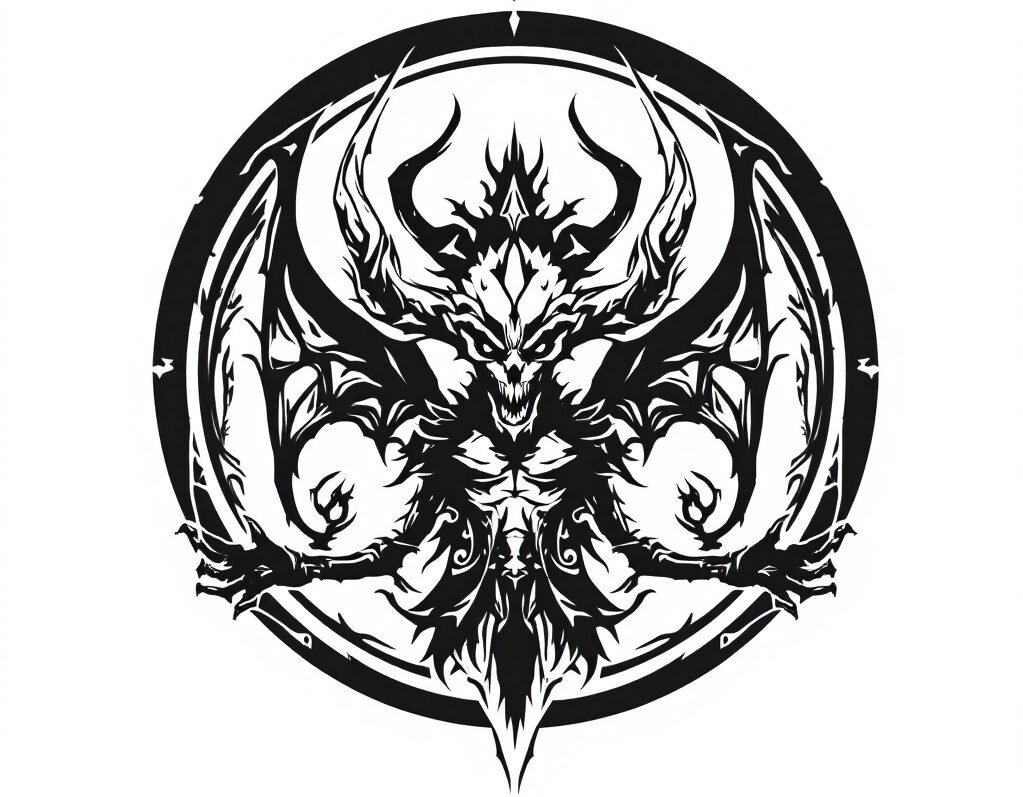

Baal’s story is one of the most remarkable examples of how a powerful Canaanite storm god was turned into a demon. Over time, he went from being a supreme deity to a hoarse-voiced, three-headed king in the underworld.
Modern grimoires often highlight Baal’s power to make people invisible. Still, his real significance is in how the title “Lord” was turned into a negative label, making him a symbol of the ultimate enemy.
This article looks at modern stories about Baal using sources like the Pseudomonarchia Daemonum and the Dictionnaire Infernal to give a well-researched historical overview. [View Full Bibliography ↓]
Summary
Key Takeaways
| Attribute | Details |
| Names | Baal, Bael, Ba’al, Baell |
| Title | First King of Hell, Prince of the East |
| Gender | Male |
| Role | Teacher of invisibility, spreader of idolatry, and corrupter of faith. |
| Rank | King / One of the Seven Princes of Hell |
| Hierarchy | Serves under Lucifer; commands numerous subordinate spirits. |
| Legions | 66 Legions |
| Powers | Grants the power of invisibility and imparts wisdom in science and art. |
| Associated Figures | Beelzebub, Lucifer, Astaroth, Elijah (adversary). |
| Weaknesses | The name of the Tetragrammaton, specific holy seals, and the sign of the cross. |
| Opposing Angel/Saint | The Archangel Raphael or Saint Elijah. |
| Pantheon | Christian (with Canaanite and Phoenician origins). |
| Primary Sources | Ars Goetia, Pseudomonarchia Daemonum, Dictionnaire Infernal, The Bible. |
Who or What is Baal?
Baal is seen as a powerful demon in Christian theology and occult traditions, believed to be a former god who became a fallen spirit. In the Ars Goetia, he is the first of seventy-two spirits said to have been bound by King Solomon.
He is described as a Great King who rules the eastern part of the underworld. In demonology, Baal is known for giving people the power to become invisible and for offering deep, though risky, knowledge.
Baal’s story shows how a pagan god was turned into a demon in Christian tradition. He started as a storm and fertility god in the ancient Canaanite religion. Still, Christian writers later described him as a major prince of darkness.
Baal is often linked to idolatry, since his worship in the Old Testament was the main challenge to worshipping Yahweh alone. He is still an important entity in studies of demonology.
DEMONS ARE REAL — AND THE BIBLE PROVES IT Limited-Time: Up to 20% OFF!
No myths. No exaggeration. Just Scripture. Clinton Arnold’s landmark biblical theology of the powers of darkness. What the Old & New Testaments actually teach about Satan, demons, and spiritual warfare. Essential reading for every pastor, counselor, and believer facing the unseen battle. The book seminaries and deliverance ministries swear by.
Demons are real • Scripture is clear • Victory is yours • Clinton Arnold’s definitive biblical study.
“Baal” Meaning
The name Baal comes from Northwest Semitic languages like Ugaritic, Phoenician, and Hebrew. The word Ba’al means “Owner,” “Master,” “Lord,” or “Husband.” At first, it was not a personal name but a title given to various local gods in the Levant, thought to rule over certain places or natural forces.
In the Hebrew Bible, the word was often used with “the” (hab-Ba’al) to mean the Canaanite storm god, or in the plural (hab-be‘ālîm) to refer to various false idols. As monotheism became stronger, Jewish and later Christian writers used Baal as a negative term for a “false god.”
Over time, the meaning of Baal changed from a title for a god to the name of a powerful demon. In the Ars Goetia, the name is often spelled Bael to set the demon apart from the original God.
How to Pronounce “Baal” in English
In English, Baal is usually pronounced in two ways. Most people say “Bail” (like “mail”), but a more traditional and accurate way is “Bah-ahl,” with two syllables and the stress on the first. Occultists and historians often use the second version, while the first is more common in everyday writing.
You may also enjoy:
What Is the Akkorokamui, Japan’s Colossal Sea Monster?
November 14, 2025
Who Is Andromalius, and Why Is He the Last Demon of the Goetia?
January 20, 2026
Mahakala: The Dark Guardian Who Consumes Evil
October 16, 2025
Gandharva: God, Spirit, or Demon?
November 13, 2025
Al-Ahmar: The Tuesday King of the Seven Jinn
February 13, 2026
Hitotsume kozō: One-Eyed Yōkai of Japanese Folklore
February 4, 2026
What Does Baal Look Like?
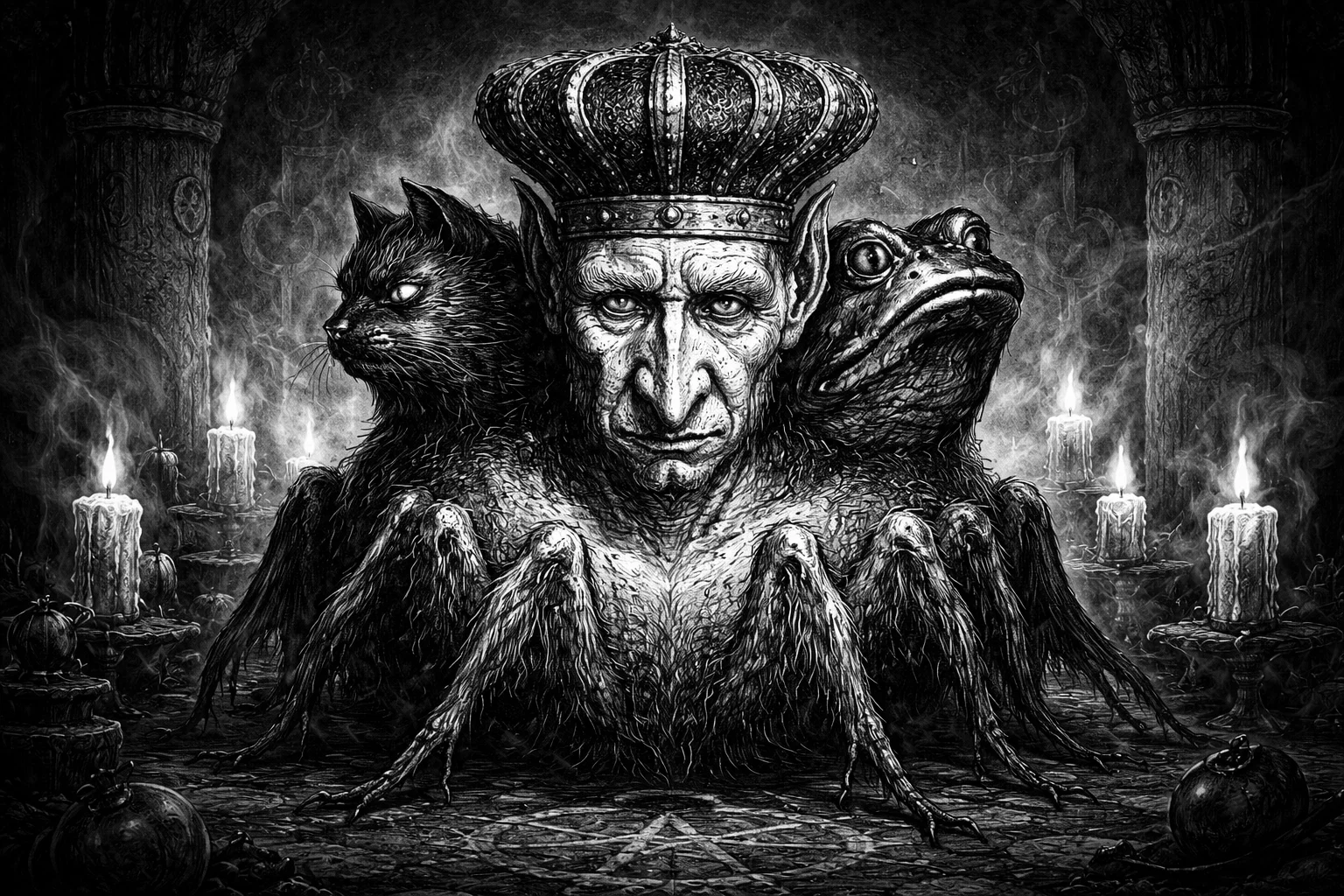
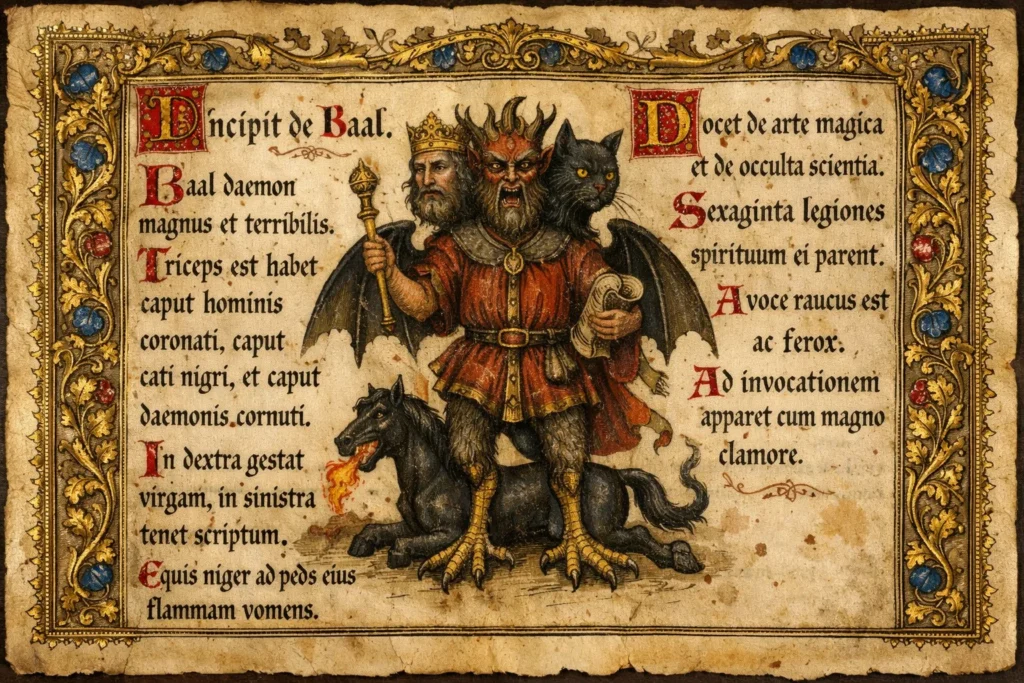
The Pseudomonarchia Daemonum and the Dictionnaire Infernal describe Baal as a shapeshifter with a strange and unsettling appearance. He is best known for having three heads: one of a cat, one of a toad, and one of a man. These heads are either on one set of shoulders or, in some accounts, attached to a body that looks like a spider or has many legs.
Baal’s voice is usually described as hoarse and deep, which makes him even more intimidating. Sometimes he is shown as a man wearing a crown to show his status as a King, but his appearance is always disturbing.
The animal heads have symbolic meanings. The cat stands for stealth and nighttime cleverness, while the toad is linked to witchcraft and the earth. When Baal is shown with a spider-like lower body, his movements are often described as jerky or scuttling.
Origins
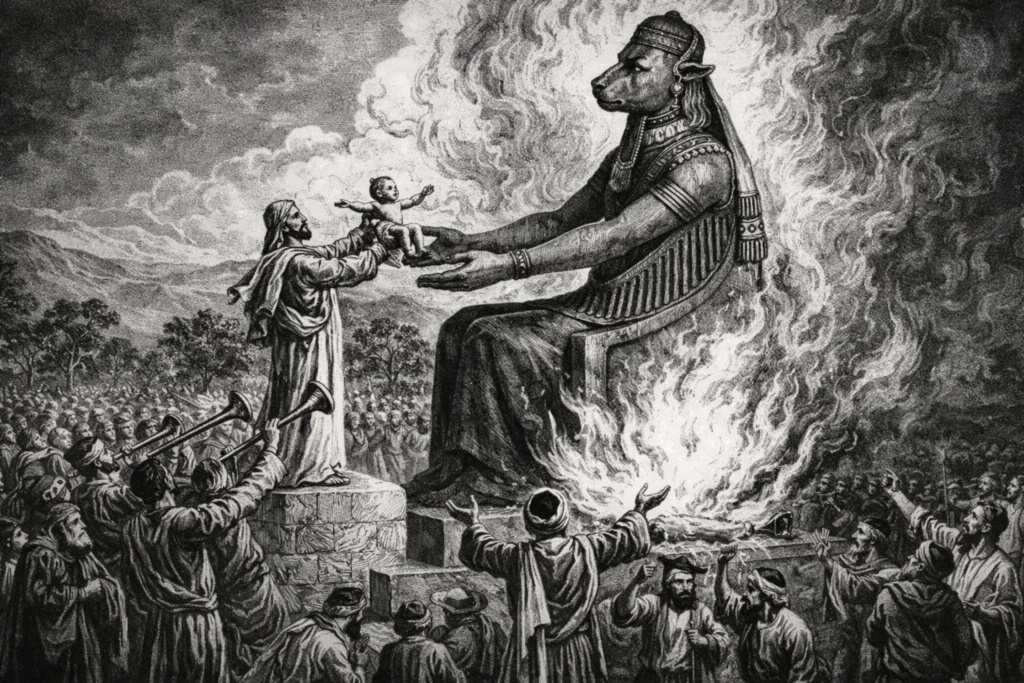
Baal’s history is more than just a name change; it shows how religious ideas can break apart over time. Before he was called the “First King of the East,” Baal was the top God in the Levant.
The word Ba‘al, meaning “Owner,” “Master,” or “Husband” in Northwest Semitic languages, was originally a title, not a personal name, and was primarily used for Hadad, the storm god.
In Ugarit around the 14th century BCE, Baal was the main character in the Baal Cycle, a set of cuneiform tablets that were like the “Old Testament” for the Canaanites. Back then, Baal was seen as a loud and powerful force who kept order in the world, not as the silent or hoarse demon described in later grimoires.
Baal’s main job was to protect the border between the fertile land and chaos. He fought against Yamm, who represented the wild sea, and Mot, who stood for death. These battles were not about good versus evil, but about keeping the world running.
If Baal lost, the rains would stop, and life would fall into chaos. This shows that Baal was originally seen as a preserver, which is quite different from his later image as a destroyer.
Baal started to be seen as a demon during the Iron Age, around 1200 to 600 BCE. As the Israelites focused on worshipping Yahweh alone, they had to deal with the fact that people saw Baal as many local gods, such as Baal-Hermon, Baal-Hazor, and Baal-Peor, each tied to a specific place.
Hebrew writers used a clever strategy called Toponymic Fragmentation. By focusing on the plural form, “Baalim,” they turned Baal from a great king of the heavens into a group of minor local spirits.
This language change turned Baal from a powerful rival into a scattered group of idols. When the medieval Ars Goetia says Baal commands 66 legions, it reflects this old idea of breaking one great God into many smaller parts.
After Alexander the Great’s conquests, the local Baals were seen through Greek and Roman eyes. They were sometimes mixed with gods like Zeus or Jupiter. But it was the change in the name Baal-Zebub that truly marked his fall into demon status.
The God worshipped at Ekron was probably called Baal-Zebul, meaning “Lord of the Prince” or “Lord of the High House.” Hebrew writers changed just one letter to turn it into Baal-Zebub, or “Lord of the Flies,” as a form of mockery.
This was more than just a new nickname; it was a way to change how people saw Baal. Since flies are drawn to decay, calling him “Lord of the Flies” linked him to filth instead of honor. This change marked the end of Baal as a god and the start of his role as a demon, paving the way for later stories that described him as a hoarse-voiced king ruling over fallen spirits.
UNLOCK THE FORBIDDEN KNOWLEDGE OF DEMONS. Limited-Time: Up to 29% OFF!
The Encyclopedia of Demons & Demonology 400+ entries • Real history • Exorcisms & Ancient Evils • Possession • Terrifying photos. This is Rosemary Ellen Guiley’s masterpiece of the occult.
The Weaponization of “Lordship”
Baal’s change from a top West Semitic storm god to the first King in the Ars Goetia was not just a natural shift in myth, but a deliberate reversal of his role. In Ugaritic stories, Baal (Hadad) was the Prince of Earth, bringing the rains that kept the world in balance.
By the time the Lesser Key of Solomon was written, the “Lord of the Heavens” had become a spirit known for hiding things, giving up his control over the skies for the power to make people invisible.
This change from open power to hidden influence reflects the idea of a ruler who has lost authority. The fight between the Israelites and the Baal worshippers was not just about religion but also about the clash between settled farmers who followed Yahweh and the wild, fertility-based practices of the Canaanites.
When medieval books depict Baal with the heads of a toad and a cat, they keep old fears alive. The toad, which lives in mud and rain, is a leftover symbol of Baal’s past as a storm god. Still, it was made to seem ugly by Christian writers who saw nature worship as something low or dirty.
Also, Baal’s role in teaching invisibility is a clever metaphor for how a defeated religion becomes hidden. In demonology, a god who is no longer worshipped doesn’t disappear; instead, he becomes unseen and works from the edges of people’s minds.
The “hoarse voice” mentioned in the Pseudomonarchia Daemonum suggests that Baal has been silent for centuries, a reminder of a god whose name was once called out to bring rain. Studying Baal shows how cultures hide their old gods, turning a once lively entity into a quiet, hidden ruler.
Texts and Grimoires Mentions
Original:
“rbt . ’ilm . l[p]n . l . šm’m . b‘l . wzbl . b‘l . ’arṣ” [The Baal Cycle (Tablet KTU 1.3), c. 1400–1200 BCE]
Translation:
“Great is the god, the mouth of the heavens; Baal is the Prince, the Lord of the Earth.”
In this early West Semitic record, Baal (Hadad) is not a demon but the main character in a cosmic story. The title Zabul (Prince) shows his power over the earth and its fertility. The main conflict here is not good versus evil, but the struggle between order and the chaos of Mot (Death) and Yamm (Sea).
From a religious point of view, this source shows Baal’s original identity, which later monotheistic writers tried to break down. Baal’s main job was to control storms, and his “voice” was the thunder that ended droughts. So, calling him “hoarse-voiced” in later grimoires is an ironic twist on his original powerful roar.
“And it came to pass at noon, that Elijah mocked them, and said, Cry aloud: for he is a god; either he is talking, or he is pursuing, or he is in a journey, or peradventure he sleepeth, and must be awaked.” [1 Kings 18:27 (King James Version/Masoretic Tradition), c. 7th–6th Century BCE]
This Bible story marks the key moment when Baal’s status was lowered. By suggesting Baal might be “sleeping” or “busy,” Hebrew writers changed him from a strong rival into a weak, local idol. This was the first step in turning him from a universal “Lord” into a specific demon.
Elijah’s mocking words introduced the idea of the “False God,” which later became common in medieval demonology. This conflict was not just about religion, but also about politics. Getting rid of Baal worship helped strengthen the worship of Yahweh in Israel, turning Baal’s title into a symbol of betrayal.
Original:
“Bael. primus rex est, sub orientis regione dominans, sexaginta sex legiones habens: Tribus apparet capitibus, humano, batrachi & felino. Loquitur voce rauca, reddit hominem invisibilem & sapientem.” [Johann Weyer, Pseudomonarchia Daemonum, 1577]
Translation:
“Bael is the first King, ruling in the East, having sixty-six legions: He appeareth with three heads, of a man, a toad, and a cat. He speaketh with a hoarse voice, and maketh a man invisible and wise.”
By the 16th century, Baal’s transformation was complete. Johann Weyer described “Bael” as a unique entity in a structured version of Hell. Instead of being a powerful, human-like storm god, Bael now had three heads—a man, a toad, and a cat. The toad and cat, linked to witchcraft and nature, connected the old storm god to the earth and the occult.
Calling Bael the “King of the East” is a leftover reference to his roots in the Levant. His main power, invisibility, is a clever metaphor. In Christian Europe, old gods like Bael were not erased but pushed to the edges of people’s minds. Summoning Bael for invisibility reflects how his worship became hidden and unseen.
Original:
“Baal, grand-duc qui est aux enfers le généralissime des armées, le premier ministre du conseil privé et le chevalier de l’ordre de la Mouche.” [Jacques Auguste Simon Collin de Plancy, Dictionnaire Infernal, 1863]
Translation:
“Baal, Grand Duke who is in hell the generalissimo of the armies, the prime minister of the private council, and the knight of the Order of the Fly.”
In the 19th century, Baal was reimagined in a more modern way, using ideas from Napoleonic military and politics. Collin de Plancy shifted from the scary, spiritual image of Baal in old books to a more organized, bureaucratic demon. Baal became not just a king of spirits, but also a “Generalissimo” and “Prime Minister,” showing the time’s interest in power and secret groups.
Adding the “Order of the Fly” mixes Baal with Beelzebub, or “Lord of the Flies.” This was the last step in Baal’s transformation, as he lost his unique identity and became part of a larger Satanic monster. In the 19th century, people used demonology to make fun of or explain the hidden workings of government and the military.
You may also enjoy:
Demon Alastor: The Grand Executioner of Hell
November 17, 2025
Aim (Aym): The Great Duke of Hell in the Ars Goetia
November 11, 2025
Abadir: The Demon Servant of Chaos and Dispersion
September 30, 2025
Andhaka: The Blind Demon Born From Cosmic Darkness
February 6, 2026
Who Was Hiranyaksha, the Golden-Eyed Asura?
October 7, 2025
Arāti: The Beautiful Demon of Aversion in Buddhist Mythology
October 15, 2025
Powers and Abilities
Baal’s main power is said to be making people invisible. This is described as more than just a visual trick—it lets someone move around without being noticed. In the 17th century, this ability was especially valued for spying or avoiding the law and religious authorities.
Besides invisibility, Baal is also said to give people knowledge and wisdom. However, this knowledge is often called “forbidden” or “dark” because it concerns the workings of the world without regard for right or wrong. As a King, Baal usually acts through his sixty-six legions rather than by himself.
Baal’s legions are believed to influence people’s thoughts, pushing them toward idolatry and away from spiritual truth. His hoarse voice is said to be so commanding that it forces lesser spirits to obey him.
Baal Myths, Legends, and Stories
The Contest on Mount Carmel
The confrontation on Mount Carmel was designed as a terminal trial of power, situated against the backdrop of a three-year drought that had withered the Kingdom of Israel.
The Prophet Elijah summoned 450 prophets of Baal and 400 prophets of Asherah to the mountain’s summit, issuing an unusual ultimatum to the wavering populace: “How long will you waver between two opinions? If the Lord is God, follow him; but if Baal is God, follow him.”
The terms were deceptively simple: two bulls would be prepared on altars of wood, but no fire would be lit. The deity who answered by igniting the sacrifice with fire from the sky would be recognized as the true master of the elements.
From morning until noon, the prophets of Baal invoked their god’s name, crying, “O Baal, answer us!” They performed a ritualistic, limping dance around the altar, their desperation mounting as the sun reached its zenith—the very hour when a sun and storm god should be at his peak power.
When the sky remained a silent, searing blue, Elijah began a psychological assault. He mocked the entity’s absence with biting, humanizing irony, suggesting that Baal might be deep in thought, “busy” (a common euphemism for relieving oneself), or merely traveling or sleeping and requiring a louder awakening.
In response, the prophets entered a frenzy, slashing themselves with swords and spears until their blood flowed, yet the “Lord of the Heavens” remained deaf to their cries.
As evening approached, Elijah signaled the transition from chaos to order. He rebuilt the ruined altar of the Lord using twelve stones—symbolizing the tribes of Israel—and dug a deep trench around it. In an act of supreme confidence, he ordered the sacrifice and the wood to be drenched with four large jars of water three times over, until the trench overflowed.
This was a direct challenge to Baal’s domain; if the God of Israel could ignite water-soaked wood, the victory would be indisputable.
Elijah stepped forward with a simple, calculated prayer, devoid of the frantic theatrics of his rivals. Immediately, a bolt of divine fire descended with such intensity that it consumed not only the bull and the wood but the very stones, the dust, and the water in the trench.
The narrative concludes with a chilling shift in the power dynamic: the once-arrogant prophets of Baal were seized and executed at the Kishon Valley, and the drought—the very thing Baal was supposed to control—was broken not by the storm god, but by a torrential rain sent by the God of Israel.
SPEAK THEIR TRUE NAMES… IF YOU DARE
Limited-Time: Up to 40% OFF!
Over 1,700+ demons – true names, ranks, infernal seals, powers & forbidden histories. The expanded & revised masterpiece by occult legend Michelle Belanger. Now with 200+ new entities, dozens of never-before-seen illustrations from ancient grimoires. The ultimate arsenal for demonologists, magicians, and the deliciously curious.
Baal vs Other Christian Demons
| Demon Name | Associated Sin/Temptation | Rank/Origin | Key Traits/Powers |
| Asmodeus | Lust | King (Ars Goetia) | Breaks marriages, teaches math. |
| Belial | Lawlessness | Prince (Various sources) | Grants senatorships, induces lies. |
| Pazuzu | Famine and Locusts | King (Mesopotamian/Christian) | Brings storms, controls winds. |
| Beelzebub | Gluttony | Prince (Binsfeld) | Lord of the Flies, false god. |
| Mammon | Greed | Prince (Binsfeld) | Obsession with wealth/materialism. |
| Leviatian | Envy | Prince (Binsfeld) | Sea monster, chaos of the deep. |
| Astaroth | Sloth | Grand Duke (Ars Goetia) | Teaches liberal sciences, smells foul. |
| Paimon | False Science | King (Ars Goetia) | Bound to Lucifer, loud voice. |
| Belphegor | Sloth/Discovery | Prince (Kabbalah) | Seduces through inventions. |
| Beherit | Heresy | Duke (Dictionnaire Infernal) | Ancient Syrian origin, scribe. |
| Lucifer | Pride | Emperor (Various) | The Morning Star, King of Hell. |
| Amon | Wrath | Marquis (Ars Goetia) | Reconciles feuds, fire-breathing. |
| Foras | Theft | President (Ars Goetia) | Finds lost things, longevity. |
Rank in the Hierarchy of Hell
Baal has the top spot in the Goetic hierarchy as the First King. He is especially linked to the East, which in occult tradition is the most powerful direction and the place of the rising Sun. As the First King, he commands sixty-six legions, showing his huge influence in the underworld.
In the complex structure of Hell, Baal is often seen as equal to, or even above, other Kings such as Paimon or Asmodeus. Some sources, especially those influenced by the Dictionnaire Infernal, say Baal and Beelzebub are closely connected, and sometimes even treat them as two sides of the same being (Baal-Zebub).
Baal is rarely shown as being under anyone’s authority except Lucifer’s. In the “Seven Princes of Hell” system, he represents the “False God,” serving as a rival to true divinity and a leader among the fallen angels.
Mystical Correspondences
| Attribute | Details |
| Planet | Sun (or occasionally Saturn) |
| Zodiac Sign | Aries (10 to 20 degrees) |
| Element | Fire |
| Direction | East |
| Color | Yellow / Gold |
| Number | 1 (as the first Goetic spirit) |
| Crystal/Mineral | Diamond / Ruby |
| Metal | Gold |
| Herb/Plant | Fern / Sage |
| Animal | Cat / Toad / Spider |
Baal’s links to the Sun and the metal gold show his status as a King. In demonic rituals, the Sun stands for the “false morning,” which is a twisted version of true divine light. Baal is also connected to Aries, the start of the zodiac, which fits his role as the first spirit and his bold, commanding nature. These solar connections highlight his obvious and powerful presence.
Baal’s ties to the element of Fire and the East also point to his power to destroy and transform.
In occult practice, the East usually symbolizes beginnings and the element of air. Still, for Baal, it signifies the burning heat of the rising desert sun, which connects to his Middle Eastern roots. These links help show his high rank in both the physical and spiritual worlds, making him a key entity in the infernal order.
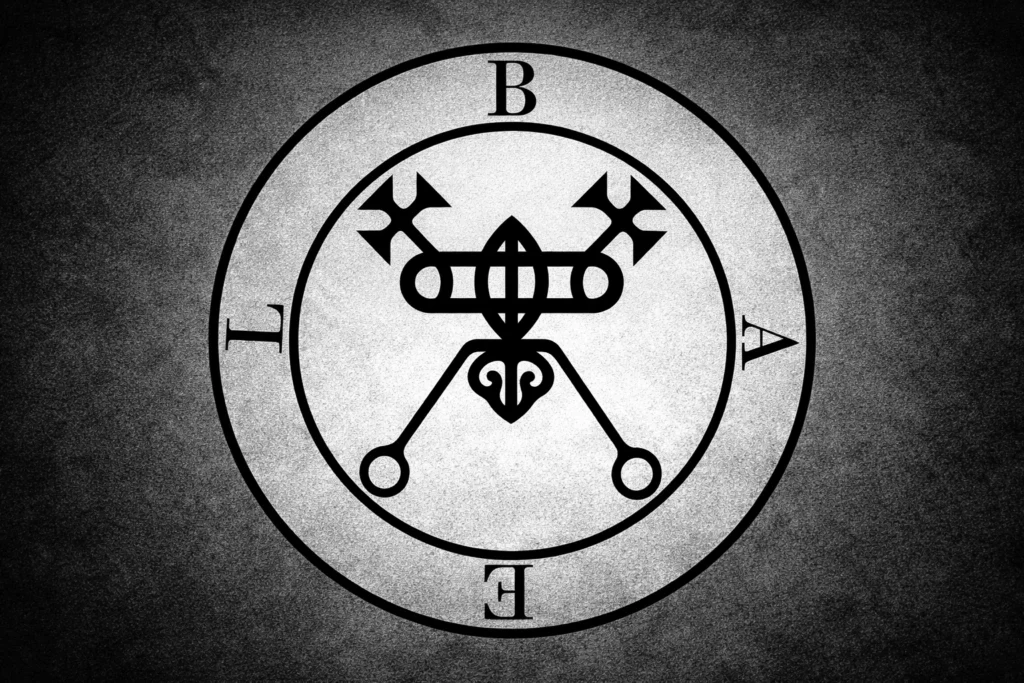
Baal’s Sigil
Baal’s sigil is a detailed geometric symbol from the Lesser Key of Solomon. It has a circular border with intersecting lines and characters. People saw this sigil as a kind of spiritual signature or “phone number” for contacting Baal. Traditionally, it was engraved on a gold Lamen, since gold matches the rank of King.
The sigil gave the practitioner something to focus on and offered protection. People believed that without the sigil, Baal would not show up or could not be controlled. Showing the sigil was like making a contract, letting the summoner command Baal to do things like grant invisibility.
You may also enjoy:
What Is a Tengu? Origins, Powers, and Dark Folklore
January 29, 2026
What Is a Qareen and Why Does It Follow Every Human Being?
October 8, 2025
Erinyes: The Chthonic Goddesses Who Enforced Blood-Guilt
November 20, 2025
Rokurokubi: The Yokai That Looks Human Until Midnight
February 3, 2026
What Is a Pishacha, the Flesh-Eating Demon of the Dead?
February 11, 2026
Bibliography
Author’s Note: Looking at these sources, I noticed a big difference between the lively Baal in the Ugaritic tablets and the “hoarse-voiced” king in Weyer’s Pseudomonarchia Daemonum. Over time, Baal’s powerful image was turned upside down, changing him from a majestic storm god into a demon known for invisibility. To tell this story, I focused on how Baal’s identity was fragmented in language, rather than simply repeating modern ideas about demons.
- McCown, Chester Charlton, editor. The Testament of Solomon. J. C. Hinrichs’sche Buchhandlung, 1922. Internet Archive. Edited from manuscripts at Mount Athos, Bologna, Holkham Hall, Jerusalem, London, Milan, Paris, and Vienna.
- Solomon, King of Israel (attributed). The Key of Solomon the King (Clavicula Salomonis). Translated and edited by S. Liddell MacGregor Mathers, George Redway, 1889. Internet Archive.
- Weyer, Johann. Pseudomonarchia Daemonum. Edited and translated by Joseph H. Peterson, digital edition, 2000. Twilit Grotto: Esoteric Archives.
- Collin de Plancy, Jacques. Dictionnaire infernal: répertoire universel des êtres, des personnages, des livres, des faits et des choses qui tiennent aux esprits. 6th ed., Henri Plon, 1863. Internet Archive.
- Clymer, R. Swinburne. The Grand Grimoire. The Philosophical Publishing Co., 1910. Internet Archive.
- U., Cassuto. Baal and Mot in the Ugaritic Texts. Israel Exploration Journal, Vol. 12, No. 2 (1962). JSTOR.
