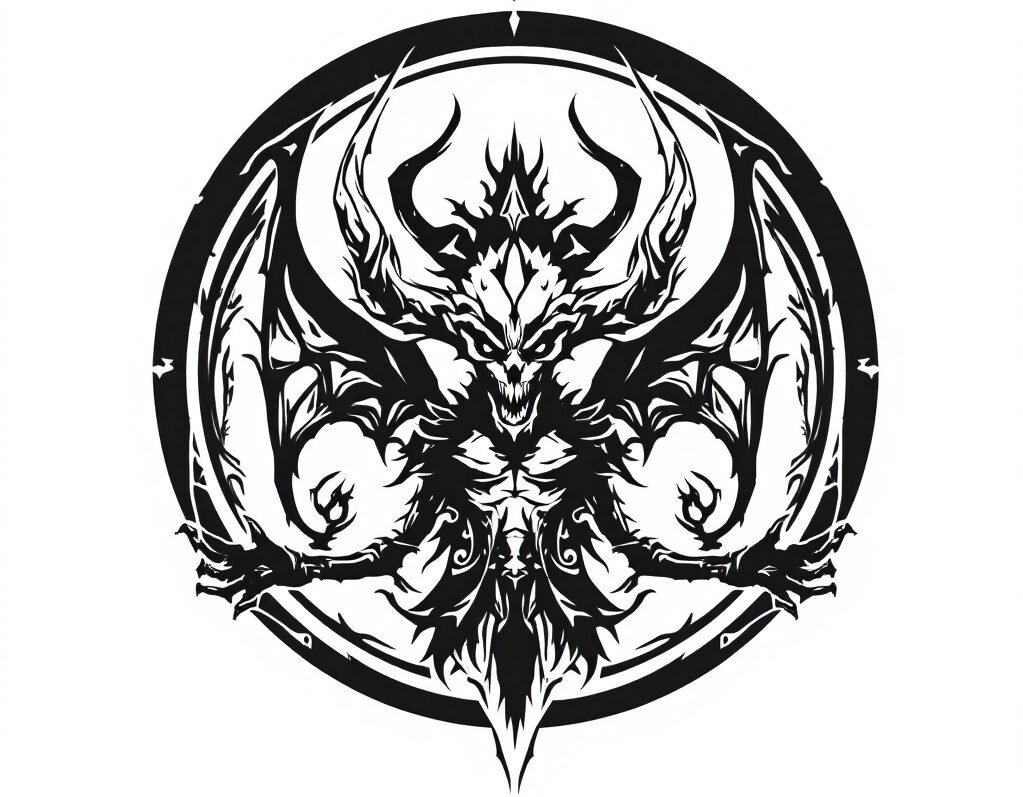

Many grimoires portray Asmodeus as merely a symbol of carnal excess. However, I believe he is actually a more complex entity that connects ancient Persian dualism with the Renaissance’s organized hierarchies.
Known as the “Demon of the Wounding Spear,” he began as a Zoroastrian spirit of pure fury and later became a scholarly King of Hell. He symbolises both disrupting domestic order and mastering higher mathematics and the liberal arts.
This article compares the Book of Tobit with the later medieval system in the Ars Goetia to show the differences between the original Persian roots and the changing hierarchies of European demonology. [View Full Bibliography ↓]
Summary
Key Takeaways
| Attribute | Details |
| Names | Asmodeus, Ashmedai, Asmoday, Asmodaios, Hasmoday, Chammaday, Sidonay |
| Title | King of Demons, Prince of Lechery, The Destroyer, Superintendent of the Houses of Gambling |
| Gender | Male |
| Role | Tempter of lust, destroyer of marriages, spreader of dissipation, and burner of houses |
| Rank | King (Ars Goetia), Prince of the Fourth Hierarchy (Binsfeld’s Classification) |
| Hierarchy | Serves under Amaymon (in some traditions); commands various lesser spirits |
| Legions | 72 Legions of Inferior Spirits |
| Powers | Induces carnal desire, grants invisibility, teaches geometry and arithmetic, reveals hidden treasures |
| Associated Figures | King Solomon, Sarah (daughter of Raguel), Tobias, Lilith (as consort in later Cabala) |
| Weaknesses | The smell of a burning fish liver and heart (as noted in Tobit), the ring of Solomon |
| Opposing Angel/Saint | Archangel Raphael, Saint John the Baptist |
| Pantheon | Christian and Jewish (with Zoroastrian roots) |
| Primary Sources | The Book of Tobit, The Testament of Solomon, Ars Goetia, Dictionnaire Infernal, Malleus Maleficarum |
Who or What is Asmodeus?
Asmodeus is an ancient and powerful demon found in Persian, Jewish, and Christian traditions. In Christian beliefs, he is seen as a fallen angel, once part of the Seraphim or Thrones before rebelling against Heaven. He is best known as the personification of Lust, one of the Seven Deadly Sins. He is said to lead people into sexual immorality and conflict.
In the Solomonic grimoires, Asmodeus is shown as a clever and dangerous King of Hell. Unlike other spirits that are wild or mindless, he is described as knowledgeable in subjects like mathematics, astronomy, and the arts.
Stories about him often show two sides: he can destroy homes and families, but he also teaches forbidden knowledge to those who dare to call on him.
COMMAND THE 72 DEMONS OF THE ARS GOETIA. Limited-Time: Up to 10% OFF!
The complete Lemegeton – restored from ancient manuscripts. Full seals & rituals • True evocation rites • Ranks & powers of every spirit Ars Goetia • Theurgia-Goetia • Ars Paulina • Almadel • Notoria • The ultimate grimoire of Solomon.
The most accurate, beautiful edition ever published (Skinner & Rankine). Every serious magician owns this. Do you?
“Asmodeus” Meaning
The name Asmodeus comes from the Avestan language of ancient Persia. It is based on the term Aēšma-daēva. In this language, aēšma means “wrath” or “fury,” and daēva means a “demon” or a harmful spirit.
So, the name Asmodeus literally means “Demon of Wrath.” When this entity became part of Jewish tradition, the name changed to Ashmedai. Some Hebrew scholars suggested it might also come from the word shamad, which means “to destroy.” This fits his role in the Book of Tobit, where he is a force to be reckoned with. In Greek texts like the Septuagint, his name appears as Asmodaios.
During the Middle Ages and the Renaissance, his name was spelled differently in various Latin and local texts. The Ars Goetia calls him Asmoday, and the Dictionnaire Infernal uses Asmodée.
Even with these changes, he is still connected to destruction, fury, and obsession. Over time, he went from being a general spirit of wrath to a specific prince of lust, showing how ideas about demons changed through the centuries.
How to Pronounce “Asmodeus” in English
In English, the name is usually pronounced az-mo-DEE-us (/ˌæzməˈdiːəs/). Another common way, especially in academic or church settings, is as-MO-dee-us (/æzˈmoʊdiəs/). Some people say az-mo-DAY-us, which matches the Latin form Asmodaios.
What Does Asmodeus Look Like?
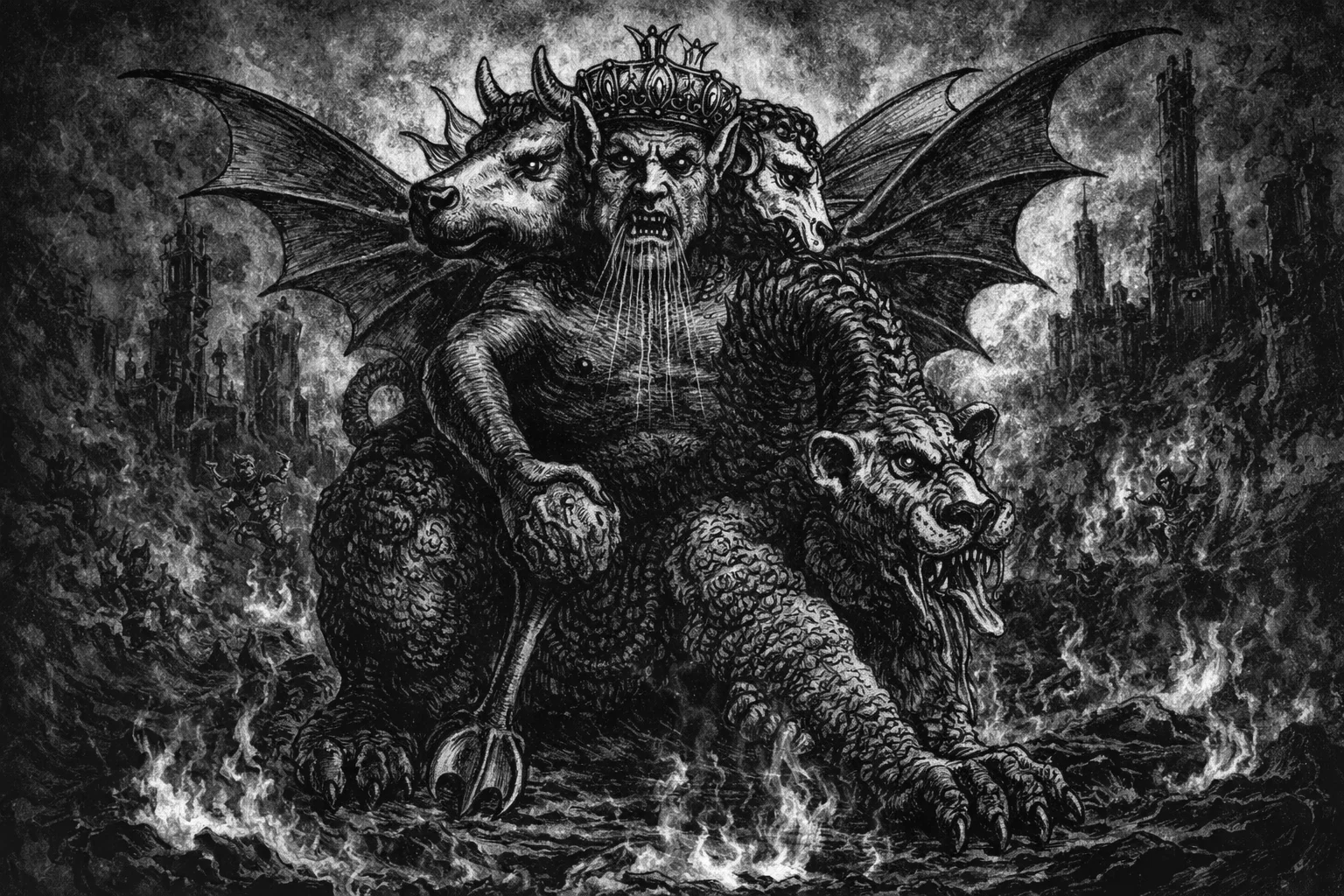
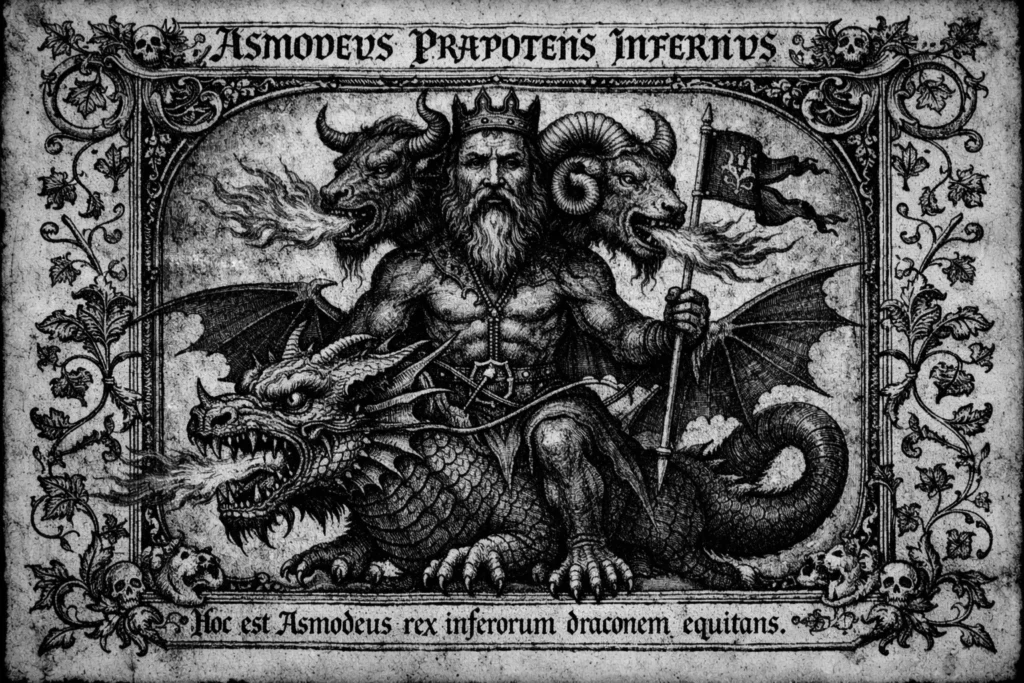
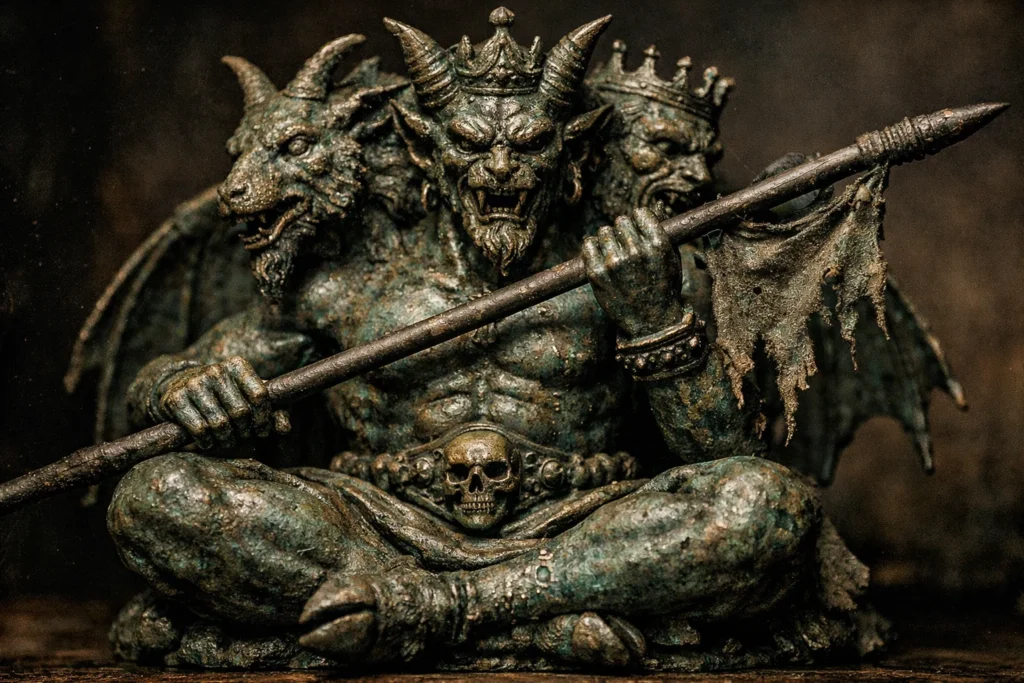
The Ars Goetia and the Dictionnaire Infernal give the clearest descriptions of what Asmodeus looks like. He is said to have three heads: one like a bull, one like a man, and one like a ram. These features stand for strength, intelligence, and stubbornness.
He is also described as having a serpent’s tail and webbed goose feet, which in European folklore are often seen as signs of a demon.
The texts say he breathes fire from his mouth. He is often shown riding a dragon and holding a lance with a banner. In the Testament of Solomon, though, he appears more like a human who tries to stop the King’s workers, but his real angelic form is hidden because he fell from grace.
THE BOOK THEY BANNED FROM THE BIBLE Limited-Time: Up to 90% OFF!
Why was Enoch removed? The fallen Watchers • The birth of the Nephilim • Origin of demons • Names of the angels who became demons • Apocalyptic visions. The original source text that inspired all demonology. Read the apocalyptic visions the church didn’t want you to see.
Historical & Scriptural Records
Original:
“Aēšmō duzhdå hvarish… vazremano̰ tbaēsho̰-taurvå.” [The Avesta: Yasna 57.10, Older Avestan Period]
Translation:
“Aēšma of the evil effects, the wielder of the wounding spear… the overcomer of the foe.”
In the earliest Indo-Iranian myths, Asmodeus is not a single prince but represents the idea of Aēšma, or Wrath. The Avestan texts describe him with the “wounding spear,” which stands for the social and spiritual violence that breaks the cosmic order, called Asha.
Unlike later Western stories that focus on sexual immorality, the original Persian Aēšma mainly opposes Sraosha, the spirit of obedience and discipline.
From a religious perspective, Asmodeus is seen as a force that brings chaos and weakens the mind’s ability to stay focused and orderly. The change from the Avestan Aēšma-daēva to the Hebrew Ashmedai happened during the Babylonian Exile, when the Jewish people met Zoroastrian beliefs and included this “Demon of the Spear” in their own stories as a more personal enemy.
Original:
“…ὁ γὰρ Ἀσμοδαῖος τὸ πονηρὸν δαιμόνιον ἀπέκτεινεν αὐτούς, πρὶν ἢ γενέσθαι αὐτοὺς μετ’ αὐτῆς.” (Greek Septuagint)
Translation:
“…for Asmodeus the evil spirit had killed them, before they had been with her.” [The Book of Tobit 3:8, Codex Sinaiticus translation]
The Book of Tobit marks an important change in Asmodeus’s role. He is no longer just a spirit of “wrath” but becomes a destroyer of homes and families. Instead of fighting on the battlefield, he now causes trouble in the bridal chamber of Ecbatana.
This story shows that Asmodeus can be driven away by certain ritual scents, especially the smoke from a fish’s heart and liver. This detail suggests that his nature had become physical enough to be affected by the real world.
The Greek name Asmodaios connects the Persian origin to the later Latin name Asmodeus. In the Book of Tobit, his role highlights the contrast between the “demon of lust” and the “angel of healing” (Raphael). This theme became central in Christian demonology for centuries.
Original:
“ἐγὼ δὲ εἶπον αὐτῷ· ‘τίς εἶ;’ ὁ δὲ ἔφη· ‘Ἀσμοδαῖος καλοῦμαι παρὰ θνητοῖς, τὸ δὲ ἔργον μου ἐστὶν ἐπιβουλεύειν τοῖς νεονύμφοις…’” (Greek)
Translation:
“I said to him: ‘Who art thou?’ And he said: ‘I am called Asmodeus among mortals, and my business is to plot against the newly wedded, so that they may not know one another.’” [The Testament of Solomon 21-23, Early Christian Era]
The Testament of Solomon is the first text to call Asmodeus a formal “King of Hell.” It also shows that he has two sides: mortals call him Asmodeus, but he says he is from a celestial race. This is the first time we get a detailed magical description of him, but here he is shown as a man with a proud stance, not the three-headed monster seen in later stories.
During this time, Asmodeus changes from a wild spirit into a creature with a set role and duties. He can now be questioned and made to work, such as making clay for Solomon’s Temple. This shows a change in thinking, where demons were seen as fallen beings who kept their rank and could be controlled by using “Divine Names.”
“The 32nd Spirit is Asmoday, a strong and powerful King. He appeareth with three heads, whereof the first is like a Bull, the second like a Man, and the third like a Ram; he hath also the tail of a Serpent, and from his mouth issue Flames of Fire.” [The Lesser Key of Solomon: Ars Goetia, 17th Century (Manuscript Harley 6483)]
The Ars Goetia sets the standard image of Asmodeus. His three heads—a bull, a man, and a ram—are not just for show; they stand for strength and lust, intelligence and cunning, and stubbornness or folly. This is very different from the human-like version in Solomon’s time, showing a shift toward a more monstrous image that became common in Europe after the Middle Ages.
In this text, Asmoday is clearly ranked as a King and is said to command 72 legions. He is also known for teaching geometry, arithmetic, and astronomy. This mix shows how, by the 1600s, people saw both pride in knowledge and carnal desire as connected forms of temptation.
You may also enjoy:
Who Is Ariton (Egyn), the Infernal King of the Eastern Gate?
February 17, 2026
Who Is Barqan, The Powerful Jinn King?
March 12, 2026
What Is a Rakshasa? Meaning, Origins, and Dark Powers
January 23, 2026
Who Is Baal in Christian Demonology?
February 25, 2026
Who Is Shiva, the Destroyer and the Lord of the Universe?
November 12, 2025
Who Is Abalam in Demonology? The Demon King That Serves Paimon
September 30, 2025
Powers and Abilities
Asmodeus has powers that affect both people’s minds and the physical world. His main ability is to control human desire. He doesn’t just cause attraction; he turns it into obsessive lust and cheating, trying to break the bonds of marriage. He does this by confusing people’s judgment and stirring up the “animal” instincts shown by his bull and ram heads.
Asmodeus is also known for his knowledge of the “liberal arts.” He is said to give those who summon him perfect understanding of arithmetic, astronomy, and geometry. He can also show where hidden treasures are, but these are often protected by tricky traps or come with moral risks.
Asmodeus can also grant invisibility. This doesn’t mean becoming physically invisible, but rather making others unable to notice the demon or the person working with him. With 72 legions under his control, he can cause minor problems, such as setting houses on fire or causing trouble in communities.
WHAT SATAN DOES NOT WANT YOU TO KNOW Limited-Time: Up to 30% OFF!
Straight from Rome’s chief exorcist of 30 years – Fr. Gabriele Amorth. Real cases of possession, oppression, and diabolic infestation exposed. How demons attack today • Signs of demonic influence • Weapons that actually work • The terrifying truth the devil fights to keep hidden • Possession • Infestation • True spiritual warfare.
The Architect of Intellectual Hubris
The Ars Goetia focuses on Asmodeus’s role in spreading lust, but looking closer at his skills in arithmetic, astronomy, and geometry shows a deeper worry about knowledge becoming separated from religion.
From the late Middle Ages to the Renaissance, people saw the liberal arts in two ways: as tools to understand God’s creation, but also as a risk because they could lead to independent thinking that ignored the divine.
Asmodeus is seen as the patron of this kind of mistake. By teaching these sciences, he offers a view of the universe that is mechanical and measurable, tying the human mind to the material world with the same logic meant to rise above it.
This kind of temptation is similar to the “Wounding Spear” of Aēšma in Zoroastrian belief. In ancient Persia, Aēšma broke the social and spiritual order with his spear. In medieval texts, Asmodeus uses the “straight lines” of geometry to break apart the soul in a similar way.
It is important to see that Asmodeus’s link to lust is not just about physical desire, but also about turning people into objects. Just as geometry turns complex space into simple points, the lust he controls turns the mystery of a person into something to use or desire. He is the demon of the “calculating gaze,” showing when reason loses empathy and becomes a tool for control.
The story of Asmodeus stealing Solomon’s ring and taking his place is a political lesson about the “Demonic Substitute.” In Rabbinic tradition, Asmodeus ruling Jerusalem without being noticed shows that a kingdom run by strict, lifeless law—without the true spirit of the King—is no different from one ruled by a demon. This connects Asmodeus to the idea of a false copy, or simulacrum.
He stands for the danger of perfect imitation: like a husband who is there in body but not in spirit, or a ruler who keeps the law but loses its true meaning. Asmodeus creates the “hollow structure,” showing that the worst kind of ruin is when the soul is lost, but the outside remains unchanged.
Asmodeus Myths, Legends, and Stories
The Torment of Sarah
In Median capital, Ecbatana, the demon Asmodeus became a localized plague centered on the household of Raguel. His target was Sarah, a woman of noble character whose beauty was overshadowed by a terrifying spiritual attachment. Asmodeus did not merely kill her suitors out of a general malice; he was a jealous “spirit of dissipation” who claimed her as his own, preventing any human union from being consummated.
Seven times, hopeful bridegrooms entered the chamber with Sarah. Each time, before the lanterns could be extinguished, Asmodeus manifested and strangled the men. The tragedy reached a breaking point when Sarah’s own father, Raguel, began digging a grave in the middle of the night for the eighth suitor, Tobias, certain that the young man would meet the same fate as the others.
Sarah herself was so broken by the insults of her father’s maids—who called her a “murderess of husbands”—that she stood by her window for three days, contemplating a leap to her death before choosing to pray for divine intervention instead.
The resolution arrived through the precise application of “sympathetic magic” sanctioned by the Archangel Raphael. Raphael (disguised as the guide Azarias) instructed Tobias to capture a giant fish from the Tigris River. He commanded the youth to carefully extract the heart, liver, and gall.
On the wedding night, as the air in the bridal suite grew heavy with the demon’s presence, Tobias placed the fish’s liver and heart on the glowing embers of the incense burner. The “holy stench” acted as a spiritual repellent so potent that Asmodeus was physically expelled from the room.
The demon fled across the Mediterranean to the “uttermost parts of Upper Egypt,” where Raphael pursued him and bound him in chains of spiritual iron, finally liberating Sarah and the lineage of Tobit.
The King and the Architect
In the Testament of Solomon, the encounter between the King and Asmodeus is a high-stakes interrogation. After Solomon used the Ring of Michael to bind lesser spirits, he demanded they bring him the “King of the Shedim.”
Asmodeus arrived with a roar, described as a being of fierce pride who refused to bow. When Solomon asked for his lineage, Asmodeus revealed a “Watcher” origin: “I was born of a human mother and a fallen angel; therefore, I am of the celestial race but bound to the earthly ruin.”
The dialogue reveals the demon’s specific “MO.” Asmodeus confessed to Solomon: “I plot against the newly wedded, so that they may not know one another. I ruin the beauty of virgins and alienate their hearts… I spread madness and desire, and I am the one who hides the tracks of the adulterer.”
He further revealed that his celestial nemesis was the Archangel Raphael, and that he could be thwarted by the smoke of a “liver of a fish smoked with gall of a she-glid.”
Solomon, unimpressed by the demon’s pedigree, forced him into servitude for the construction of the First Temple. He did not merely make Asmodeus carry stones; he forced him to tread clay with his feet and perform the menial labor of a common slave.
To keep the demon from using his fire-breath to destroy the workers, Solomon hung the keys to the Temple’s inner sanctum above the demon’s head, effectively using the “Weight of the Divine” to pin the entity to the earth.
This story is the ultimate archetype of the Subjugated Shadow, where the most rebellious force of Hell is made the literal foundation of God’s house.
You may also enjoy:
Banasura: The Thousand-Armed Demon King
October 10, 2025
Andrealphus: The Peacock Demon Who Twists Minds and Bodies
January 19, 2026
Bakeneko: A Supernatural Cat Yōkai in Japanese Folklore
January 27, 2026
Who Was Hiranyaksha, the Golden-Eyed Asura?
October 7, 2025
Ammit: Devourer of the Dead in Ancient Egyptian Mythology
November 10, 2025
Hitotsume kozō: One-Eyed Yōkai of Japanese Folklore
February 4, 2026
The Exile of the King
The most detailed account of Asmodeus (Ashmedai) comes from the Babylonian Talmud. Solomon required the Shamir—a creature that could split stone without the use of iron (as no tools of war were allowed to touch the Temple).
Learning that Ashmedai alone knew the location of the Shamir, Solomon sent his chief general, Benaiah ben Jehoiada, equipped with a chain and a ring engraved with the Shem HaMephorash (the Holy Name).
Benaiah found Ashmedai’s well, bored a hole in the bottom to drain the water, and refilled it with wine. When Ashmedai returned from his daily study in the “Academy of the Sky,” he found the wine. Initially quoting scripture to avoid intoxication (“Wine is a mocker”), the demon eventually succumbed to thirst, drank, and fell into a deep sleep.
Benaiah bound him with the Holy Chain. After waking, Ashmedai did not fight; he walked in silence, but his power was evident: he brushed against a palm tree and uprooted it; he leaned against a house, and it toppled.
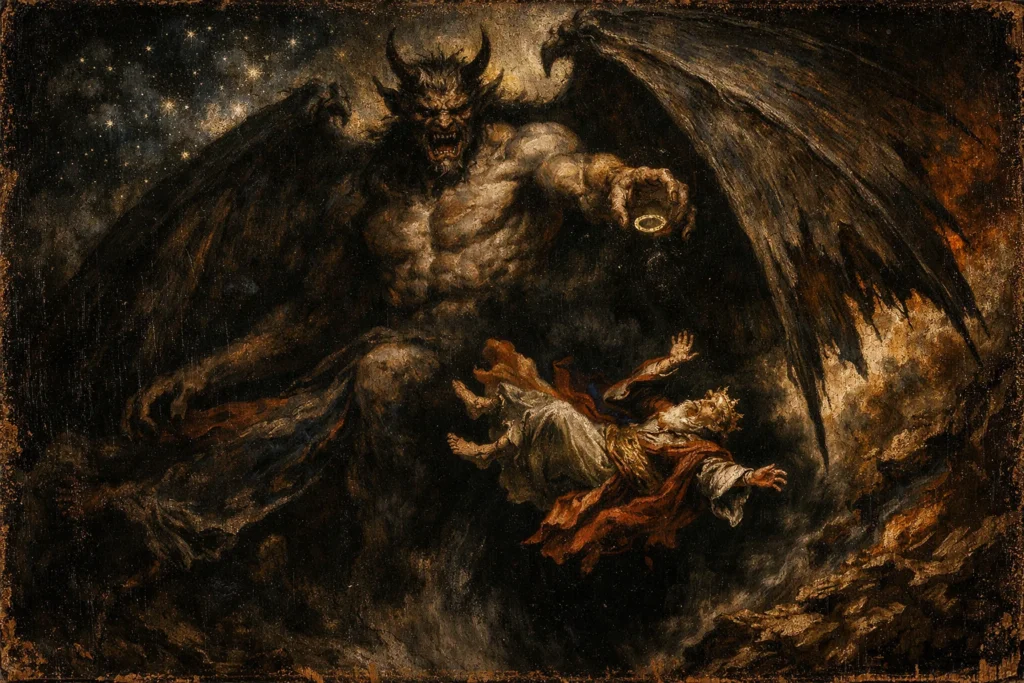
During his years of captivity in Jerusalem, Ashmedai acted as a dark mirror to Solomon’s wisdom. One day, Ashmedai tricked Solomon into removing his protective ring. Instantly, the demon regained his true stature. He swallowed the King’s ring, stood with one wing touching the earth and the other the stars, and hurled Solomon four hundred parasangs away.
While Solomon wandered the earth as a beggar—mocked by people who thought he was a madman for claiming to be the King—Ashmedai assumed Solomon’s form. He sat on the throne, slept with Solomon’s wives, and confused the Sanhedrin with erratic legal rulings. The elders eventually grew suspicious when they noticed the “King” never removed his socks (hiding his webbed “goose feet”).
Solomon eventually recovered his ring from the belly of a fish in a coastal town and returned to Jerusalem. After seeing the true King holding the Seal, Ashmedai let out a shriek and vanished into the void, leaving the throne empty for its rightful occupant.
SPEAK THEIR TRUE NAMES… IF YOU DARE
Limited-Time: Up to 40% OFF!
Over 1,700+ demons – true names, ranks, infernal seals, powers & forbidden histories. The expanded & revised masterpiece by occult legend Michelle Belanger. Now with 200+ new entities, dozens of never-before-seen illustrations from ancient grimoires. The ultimate arsenal for demonologists, magicians, and the deliciously curious.
Asmodeus vs Other Christian Demons
| Demon Name | Associated Sin | Rank/Origin | Key Traits/Powers |
| Lucifer | Pride | Emperor / Fallen Seraph | Command over the hierarchy of Hell |
| Mammon | Greed | Prince / Biblical | Influence over wealth and materialism |
| Beelzebub | Gluttony | Prince / Philistine | Lord of the Flies; spreading of pestilence |
| Leviathan | Envy | Grand Admiral / Biblical | Monstrous sea serpent; gatekeeper of Hell |
| Belphegor | Sloth | Prince / Moabite | Discovery of inventions; inciting laziness |
| Satan | Wrath | Prince / Biblical | Accuser of humanity; personification of evil |
| Astaroth | Laziness/Vanity | Grand Duke / Ars Goetia | Teaches liberal sciences; knows past/future |
| Belial | Lawlessness | Prince / Dead Sea Scrolls | Hostility toward God; grants titles |
| Paimon | Obedience to Evil | King / Ars Goetia | Bound to Lucifer; teaches all arts |
| Bael | Deceit | King / Ars Goetia | Ability to make men invisible |
| Beherit | Blasphemy | Duke / Syrian | Associated with the moon and black magic |
| Moloch | Child Sacrifice | Prince / Canaanite | God of fire and sacrifice |
| Abaddon | Destruction | King / Revelation | Lord of the locust plague |
| Azazel | Corruption | Prince / Book of Enoch | Introduced weapons and cosmetics to man |
Rank in the Hierarchy of Hell
Asmodeus has a top position in the ranks of Hell. In the Binsfeld system, he is one of the seven main princes, just below Lucifer and Beelzebub. He often competes with other demons.
For example, both he and Astaroth are said to be experts in the liberal sciences. Still, Asmodeus is seen as more aggressive and focused on corrupting the body.
In the Lesser Key of Solomon, he is clearly called a King, meaning he only answers to the four Great Kings of the cardinal directions, especially Amaymon, who rules the East.
In later Cabalistic writings, he is often shown with Lilith as his queen or partner, forming an unholy pair that mirrors the holy couple in the Sephirot. Together, they lead the “Other Side” (Sitra Achra), where he commands demons that tempt people away from spiritual purity.
Mystical Correspondences
| Attribute | Details |
| Planet | Sun (in Ars Goetia) or Mars |
| Zodiac Sign | Aquarius |
| Element | Air |
| Direction | East |
| Color | Yellow or Gold |
| Number | 9 |
| Crystal/Mineral | Heliotrope (Bloodstone) |
| Metal | Gold |
| Herb/Plant | Wormwood |
| Animal | Spider or Serpent |
In the Ars Goetia, Asmodeus is often connected to the Sun, showing his rank as a King and the use of gold in rituals. This link to the Sun is seen as a twisted form of divine light, symbolizing intense passion and pride. His zodiac sign is Aquarius, which points to his intelligence and his power to influence people’s minds and groups through the “air.”
His link to the Air element allows him to move freely and whisper tempting thoughts to unsuspecting people. In numerology, the number 9 is often tied to him, symbolizing the end of a cycle or the “completion” of a fall.
These connections make his evil seem more real in the physical world and give people in the past specific times and materials to use when trying to contact his powerful energy.
Asmodeus’s Sigil
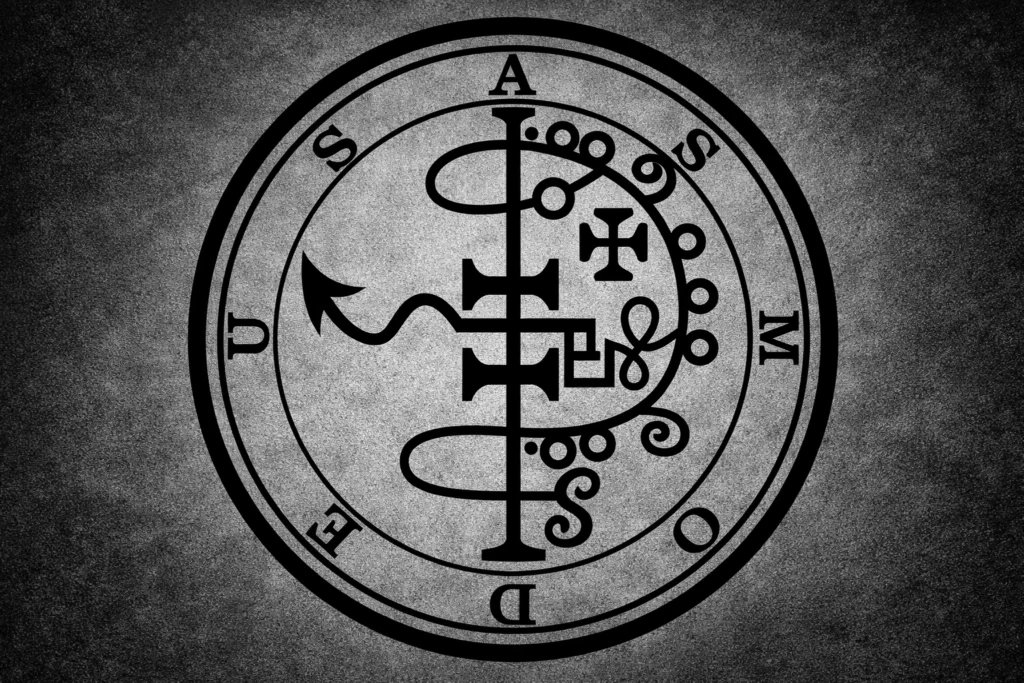
The sigil of Asmodeus is a detailed geometric symbol from the Ars Goetia. It is seen as his spiritual signature. In old occult practices, the sigil was carved onto a “Lamen” (a breastplate or pendant) made of gold to show his royal status.
The sigil is important because people believed it connected the physical world to the demon’s spirit. Without it, a summoner had no control or protection and could be harmed by the demon. The sigil was used to bind and protect, making sure the demon knew the summoner’s purpose.
You may also enjoy:
Erinyes: The Chthonic Goddesses Who Enforced Blood-Guilt
November 20, 2025
Who Is Andromalius, and Why Is He the Last Demon of the Goetia?
January 20, 2026
Akateko: The Bloody Hand Ghost That Guards a Cursed Temple Tree
November 14, 2025
Who Is Astaroth in Demonology and the Ars Goetia?
February 20, 2026
Ammit: Devourer of the Dead in Ancient Egyptian Mythology
November 10, 2025
Bibliography
Author’s Note: Looking at all these sources, I noticed a strong disparity between the organized rankings in the Ars Goetia and the vivid fear shown in the Book of Tobit. It was interesting to see how the “wounding spear” of ancient Persian wrath was transformed by medieval writers into the mastery of the liberal arts in works such as the Steganographia and Pseudomonarchia Daemonum. These texts show how a wild force of nature became a carefully controlled, scholarly King of Hell, reflecting changing worries about the balance between intellect and desire.
- The Book of Tobit. Narrated by various speakers, LibriVox, 2006. Internet Archive. From the King James Version (Authorized).
- Damásdi, Péter. Robert J. Littman. Tobit The Book of Tobit in Codex Sinaiticus (Septuagint Commentary). Academia.edu, 2008.
- McCown, Chester Charlton, editor. The Testament of Solomon. J. C. Hinrichs’sche Buchhandlung, 1922. Internet Archive. Edited from manuscripts at Mount Athos, Bologna, Holkham Hall, Jerusalem, London, Milan, Paris, and Vienna.
- Trithemius, Johannes. Steganographia: Hoc Est: Ars Per Occultam Scripturam Animi Sui Voluntatem Absentibus Aperiendi Casu. Published by Ioannis Alberti, 1608. Internet Archive.
- Trithemius, Johannes. Steganographia (Secret Writing). Translated by Fiona Tait and Christopher Upton, edited by Adam McLean, 1997. Internet Archive.
- Weyer, Johann. Pseudomonarchia Daemonum. Edited and translated by Joseph H. Peterson, digital edition, 2000. Twilit Grotto: Esoteric Archives.
- Institoris, Heinrich, and Jakob Sprenger. The Hammer of Witches (Malleus Maleficarum). Translated by Montague Summers, John Rodker, 1928. Internet Archive.
- De Laurence, L. W. The Lesser Key of Solomon, Goetia. Project Gutenberg, 7 Nov. 2023. Originally published by De Laurence, Scott & Co., 1916.
- Henson, Mitch, and Jeff Wellman, editors. Lemegeton: The Complete Lesser Key of Solomon. Metatron Books, 1999. Internet Archive.
- Solomon, King of Israel (attributed). The Key of Solomon the King (Clavicula Salomonis). Translated and edited by S. Liddell MacGregor Mathers, George Redway, 1889. Internet Archive.
- Clymer, R. Swinburne. The Grand Grimoire. The Philosophical Publishing Co., 1910. Internet Archive.
- Guiley, Rosemary Ellen. The Encyclopedia of Demons and Demonology. Visionary Living, Inc., 2009. Internet Archive.
