
Tengu are supernatural beings from Japanese folklore, seen as both yōkai and minor deities. They are closely tied to Japan’s mountains and are often shown as protectors or residents of sacred forests.
In early stories, Tengu were seen as dangerous, bird-like creatures that brought war and trouble. Over time, they became more complex, sometimes shown as proud martial arts masters or strict protectors of Buddhist law.
Summary
Key Takeaways
| Attribute | Details |
| Names | Tengu, Kotengu, Karasu-tengu, Daitengu, Hanataka-tengu, Konoha-tengu |
| Translation | Heavenly dog |
| Title | Mountain Demon, Goblin, Guardian of the Mountains |
| Type | Kami, Yōkai, Obake |
| Origin | Evolved from Chinese Tiāngǒu; later associated with the ghosts of arrogant priests or mountain spirits. |
| Gender | Predominantly male |
| Appearance | Avian-humanoid with a beak (Karasu-tengu) or a red-faced man with a long nose (Daitengu). |
| Powers/Abilities | Flight, shapeshifting, telepathy, wind manipulation, and mastery of martial arts. |
| Weaknesses | Sacred Buddhist prayers, physical confinement in nets, and vulnerability to their own pride. |
| Habitat | Remote mountains and old-growth forests, specifically Mt. Kurama and Mt. Atago. |
| Diet/Prey | Originally children and arrogant monks; later, they were offered fish or rice by villagers. |
| Symbolic Item | Hauchiwa (feather fan), Shakujō (Buddhist staff), and Tokin (hat). |
| Symbolism | The dangers of spiritual pride (mana), the power of nature, and martial excellence. |
| Sources | Nihon Shoki, Konjaku Monogatari, Taiheiki, Shasekishū. |
Who or What is Tengu?
Tengu are among the most well-known supernatural beings in Japan. They originally came from the Chinese Tiāngǒu, or celestial dog. Still, in Japan, they became winged, human-like spirits of the mountains.
In Japanese folklore, they are seen as somewhere between divinities and demons. They are often called Gedō, meaning ‘outside the path,’ referring to monks who lost their way due to pride or excessive attachment to worldly things.
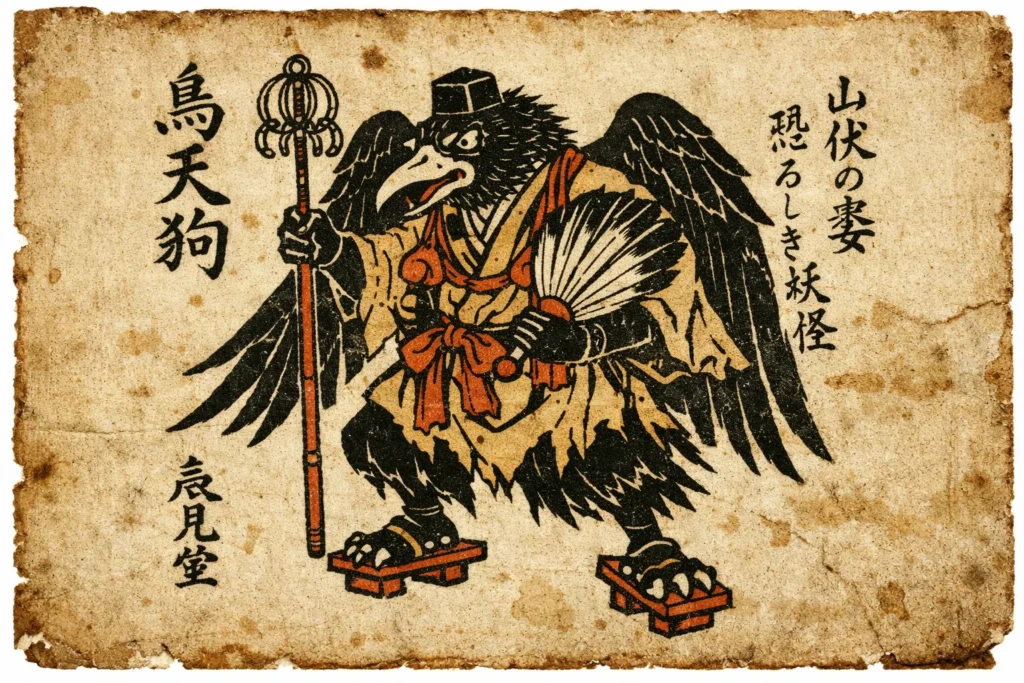
There are two main types of Tengu. The older kind, called Karasu-tengu or crow tengu, have bird-like heads, beaks, and wings. The newer and stronger Daitengu look more human, with red faces and very long noses, which show their arrogance.
Tengu are famous for their skill with weapons and are said to have taught legendary warriors like Minamoto no Yoshitsune how to use a sword.
MEET THE MONSTERS THAT HAUNT JAPAN Limited-Time: Up to 28% OFF!
Kappa • Yuki-onna • Tanuki • Kitsune • Hundreds more legendary spirits Hilarious, horrifying, and downright bizarre tales from Japan’s shadow side. Fully illustrated encyclopedia by Thersa Matsuura – your passport to the world of yōkai. Anime origins • Real folklore • Things that go bump in the tatami. Dare you invite them in?
“Tengu” Meaning
The word Tengu comes from two kanji: 天 (ten), which means ‘heaven’ or ‘celestial,’ and 狗 (gu), which means ‘dog.’ So, Tengu literally means ‘heavenly dog,’ but in Japan, they do not look much like dogs. The name comes from the Chinese Tiāngǒu, a demon that looked like a dog and was said to eat the moon.
In old Japanese books like the Nihon Shoki, Tengu was first used to describe a shooting star that looked and sounded like a barking dog. Later, as the story mixed with local mountain beliefs and the bird-like Garuda from Buddhism, the dog features disappeared. By the Heian period, Tengu meant mountain goblins.
There are different names for Tengu. Kotengu means ‘small tengu’ and refers to the bird-like kind, while Daitengu means ‘great tengu’ and refers to the long-nosed leaders. In some areas, people called them Gehō-sama to show that they were outside regular Buddhist teachings.
How to Pronounce “Tengu” in English
In English, Tengu is pronounced as TEN-goo. ‘TEN’ sounds like ‘pen,’ and ‘goo’ sounds like ‘too.’ The stress is on the first part. In Japanese, the ‘u’ at the end is short and quick, but English speakers often make it longer.
What Does Tengu Look Like?
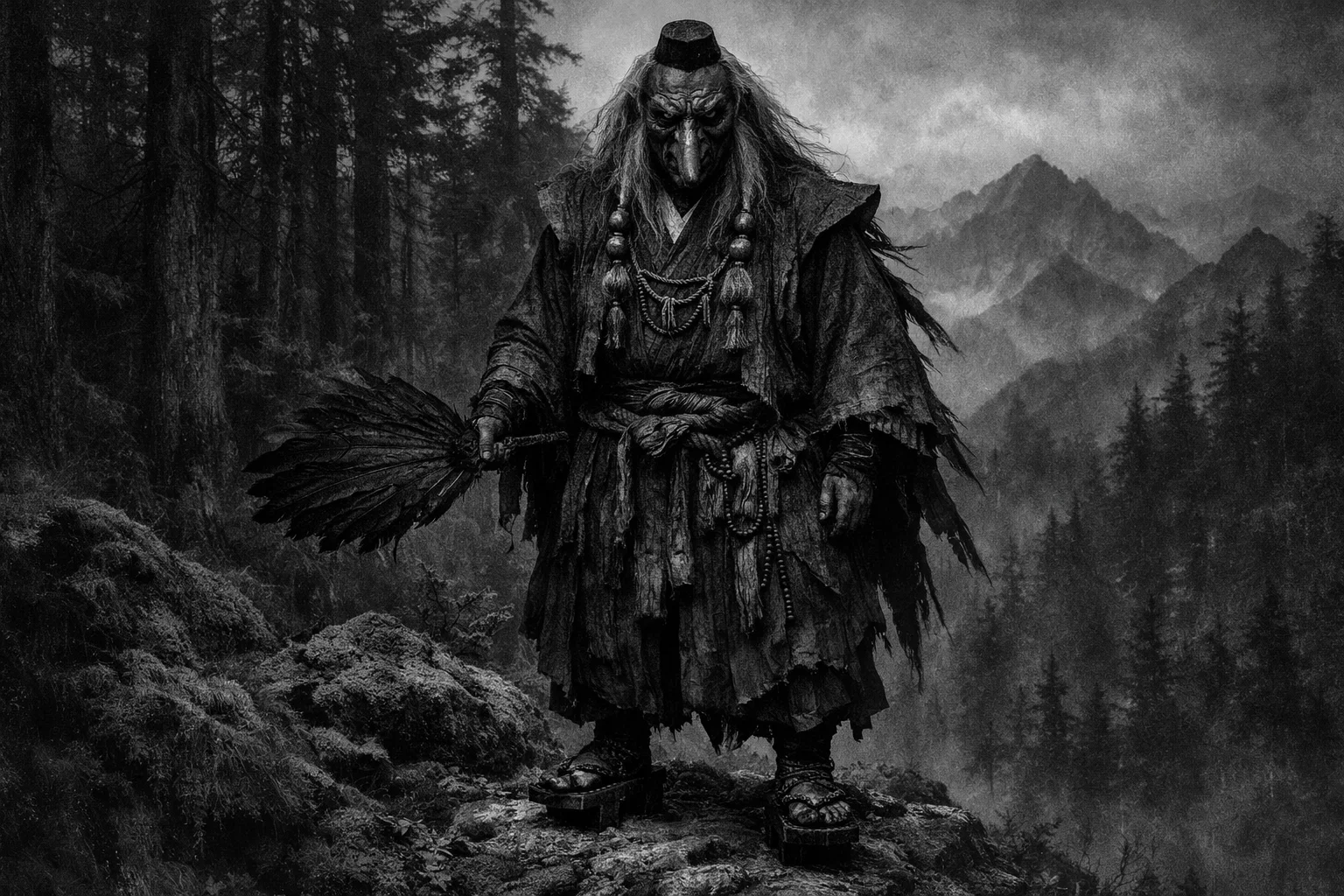
Tengu look different depending on the time period and their rank. Karasu-tengu have the head of a bird of prey, usually a crow or black kite, and a human-shaped body covered in feathers or dressed like a mountain monk (Yamabushi). They have big wings and sharp claws on their hands and feet.
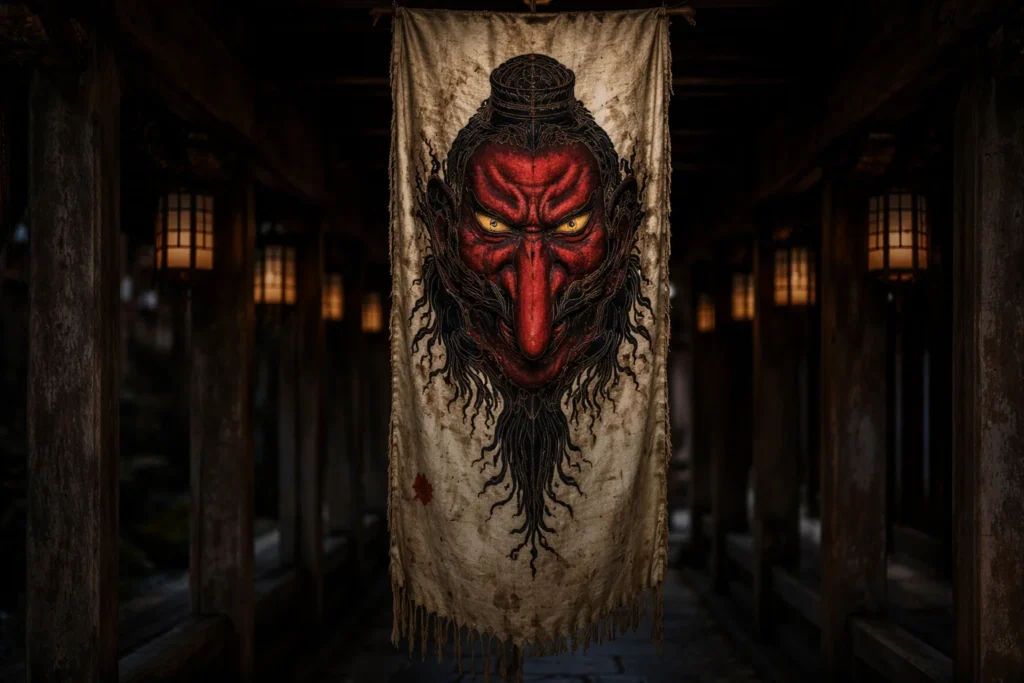
Daitengu look more human but still have supernatural features. Their most noticeable trait is a bright red face and a very long nose, which replaced the beak in art during the 14th century to show their vanity.
They are usually shown wearing mountain monk clothing: a small black hat called a tokin, a vest with pom-poms called a yuigesa, and tall wooden sandals called geta, often with just one central slat (ippon-ba geta).
Both types of Tengu carry special ritual items. The most common is the hauchiwa, a fan made from seven or eleven feathers from a bird of prey or a ginkgo leaf. They might also carry a shakujō, a metal staff with rings that Buddhist monks use to warn small animals so they are not stepped on.
Habitat
Tengu live in the deep, hard-to-reach mountains of Japan, which people have long seen as the border between the human world and the spirit world. They like high mountain peaks with thick old forests, especially those with lots of cedar as well as pine trees.
Some mountains are especially famous for their Tengu lords. Mount Kurama, north of Kyoto, is the most well-known and is said to be home to Sōjōbō, the king of all Tengu. Other important places include Mount Atago, Mount Takao, and Mount Hikosan.
These places are chosen because they are believed to have strong spiritual energy and are centers for Shugendō, a religion focused on mountain training. Tengu are said to live in hidden palaces or simple huts in these mountains, coming out only to bother arrogant priests or to protect the mountain from harm.
1,000+ SPIRITS, GODS & GODDESSES AWAITING YOUR CALL. Limited-Time: Up to 49% OFF!
The ultimate global spirit encyclopedia – 2,000+ entries from every culture on Earth. Fairies • Djinn • Demons • Loa • Angels • Deities • Ancestors Real names • True offerings • Ancient rituals that actually work. Judika Illes’ legendary masterwork – the one book every serious witch, mage, and spirit-worker owns.
Origins and History
Tengu first appeared in Japanese records in the 7th century. At first, they were linked to Chinese omens and shooting stars. By the 9th and 10th centuries, they became known as mountain spirits. In the Heian and Kamakura periods, people saw Tengu as enemies of Buddhism, with stories about them tricking monks, burning temples, and kidnapping children.
By the Edo period, people started to see Tengu differently. They were now viewed as more helpful, though still dangerous, guardians. Tengu also became linked to Yamabushi monks who trained in the mountains.
This change showed a culture shift. Tengu were no longer merely scary demons, but complex spirits who taught lessons and protected nature. Their story is closely tied to the rise of Shugendō, where Tengu were seen as forms of mountain gods called Gongen.
Sources
Tengu are mentioned in many important Japanese books and religious stories.
| Source | Quote |
| Nihon Shoki | “A great star floated from East to West, and there was a noise like thunder… A monk said: ‘It is not a shooting star, it is a Heavenly Dog (Tengu).’ ” |
| Konjaku Monogatari | “The Tengu flew through the sky, took the form of a Buddha, and appeared before the monk to lead him astray.” |
| Taiheiki | “The Tengu of Mt. Atago gathered to discuss the disturbances in the realm and the downfall of the Hojo clan.” |
Famous Tengu Legends and Stories
Sōjōbō and Minamoto no Yoshitsune
The most famous Tengu story is about a young fighter named Ushiwaka-maru, who later became Minamoto no Yoshitsune. After the Taira clan killed his father, he was sent to live at Kurama-dera temple.
Each night, he snuck into the forests of Mount Kurama to practice martial arts. There, he met an old man with a long nose and red face, Sōjōbō, the King of the Tengu. Seeing the boy’s potential and wish for justice, Sōjōbō taught him sword skills, strategy, and supernatural agility.
Because of this training, Yoshitsune became one of Japan’s greatest heroes, able to defeat many enemies with the elegance of a bird.
You may also enjoy:
Who Is Al-Abyad? The White King Jinn Who Rules Love and Chaos
January 26, 2026
Rokurokubi: The Yokai That Looks Human Until Midnight
February 3, 2026
Barbas: The Lion Demon Who Spreads Disease
March 3, 2026
Agubanba: The Ash-Born Demon of Japanese Folklore
October 23, 2025
What Is Akaname, The Filth-Licking Yōkai?
October 28, 2025
Chort: The Sinister Slavic Demon of Chaos and Bad Luck
March 10, 2026
The Tengu’s Deception of the Monk
In the Konjaku Monogatari, there is a story about a Tengu who tried to embarrass a high-ranking Buddhist monk. The Tengu used its magic to make people see a glowing, golden Buddha sitting on top of a tree. Many villagers and lower-ranking monks were tricked and started worshipping the tree.
But a wise priest realized it was a trick and sat nearby, quietly meditating and reciting sacred sutras. The Tengu could not maintain its illusion in the presence of true spiritual purity. Its wings failed, and it fell from the tree in its real, bird-like form, unable to fly away until the prayers stopped.
The Abduction of the Woodcutter
Stories handed down by word of mouth often mention Tengu-tsubute, where stones are thrown by unseen powers in the forest, and Tengu-kakushi, or ‘Tengu kidnapping.’ In one tale, a woodcutter fell asleep in a sacred grove and woke up far away, having been carried through the air by a Tengu.
He stayed confused for days, saying he had visited a beautiful palace in the clouds where spirits held feasts. Stories like this warned villagers to respect the mountains’ borders.
Tengu Powers and Abilities
Tengu are seen as some of the most powerful yōkai, often more versatile than Oni or Kappa. Their strength comes not only from their physical power but also from their magical and martial skills.
- Aerokinesis: They can create powerful gusts of wind or even tornadoes using their hauchiwa.
- Flight: Using their wings, they can journey vast distances at incredible speeds.
- Metamorphosis: They frequently take the form of old men, monks, or even Buddha to deceive humans.
- Martial Mastery: They are the legendary masters of the sword and spear.
- Telepathy: They are said to be able to read human thoughts and communicate without speaking.
- Invisibility: They can mask their presence entirely, making only their footsteps or laughter heard.
How to Defend Against Tengu
To defend against a Tengu, you need both spiritual strength and humility. Because they are often thought to be the ghosts of proud priests, they are very sensitive to Buddhist sutras and Shinto prayers. People say that reciting the Heart Sutra can break their illusions.
Fighting a Tengu usually does not work because they are so fast, but keeping a Shinto charm called an ofuda can stop them from coming into your home. If you have to go into a forest where Tengu live, it is traditional to leave an offering of mackerel or rice and to avoid acting proud, since Tengu like to punish people who boast.
Tengu vs Other Yōkai
| Name | Category | Origin | Threat Level | Escape Difficulty |
| Oni | Oni | Manifestation of evil or transformed human | High | Moderate; can be outsmarted |
| Kappa | Suijin | Water deity/spirit | Moderate | Easy; bow to make them spill water |
| Yuki-onna | Yūrei | Spirit of a woman who died in snow | High | Hard; they freeze victims instantly |
| Kitsune | Obake | Magical fox | Variable | Moderate; requires seeing through illusions |
| Tanuki | Obake | Magical raccoon dog | Low | Easy; they are mostly pranksters |
| Gashadokuro | Yūrei | Bones of the unburied dead | Extreme | Very Hard; massive and indestructible |
| Jorōgumo | Obake | Spider that reached 400 years of age | High | Hard; use of silk traps |
| Rokurokubi | Obake | Humans with a curse | Low | Easy; avoid their reach |
| Nurarihyon | Yōkai | The leader of all yōkai | Moderate | Hard; they are impossible to catch |
| Ittan-momen | Tsukumogami | Spirit of a roll of cotton | Moderate | Moderate; requires a knife to cut |
SPEAK THEIR TRUE NAMES… IF YOU DARE
Limited-Time: Up to 40% OFF!
Over 1,700+ demons – true names, ranks, infernal seals, powers & forbidden histories. The expanded & revised masterpiece by occult legend Michelle Belanger. Now with 200+ new entities, dozens of never-before-seen illustrations from ancient grimoires. The ultimate arsenal for demonologists, magicians, and the deliciously curious.
Symbolism
| Attribute | Details |
| Element | Air |
| Animal | Crow or Black Kite |
| Cardinal Direction | North-West (associated with mountains and heavens) |
| Color | Red (for the face) and Black (for the feathers/robes) |
| Plant | Japanese Cedar (Sugi) or Ginkgo |
| Season | Autumn |
| Symbolic Item | Hauchiwa (feather fan) |
In Japanese culture, Tengu show both the dangers and the mystery of the wild. They stand for the risks of the mountains, like sudden storms, thick mists, and wild animals. Socially, they warn against spiritual pride, called mana. The Daitengu’s long nose is a lasting symbol of the ego that keeps someone from reaching enlightenment.
They also represent the link between fighting skills and spiritual life. In art and theater, like Noh and Kyōgen, Tengu are shown as both scary warriors and clumsy, overconfident fools.
Today, Tengu are still popular at festivals, where people wear Tengu masks to keep away evil spirits and bring a good harvest. This shows how Tengu changed from feared demons to important cultural guardians.
You may also enjoy:
Setcheh: Egypt’s Soul-Stealing Ancient Demon
November 11, 2025
Andhaka: The Blind Demon Born From Cosmic Darkness
February 6, 2026
Ambri: The Imperial Duchess of Caspiel’s Empire
December 1, 2025
Who Is Shiva, the Destroyer and the Lord of the Universe?
November 12, 2025
Who Is Al-Abyad? The White King Jinn Who Rules Love and Chaos
January 26, 2026
Pazuzu: The Demon Who Fought Evil with Evil
November 4, 2025
Frequently Asked Questions About Tengu
What is the connection between Tengu and the Sarutahiko Okami?
In Japanese mythology, Tengu are often conflated with the Shinto god Sarutahiko Okami, who is the god of crossroads. This is because they look very similar, both having red faces andlong noses. Since Sarutahiko helped guide the sun goddess’s grandson to earth, many shrines, like the Tsubaki Grand Shrine, honor Tengu-like figures as symbols of guidance, protection, and the removal of obstacles.
Do Tengu have any specific weaknesses to certain types of wood or metals?
Even though Tengu are masters of the forest, stories say they dislike iron and nets made from hemp. In some legends, hunters and monks used iron-tipped arrows or blessed iron chains to tie up a Tengu’s wings. They are also said to be driven away by the smell of burning hair or the sound of a conch shell, called a horagai, which Yamabushi monks use to show spiritual power.
Are there female Tengu in Japanese folklore?
Traditionally, Tengu are shown as male and are thought to come from the spirits of monks who lost their way. But in some local stories, there are female Tengu, called Nyotengu. These are rare and mostly appear in later Edo-period art or in stories from the Tohoku region. Female Tengu have the same bird-like wings and fighting skills as male Tengu, but are often described as more refined, though just as dangerous.
What is a “Tengu-bi” or Tengu Fire?
Tengu-bi are strange, ghostly lights that float over mountain rivers or deep forests at night. Unlike Kitsunebi, or fox fire, Tengu-bi are big, reddish-orange balls of light that move in a wave-like pattern. Legends say these fires show up when Tengu are moving their homes or doing night rituals. Seeing these lights is a sign that someone has crossed into a sacred spirit area.
How did the Tengu influence the development of Ninjutsu?
In both real and legendary stories, Tengu are said to be the original teachers of Ninjutsu, the art of the ninja. Since Tengu were experts at hiding, surviving in the mountains, and unusual fighting, early ninja groups in Iga and Koga claimed they got scrolls or training from Tengu. That’s why many ninja artworks show Tengu masks or symbols.
