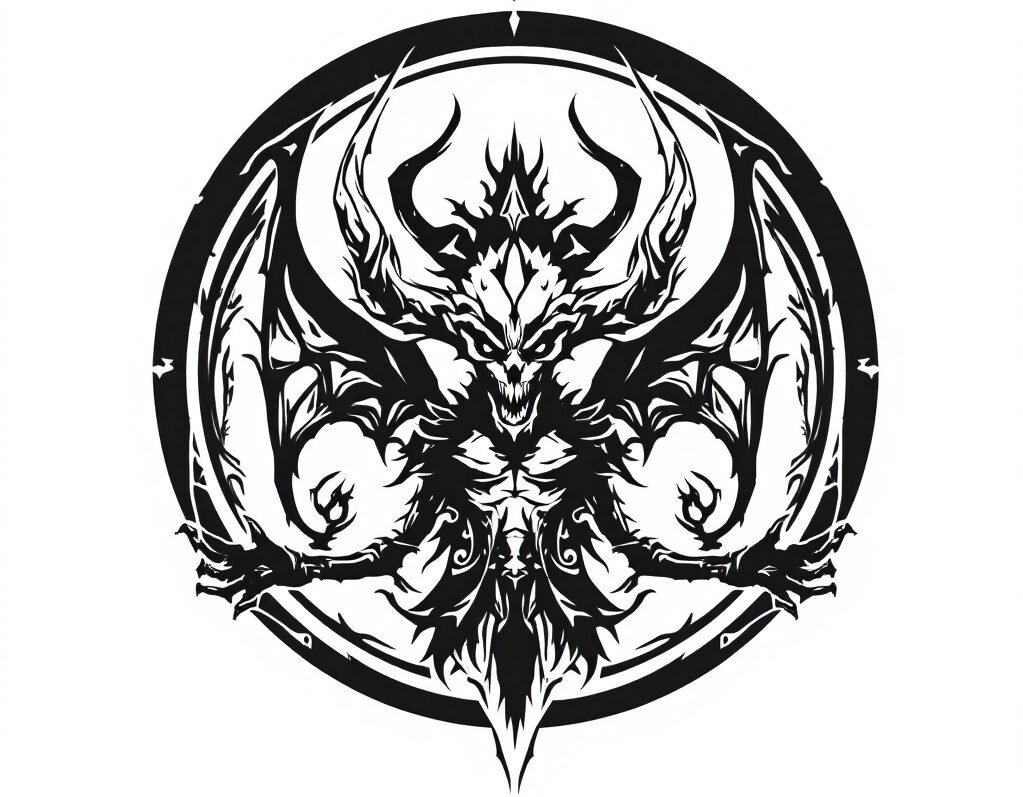
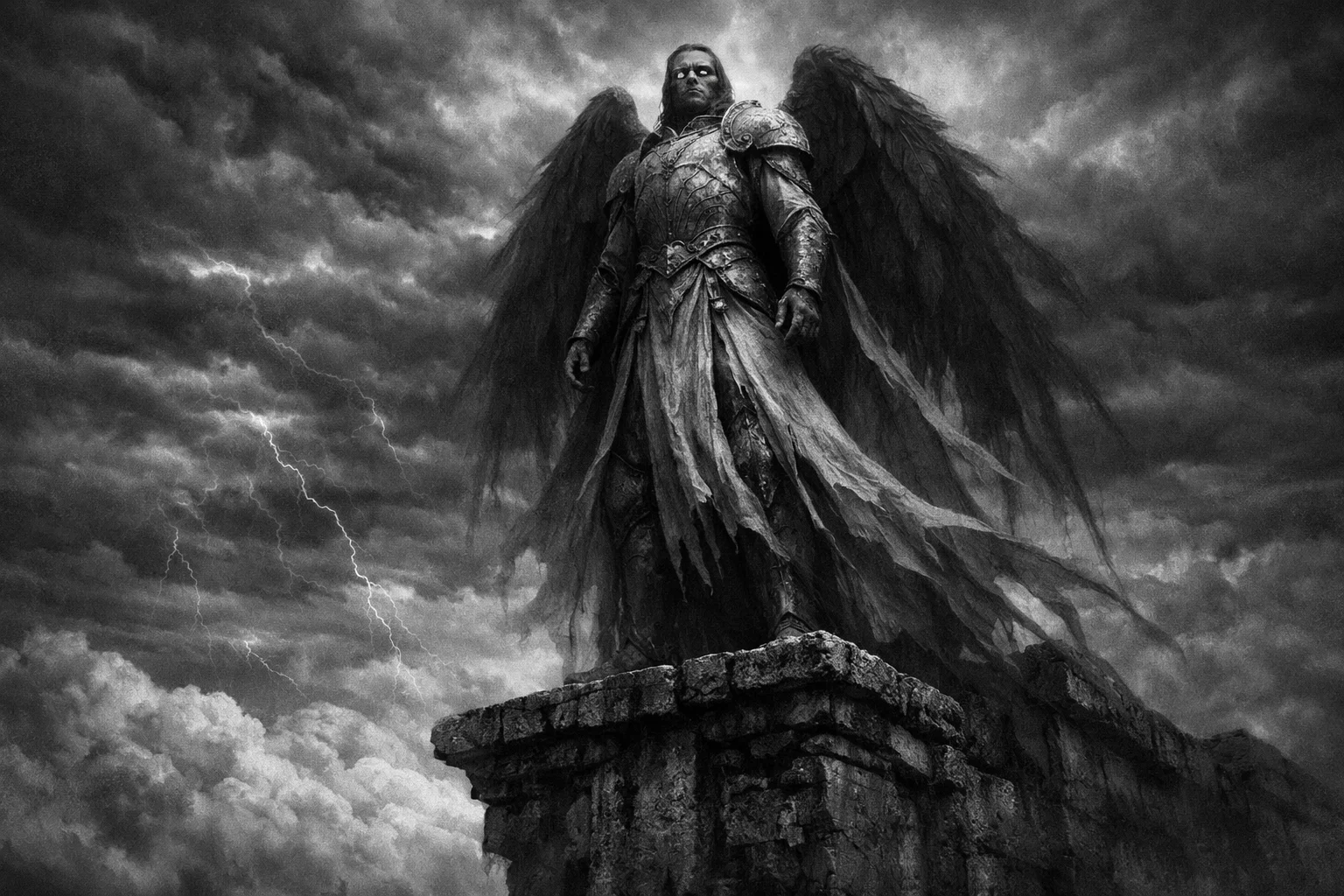

Amenadiel is a high-ranking demon often classified within the hierarchy of aerial spirits and one of the fallen angels. In classical demonology and occult traditions, he is primarily identified as a great emperor or king ruling over the demons of the air.
While he does not appear among the 72 spirits of the Ars Goetia, he has a significant position in related Solomonic texts, specifically the Theurgia-Goetia, where he is established as the first and chief spirit under the Emperor of the East.
Summary
Key Takeaways
| Attribute | Details |
| Names | Amenadiel, Amanadiel, Amonadiel |
| Title | Emperor of the West, King of the Air, Great President |
| Gender | Male |
| Role | Commanding aerial spirits, governing the transition between celestial and terrestrial realms, and overseeing the deceit of the mind through illusions of the air. |
| Rank | Chief Emperor or Great King of the Aerial Spirits. |
| Hierarchy | Governs 300 great dukes and numerous lesser spirits; serves as a primary potentate within the Theurgia-Goetia system. |
| Legions | Commands approximately 3,000,000 spirits across various dukedoms. |
| Powers | Manipulation of atmospheric conditions, creation of mental fog and confusion, commanding spirits of the wind to cause destruction, and facilitating astral travel to lead souls astray. |
| Associated Figures | Lucifer, Demoriel, Caspiel, and Carnesiel. |
| Weaknesses | Holy geometric seals, invocation of the Tetragrammaton, and the presence of Archangel Michael. |
| Opposing Angel/Saint | Archangel Michael or Archangel Gabriel. |
| Pantheon | Christian Occultism, Solomonic Tradition. |
| Primary Sources | Theurgia-Goetia (Book II of The Lesser Key of Solomon), Steganographia by Johannes Trithemius, Pseudomonarchia Daemonum. |
Who or What is Amenadiel?
Amenadiel is a demon of significant magnitude within the theurgical traditions of the Middle Ages and the Renaissance. Unlike lower-level demons who live in the infernal depths of the earth, he is categorized as an aerial spirit.
This classification suggests that his essence is bound to the lower heavens or the atmosphere surrounding the Earth. When it comes to Christian demonology, he is viewed as a fallen angel who retained a vast degree of his former celestial authority, allowing him to command a complex bureaucracy of subordinate spirits.
In historical grimoires, he is often depicted as a bridge between the physical and spiritual worlds. His nature is inherently deceptive; he governs the “unstable” element of air, which occultists believe grants him power over perceptions, thoughts, and the invisible forces of nature.
While some modern interpretations have softened his image, historical texts remain steadfast in classifying him as a potentate of darkness whose primary function is to govern lesser malevolent entities that harass the human soul.
DEMONS ARE REAL — AND THE BIBLE PROVES IT Limited-Time: Up to 20% OFF!
No myths. No exaggeration. Just Scripture. Clinton Arnold’s landmark biblical theology of the powers of darkness. What the Old & New Testaments actually teach about Satan, demons, and spiritual warfare. Essential reading for every pastor, counselor, and believer facing the unseen battle. The book seminaries and deliverance ministries swear by.
Demons are real • Scripture is clear • Victory is yours • Clinton Arnold’s definitive biblical study.
“Amenadiel” Meaning
The etymology of the name Amenadiel is subject to linguistic debate among researchers of Semitic and Greek languages. A prominent theory suggests the name is a hybrid of the Hebrew word Amen, meaning “certainty” or “truth,” and the suffix -el, which denotes “God.”
However, within the context of fallen entities, this name is often interpreted as a perversion of divine titles, signifying one who was once a “Truth of God” but has since been cast out.
Another linguistic path links the name to the Greek term amene (meaning “fleeting” or “weak”) or the root man (meaning “mind” or “spirit”). This supports his role in the Theurgia-Goetia as a ruler of spirits that influence the human intellect and the airy realms.
Across different historical manuscripts, variations such as Amanadiel appear, often due to transcription errors by medieval monks and scribes.
In the Steganographia of Johannes Trithemius, the name is used within a coded system of angel magic, where it represents a specific frequency of spiritual communication. Despite these variations, the core identity remains that of an aerial emperor whose name invokes the authority he wields over the invisible legions of the sky.
How to Pronounce “Amenadiel” in English
The name is generally pronounced in English as ah-MEN-uh-dee-el. The emphasis is placed on the second syllable (MEN). The first syllable uses a soft “a” as in “father,” followed by a neutral “uh” sound, and ending with a clear, distinct pronunciation of the -el suffix.
What Does Amenadiel Look Like?
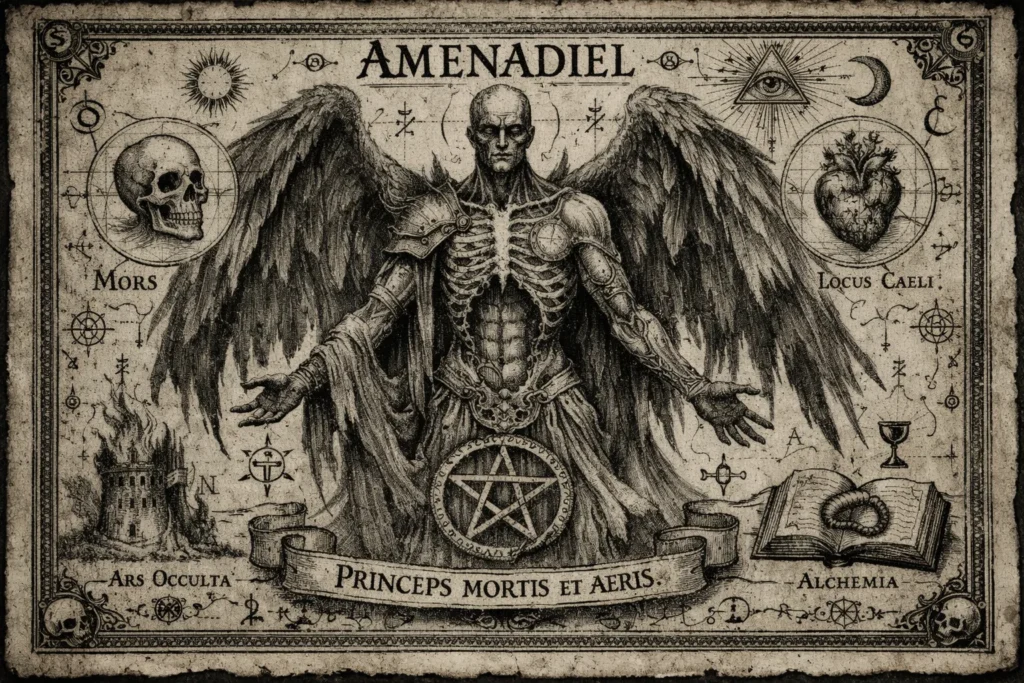
Historical descriptions of Amenadiel vary depending on the grimoire. Still, he is consistently described as possessing a regal and intimidating presence.
In the Theurgia-Goetia, he does not have a single fixed form. Yet he most often appears as a tall, majestic warrior or a king. His skin is usually described as pale, almost translucent, mirroring his association with the air. He is frequently depicted wearing ancient armor or robes that appear to shift and flow like clouds or smoke.
Unlike the grotesque, zoomorphic descriptions of many Goetic demons, Amenadiel maintains a humanoid appearance that masks his inner malice. He is sometimes said to possess vast, shadowy wings that cast no shadow on the ground, or eyes that reflect the turbulent state of a storming sky.
In some older traditions, he is accompanied by a shimmering aura that causes those who look upon him to feel a sense of profound dread and vertigo, a physical manifestation of his power over the heights and the air.
Origins
The history of Amenadiel is embedded in the synthesis of Judeo-Christian angelology and the occult sciences of the Renaissance. His evolution follows the path of “learned magic,” where entities were categorized based on their functions in the cosmos.
The Aerial Hierarchy
The earliest records of Amenadiel appear when it comes to the aerial demons. In medieval thought, the space between the Moon and the Earth was believed to be inhabited by spirits neither purely celestial nor purely infernal. Amenadiel appeared as a primary creature in this “Middle Kingdom,” serving as an emperor over the cardinal directions.
COMMAND THE 72 DEMONS OF THE ARS GOETIA. Limited-Time: Up to 10% OFF!
The complete Lemegeton – restored from ancient manuscripts. Full seals & rituals • True evocation rites • Ranks & powers of every spirit Ars Goetia • Theurgia-Goetia • Ars Paulina • Almadel • Notoria • The ultimate grimoire of Solomon.
The most accurate, beautiful edition ever published (Skinner & Rankine). Every serious magician owns this. Do you?
The Solomonic Expansion
During the 16th and 17th centuries, the development of the Lemegeton (The Lesser Key of Solomon) solidified his status. He was formally documented in the Theurgia-Goetia, which expanded on the work of Johannes Trithemius.
Here, he moved from a vague spiritual concept to a documented Emperor of the West, with a specific list of subordinate dukes and detailed instructions for his constraint. This era marked his transition into a standardized monster of demonic hierarchy.
Was Amenadiel Ever Mentioned in the Bible?
Amenadiel is not mentioned in the canonical Bible (Old or New Testament). He is a demon that arises strictly from later apocryphal traditions, grimoires, and occult literature that developed during the Middle Ages and the Renaissance.
You may also enjoy:
Lamashtu, the Mesopotamian Demoness of Childbirth and Infant Death
November 4, 2025
What Is a Tengu? Origins, Powers, and Dark Folklore
January 29, 2026
Barbas: The Lion Demon Who Spreads Disease
March 3, 2026
Who Is Adrammelech in Demonology and the Bible?
October 1, 2025
Yuki Onna: The Terrifying Demon Bride Who Feeds on Travelers
December 9, 2025
Amenadiel in Grimoires and Other Texts
Amenadiel is a central demonic entity in the Theurgia-Goetia, the second book of the Lesser Key of Solomon. This text describes him as the “Great Emperor of the East,” ruling over all other spirits of his order.
He is also prominently featured in Johannes Trithemius’s Steganographia. This work ostensibly teaches secret communication through spirits, but is a major source for the names and ranks of aerial demons.
| Source | Quote |
| Theurgia-Goetia | “The first and chief spirit is Amenadiel, who is the great Emperor of the East, and hath under him 300 great Dukes, and 300 petty Dukes, and 3,000,000 of spirits under them.” |
| Steganographia | “Amenadiel est spiritus primus & maximus sub Orientis Imperatore, habens sub se duces multos, & spiritus innumerabiles.” (Amenadiel is the first and greatest spirit under the Emperor of the East, having under him many dukes, and innumerable spirits.) |
Powers and Abilities
The powers of Amenadiel are intrinsically tied to his status as a king of the aerial spirits. His primary mechanism of influence is the manipulation of the atmosphere and the intellect.
He does not merely cause physical storms; he projects the essence of a storm into the human mind, causing states of extreme confusion, madness, and psychological instability. By controlling the “breath” or “air” of a person, he can induce suffocating despair or terrifying hallucinations.
What’s more, Amenadiel governs the legions of the wind. When his power is directed toward the physical world, it manifests as destructive gales, lightning without rain, and the “blighting” of crops through foul mists. He can conceal objects or entities within “thick air,” essentially granting invisibility to himself and his subordinates.
This power allows him to observe human affairs unseen, whispering deceptions that sound like the natural whistling of the wind. His authority over 3,000,000 spirits ensures that his influence can be felt simultaneously across vast geographic distances, making him a pervasive threat in the spiritual hierarchy.
SPEAK THEIR TRUE NAMES… IF YOU DARE
Limited-Time: Up to 40% OFF!
Over 1,700+ demons – true names, ranks, infernal seals, powers & forbidden histories. The expanded & revised masterpiece by occult legend Michelle Belanger. Now with 200+ new entities, dozens of never-before-seen illustrations from ancient grimoires. The ultimate arsenal for demonologists, magicians, and the deliciously curious.
Amenadiel Myths, Legends, and Stories
The Governance of the Four Emperors in the Theurgia-Goetia
In the narratives found within the Theurgia-Goetia, Amenadiel is established not as a solitary actor but as a pillar of the Infernal World’s aerial administration.
The story dictates that the world is divided among four great emperors who control the spirits of the air. Amenadiel is designated as the Emperor of the East (or the West in conflicting manuscripts), holding a court that mirrors that of a mortal king.
The text describes his daily routine as one of constant oversight. He spends his existence receiving reports from his 300 great dukes, who in turn manage thousands of lesser spirits. These spirits are sent to various corners of the world to carry out his will.
The “legend” of Amenadiel in this context is one of absolute bureaucracy and order within the demonic realm. He represents the terrifying efficiency of evil, where every whisper of temptation or sudden gust of ill-fortune is part of a calculated chain of command originating from his throne.
Amenadiel vs Other Christian Demons
| Demon Name | Associated Sin/Temptation | Rank/Origin | Key Traits/Powers |
| Lucifer | Pride | Emperor/Fallen Archangel | Source of all darkness and rebellion. |
| Beelzebub | Gluttony/False Gods | Prince of Demons | Commanding flies and spreading decay. |
| Asmodeus | Lust | King (Ars Goetia) | Breaking marriages and inciting carnal desire. |
| Belphegor | Sloth/Discovery | Prince of Hell | Invention of machines to promote laziness. |
| Mammon | Greed | Prince/Biblical | Corrupting through material wealth. |
| Leviathan | Envy | Grand Admiral | Ruling the deep seas and chaos. |
| Astaroth | Vanity/Sloth | Grand Duke | Teaches liberal sciences but smells foul. |
| Belial | Lawlessness | King/Dead Sea Scrolls | Seducing through worthlessness and lies. |
| Pazuzu | Famine/Locusts | King of Wind Demons | Bringer of storms and plagues. |
| Azazel | Corruption/Weaponry | Chief Se’irim | Taught man the art of war and cosmetics. |
| Bael | Invisibility | First King of Goetia | Grants wisdom and the power of stealth. |
| Paimon | Subservience | King (Ars Goetia) | Teaches all arts and sciences. |
| Dagon | Idolatry | Philistine/Demonic | Half-man, half-fish; maritime destruction. |
| Moloch | Sacrifice | Prince of Hell | Associated with the fire and child sacrifice. |
| Mephistopheles | Cunning/Deceit | Germanic Lore | Specializes in soul contracts and bargains. |
Rank in the Hierarchy of Hell
In the complex hierarchies of the occult, Amenadiel has a position of supreme local authority. While entities like Lucifer or Satan are viewed as the universal monarchs of the Pit, Amenadiel is the practical administrator of the Aerial Realm.
He is frequently described as a rival to other cardinal kings, such as Demoriel or Caspiel. His relationship with these entities is one of “armed neutrality,” where they respect each other’s boundaries to avoid celestial conflict that would alert the angelic hosts.
He acts as an overlord to a massive network of spirits. His subordinate dukes are often powerful in their own right, but they are bound to Amenadiel by ancient oaths of fealty.
In some interpretations of the Steganographia, he is the “Chief Secretary” to the higher infernal powers, acting as the primary point of contact for any spiritual influence that must pass through the air to reach the earth. This makes him a vital intermediary; without his “clearance,” lower demons would find it more difficult to manifest their powers in the physical atmosphere.
Mystical Correspondences
| Attribute | Details |
| Planet | The Moon (in its dark phase) or Uranus |
| Zodiac Sign | Gemini (associated with air and duality) |
| Element | Air |
| Direction | East (sometimes West depending on source) |
| Color | Pale Blue, Grey, or Silver |
| Number | 3 (representing the legions in threes) |
| Crystal/Mineral | Sapphire (clouded) or Celestite |
| Metal | Silver or Quicksilver (Mercury) |
| Herb/Plant | Wormwood or Mistletoe |
| Animal | The Vulture or The Bat |
The mystical associations of Amenadiel serve to focus on his ethereal and volatile nature. His connection to the planet Uranus (in modern interpretations) or the Moon reflects his power over sudden changes and the hidden side of the mind.
By aligning with the zodiac sign of Gemini, he taps into the energy of duality and communication, using it to twist words and spread discord through the air. These correspondences are vital for occultists to understand, as they highlight that Amenadiel’s evil is not heavy or grounded, but swift, invisible, and cold.
His connection to the element of air and the direction of the East anchors him to the rising sun, symbolizing his role as a “Morning Star” equivalent among the aerial spirits. The use of silver in his talismans reflects the air’s flickering, reflective quality. At the same time, the vulture represents his habit of circling human souls, waiting for a moment of spiritual weakness to descend.
Amenadiel’s Sigil
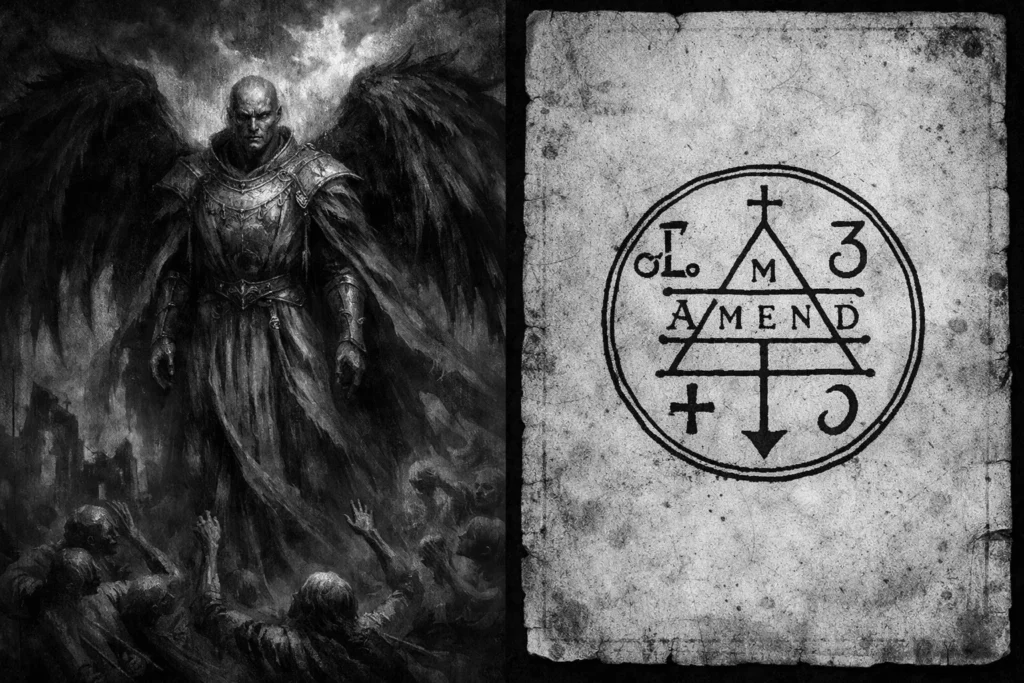
The sigil of Amenadiel is a complex geometric arrangement used in Solomonic magic to constrain and command him. In the Theurgia-Goetia, these sigils (or characters) are considered the “true names” of the spirits in visual form. The sigil is essential because, without it, an occultist would have no defense against the spirit’s overwhelming presence.
Historically, it was engraved on metal plates or drawn on parchment to create a “focal point” for his energy, effectively trapping a portion of his essence within a ritual circle to ensure he spoke the truth rather than his natural deceptions.
Summoning and Rituals
Historically, the summoning of Amenadiel was considered a task of immense danger, reserved for the most experienced practitioners of high magic. Rituals were typically performed in high, open places—such as mountain peaks or towers—to be closer to his aerial domain. The timing was strictly governed by the planetary hours, usually during the hours of the Moon or Mercury when the “veil” between the air and the earth was thinnest.
Witches and warlocks would use the Theurgia-Goetia as their primary manual, using specialized incense made of storax or galbanum to give the spirit a “body” of smoke in which to manifest. The purpose of these invocations was rarely for simple favors; instead, they were intended to gain control over the weather or to send “whispering spirits” to influence the minds of enemies.
Because Amenadiel commands such a vast hierarchy, his ritual required the conjurer to also acknowledge his subordinate dukes, creating a long and arduous process of spiritual negotiation.
You may also enjoy:
Empusa: The Blood-Drinking Wraith of Greek Mythology
November 20, 2025
Chort: The Sinister Slavic Demon of Chaos and Bad Luck
March 10, 2026
Who Is Shiva, the Destroyer and the Lord of the Universe?
November 12, 2025
Who Are the Yaksha, and Why Did Buddhists Fear Their Wrath?
October 20, 2025
Who Was Hiranyakashipu, the Demon King of Hindu Mythology?
October 6, 2025
Frequently Asked Questions
How many legions does Amenadiel command?
In the hierarchy of the Theurgia-Goetia, Amenadiel commands approximately 3,000,000 spirits. This massive force is organized into 300 great dukes and 300 petty dukes, making the demon one of the most powerful entities in the aerial hierarchy and significantly outnumbering many spirits found in the Ars Goetia.
Is Amenadiel Lucifer’s brother?
In traditional Christian demonology and historical grimoires, there is no record of Amenadiel being Lucifer’s brother. The concept of them being brothers is a modern fictional invention from popular media and comic books. Historically, they are distinct entities; Lucifer is a supreme fallen archangel, while Amenadiel is a high-ranking King of the aerial spirits.
Is Amenadiel the son of God?
According to classical theology and historical occult texts, Amenadiel is not the “Son of God” in the way Jesus Christ is. While all angels were technically created by God and are sometimes referred to as “sons of God” in a general sense in the Bible, Amenadiel is specifically classified in grimoires as a fallen angel and a demon, signifying his separation from the divine.
Is Amenadiel good or bad?
In every historical, religious, and occult source, Amenadiel is considered a malevolent or “bad” entity. As an emperor of aerial spirits and a fallen angel, he is categorized as a demon who uses his powers to deceive the human mind, cause destruction via the elements, and command legions of lesser evil spirits to carry out his dark will.
Who is Amenadiel in the Bible?
Amenadiel does not appear in the Bible. There are no mentions of him in the Old or New Testaments or in the recognized Deuterocanonical books. His identity was developed entirely within extrabiblical occult literature, specifically Renaissance-era grimoires and texts such as the Lesser Key of Solomon and the works of Johannes Trithemius.
