
Amaymon is an important demon in Western ceremonial magic and demonology, particularly known from late Renaissance grimoires.
His primary role is as one of the four Infernal Kings who rule the cardinal directions, often specifically presiding over the East. This makes him a pivotal entity for any practitioner of the Goetic arts, as these Kings have ultimate authority over all the lesser spirits in their dominion.
Summary
Key Takeaways
| Attribute | Details |
| Names | Amaimon, Maymon, Maimon, Amoymon |
| Title | King of the East, King of the South |
| Gender | Male |
| Role | Governs legions of spirits; must be bound for the successful summoning of many demons |
| Rank | Infernal King |
| Hierarchy | Superior to many of the 72 Spirits of the Ars Goetia; serves under no known superior demon |
| Legions | Vast and uncounted; commands the majority of spirits mentioned in the Goetia when he rules the East |
| Powers | Commands all lesser spirits under his dominion; causes pain and death to those who fail to properly bind him |
| Associated Figures | Ziminiar (King of the North), Corson (King of the West), Gaap (King of the South) |
| Weaknesses | Bound by the Divine Name of God; must be constrained by the practitioner’s authority |
| Opposing Angel/Saint | None specifically assigned to him in primary sources due to his role as a directional King |
| Pantheon | Christian Demonology (Goetic) |
| Primary Sources | The Lesser Key of Solomon (especially the preliminary instructions of the Ars Goetia), Pseudomonarchia Daemonum, The Book of Abramelin |
Who or What is Amaymon?
Amaymon is one of the four Great Kings of Hell mentioned in various Goetic and Solomonic grimoires, a tradition of ceremonial magic texts focused on the conjuration of spirits.
His fundamental identity is tied to the concept of cardinal governance within the demonic hierarchy. He is consistently ascribed to a cardinal direction, most often the East, making him the reigning monarch over a vast territory of the infernal realm and countless legions of spirits.
The principal purpose of acknowledging Amaymon in a ritual is not to summon him for a favor, but to restrain him and the other Kings. This act of binding is considered essential because the 72 lesser spirits of the Ars Goetia are believed to be under the ultimate command of one of these four Kings.
If a practitioner fails to restrain the ruling King, the King can potentially release his subordinate spirit or cause the practitioner great harm. Thus, Amaymon represents a force of ultimate, directional authority that must be ceremonially overcome before any lesser spirit can be safely commanded.
“Amaymon” Meaning
The precise etymology of the name Amaymon is uncertain. It lacks clear historical linguistic roots in Hebrew or Aramaic, unlike many other prominent demonic names. This suggests its origin is likely post-classical, possibly a corrupted or invented term that appeared within the European grimoire tradition of the late Middle Ages or Renaissance.
One hypothesis connects the name to the Greek term mēmōn (μημων), meaning ‘wise’ or ‘prudent’, possibly through the Latin equivalent memor. However, this connection is purely speculative and would be a deeply ironic etymology for a figure representing a malign, unholy authority.
Another theory links it to Mammon, the Aramaic word for ‘wealth’ or ‘profit’ personified as an evil deity in Christian scripture.
The name variation Maimon supports this connection, suggesting that Amaymon may be a variant spelling or a deliberate elaboration of Mammon to create a new figure of immense infernal power (often associated with the South in some texts, a direction sometimes linked to riches and heat).
The prefix’ A-‘ in Amaymon may simply be an intensification or a linguistic flourish common in the invention of occult names.
How to Pronounce “Amaymon” in English
The most common pronunciation for Amaymon in English, particularly within occult and scholarly circles, is Ah-MAY-mon or Ah-MY-mon. The stress falls on the middle syllable, and the initial ‘A’ is pronounced as a short ‘uh’ sound.
What Does Amaymon Look Like?
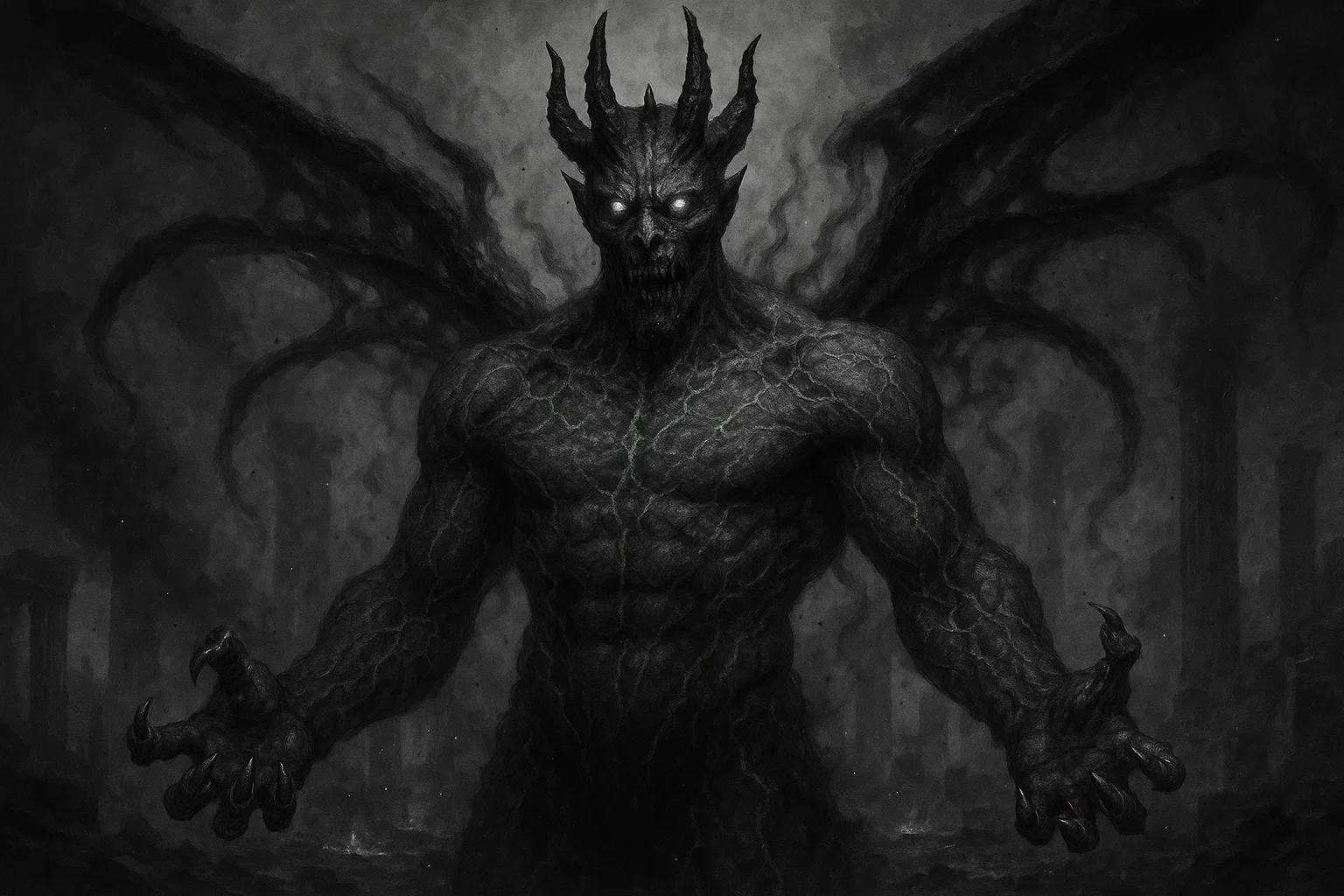
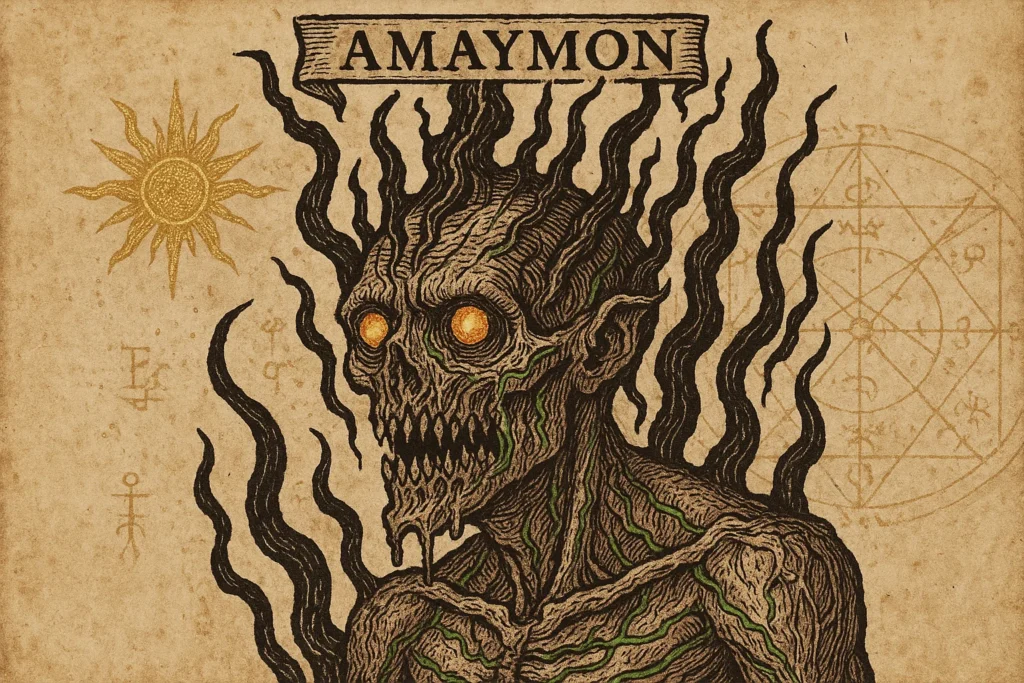
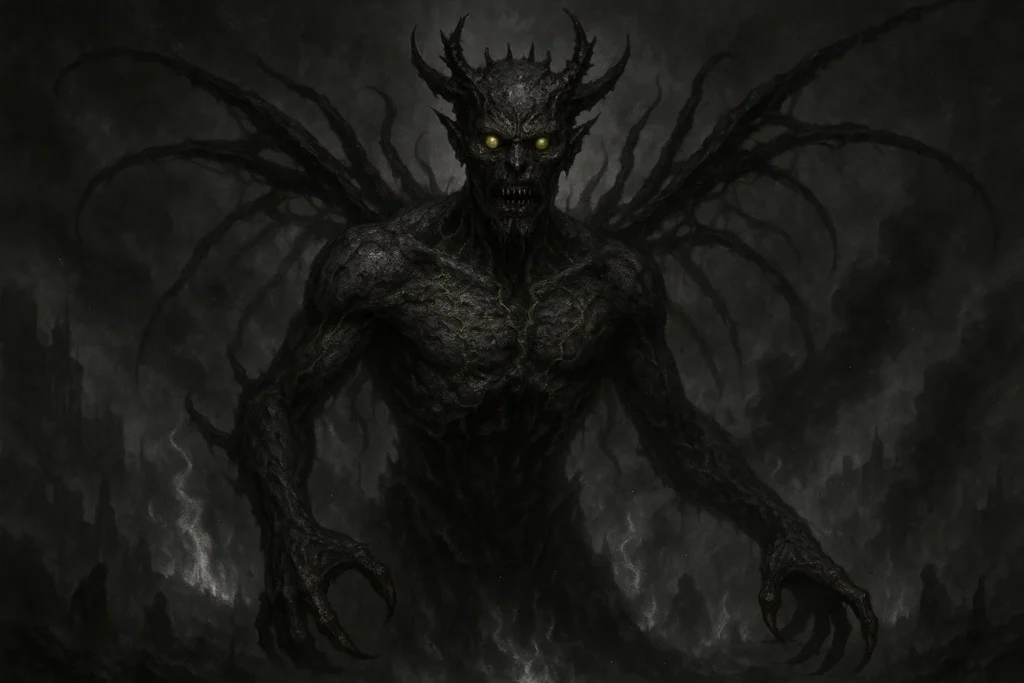
Descriptions of this Christian demon’s physical appearance are extremely rare in the primary sources, especially the Lesser Key of Solomon. Most grimoires focus on his rank and authority rather than his physical form.
He is most often invoked by his name and title, suggesting that his appearance is less relevant than his function as a directional binding force.
In the Book of Abramelin, where the four kings are named, their physical forms are similarly not detailed, with their governance of the world’s quarters prioritized. When he is mentioned in a context that calls for a description, he is generally portrayed as having a terrible or fearsome presence, fitting his status as the King of Hell.
This absence of a fixed physical description allows him to be perceived as an immense, all-encompassing force rather than a single anthropomorphic entity, symbolizing the vast, uncontainable power of the East or South.
UNLOCK THE FORBIDDEN KNOWLEDGE OF DEMONS. Limited-Time: Up to 29% OFF!
The Encyclopedia of Demons & Demonology 400+ entries • Real history • Exorcisms & Ancient Evils • Possession • Terrifying photos. This is Rosemary Ellen Guiley’s masterpiece of the occult.
Origins
The origins of Amaymon are found exclusively within the European grimoire tradition, and he has no known pre-Christian or biblical genealogy. His earliest documented appearances are in the texts attributed to King Solomon, specifically those compiled in the late medieval and early modern periods.
One of his most significant early appearances is in the preliminary section of the Ars Goetia, the first book of the Lesser Key of Solomon (c. 17th century). This text lays out the methods for safely conjuring the 72 spirits.
Amaymon is immediately introduced as one of the four Great Kings who rule the four quarters of the world. In the Ars Goetia, he is specifically assigned the East, making him one of the most important figures to be dealt with before any lesser spirit of the East can be controlled.
A slightly earlier mention is in Johann Weyer’s Pseudomonarchia Daemonum (1563). While Weyer lists the 72 spirits, the instructions leading up to that list also reference the four Great Kings.
His stature solidified with the translation and circulation of the Lesser Key of Solomon manuscripts, in which his importance as a binding force became central to Solomonic magic. His evolution in these texts is from a simple regional ruler to a talismanic constraint required for the ritual’s safety and success.
In some variations, the King of the South, Gaap, is conflated with or replaced by Amaymon.
Was Amaymon Ever Mentioned in the Bible?
Amaymon is not mentioned in the Bible in the Old Testament, the New Testament, or the Apocrypha. This demon is entirely a creation of the grimoire tradition and post-biblical Christian demonology, appearing primarily in late medieval and early modern European occult texts.
Amaymon in Grimoires and Other Texts
Amaymon’s appearances in key occult works are crucial for understanding his role as a foundational authority figure rather than a functioning spirit to be summoned for specific purposes.
| Source | Quote |
| The Lesser Key of Solomon (Ars Goetia) | ”Also thou shalt know and observe the four times of the yeare. The first King is Amaymon, he ruleth the East: the second King is Corson, he ruleth the West: the third King is Ziminiar, he ruleth the North: the fourth King is Gaap, he ruleth the South.” |
| The Lesser Key of Solomon (Ars Goetia) | ”Whereof there are four Kings, to wit, Amaymon, King of the East, Corson, King of the West, Ziminiar, King of the North, and Gaap, King of the South.” |
| The Lesser Key of Solomon (Ars Goetia) | ”Also note, that Amaymon doth governe the East part; Corson, the West; Ziminiar, the North; and Gaap the South.” |
| The Book of Abramelin (Book III, Chapter 2) | ”The four princes, to wit, Amaymon, Egyn, Oriens, and Paimon.” (Note: This text gives different names for the four Kings, demonstrating variations across traditions.) |
| Pseudomonarchia Daemonum (Attributed to Weyer, 1563) | ”When thou wilt call any of them to appeare, in what part of the world soever, if it be in the East, call Amaymon; if in the West, Corson; if in the North, Ziminiar; if in the South, Gaap.” |
Powers and Abilities
Amaymon’s powers are derived from his regal authority and directional dominion over a vast segment of the infernal hierarchy. His abilities are focused on governance, control, and retribution:
- Commands Lesser Spirits: He holds ultimate authority over the multitude of spirits that live in the territory he governs (primarily the East, and sometimes the South). Any of the 72 spirits of the Goetia who fall under his command are completely subservient to him.
- Wields Malicious Influence: He can exert a general influence of evil and malice over the mortal realm, particularly from his cardinal direction, though specific activities are usually delegated to his subordinates.
- Inflicts Retribution: If a practitioner fails to properly constrain or bind him using the required holy names and ritual components, Amaymon has the power to inflict severe harm, pain, and death upon the conjurer.
- Causes Confusion and Failure: His unchecked presence is believed to cause the entire ritual to fail, leading to confusion, errors, and an inability to command the desired lesser spirit.
You may also enjoy:
Who Is Aka Manto, Japan’s Terrifying Red-Cloaked Yōkai?
October 24, 2025
Who Is Agaliarept, the General of Hell Under Lucifer?
October 8, 2025
Al-Ahmar: The Tuesday King of the Seven Jinn
February 13, 2026
What Is the Akashita, the Red-Tongued Demon of Japanese Folklore?
November 5, 2025
Gandharva: God, Spirit, or Demon?
November 13, 2025
Who Was Hiranyakashipu, the Demon King of Hindu Mythology?
October 6, 2025
Amaymon Myths, Legends, and Stories
Amaymon does not feature as a character in any extensive, freestanding narratives, myths, or legends within the primary grimoire texts or historical folklore. His function is purely structural and ceremonial.
He is mentioned repeatedly, but only in the preparatory and instructional sections of the grimoires like the Ars Goetia and the Book of Abramelin.
The core myth of Amaymon is his role as a necessary constraint for the successful practice of Solomonic magic.
His importance lies not in what he does in a story, but what he is to the ritual: a dangerous, reigning king who must be bound by divine authority. Therefore, there are no specific tales of his interactions with humanity, his battles, or his exploits outside of his role as an infernal monarch.
Amaymon vs Other Christian Demons
| Demon Name | Associated Sin/Temptation | Rank/Origin | Key Traits/Powers |
| Asmodeus | Lust, Gambling, Extravagance | Prince/Grimoire and Talmudic | Causes strife between spouses; commands 72 legions; associated with the planet Venus |
| Belial | Lawlessness, Arrogance, Deceit | King/Biblical (Old Testament) and Goetic | Grants dignities and favors; commands 80 legions; compels lying and wickedness |
| Paimon | Blasphemy, Pride | King/Goetic | Teaches all arts and sciences; commands 200 legions; rides a dromedary |
| Balam | Cruelty, Bestiality | King/Goetic | Gives true answers of the past, present, and future; appears with three heads (man, bull, ram) |
| Baal | Idolatry, Worship of False Gods | King/Biblical (Canaanite/Goetic) | Gives invisibility; commands 66 legions; appears with three heads (man, toad, cat) |
| Purson | False Prophecy, Conceit | King/Goetic | Gives true answers about secrets; appears as a lion-headed man riding a bear |
| Zagan | Deceit, Counterfeiting | King/Goetic | Turns water into wine, oil into water; commands 33 legions; appears as a bull with griffin wings |
| Ziminiar | Authority over the North | King/Goetic | One of the four Great Kings; rules the North quarter |
| Astaroth | Sloth, Vanity | Duke/Goetic and Biblical (Phoenician) | Teaches liberal sciences; gives true answers of the past and future; rides a dragon |
| Vassago | Destruction, Frivolity | Prince/Goetic | Declares things past and future; finds lost items; one of the “good-natured” demons |
| Gaap | Hatred, Manipulation | President/Goetic | Teaches philosophy and liberal sciences; causes love or hate; transports people rapidly |
| Satan/Lucifer | Pride, Rebellion | Emperor/Biblical (Christian Theology) | Ruler of Hell; supreme tempter of mankind; the adversary |
Rank in the Hierarchy of Hell
Amaymon holds the rank of an Infernal King within the demonic hierarchy presented in Solomonic grimoires, positioning him among the highest stratum of governance in Hell.
He is explicitly identified as one of the four Great Kings who rule the four cardinal directions of the cosmos. In the Ars Goetia, the most prevalent source, he is assigned the East. This role is not merely symbolic; it grants him ultimate authority over the territory and all the legions of lesser spirits assigned to that quarter.
The 72 spirits of the Ars Goetia are believed to be subordinate to one of these four Kings. For example, any spirit of the East is fundamentally under Amaymon’s control.
This establishes his rank as superior to the 72 Goetic spirits and a necessary point of control for the practitioner. His authority is directional and territorial, making him a pivotal figure in the infernal organization. He serves as an executor of control over a vast number of subordinates.
Mystical Correspondences
| Attribute | Details |
| Planet | Sun, possibly Mars |
| Zodiac Sign | Leo or Aries |
| Element | Fire |
| Direction | East (sometimes South) |
| Color | Red, Gold, Orange |
| Number | Six |
| Crystal/Mineral | Ruby, Carnelian |
| Metal | Gold or Copper |
| Herb/Plant | Frankincense, Tobacco |
| Animal | Lion, Serpent |
Amaymon’s mystical correspondences are heavily influenced by his assigned cardinal direction, the East, which in many occult traditions is associated with the Element of Fire and the powers of the Sun. This powerful elemental and planetary alignment highlights his regal status and the potentially destructive nature of his power.
The association with the Sun (or Mars) and the sign of Leo (or Aries) links him to concepts of kingship, overwhelming force, heat, and command, all attributes fitting for a supreme Infernal King. These correspondences imply that Amaymon’s influence is at its strongest when the Sun is at its height, or during periods astrologically aligned with fire signs.
The Direction of the East is traditionally the starting point of creation. It is therefore viewed as the quarter of supreme authority and initial force. The color Red and the metal Gold further focus on his royal rank, linking him to the material splendor of a king and the martial power of a commander.
Amaymon’s Sigil
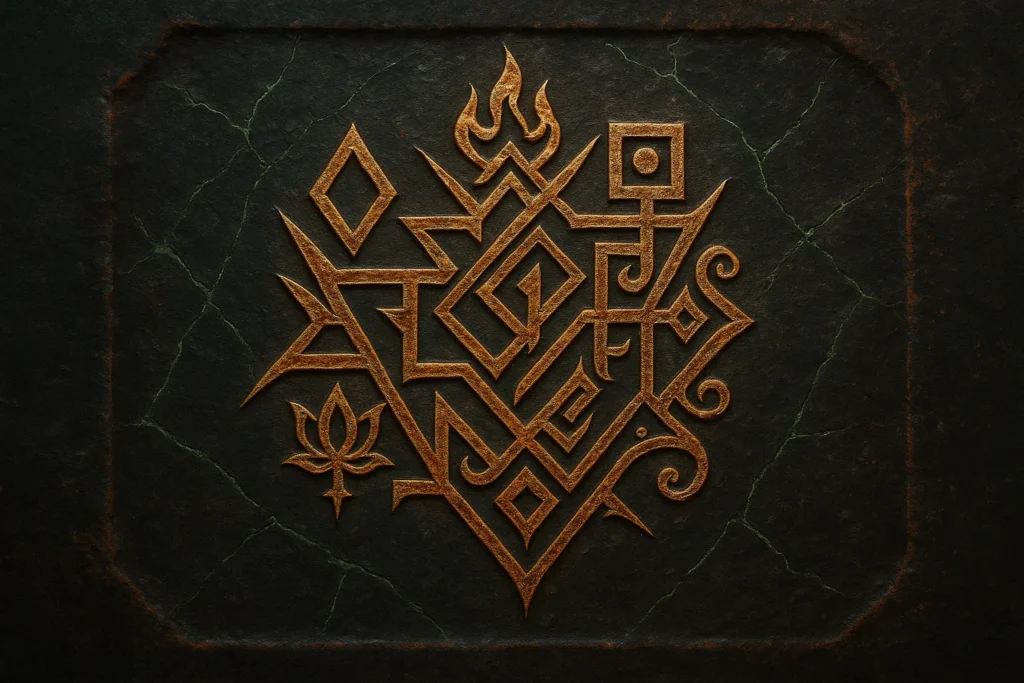
Amaymon is one of the few high-ranking demons whose sigil is not consistently depicted or even provided in many primary Solomonic texts, unlike the 72 spirits of the Ars Goetia. The focus on his binding is via divine names and ceremonial circles rather than a unique seal.
However, in some later grimoire variations and occult manuals, a sigil for him is introduced. Such a sigil is typically a complex, angular glyph, often incorporating elements that visually suggest kingship, fire, and the East.
Historically, any sigil created for Amaymon would have been used as a means of control and constraint, drawn on a brass or gold plate and placed within the magical triangle or circle.
This seal would represent the practitioner’s authority over the King, compelling him to submit to the power of the Divine Names inscribed on the talisman and preventing him from interfering with the summoning of the lesser spirits under the practitioner’s dominion.
Summoning and Rituals
The primary purpose of performing a ritual involving Amaymon is not to summon him for dialogue or tasks, but to bind his authority to ensure the safety and success of summoning a subordinate demon.
The ceremonial acts required for Amaymon are detailed in the preliminary instructions of the Lesser Key of Solomon. The practitioner would first enter a magical circle inscribed with the Divine Names and protective symbols. An essential tool for this process is the Magical Ring of Solomon, typically worn on the finger, bearing the Divine Name of God.
The ritual involves reciting a powerful Conjuration that directly addresses Amaymon and the other Kings, commanding them, by the authority of the Holy Trinity and the Name of God, to remain quiet and peaceable and not to inflict any injury upon the practitioner or the ritual space.
The process is a necessary preliminary constraint. The practitioner must also note the time of day and the lunar phase, as the grimoires indicate specific times when the Kings are more or less active.
By invoking the Divine authority, the practitioner essentially establishes an absolute barrier of protection that forces Amaymon, despite his regal rank, into submission, allowing the subsequent, less powerful spirit to be commanded.
You may also enjoy:
Who Is Ariton, the Infernal King of the Eastern Gate?
February 17, 2026
Iblis, the Jinn King of Darkness and Deception
September 29, 2025
Demon Alastor: The Grand Executioner of Hell
November 17, 2025
What Is Jorōgumo? The Deadly Spider Woman of Japanese Myth
February 2, 2026
Bakeneko: A Supernatural Cat Yōkai in Japanese Folklore
January 27, 2026
Who Is Abalam in Demonology? The Terrifying King That Serves Paimon
September 30, 2025
Frequently Asked Questions
Is Amaymon a real demon?
Amaymon is considered a real entity in Christian demonology and the Western occult tradition, particularly in the Solomonic grimoires such as the Lesser Key of Solomon. However, he is a figure of occult lore and ceremonial magic texts (c. 16th-17th century), with no mention in the Bible or earlier historical religious texts. For practitioners of these traditions, he is a formidable, real infernal King; in mainstream theology, he is a mythological or folkloric figure.
What is Amaymon’s rank and role in the hierarchy of Hell?
Amaymon holds the highest rank of Infernal King in the Solomonic hierarchy. His primary role is as one of the four Great Kings of Hell who govern the cardinal directions, most often presiding over the East. He has supreme authority over all the lesser demons (including many of the 72 Goetic spirits) that fall within his territory, and he must be ceremonially bound for the safe conjuration of his subordinates.
Which cardinal direction does Amaymon rule?
Amaymon primarily rules the East in the context of the Lesser Key of Solomon and Johann Weyer’s Pseudomonarchia Daemonum. In some less common variations of the four directional Kings, he is occasionally linked to the South. The East association links him mystically to the Element of Fire and the powers of the Sun.
What is Amaimon’s demon form?
Amaymon’s demon form is not specifically described in his primary sources, such as the Lesser Key of Solomon. The grimoires focus almost entirely on his rank and the necessity of his binding rather than his physical appearance. He is generally implied to be an entity of immense and terrifying power, fitting his royal status, but without a consistent or fixed physical description.
What texts and grimoires mention the demon Amaymon?
The primary sources that mention Amaymon are the grimoires of the European occult tradition. These include the Preliminary Discourse of the Ars Goetia (the first book of the Lesser Key of Solomon), Johann Weyer’s Pseudomonarchia Daemonum (1563), and the Book of Abramelin.
What is the purpose of binding Amaymon in a ritual?
The purpose of binding Amaymon is to ensure the safety and success of a ritual to summon one of the lesser Goetic spirits. As the ruling Infernal King, if he is not properly constrained by the practitioner using Divine Names and the Magical Ring of Solomon, he can interfere with the operation, release the lesser spirit, or inflict severe harm and death upon the conjurer.
