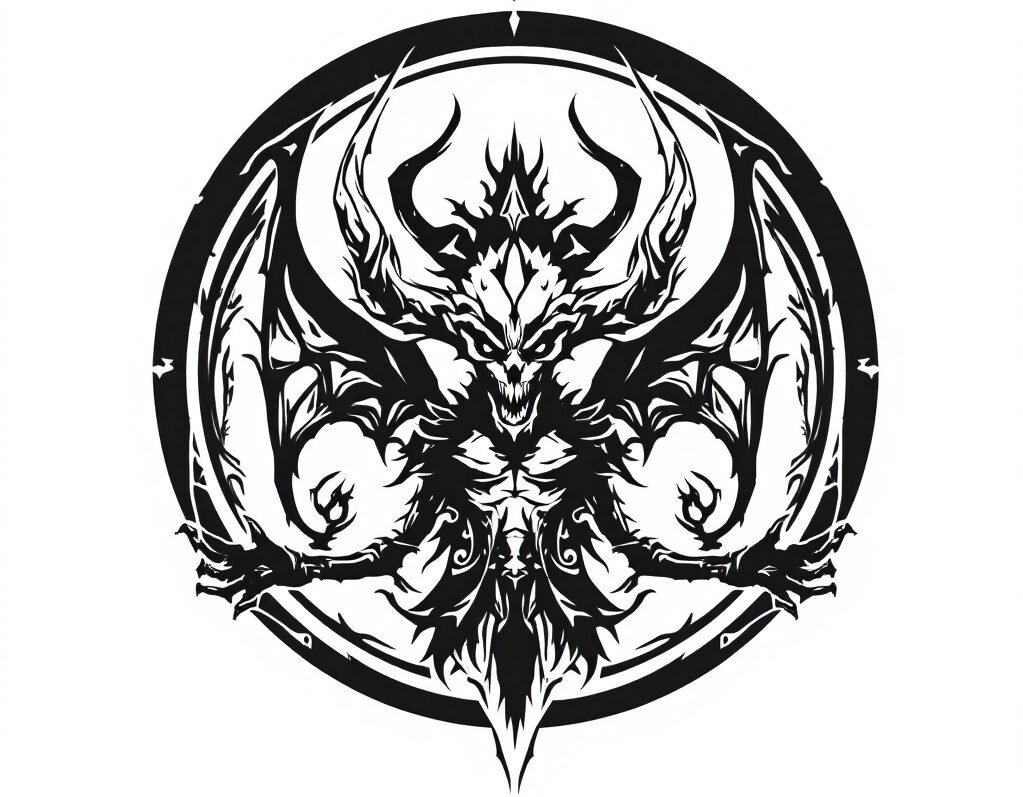

Allocer (also known by several variations of his name) is a powerful Great Duke of Hell within the infernal hierarchy. His domain centers around astronomy and the liberal arts.
As a notable figure among the 72 spirits documented in the Lesser Key of Solomon, Allocer is named as the 52nd spirit of this order. He commands thirty-six legions of lesser demons. His role is consistently portrayed as one who imparts dark, forbidden knowledge to those who dare to summon him.
Summary
Key Takeaways
| Attribute | Details |
| Names | Allocer, Alocer, Alloces |
| Title | Duke, Great Duke of Hell |
| Gender | Male |
| Role | Grants knowledge in astronomy and liberal arts; incites lust; leads legions in hell |
| Rank | Duke |
| Hierarchy | Commands thirty-six legions of lesser spirits; serves under one of the Great Kings of Hell, potentially Zagan (in some interpretations) |
| Legions | Thirty-six |
| Powers | Teaches the secrets of astronomy and all liberal arts; incites lust and depravity; delivers true answers to hidden things; causes great tumult |
| Associated Figures | King Solomon (in the context of the Lemegeton), various other spirits of the Ars Goetia |
| Weaknesses | Bound by the binding triangle and pentagram of Solomon; constrained by the power of the Divine Name |
| Opposing Angel/Saint | The corresponding Shem HaMephorash angel is Imamiah |
| Pantheon | Christian Demonology (Goetic, Solomonic) |
| Primary Sources | Ars Goetia (The Lesser Key of Solomon), Johann Weyer’s Pseudomonarchia Daemonum |
Who or What is Allocer?
Allocer is an infernal entity known primarily from the Ars Goetia and similar grimoires, which detail the hierarchy and characteristics of the 72 Spirits of Solomon. He is generally recognized as a Duke in the ranks of Hell, holding a command position over a formidable army of lesser demonic entities.
His essential nature is that of a purveyor of dark knowledge and influence. Summoners sought him out for his ability to reveal hidden mysteries in the heavens, particularly in astronomy and the liberal arts.
However, his knowledge is not benign. Rather, it is often tied to inciting lust and the temptation of forbidden truths. The demon’s reputation comes from his inclusion in the core texts of Solomonic magic, where he is consistently described with a unique and frightening physical appearance, reinforcing his identity as a powerful and malevolent spirit of the underworld.
“Allocer” Meaning
The name “Allocer” and its variants, such as Alocer or Alloces, lack a clearly defined, universally agreed-upon linguistic root, unlike the names of some other demons, which derive from Hebrew or Greek terms. The primary sources for his name are the 16th- and 17th-century grimoires, which present his name as already established within an existing demonic catalog.
One possible, though speculative, etymological path is a corruption or modification of a name from an earlier, non-Christian tradition, perhaps altered through translation and transcription errors across various European languages as the grimoires were compiled. For example, some names in the Goetia have been linked, through complex linguistic evolution, to certain pagan deities or even corrupted classical terms.
Without a direct root in a major religious language like Hebrew, Aramaic, or Latin for the name Allocer, its meaning remains strictly tied to the entity it represents—the 52nd Duke of the Ars Goetia.
The variations Alocer and Alloces are likely scribal differences that arose during the transmission of the Solomonic texts, with Allocer being the most frequently cited spelling in modern renditions of the grimoire.
How to Pronounce “Allocer” in English
The most common pronunciation of the name Allocer in English, following typical transliteration of Latin-based occult texts, is Al-oh-sir. The emphasis is typically placed on the first syllable (Al-oh-sir). It is sometimes pronounced as Al-low-ker, particularly in contexts that favor a Latin-based ‘c’ sound before ‘e’ or ‘i’, but Al-oh-sir remains the prevailing pronunciation.
What Does Allocer Look Like?
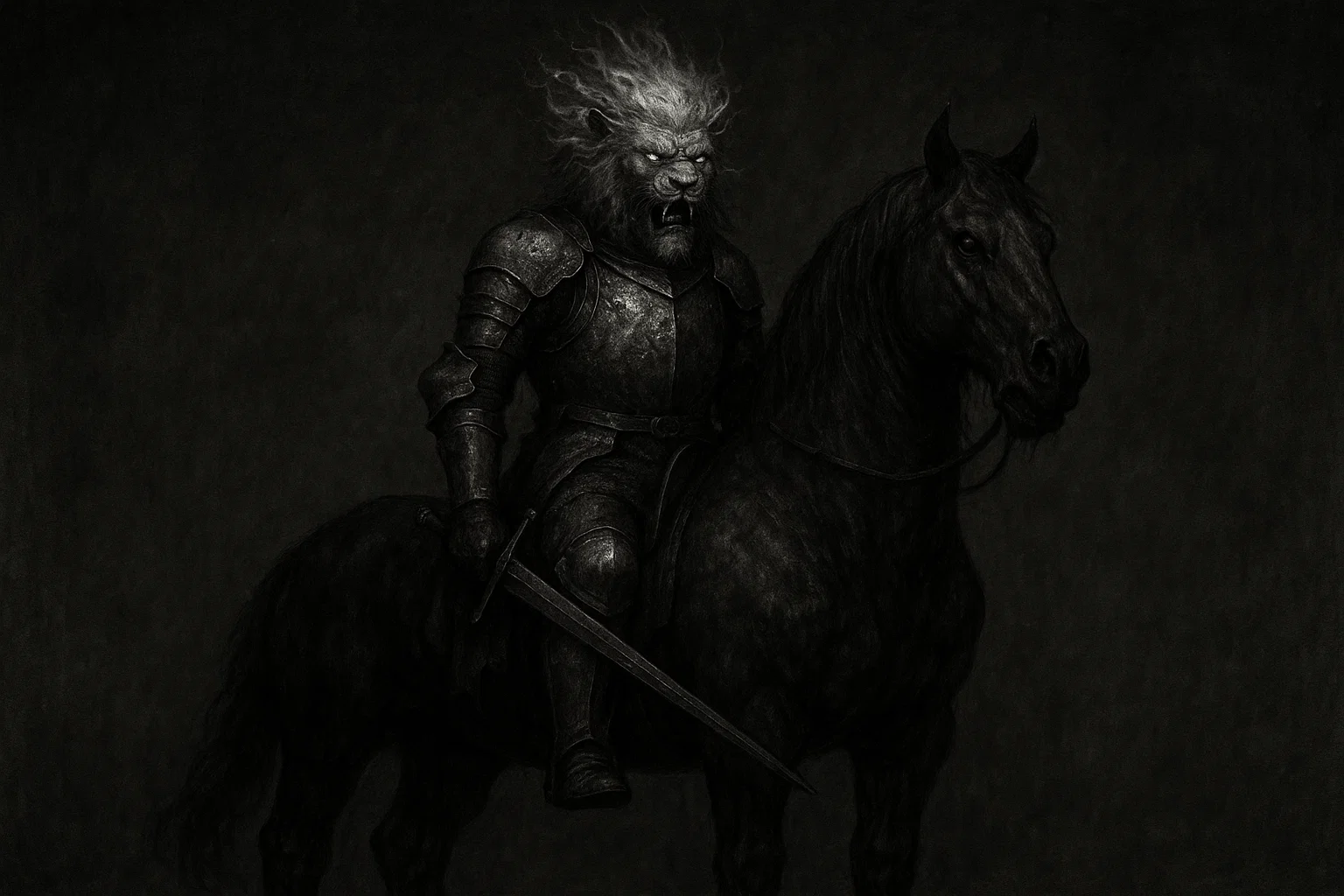
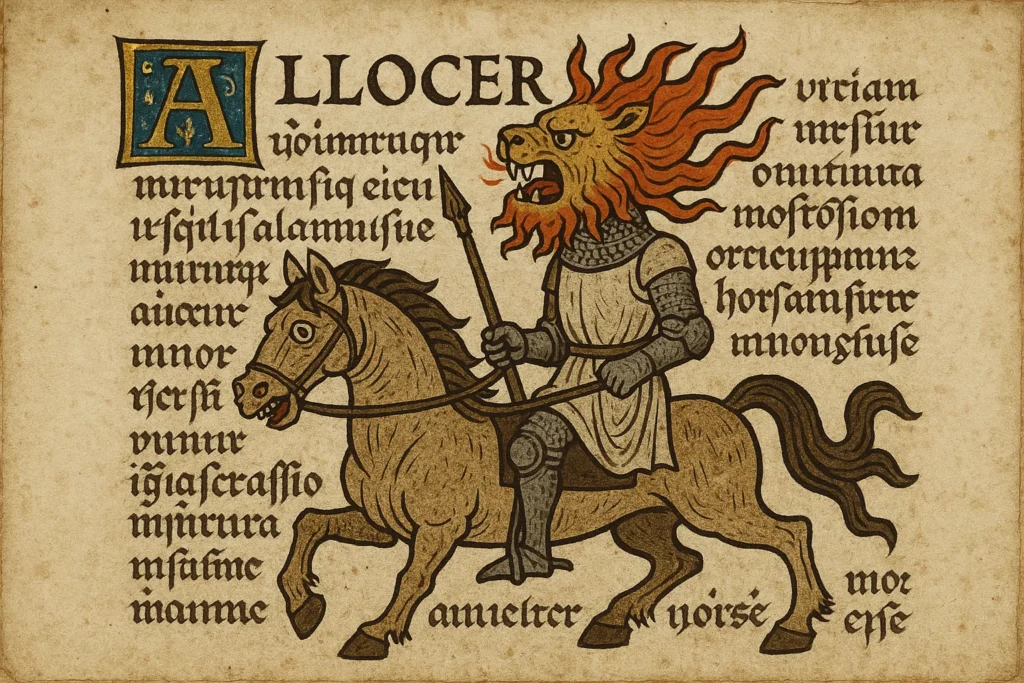
The physical description of Allocer is one of his most distinctive and alarming features, consistently rendered across the key grimoires. He is most commonly depicted as a great soldier or a knight who rides a huge, imposing, demonic horse.
However, his head is the most remarkable and fearsome attribute: it is described as the head of a lion, which is traditionally large and ruddy (reddish in color). This leonine head is often adorned with fiery eyes that are said to blaze with intense heat.
Adding to his sinister appearance, his mount is often described as monstrous and of unspecified, terrible size. The descriptions focus on the combination of the regal, human form of a duke or knight and the savage, bestial head of a lion, creating an image of potent, untamed malice. He speaks with a great, coarse voice, further underscoring his fierce and unrefined nature.
Origins
The origins of Allocer are intrinsically linked to the compilation of the Solomonic cycle of grimoires in early modern Europe. He is not a demon that appears in ancient scripture or early Christian patristic writings. Instead, his earliest documented appearance is in the 16th and 17th-century texts that formalized the classification and hierarchy of demons.
Allocer’s most primary and crucial documentation is found in Johann Weyer’s Pseudomonarchia Daemonum (1563) and, subsequently, in the first book of The Lesser Key of Solomon, the Ars Goetia (mid-17th century).
Weyer’s text lists Allocer as a Great and Mighty Duke, detailing his physical form, rank, and powers. This description was largely preserved and integrated into the Ars Goetia, which codified the 72 spirits into a system associated with the legend of King Solomon binding the spirits into a brass vessel.
Allocer’s character, therefore, evolved from a collection of existing lore, potentially incorporating older folk traditions or earlier, lost demon lists, which were systematized by Weyer and the subsequent compilers of the Lesser Key. His genealogy is entirely infernal—a Duke of Hell, with no known human or angelic pre-existence established in these foundational texts.
Was Allocer Ever Mentioned in the Bible?
Allocer is not mentioned in the Bible, in the Old or New Testaments, or in the apocrypha. The demon likely appeared much later in the tradition of Western esotericism and demonology, specifically within the corpus of Solomonic grimoires and the systematization of infernal hierarchies conducted by occultists and demonographers in the 16th and 17th centuries.
Allocer in Grimoires and Other Texts
Allocer’s existence is anchored almost exclusively in the tradition of European ceremonial magic and demonology, particularly in the grimoires of the early modern period.
| Source | Quote |
| Pseudomonarchia Daemonum (1563) by Johann Weyer | Allocer is a strong Duke, he commeth foorth in the shape of a soledier, riding on a great horse, he hath a lions face, verie fierie, he speaketh gravelie: his office is to teach Astronomie, and all the liberall sciences: he bringeth thither thirtie sixe legions. |
| Ars Goetia (The Lesser Key of Solomon) | The Fifty-second Spirit is Allocer, or Alocer. He is a Duke Great and Mighty, appearing in the form of a Soldier riding upon a Great Horse. His Face is as the Face of a Lion, very Red and Fiery. He speaketh with a Great Voice. His Office is to teach Astronomy and all the Liberal Sciences. He bringeth unto the desired knowledge of Strange Lands and Foreign Parts, and maketh a Man’s Desire to be fulfilled in all things. He governeth 36 Legions of Spirits. |
Powers and Abilities
As a Great Duke of Hell and a commander of legions, the demon possesses a range of malevolent powers and functions sought by summoners:
- Imparts Knowledge of Astronomy: His foremost power is to teach the secrets of the field of astronomy, granting the summoner a profound, and potentially forbidden, understanding of the cosmos and the stars.
- Teaches the Liberal Sciences: He imparts knowledge in all the liberal sciences, implying a broad range of intellectual mastery that can be used for sinister or self-serving purposes.
- Incites Lust and Depravity: While not always explicitly mentioned, his connection to the incitement of lust is an implied or explicit part of his function in some texts, tying his intellectual gifts to temptation and sin.
- Delivers True Answers: The demon can reveal hidden and secret truths, offering insight into matters concealed from the human realm that can be leveraged for wicked schemes.
- Causes Great Tumult and Trouble: His presence and nature as a fearsome, lion-headed Duke are associated with creating great tumult or disturbance, reflecting his power to bring chaos.
- Command over Legions: He holds the supreme command over thirty-six legions of lesser spirits, giving him immense organizational and military power within the infernal hierarchy.
You may also enjoy:
Azhi Dahaka: The Three-Headed Dragon of Zoroastrian Mythology
January 14, 2026
Nasnas: The Monstrous Demon Hybrid That Haunted Pre-Human Earth
November 12, 2025
The Kumbhanda: Grotesque Demons of Buddhist Hell
November 13, 2025
The Ghul: The Flesh-Eating Demon of Arabian Folklore
October 1, 2025
Amenadiel: Origins, Hierarchy, and Demonic Attributes
January 5, 2026
Who Is Arioch, the Demon of War and Vengeance?
January 21, 2026
Allocer Myths, Legends, and Stories
Allocer is primarily a cataloged entity in the grimoires, with a detailed entry on rank, power, and appearance, rather than a figure central to an extended narrative or myth. Unlike demons such as Asmodeus or Belial, who feature in biblical or pseudepigraphal tales, Allocer’s presence in literature is generally restricted to the Roll Call of Spirits.
Allocer’s Description in the Ars Goetia
The Ars Goetia provides the most detailed account of Allocer, serving as the definitive narrative source. However, it is a descriptive entry rather than a story.
The text’s significance lies in its detailed, specific portrait of the demon:
The Fifty-second Spirit is Allocer, or Alocer. He is a Duke Great and Mighty, appearing in the form of a Soldier riding upon a Great Horse. His Face is as the Face of a Lion, very Red and Fiery. He speaketh with a Great Voice. His Office is to teach Astronomy and all the Liberal Sciences. He bringeth unto the desired knowledge of Strange Lands and Foreign Parts, and maketh a Man’s Desire to be fulfilled in all things. He governeth 36 Legions of Spirits.
This entry is the entirety of the mythos—a highly structured statement of his power, appearance, and command—which defines him as a formidable, knowledge-granting entity under the authority of the purported Seal of Solomon.
Allocer vs Other Christian Demons
| Demon Name | Associated Sin/Temptation | Rank/Origin | Key Traits/Powers |
| Vepar | Death/Sea Travel | Great Duke / Ars Goetia | Governs the sea, causes ships to perish, makes men die in three days from putrefying sores. |
| Buer | Philosophy/Medicine | President / Ars Goetia | Teaches philosophy and logic, herbalism, and provides healing; represented as a star or wheel. |
| Zagan | Deception/Transmutation | King/President / Ars Goetia | Transmutes liquids (e.g., wine to water), makes men witty, has a bull’s head with a man’s body. |
| Murmur | Necromancy/Philosophy | Duke/Earl / Ars Goetia | Teaches philosophy and can force the souls of the dead to appear and answer questions. |
| Barbatos | Knowledge/Hidden Treasure | Great Duke / Ars Goetia | Understands the language of animals, reveals hidden treasures, reconciled friends and dignitaries. |
| Belial | Lawlessness/Arrogance | King / Bible & Ars Goetia | Creates lawlessness, grants titles and favors, speaks with a comely voice, rules 80 legions. |
| Asmodeus | Lust/Gambling | King / Book of Tobit & Ars Goetia | Prince of Lechery, incites lust, destroys marriages, is associated with the sin of Lust. |
| Azazel | War/Weaponry | High-Ranking Fallen Angel / Book of Enoch | Taught men to make weapons, ornaments, and cosmetics; leader of the rebellious Watchers. |
| Paimon | Sciences/Earthly Authority | King / Ars Goetia | Teaches all arts, sciences, and secret things; gives dignity; has a great clamor and roar at his coming. |
| Gremory | Love/Past, Present, Future | Duke / Ars Goetia | Reveals all things past, present, and to come, procures the love of women. |
| Valefor | Theft/Familiarity | Duke / Ars Goetia | Incites theft, appears as a lion-headed man, is a familiar spirit to those who summon him. |
Rank in the Hierarchy of Hell
Allocer is consistently assigned the high status of a Duke in the infernal hierarchy. This rank places him among the most powerful and authoritative spirits beneath the Kings of Hell.
In the Ars Goetia, Dukes are generally listed in the middle-to-upper portion of the 72 spirits, signifying a blend of both executive command and specialized power.
His position is one of administrative and military control, allowing him to execute the will of the supreme rulers of Hell (such as Lucifer, Beelzebub, or one of the Kings of the Goetia, such as Bael).
His specific office—teaching the Liberal Sciences and Astronomy—further differentiates his rank from pure military commanders or demons of temptation. It suggests a sophisticated, strategic role where knowledge itself is a tool of corruption, fitting for a higher-ranking spirit who does more than merely incite petty sins.
Mystical Correspondences
| Attribute | Details |
| Planet | Jupiter |
| Zodiac Sign | Sagittarius |
| Element | Fire |
| Direction | East |
| Color | Blue, Violet, Red |
| Number | 9 (in some systems) |
| Crystal/Mineral | Topaz, Amethyst |
| Metal | Tin |
| Herb/Plant | Anise, Saffron |
| Animal | Lion (Head), Horse (Mount) |
Allocer’s mystical correspondences align with the infernal forces and the specific nature of his powers, particularly his knowledge of the heavens (astronomy).
His ruling planet is Jupiter, the classical planet associated with expansion, higher learning, and rulership. This celestial tie underpins his role as a Duke who grants knowledge of the Liberal Sciences. This function aligns with Jupiter’s domain over intellectual pursuits. However, in Allocer’s context, this expansive knowledge is a means to spiritual corruption.
The associated zodiac sign, Sagittarius, further focuses on this connection to higher learning, philosophy, and foreign travel (or strange lands, as mentioned in his description), making the period of the sign’s rulership (late November to late December) a time when his influence is deemed most potent.
His element is Fire, a classification that resonates with his appearance—a very Red and Fiery face—symbolizing his passion, commanding presence, and destructive potential as a powerful Duke. The metal Tin is also traditionally linked to Jupiter.
The colors Blue, Violet, and Red (Jupiter’s traditional colors, plus the color of his own fierce appearance) are recommended for use in the binding and summoning rites.
Allocer’s Sigil
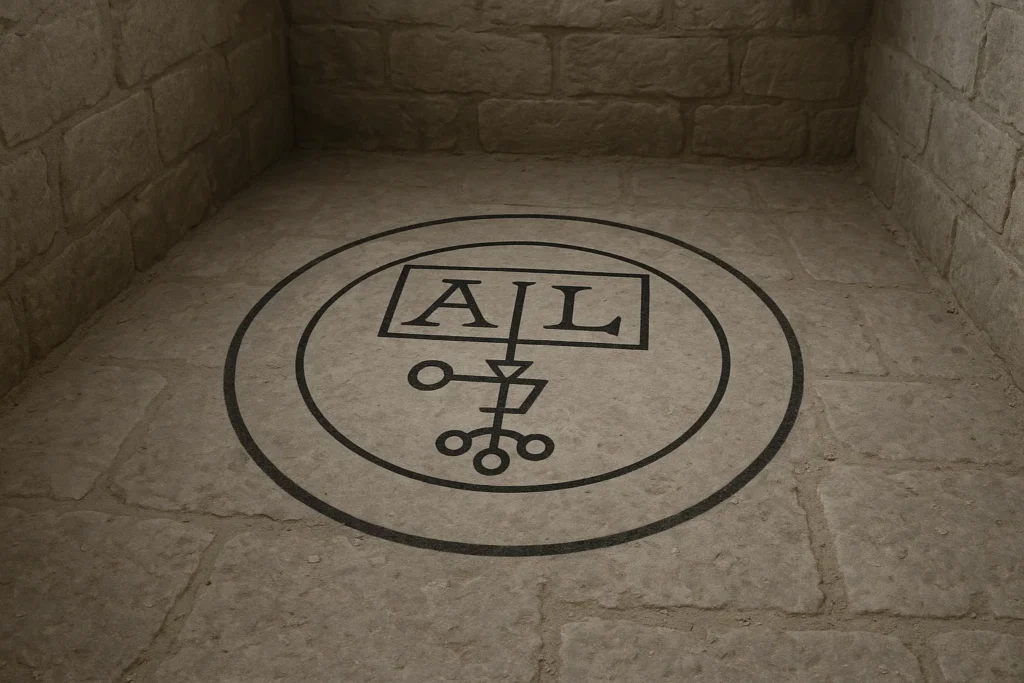
Allocer’s sigil is a unique, complex figure used as a Seal of Authority within the Solomonic magical tradition. Like the seals of all 72 spirits in the Ars Goetia, his sigil is a distinctive linear figure composed of lines, curves, and angles, purportedly derived from a cryptographic transformation of the spirit’s name.
The primary purpose of the sigil is to command and compel Allocer. Historically, the sigil was engraved on a metal lamens (a protective plate or disc, often of tin due to its Jupiter association) or drawn upon parchment with specific inks.
The mere display of this sigil during the ritual was said to bind Allocer to the will of the Magician, preventing him from causing harm and forcing him to answer truthfully. It served as a visual focus and a tool of spiritual authority, representing the covenant and constraint placed on him by the supposed power of King Solomon.
Summoning and Rituals
The historical methods for summoning Allocer, as detailed in the Ars Goetia and related texts, were complex and dangerous ritual operations that emphasized the magician’s authority over the demon. The primary goal of the ritual was to bind Allocer to ensure he provided the desired knowledge (astronomy, liberal arts) without causing the summoner harm.
The required tools included the Magical Circle drawn on the ground for the operator’s protection and the Triangle of Art where the spirit was commanded to appear.
Central to the operation was the use of the Seal of Allocer, which would be properly prepared and held forth. The ritual involved reciting a specific conjuration or invocation, naming Allocer and commanding him to appear by the power of a higher deity, such as Adonai or the Divine Name.
The purpose of the ritual was strictly for gaining the knowledge Allocer possesses—to teach Astronomy and all the Liberal Sciences—and, in some accounts, for his power to bring true answers to things hidden.
The process was intended to be one of force and constraint, relying on the alleged superior power of the magical implements and the Authority of the Seal of Solomon to subdue this Great Duke and his formidable legions.
You may also enjoy:
Who Is the Infernal King Balam? Origins, Powers, and Occult History
February 26, 2026
Amdusias in the Ars Goetia: The Demon of Dark Music
December 2, 2025
Who Is Al-Abyad? The White King Jinn Who Rules Love and Chaos
January 26, 2026
Mahakala: The Dark Guardian Who Consumes Evil
October 16, 2025
Hitotsume kozō: One-Eyed Yōkai of Japanese Folklore
February 4, 2026
What Is Qarin and Why Does It Follow Every Human Being?
October 8, 2025
Frequently Asked Questions
What is Allocer a demon of?
Allocer is primarily known as a demon of forbidden knowledge, specifically associated with Astronomy and the Liberal Sciences. He also serves as a Great Duke of Hell, responsible for commanding a large military contingent of spirits.
What is the Allocer known for?
The demon Allocer is known for his distinguished rank as a Duke, his unique appearance (a soldier with a lion’s face riding a great horse), and his power to impart profound, hidden knowledge concerning the stars and intellectual arts. He is the 52nd Spirit listed in the Ars Goetia.
What kind of demon is Allocer in the Bible?
Allocer is not mentioned in the Bible. He is a figure derived from later, post-Biblical medieval and Renaissance demonology, specifically the tradition of Solomonic magic found in grimoires like the Lesser Key of Solomon.
What are Allocer’s weaknesses?
Allocer’s primary weakness lies is the authority of the Divine Name and the conjurer’s magical implements. As detailed in Solomonic texts, he must obey the operator who uses the binding pentagram (the Lamen) and compels him within the Magic Circle. He is constrained by the power believed to have been used by King Solomon to originally bind all 72 spirits.
What are Allocer’s key titles in the infernal hierarchy?
Allocer’s key title is Great Duke of Hell (or simply Duke). This title designates him as a high-ranking, powerful commander, subordinate only to the Kings of Hell. It is mentioned in both the Pseudomonarchia Daemonum and the Ars Goetia.
Which grimoire first documented Allocer?
Allocer was first documented in Johann Weyer’s 1563 text, Pseudomonarchia Daemonum, where he is described as a “strong Duke” who teaches astronomy. This work preceded and heavily influenced the later and more famous Lesser Key of Solomon.
How many legions does Allocer command?
Allocer is recorded to command thirty-six (36) legions of lesser spirits. This is a significant number, underscoring his high rank and the infernal organization’s formidable military power.
What is the origin of Allocer’s monstrous appearance?
Allocer’s appearance—a lion’s head on a soldier’s body—is an example of a chimeric form common among high-ranking Goetic demons. This combination may symbolize the fusion of regal authority (Duke/soldier) with savage, untamed ferocity (lion), reflecting the dangerous nature of the hidden knowledge he imparts.
Does Allocer have an angelic counterpart?
In some modern, syncretic occult systems that attempt to categorize the Goetic demons, Allocer is opposed by the Shem HaMephorash Angel Imamiah
