
Amdusias is one of the 72 demons of the Ars Goetia (a section of the infamous Lesser Key of Solomon). According to this grimoire, the demon is one of the Great Dukes of Hell and the 67th demon listed in the hierarchy. He commands at least 29 legions of lesser demons.
In most grimoires, Amdusias is linked to the creation of sound (specifically in the form of demonic music) and to the bending of trees (one of his primary powers).
Summary
Key Takeaways
| Attribute | Details |
| Names | Amdusias, Amdukias, Ambuscias |
| Title | Duke, Great Duke |
| Gender | Male |
| Role | Distortion of nature, particularly trees; creating musical noise and disharmony; providing familiar spirits |
| Rank | Duke of Hell |
| Hierarchy | Commands twenty-nine legions of spirits |
| Legions | 29 |
| Powers | Causing trees to fall and bend against the will of the summoner; producing music and sound of all kinds; granting excellent familiar spirits |
| Associated Figures | King Solomon (who bound him), the 72 Spirits of the Ars Goetia |
| Weaknesses | Bound by the authority of the magician; subject to the divine powers invoked during the ritual (e.g., holy names) |
| Opposing Angel/Saint | Angel assigned by the Ars Goetia: Aiael |
| Pantheon | Christian Demonology, Solomonic Cycle |
| Primary Sources | The Lesser Key of Solomon (Ars Goetia), Pseudomonarchia Daemonum, Dictionnaire Infernal |
Who or What is Amdusias?
Amdusias is a powerful demonic entity that appears in several prominent grimoires of the early modern period—especially The Lesser Key of Solomon and Johann Weyer’s Pseudomonarchia Daemonum. He is consistently ranked as a Great Duke within the infernal hierarchy. This position grants him significant authority over his many subject lesser demons.
His primary domain of influence relates to sound and nature. The demon can produce music (though his music is discordant). He’s also linked to bizarre powers, including the ability to cause trees to bend, fall, or move. What’s more, he is said to grant extraordinary familiars, which are often sought after in occult practices to assist the magician.
Amdusias—like all other Goetic demons—is believed to have been bound by King Solomon and forced to serve the will of the human magician.
NAME THEM. BIND THEM. CAST THEM OUT! Limited-Time: Up to 40% OFF!
The ultimate deliverance thesaurus by Apostle John Eckhardt. Hundreds of demonic names & attributes exposed alphabetically – from Jezebel to Python, infirmity to poverty. Hundreds of demons named & defeated Identify → Bind → Cast Out!
The essential weapon for every prayer warrior, intercessor, and deliverance minister. Victory starts with identification.

“Amdusias” Meaning
The name Amdusias is of uncertain etymology. Its origins are obscured within the specialized tradition of Solomonic demonology.
Like many names in the Ars Goetia, it is likely a construct, perhaps based on Hellenic, Hebrew, or Latin fragments, designed specifically for ritual use, rather than a name with a clear historical or linguistic root outside of the grimoires.
The primary forms of the name that appear in the most influential texts are Amdusias, found in The Lesser Key of Solomon, and Amdukias, which appears in Johann Weyer’s 1563 catalogue Pseudomonarchia Daemonum. A third, less common variation, Ambuscias, is sometimes cited.
The small differences between the two names often happen because they were written down in different languages and settings. Weyer’s book, which came out before the Lesser Key of Solomon, was frequently used as a reference for later lists of demons. This suggests that the name Amdukias might be the original or more ancient version.
How to Pronounce “Amdusias” in English
The most common and accepted pronunciation of the name in English follows a four-syllable pattern: Am-doo-zee-ahs. The stress typically falls on the second syllable: Am-DU-si-as.
A common alternative based on the variant Amdukias would be Am-doo-key-as, with the same syllable stress pattern.
What Does Amdusias Look Like?
The demons’ physical appearance is detailed in the core sources of Solomonic demonology.
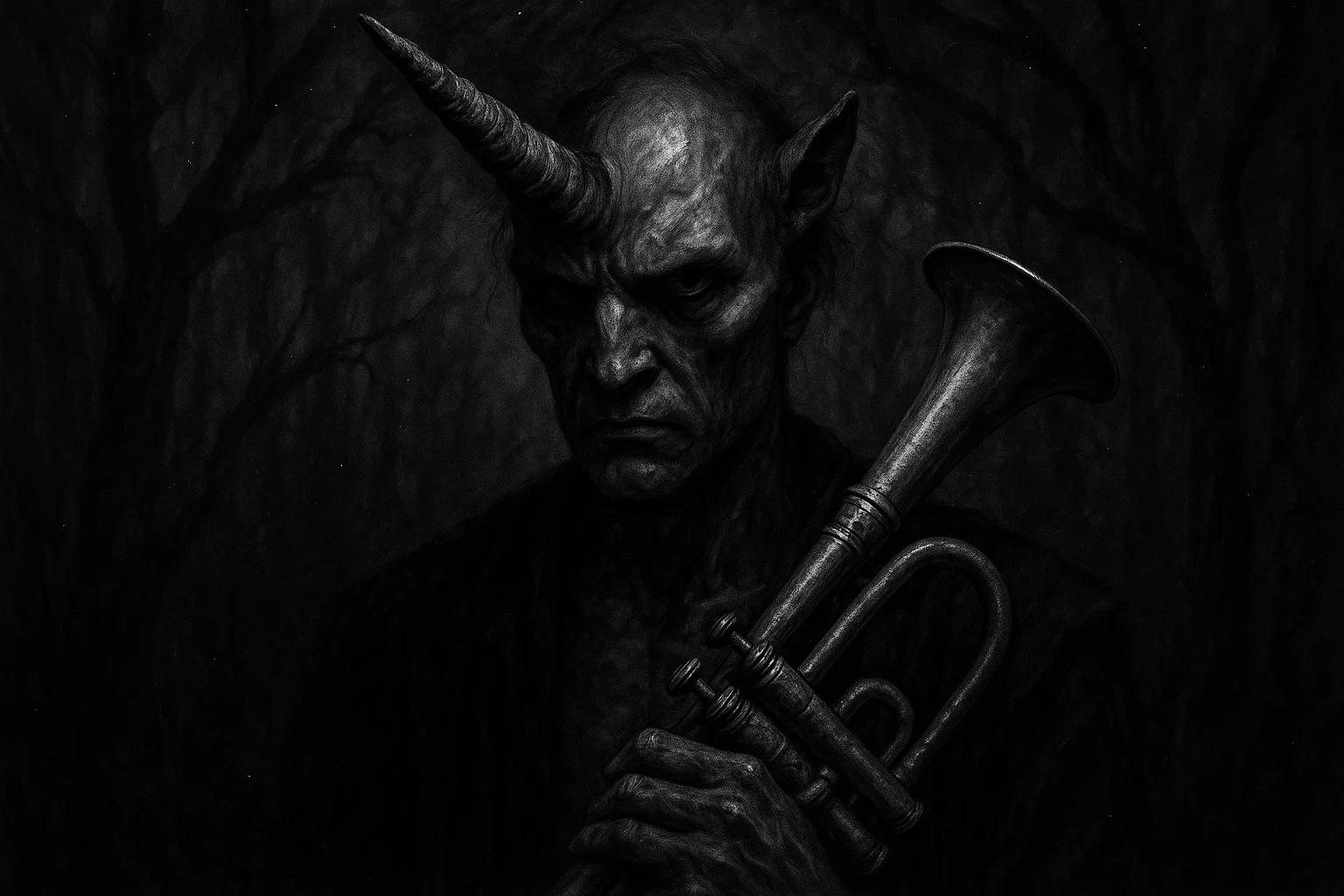
According to The Lesser Key of Solomon, the demon appears at first like a unicorn. This initial form is a recurring motif in demonology (possibly symbolizing untamed power or a deceptive, false purity). Once the sorcerer has successfully commanded him, the demon “changeth into a man’s shape,” appearing as a human male.
However, even in his human form, he is not entirely disguised, as he is described as being with a trumpet in his hand. This trumpet serves as a clear physical manifestation of one of his primary powers: the control over sound and music.
The unicorn form and the trumpet in the human shape are consistent across the primary grimoires. Collin de Plancy’s Dictionnaire Infernal also describes him in this manner, often depicting the demon as a man with a unicorn’s head, or simply riding a unicorn, holding a trumpet.
You may also enjoy:
Bali: The Benevolent Asura King of Hindu Mythology
October 10, 2025
Who Was Ravana in Hindu Mythology and Why Was He Feared?
October 3, 2025
Kuchisake-onna: Folklore, Origins, and Urban Legend History
February 10, 2026
Vritra: The Dragon Who Swallowed the Sky in Hindu Mythology
October 7, 2025
Banasura: The Thousand-Armed Demon King
October 10, 2025
The Kumbhanda: Grotesque Demons of Buddhist Hell
November 13, 2025
Origins
The genealogical origins of Amdusias are not detailed in the primary demonological literature. Unlike more powerful demonic entities—such as Belial or Asmodeus—who may have roots in older mythologies or religious texts, Amdusias is a product of the Solomonic magical tradition, which reached its peak in the 16th and 17th centuries.
As a result, the earliest verifiable documentation mentioning the demon is Pseudomonarchia Daemonum (1563). However, the portrayal in Weyer’s text already attributes to him the ability to create music and bend trees, suggesting these characteristics were fixed parts of his lore before 1563.
Was Amdusias Ever Mentioned in the Bible?
Amdusias is not mentioned in the Bible (Old Testament, New Testament, or Apocrypha). He is a demon that appeared centuries later within the context of Christian demonology and occult literature, specifically the grimoire tradition, which is separate from mainstream biblical or theological texts.
Amdusias in Grimoires and Other Texts
The demon is found in the Goetic tradition (a branch of demonology). This tradition provides detailed descriptions of various demons and their unique abilities, based on important writings that describe the spirits King Solomon is said to have summoned and controlled.
| Source | Quote |
| The Lesser Key of Solomon (Ars Goetia) | The Sixty-Seventh Spirit is Amdusias, or Amdukias. He is a Great Duke, strong and mighty, appearing at first like a Unicorn, but at the request of the Exorcist he changeth into a man’s shape, with a trumpet in his hand, and causeth all Music to be heard, and not by and by. He can also cause Trees to bend and fall at the will of the Exorcist, and giveth excellent Familiars. He governeth 29 Legions of Spirits. And this is his Seal, to be perfectly made and worn, &c. |
| Pseudomonarchia Daemonum (Johann Weyer) | A great and strong duke is Amdukias, he appeareth as an Unicorne, when he is bidden he commeth in a mans shape with a trumpe in his hand, all instruments of musicke are heard round about him, and he maketh trees to bend and fall downe, he geveth excellent familiars, and governeth nine and twentie legions. |
| Dictionnaire Infernal (Collin de Plancy) | Amdusias est un grand-duc aux enfers. Il vient la première fois sous la forme d’une licorne; mais, au commandement de l’exorciste, il prend l’aspect humain, sans cependant quitter sa trompette, instrument dont il fait usage pour se faire entendre. Il fait aussi pencher les arbres et les fait tomber au gré de celui qui l’évoque. Il donne d’excellents domestiques. Il commande vingt-neuf légions. (English Translation: Amdusias is a great duke in hell. He comes the first time in the form of a unicorn; but, at the command of the exorcist, he takes on the human appearance, without, however, leaving his trumpet, an instrument he uses to make himself heard. He also makes trees lean and fall according to the will of the one who invokes him. He gives excellent servants. He commands twenty-nine legions.) |
DEMONS ARE REAL — AND THE BIBLE PROVES IT Limited-Time: Up to 20% OFF!
No myths. No exaggeration. Just Scripture. Clinton Arnold’s landmark biblical theology of the powers of darkness. What the Old & New Testaments actually teach about Satan, demons, and spiritual warfare. Essential reading for every pastor, counselor, and believer facing the unseen battle. The book seminaries and deliverance ministries swear by.
Demons are real • Scripture is clear • Victory is yours • Clinton Arnold’s definitive biblical study.
Powers and Abilities
Amdusias’ powers and abilities are highly specialized, with many focused on creating sounds and manipulating nature. These powers are invariably presented when it comes to being compelled by the magician:
- Can Force Trees to Bend and Fall: His most distinct power is his control over the natural environment, particularly flora. He can make trees bend and fall against their natural inclination, and even against the will of the observer, simply at the command of the summoner. This suggests a power to cause distortion, destruction, or upheaval in the natural world.
- Can Produce Music and Sound of All Kinds: Amdusias is a musical demon. He can cause music to be heard, often in a manner that is not by and by (meaning not immediately or obviously sourced), and sometimes in a manner that suggests discord or hidden presence. This power allows the magician to invoke spurious sounds or create a disorienting acoustic atmosphere. He causeth all Music to be heard.
- He Can Grant Familiars: He is known for providing the summoner with excellent familiars. These are lesser demonic or magical entities that serve the magician in various capacities, often acting as spies, assistants, or aids in other magical operations. This ability solidifies his utility in ritual magic.
- Assuming a Human Form: Amdusias can transform his primary appearance (that of a unicorn) into a man’s shape, though he retains the trumpet in his hand. This transformation capability is a common trait among high-ranking Goetic demons, enabling them to communicate or interact in more recognizable ways.
- Commands Legions: The demon commands over twenty-nine legions of lesser demons, giving him immense organizational and military power within the infernal hierarchy.
Amdusias vs Other Christian Demons
| Demon Name | Associated Sin/Temptation | Rank/Origin | Key Traits/Powers |
| Bael | Idolatry, Pride, Deceit | King of Hell (Ars Goetia) | Power of invisibility; appears with three heads (man, toad, cat) |
| Paimon | Knowledge of Arts and Sciences | King of Hell (Ars Goetia) | Teaches all arts, sciences, and secret things; appears riding a dromedary |
| Bifrons | Necromancy, Witchcraft | Earl (Ars Goetia) | Teaches astrology and geometry; illuminates tombs and changes the position of dead bodies |
| Murmur | Philosophy, Coercion | Duke/Earl (Ars Goetia) | Teaches philosophy; compels souls of the dead to answer questions; appears riding a Gryphon |
| Gremory | Knowledge of Past, Present, Future | Duke (Ars Goetia) | Reveals treasures; procures the love of women; appears as a beautiful woman riding a camel |
| Orias | Transformation, Divination | Marquis (Ars Goetia) | Teaches the virtues of the stars; transforms men into any shape; appears as a lion riding a horse |
| Vine | Construction, Discovery of Secrets | King/Earl (Ars Goetia) | Builds towers and throws down walls; discovers hidden things and witches; appears as a lion on a black horse, holding a serpent |
| Purson | Hidden Secrets, Divination | King (Ars Goetia) | Reveals all things hidden, past, present, and future; appears as a man with a lion’s face, riding a bear |
| Valefar | Theft, Temptation | Duke (Ars Goetia) | Leads men to steal; appears as a lion with the head of a man, or a winged lion |
| Zagan | Transmutation, Wit | King/President (Ars Goetia) | Can change wine into water, blood into wine, and lead into gold; appears as a bull with Gryphon’s wings |
| Andromalius | Retrieval of Stolen Goods | Earl (Ars Goetia) | Brings back stolen goods and punishes thieves; appears holding a great serpent |
| Asmodeus | Lust, Gambling, Extravagance | King (Talmud, Grimoires) | Architect; appears with three heads (bull, man, ram); one of the Seven Deadly Sins |
| Belial | Lawlessness, Treachery | King (Biblical, Grimoires) | Incites sin and guilt; commands over fire; one of the first demons created after Lucifer |
| Mammon | Greed, Earthly Riches | Demon of Avarice (Biblical, later works) | Incarnation of wealth; not listed in the Ars Goetia |
Rank in the Hierarchy of Hell
Amdusias is consistently recognized as a Great Duke within Hell’s infernal hierarchy. This rank places him among the powerful command structure documented in the Ars Goetia. This position signifies a military authority over a substantial number of subordinates.
Given his ducal status, Amdusias would likely occupy a role distinct from the Kings of Hell (such as Bael or Paimon), who are considered his overlords or superiors. While no direct alliances are documented, he would, by virtue of his rank, maintain professional contact with other Dukes and high-ranking officials—like the Marquises or Princes—to coordinate the deployment and command of their respective legions.
His specialized powers suggest that his domain does not overlap a lot with those of demons focused on general temptation (like Asmodeus) or lawlessness (like Belial), potentially reducing immediate rivalry. However, within the highly competitive Goetic system, all Dukes are in implicit rivalry for power and influence.
His function as a provider of excellent familiars might position him as an ally to lower-ranking Presidents or Earls who require assistance in their own magical operations. However, their relationship would remain subordinate to his higher ducal authority.
The structure dictates that the numerous spirits under his command are bound to enforce his will, serving as the necessary manpower for his destructive abilities concerning nature and for carrying his discordant musical influence across the mortal world.
Mystical Correspondences
Amdusias primarily aligns with the energies of Saturn and the Earth element. Saturn, as the ruling planet, imbues him with qualities of structure, limitation, and solemnity, which can be interpreted as the rigorous control needed to command legions and the powerful, physical effect he has on nature (causing trees to fall).
The association with the astrological sign Capricorn, which is ruled by Saturn, further highlights his connection to the Earth element and the North direction—traditional symbols of stability, structure, and the material world.
These cosmic ties anchor Amdusias’s evil nature firmly within the tangible realm. His manipulation of trees and his capacity to bestow familiars (physical, material helpers) reflect this Earth/Saturn influence.
The colors like black and deep blue, and the metal lead, also correspond to Saturn, often used in ritual to channel his immense, yet slow and heavy, destructive power.
BREAK THE TOUGHEST DEMONIC BONDAGE! Limited-Time: Up to 41% OFF!
Real-life deliverance secrets from Apostle Alexander Chisango – straight from the front lines in Africa. Generational curses • Witchcraft • Sexual bondages • Addiction strongholds. Step-by-step keys that actually work when everything else has failed. Hundreds set free – your breakthrough starts here!

Amdusias’s Sigil
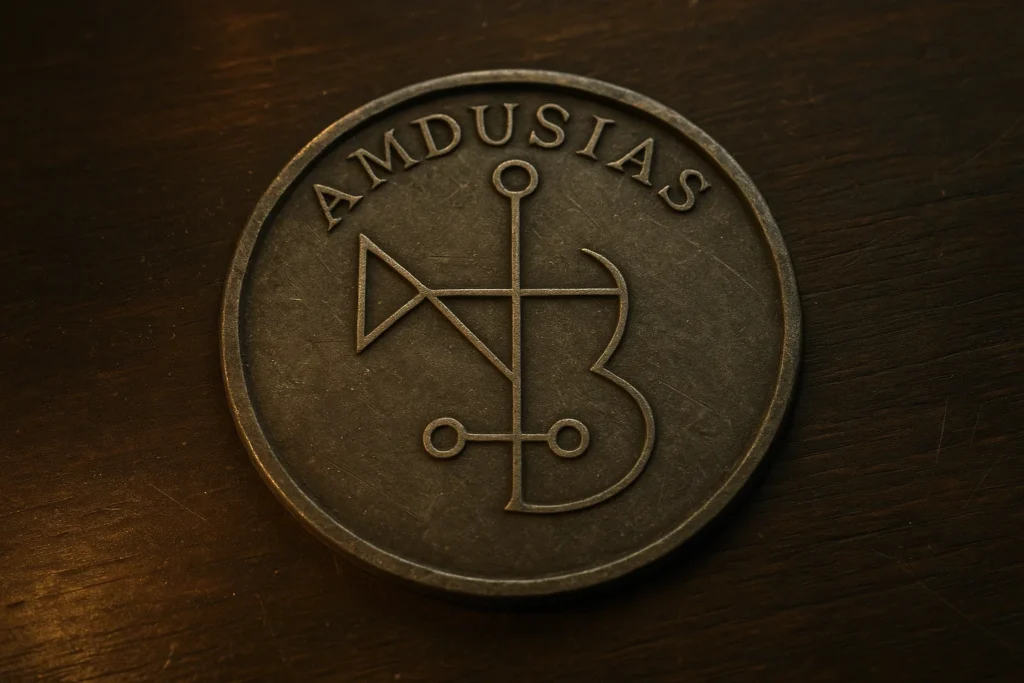
The sigil of Amdusias is a special symbol found in ancient texts about magic. This sigil is a vital part of any ritual performed to call on or control the demon Amdusias.
The sigil is a complex design composed of angles, straight lines, and various symbols. Though it may look a little different depending on the book you read, it usually has a unique geometric feel meant to capture the essence of Amdusias’s name and power.
In the past, this sigil was more than just a drawing; it was thought to be a powerful focus for the demon’s energy. For a ritual to work properly, the magician needed to create the sigil precisely—often by carving it into a piece of metal, such as lead or tin, or by drawing it on parchment. Sometimes, they’d wear it as an amulet called a Lamen, or place it within a protective space known as the Triangle of Art.
The sigil served two main purposes: it acted as a command to summon the demon. It functioned as a safeguard to ensure that Amdusias would obey and not harm the person performing the ritual.
Summoning and Rituals
The process of calling on Amdusias was typically carried out by practitioners of Solomonic magic, which includes magicians, exorcists, and ritualists, many of whom were historically linked to witches or warlocks.
People performed these rituals primarily to make Amdusias appear and use his unique abilities, like making trees fall or providing magical familiars to help the magician.
Success in these rituals required careful preparation and strict adherence to rules to keep the magician safe and in control. This preparation generally involved creating a protective circle on the ground, drawing the sigil on parchment or metal, and wearing a Lamen bearing the name of Amdusias’s controlling angel, Aiael.
The approach was not one of asking nicely but of asserting control through powerful names and specific prayers to compel Amdusias to show himself, first as a Unicorn and then as a human. The summoner would then give commands, believing that Amdusias was bound by the same authority used by King Solomon.
The entire process was a formal and structured operation meant to dominate the spirit for practical purposes, which were often manipulative or even harmful.
You may also enjoy:
Who Is Asmodeus in Demonology and the Bible?
February 18, 2026
Vritra: The Dragon Who Swallowed the Sky in Hindu Mythology
October 7, 2025
Aamon: The Infernal Marquis of Lust, Feuds, and False Prophecies
September 29, 2025
The Kumbhanda: Grotesque Demons of Buddhist Hell
November 13, 2025
What Is the Akashita, the Red-Tongued Demon of Japanese Folklore?
November 5, 2025
Lamashtu, the Mesopotamian Demoness of Childbirth and Infant Death
November 4, 2025
Frequently Asked Questions
What is Amdusias the demon of?
Amdusias is primarily associated with the creation of sound (producing music and noise) and the manipulation of nature, specifically having the power to cause trees to bend and fall against their natural inclination. He is also known for providing excellent familiar spirits to the summoner.
What rank does Amdusias hold in Hell?
Amdusias has the high rank of a Great Duke of Hell. This position grants him command over twenty-nine legions of infernal spirits, as detailed in the Ars Goetia and Pseudomonarchia Daemonum.
Who is the angel opposing Amdusias?
According to the tradition found in some versions of the Ars Goetia, the opposing or countering angel assigned to Amdusias is Aiael.
Is Amdusias a fallen angel?
The primary grimoire sources, such as the Ars Goetia, classify Amdusias as a Great Duke of Hell and one of the 72 spirits bound by King Solomon. While all Goetic demons are generally believed to be fallen angels in the broader Christian demonological context, the texts do not provide specific details regarding their angelic origin or fall.
Who is the 67th demon in the Ars Goetia?
The 67th demon listed in the Ars Goetia, the foundational text of Solomonic demonology, is Amdusias (or Amdukias), the Great Duke commanding twenty-nine legions.
